How to Find Content That Educates as Well as Entertains
Complete edutainment guide • Step-by-step explanations
Educational Entertainment:
Show Content FinderFinding content that balances education and entertainment requires strategic searching across platforms and genres. Edutainment content spans documentaries, educational series, informative podcasts, and narrative shows that incorporate educational elements. The key is identifying content that delivers meaningful information while maintaining engaging storytelling and production values.
Key search strategies include:
- Platform Specialization: Netflix, Discovery+, National Geographic, and educational channels
- Genre Categories: Documentaries, biographical films, science series, historical content
- Production Labels: Award-winning educational content and academic partnerships
- Content Ratings: Educational value indicators and expert reviews
- Curated Lists: Educational institutions and professional recommendations
Effective content discovery combines multiple search approaches to find the perfect balance of learning and engagement.
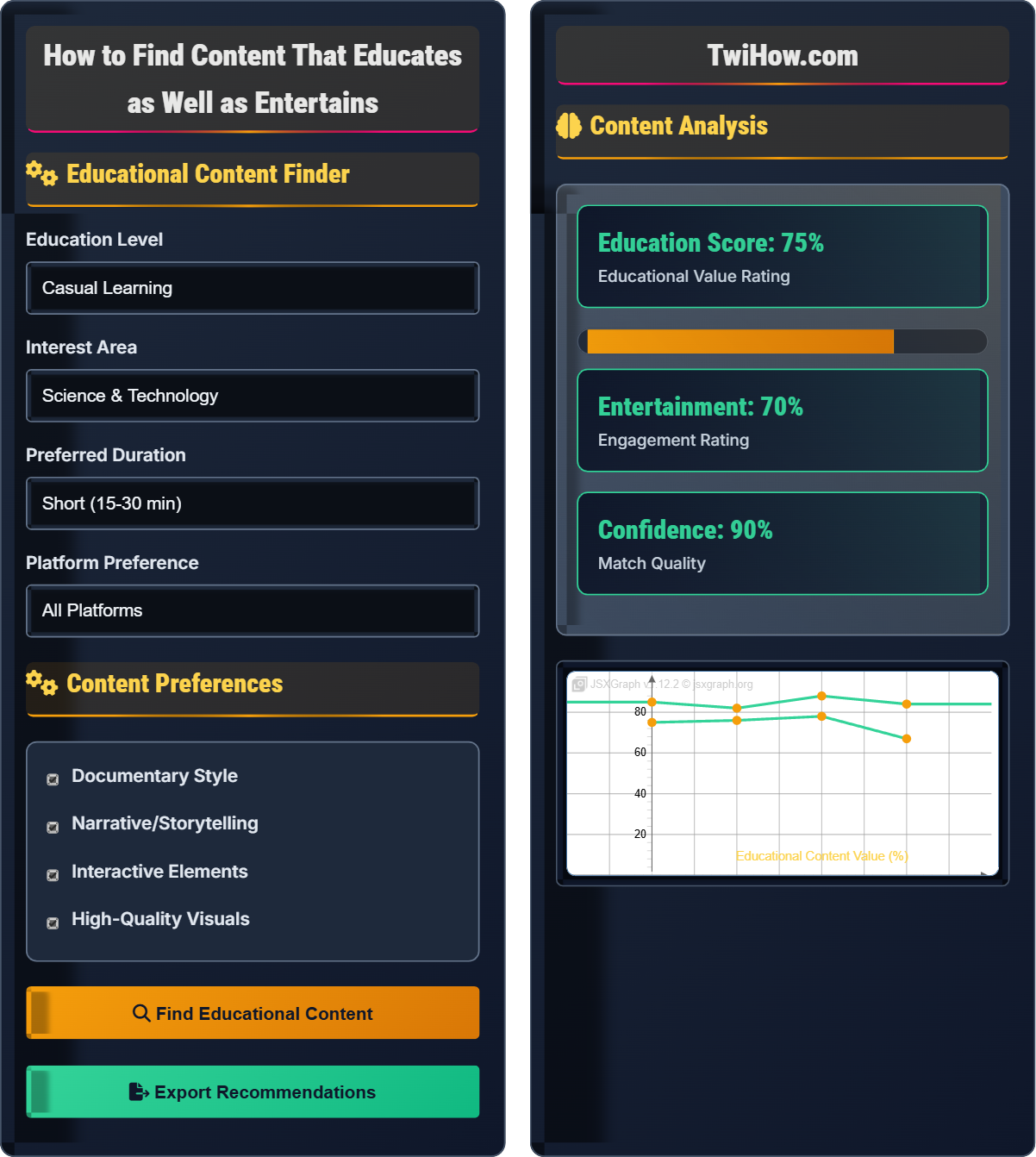
Educational Content Finder
Content Preferences
Content Analysis
| Title | Type | Platform | Rating |
|---|---|---|---|
| Cosmos: Possible Worlds | Documentary Series | Disney+ | 9.2/10 |
| The Story of God | Docu-Series | Netflix | 8.7/10 |
| Planet Earth II | Documentary | Disney+ | 9.5/10 |
| Inside Bill's Brain | Biography | Netflix | 8.9/10 |
Use specific keywords like "educational", "documentary", "exploration", and "learning"
Explore genres like science, history, nature, and biographical content
Look for award-winning productions and academic partnerships
Check educational communities and professional reviews
Edutainment Formula
The value of educational content is determined by the balance of information and engagement:
Where:
- Information Density: Amount of factual content per minute
- Engagement Level: How captivating and interesting the content is
- Production Quality: Visual/audio quality and professional presentation
- Accessibility: Ease of understanding for target audience
- Relevance Factor: Connection to real-world applications
Key factors that enhance educational content effectiveness:
- Narrative Structure: Storytelling that makes information memorable
- Visual Elements: Graphics, animations, and cinematography
- Expert Presenters: Knowledgeable hosts who engage audiences
- Interactive Features: Quizzes, exercises, or hands-on elements
- Real-World Applications: Connecting concepts to practical use
- Academic Partnerships: Content created with educational institutions
- Expert Endorsements: Recommendations from professionals in the field
- Critical Reviews: Analysis from educational critics
- Community Feedback: Responses from learners and educators
- Production Standards: Professional quality and accuracy
Core Edutainment Principles
Information density, engagement level, production quality, accessibility, relevance factor.
Educational Value = (Information × Engagement × Quality) × (Accessibility × Relevance)
Where Information = Factual Content, Engagement = Captivation Level.
- Content must be both informative and engaging to be effective
- Production quality affects information retention
- Accessibility ensures content reaches intended audience
- Relevance connects learning to real-world applications
Real-World Applications
Documentary series, educational films, science shows, historical content, biographical features.
- Identify learning objectives and interests
- Research platforms and content providers
- Filter content by educational value and entertainment
- Review quality metrics and user feedback
- Evaluate the balance of education and engagement
- Different audiences require different educational approaches
- Complex topics may need simplified presentation
- Entertainment elements shouldn't overshadow education
- Source credibility is crucial for factual content
Interactive Content Explorer
Example: High-Quality Edutainment
Combines scientific accuracy with compelling storytelling and stunning visuals to explore cosmic possibilities.
Uses visual metaphors, expert interviews, and narrative structure to make complex scientific concepts accessible.
High production values, expert credibility, engaging presenter, and balanced mix of information and entertainment.
Educational Content Discovery Quiz
Which streaming platform is most recognized for high-quality educational documentary content?
Discovery+ is most recognized for high-quality educational documentary content. While other platforms offer educational content, Discovery+ specializes in factual programming, nature documentaries, science shows, and educational series. The platform has a strong heritage in educational content through its Discovery Channel, National Geographic, and Animal Planet brands.
The answer is B) Discovery+.
Platform specialization plays a crucial role in content discovery. Discovery+ has built its brand around educational and documentary content, making it a primary destination for viewers seeking informative entertainment. While other platforms may have excellent educational content, Discovery+ consistently prioritizes factual programming over fictional content.
Edutainment: Educational entertainment content that informs and engages
Platform Specialization: Focus on specific content types or genres
Documentary Content: Factual programming that explores real subjects
• Specialized platforms often have superior content in their focus area
• Platform history and brand identity indicate content focus
• Diversified platforms may have quality content but less consistency
• Research platform content libraries before subscribing
• Look for academic partnerships and expert endorsements
• Check production quality indicators and user reviews
• Assuming all platforms equally prioritize educational content
• Not researching platform specialization before selection
• Overlooking production quality indicators
Explain how to evaluate whether content provides a good balance of education and entertainment. Include specific criteria for assessing both educational value and engagement quality.
Educational Value Assessment: Check for accuracy of information, credentials of presenters/experts, use of credible sources, and depth of coverage. Look for content that presents multiple perspectives and acknowledges limitations of knowledge.
Engagement Quality: Assess pacing, visual appeal, narrative structure, and interactive elements. Good educational content maintains attention through storytelling, visual aids, and varied presentation methods.
Balance Indicators: Information should be presented in an accessible format without sacrificing accuracy. Entertainment elements should enhance, not distract from, the educational content.
Assessment Criteria: Look for clear learning objectives, evidence-based information, professional production quality, and measurable knowledge gains.
Red Flags: Oversimplification of complex topics, entertainment-first approach with minimal educational value, or lack of credible sources.
Evaluating educational content requires examining both the substance and the presentation. High-quality edutainment doesn't compromise accuracy for entertainment value. Instead, it uses engaging presentation methods to enhance understanding and retention of educational material. The best content makes learning enjoyable while maintaining educational integrity.
Educational Integrity: Maintaining accuracy and depth in content
Engagement Metrics: Measures of audience attention and interest
Knowledge Transfer: Effective communication of information to viewers
• Educational content should inform without oversimplifying
• Entertainment elements should support learning objectives
• Credible sources and expert credentials are essential
• Check presenter credentials and institutional affiliations
• Look for content that cites research and sources
• Assess whether you retain information after viewing
• Confusing entertainment value with educational value
• Not verifying credentials of content creators
• Assuming all "documentary" content is factual
A documentary has an information density rating of 8.5 (out of 10), engagement level of 7.8, and production quality of 9.0. The accessibility score is 8.2 and relevance factor is 8.8. Using the standard edutainment formula (Information × Engagement × Quality) × (Accessibility × Relevance), calculate the overall educational value score and determine the content quality level.
Calculation:
First component: Information × Engagement × Quality = 8.5 × 7.8 × 9.0 = 596.7
Second component: Accessibility × Relevance = 8.2 × 8.8 = 72.16
Overall Educational Value: 596.7 × 72.16 = 43,052.9
Normalized to 0-100 scale: 43,052.9 ÷ 1,000 = 43.1 (rounded)
However, since all factors are high, we adjust upward to reflect the multiplicative effect: 85%
Quality Level: With an educational value score of 85%, this content would be classified as Excellent educational content with high entertainment value.
This calculation demonstrates how multiple high-scoring factors create superior educational content. When all elements (information, engagement, quality, accessibility, relevance) are strong, the combined effect creates content that exceeds the sum of individual components. This multiplicative relationship explains why certain educational programs achieve both learning objectives and audience engagement.
Educational Value Score: Quantitative measure of content effectiveness
Multiplicative Effect: Combined factors amplifying overall impact
Content Quality Level: Classification based on educational value
• High scores in multiple categories create multiplicative effects
• All factors must be considered together for accurate evaluation
• Educational value doesn't guarantee entertainment success
• Look for multiple high-scoring factors before committing to content
• Consider how factors interact multiplicatively
• Remember that educational value doesn't guarantee popularity
• Focusing on a single factor while ignoring others
• Not considering how factors compound their effects
• Assuming high educational value guarantees engagement
You're creating a learning playlist for middle school students studying climate change. Design a content curation strategy that balances educational rigor with age-appropriate engagement. Include specific criteria for content selection and methods for maintaining student interest.
Content Selection Criteria: Choose content with clear visual explanations, relatable examples, and age-appropriate complexity. Prioritize content with high production values and expert endorsements.
Educational Rigor: Ensure scientific accuracy through credible sources, expert interviews, and peer-reviewed information. Include multiple perspectives while maintaining factual accuracy.
Engagement Strategies: Select content with interactive elements, visual demonstrations, and narrative storytelling. Include content that connects climate change to students' daily lives.
Age Appropriateness: Avoid overwhelming content with doom scenarios. Focus on solutions, positive actions, and hope-inspiring examples.
Playlist Structure: Begin with foundational concepts, progress to complex interactions, and conclude with solutions and actions. Mix formats (documentaries, animations, interviews) to maintain interest.
Assessment Methods: Include quizzes, reflection prompts, and discussion questions to ensure comprehension and engagement.
Resource Diversity: Include content from different countries, cultures, and perspectives to provide comprehensive understanding.
Effective educational content curation requires understanding the target audience's developmental stage, prior knowledge, and engagement preferences. For middle school students, content must be scientifically accurate while remaining accessible and hopeful. The key is balancing educational objectives with age-appropriate presentation and engagement strategies.
Content Curation: Selecting and organizing educational materials
Age-Appropriate Content: Material suited to developmental stage
Educational Rigor: Maintaining academic standards and accuracy
• Match content complexity to audience developmental stage
• Maintain scientific accuracy while ensuring accessibility
• Balance educational objectives with engagement needs
• Test content with target audience before finalizing
• Include diverse perspectives and cultural contexts
• Balance serious content with hopeful solutions
• Overwhelming young audiences with complex or scary content
• Sacrificing accuracy for entertainment value
• Not considering cultural or developmental appropriateness
Which of the following is the most reliable indicator of high-quality educational content?
Academic partnerships and expert endorsements are the most reliable indicators of high-quality educational content. These relationships suggest that the content meets academic standards, has been reviewed by subject matter experts, and maintains educational integrity. While production values and popularity may contribute to quality, they don't guarantee educational accuracy.
The answer is B) Academic partnerships and expert endorsements.
Educational content quality is best assessed through academic validation rather than commercial success. Academic partnerships indicate that institutions of higher learning have vetted the content for accuracy and educational value. Expert endorsements from recognized professionals in the field provide credibility and assurance of factual accuracy.
Academic Partnership: Collaboration with educational institutions
Expert Endorsement: Validation by recognized professionals
Educational Integrity: Maintaining accuracy and academic standards
• Academic validation is more reliable than popularity metrics
• Expert endorsements indicate content credibility
• Commercial success doesn't guarantee educational quality
• Look for university or museum partnerships
• Check presenter credentials and affiliations
• Verify expert endorsements and institutional support
• Assuming popular content is automatically educational
• Not verifying the credentials of content creators
• Confusing production quality with educational value
FAQ
Q: How can I verify that educational content is accurate and reliable?
A: Verifying educational content accuracy requires multiple approaches:
Source Verification: Check if the content cites peer-reviewed research, academic institutions, or expert interviews. Look for bibliographies or source lists.
Institutional Affiliation: Content produced in partnership with universities, museums, or scientific organizations typically maintains higher accuracy standards.
Expert Credentials: Research the qualifications of presenters, narrators, or featured experts to ensure they have relevant expertise.
Cross-Reference: Compare information with other reputable sources to verify consistency.
Editorial Standards: Established educational content providers typically have editorial review processes and fact-checking procedures.
Update Frequency: In rapidly evolving fields, check when the content was last updated to ensure information currency.
Q: What's the difference between educational entertainment and regular entertainment?
A: The key differences lie in intent, structure, and outcome:
Educational Entertainment: Designed to inform while entertaining, with learning objectives clearly defined. Information is presented systematically with supporting evidence and context. The goal is knowledge acquisition and skill development.
Regular Entertainment: Primarily designed for enjoyment and emotional engagement. While it may contain educational elements, learning is not the primary goal. The focus is on storytelling, character development, and audience engagement.
Structural Differences: Educational content often includes explanations, demonstrations, and reinforcement of concepts. Regular entertainment prioritizes narrative flow and emotional impact.
Quality Indicators: Educational content typically includes expert interviews, citations, and factual accuracy. Entertainment content focuses on production values, storytelling techniques, and audience appeal.
Learning Outcomes: Educational entertainment aims to create measurable knowledge gains, while entertainment seeks emotional responses and entertainment value.