How do I find family-friendly content that appeals to different ages?
Complete family content guide • Step-by-step strategies
Family-Friendly Content:
Show Content FinderFinding family-friendly content that appeals to different ages requires strategic approaches that consider content ratings, age-appropriate themes, and engaging storytelling for multiple generations. The key is identifying content with universal appeal that offers layered entertainment value—simple enough for young children while sophisticated enough for adults.
Successful family content typically features positive values, humor that works on multiple levels, relatable characters, and themes that spark meaningful conversations. It avoids mature content while still being engaging and well-produced. Modern streaming platforms offer advanced filtering tools to help families discover appropriate content.
Effective strategies include:
- Rating Systems: Understanding content ratings and age guidelines
- Universal Themes: Identifying stories that resonate across generations
- Layered Humor: Finding content with jokes for both kids and adults
- Positive Values: Selecting content that promotes good character
- Platform Tools: Using streaming service filters and recommendations
- Community Reviews: Leveraging family-focused review sources
These approaches help families enjoy screen time together while ensuring age-appropriate content for all viewers.
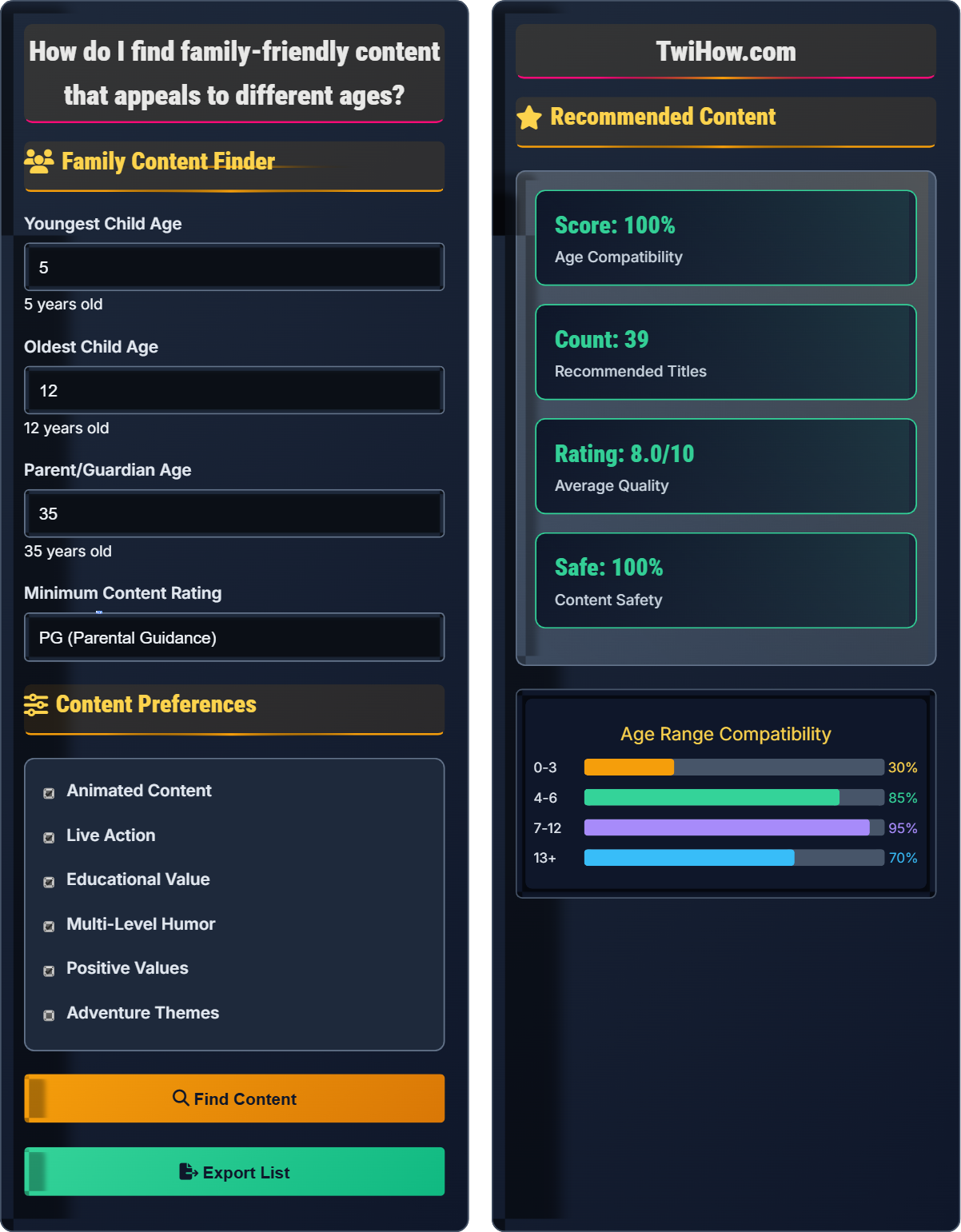
Family Content Finder
Content Preferences
Recommended Content
| Title | Type | Rating | Age Range |
|---|---|---|---|
| Toy Story | Animation | G | 0-12 |
| Moana | Animation | PG | 2-14 |
| Encanto | Animation | PG | 4-16 |
| The Peanuts Movie | Animation | G | 0-10 |
Selection Criteria
Safety
No inappropriate content for specified age ranges.
Engagement
Appealing to both children and adults in the family.
Quality
High production values and positive reviews.
Values
Promotes positive character traits and messages.
Family-Friendly Content Strategies Explained
Family-friendly content must balance entertainment value for multiple age groups while maintaining appropriate content standards. The challenge lies in finding material that engages both young children and adults, offering simple pleasures for the former while providing sophisticated humor, themes, or storytelling for the latter. This requires understanding different developmental stages and content preferences across age ranges.
Where:
- Age Range Compatibility: Percentage of family members who find content engaging
- Content Quality: Production values, storytelling, and entertainment value
- Safety Score: Appropriateness and absence of concerning content
- Complexity Mismatch: Difference between content complexity and age appropriateness
Effective family content spans multiple categories:
- Universal Themes: Friendship, courage, kindness, perseverance that transcend age
- Multi-Level Storytelling: Simple plots for young children with deeper themes for adults
- Appropriate Humor: Physical comedy for young children and clever wordplay for older audiences
- Positive Values: Content that reinforces good character and moral lessons
- Engaging Characters: Relatable protagonists that appeal to different age groups
- High Production Quality: Professional presentation that maintains adult interest
- Classic Films: Time-tested movies that appeal to multiple generations
- Animated Features: Visually engaging content with sophisticated storytelling
- Adventure Stories: Exciting plots that captivate all ages
- Educational Content: Learning opportunities disguised as entertainment
- Music and Sing-Along: Interactive experiences that engage the whole family
- Seasonal Content: Holiday-themed content that creates traditions
Content Fundamentals
Age compatibility, content safety, family appeal, universal themes, multi-level storytelling, positive values, appropriate humor.
Family Appeal = (Age Compatibility × Content Quality × Safety) / Complexity Mismatch
Where Appeal = measure of suitability for mixed-age family viewing.
- Content should be accessible to youngest viewer
- Adults should also find content engaging
- Safety and values are paramount considerations
Discovery Strategies
Content research, rating systems, platform tools, community reviews, preview evaluation, collection building.
- Assess family composition and preferences
- Define content boundaries and safety standards
- Research options using multiple sources
- Preview content before family viewing
- Test and adjust based on family feedback
- All family members enjoy the content
- No age-inappropriate content appears
- Positive family discussions follow viewing
- Content can be enjoyed repeatedly
Family Content Learning Quiz
What is the most important factor when determining if content is suitable for multiple age groups in a family?
While all factors matter, the safety of the youngest viewer is the most critical consideration. Content must be completely appropriate for the youngest family member, as they are most vulnerable to inappropriate content. Once safety is ensured, the focus shifts to engagement for all age groups, but safety always takes precedence. The youngest child's safety determines the baseline for content selection, though engagement for all family members is important for successful family viewing experiences.
The answer is D) The content's safety for the youngest viewer.
Understanding the hierarchy of content selection priorities is crucial for family-friendly media consumption. The safety-first principle protects the most vulnerable family members while creating a foundation for broader family enjoyment. This approach ensures that content meets the highest safety standards while still allowing for entertainment value across age groups. The principle follows the "lowest common denominator" approach where the most restrictive safety requirements set the baseline for all family members.
Age-Appropriate Content: Material suitable for specific developmental stages
Safety Standards: Guidelines protecting children from harmful content
Lowest Common Denominator: Setting standards based on most restrictive requirements
• Safety always precedes entertainment value
• Youngest viewer sets the baseline standard
• Content should be engaging for all family members
• Always check content for the youngest family member first
• Use detailed content descriptions, not just ratings
• Preview content yourself before family viewing
• Relying solely on content ratings without details
Explain how "multi-level content" works in family-friendly entertainment and why it's effective for audiences spanning different age groups.
Definition: Multi-level content refers to entertainment that operates on multiple intellectual and emotional levels simultaneously, offering simple pleasures for younger viewers while providing sophisticated elements for older audiences.
How It Works: Animated films often feature basic storylines that young children can follow while incorporating references, jokes, and themes that only adults understand. Characters may face simple conflicts children relate to while dealing with complex moral dilemmas that resonate with adults.
Effectiveness: This approach ensures all family members find something engaging, preventing adults from being bored while children are entertained. The layered approach allows for repeated viewing with new discoveries at each level, creating shared experiences that can be appreciated differently by different age groups.
Multi-level content represents sophisticated understanding of how different developmental stages process information and entertainment. The technique requires creators to think simultaneously about multiple audience needs, crafting content that satisfies basic entertainment needs while offering intellectual and emotional rewards for more mature viewers. This approach acknowledges that family viewing experiences work best when all participants feel their needs are met, rather than one group being accommodated at the expense of another.
Multi-Level Content: Entertainment operating on multiple intellectual/emotional levels
Developmental Stages: Different cognitive and emotional maturity levels
Layered Storytelling: Multiple narrative depths within single content
• Don't talk down to children
• Respect adult intelligence in family content
• Balance simplicity with sophistication
• Look for content with hidden references for adults
• Choose stories with simple cores and complex themes
• Select content that rewards repeat viewing
• Assuming simple content bores adults
• Thinking complex content always excludes children
• Failing to appreciate sophisticated family content
You have a family with children aged 4, 8, and 13, plus parents in their 30s. You want to select a movie that everyone can enjoy together. How would you evaluate three options: a G-rated animated film, a PG-rated live-action adventure, and a PG-13 action movie? Include specific criteria and decision-making process.
Decision-Making Process: Start with safety requirements (13-year-old can handle PG-13, but 4-year-old may be overwhelmed by intense action). The PG-13 option immediately becomes problematic due to age-inappropriate content for the youngest viewers.
Evaluation Criteria: Content appropriateness, engagement potential for each age group, safety concerns, and family viewing dynamics. The G-rated animated film ensures safety for all but may bore the 13-year-old. The PG-rated adventure offers middle ground with age-appropriate content for all while potentially engaging the older child more than the animated option.
Final Decision: The PG-rated live-action adventure is likely the best choice, assuming it offers multi-level storytelling that engages all ages. It maintains safety standards while providing more sophisticated content than a G-rated film. The key is ensuring the specific PG movie doesn't contain elements inappropriate for the 4-year-old.
Content selection for multi-age families requires careful balancing of competing needs and safety requirements. The decision-making process must prioritize safety while maximizing engagement across age groups. This example illustrates the complexity of family media selection, where the most restrictive safety requirements often determine the baseline, but engagement considerations help select among appropriate options. The goal is finding content that meets safety standards while offering sufficient sophistication to maintain adult interest.
Content Appropriateness: Suitability for specific age groups and sensibilities
Safety Requirements: Standards protecting children from harmful content
Engagement Potential: Likelihood of holding attention across age groups
• Safety requirements set the baseline
• Engagement should be maximized within safety limits
• Specific content details matter more than ratings alone
• Read detailed content descriptions, not just ratings
• Consider the specific 13-year-old's maturity level
• Preview content for the 4-year-old's reactions
• Assuming PG-13 is appropriate for 13-year-olds
• Overlooking content details beyond ratings
• Prioritizing convenience over careful selection
You're setting up streaming accounts for a family with varying ages (2, 6, 10, and 14 years old). How would you configure parental controls, create profiles, and establish content curation strategies to ensure each child accesses appropriate content while allowing flexibility for family viewing?
Profile Configuration: Create individual profiles for each child with age-appropriate content restrictions, a family profile for group viewing, and parent profiles for unrestricted access. Set PIN protections for switching between profiles.
Content Curation: Build collections for different age groups, use platform recommendations based on age settings, and create playlists for various viewing scenarios (quiet time, family night, individual viewing).
Control Strategies: Enable content rating restrictions for each profile, set time limits for younger children, create activity reports for monitoring, and establish clear family viewing guidelines for shared profiles.
Flexibility Mechanisms: Allow parent override for special occasions, create "family approved" lists that bypass some restrictions during family time, and establish clear communication about content requests and approvals.
Platform optimization for multi-age families requires balancing automation with human oversight. The goal is creating systems that protect younger children while providing appropriate independence for older ones, all while facilitating family viewing experiences. This approach recognizes that technology alone cannot solve content management challenges—human judgment and communication remain essential. The configuration should support both individual and collective viewing while maintaining safety and educational goals.
Individual Profiles: Personalized viewing experiences with custom restrictions
Family Profiles: Shared accounts for group viewing experiences
Content Curation: Organizing and managing available content options
• Age-appropriate restrictions by profile
• Maintain flexibility for family viewing
• Combine technology with human oversight
• Regularly review and update age restrictions
• Create "favorites" lists for quick access
• Use platform "kids" modes for youngest children
• Setting identical restrictions for all children
• Neglecting to customize recommendations
• Failing to update restrictions as children grow
Which characteristic is most important for family-friendly content to have educational value?
While all options have value, positive character development and values form the foundation of meaningful educational content for families. Content that models good character traits, ethical decision-making, and positive social behaviors provides the most broadly applicable educational value. Academic subjects and factual accuracy are important, but character education creates lasting impact across all areas of life. Values-based content also tends to be more universally appealing across age groups while maintaining safety standards.
The answer is B) Positive character development and values.
Character education represents the most fundamental form of learning that transcends specific academic subjects and remains relevant throughout life. Content that models positive values, ethical decision-making, and good character provides educational value that extends beyond entertainment. This type of content helps families discuss important life lessons and moral principles in the context of engaging stories. Character development also supports the emotional and social growth that academic subjects alone cannot address.
Character Development: Growth of moral and ethical understanding
Values-Based Learning: Education focused on principles and ethics
Universal Education: Lessons applicable across contexts
• Character education has lasting impact
• Values transcend specific subjects
• Moral lessons enhance entertainment value
• Discuss character choices after viewing
• Look for content modeling positive behaviors
• Choose stories with clear moral lessons
• Prioritizing academic content over character development
• Assuming entertainment cannot be educational
• Neglecting to discuss values presented in content
FAQ
Q: How do I know if content rated PG is appropriate for my 8-year-old, since ratings seem subjective?
A: Content ratings provide general guidelines, but individual children vary in sensitivity and maturity. For PG content with an 8-year-old:
1. Read Detailed Descriptions: Look beyond the rating for specific content details (violence, scary scenes, language)
2. Check Parent Review Sites: Commonsense Media, Plugged In, and similar sites provide detailed content breakdowns
3. Consider Your Child's Sensitivity: Some 8-year-olds handle mild action/scary scenes well, others don't
4. Watch Together Initially: View the first few minutes with your child to gauge their reaction
5. Have Backup Plans: Be ready to pause or stop if content proves too intense
Remember that PG means "parental guidance suggested," so your judgment as a parent who knows your child best is the most important factor.
Q: What's the difference between content for preschoolers vs. elementary-aged children?
A: The differences reflect distinct developmental capabilities:
Preschoolers (Ages 2-5): Short attention spans (10-15 minutes), simple vocabulary, concrete thinking, need immediate gratification, sensitive to scary or loud content, enjoy repetition and familiar characters.
Elementary (Ages 6-12): Longer attention spans (30-90 minutes), more complex vocabulary and concepts, beginning abstract thinking, can handle minor conflicts or mild scares, enjoy learning and problem-solving elements.
Preschool content focuses on basic concepts, emotions, and social skills with simple plots. Elementary content can include more complex storylines, character development, and educational elements while maintaining positive values and avoiding mature themes.
Q: Why do parents think all "kid shows" are bad quality?
A: This is often a misconception, but there are valid reasons for parent skepticism:
1. Repetitive Viewing: Parents may see the same content dozens of times, making initially enjoyable content tiresome
2. Historical Quality Issues: Some older children's programming was indeed lower quality, though this has improved dramatically
3. Different Standards: Adults may judge children's content by adult entertainment standards rather than age-appropriate criteria
4. Commercial Concerns: Worry about excessive advertising and product tie-ins
However, many modern children's programs offer excellent production values, sophisticated storytelling, and positive values. Shows like "Bluey," "Avatar: The Last Airbender," and "Steven Universe" demonstrate that children's content can be both age-appropriate and artistically excellent. The key is finding quality content that works for the whole family.