Benefits of Watching Content in Original Language with Subtitles
Complete streaming guide • Step-by-step explanations
Original Language Benefits:
Show Subtitle SimulatorWatching content in its original language with subtitles provides numerous cognitive and linguistic benefits. This approach combines the authentic audio experience with textual support, creating an optimal environment for language acquisition, cultural immersion, and enhanced comprehension.
Key benefits include:
- Improved Pronunciation: Hearing authentic native speech patterns
- Vocabulary Expansion: Exposure to natural word usage
- Cultural Immersion: Authentic cultural references and expressions
- Listening Skills: Better auditory processing and recognition
- Reading Comprehension: Enhanced text-to-speech correlation
Research shows that this method is particularly effective for intermediate to advanced learners who have foundational vocabulary knowledge.
Language Learning Simulator
Learning Options
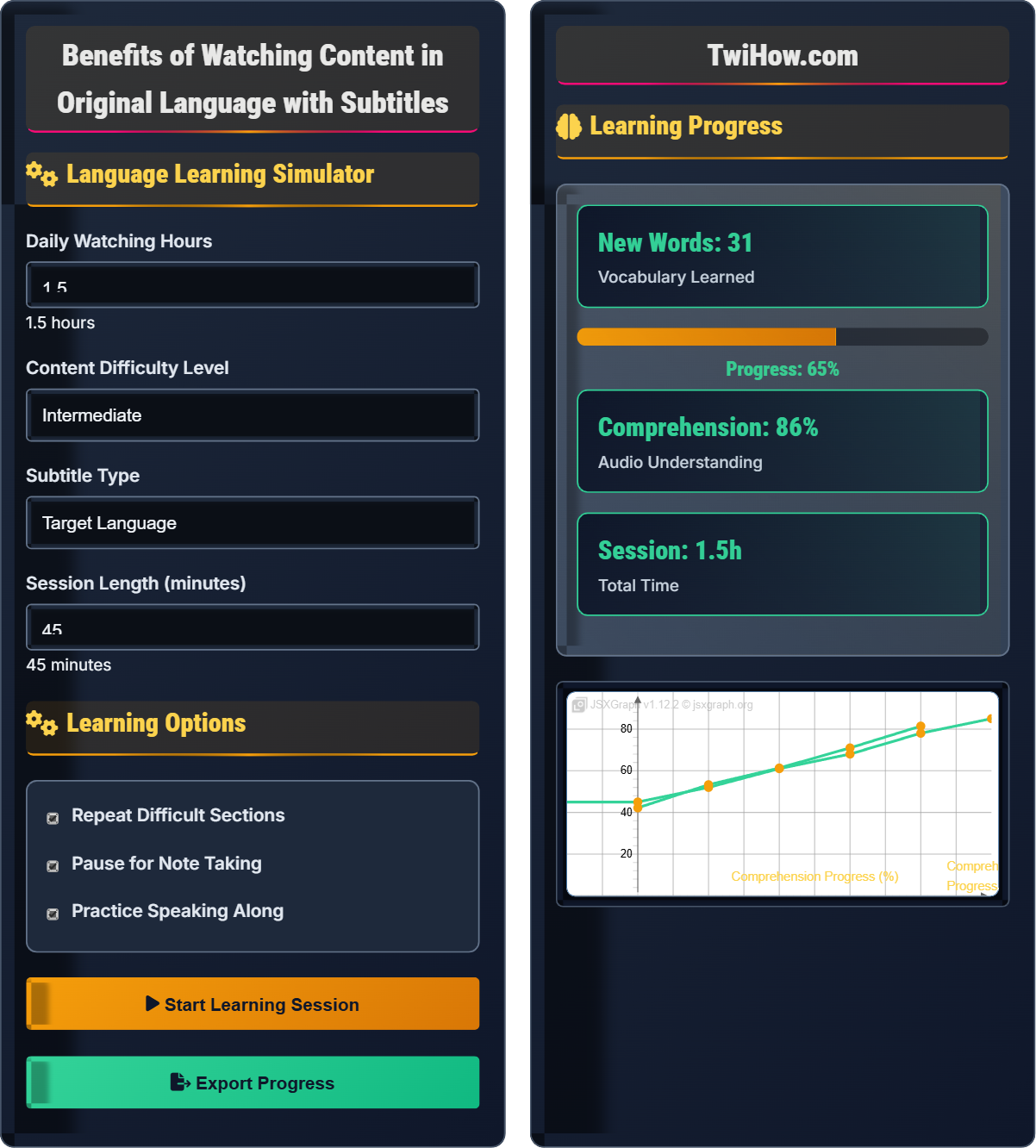
Learning Progress
| Day | New Words | Comprehension | Time (min) |
|---|---|---|---|
| 1 | 12 | 45% | 45 |
| 2 | 15 | 52% | 45 |
| 3 | 10 | 61% | 45 |
| 4 | 8 | 68% | 45 |
| 5 | 7 | 78% | 45 |
Hearing authentic native pronunciation helps develop correct accent and intonation patterns.
Exposure to natural word usage and colloquial expressions not found in textbooks.
Authentic cultural references, humor, and social contexts enhance understanding.
Better auditory processing and recognition of speech patterns and accents.
How Original Language Viewing Works
Watching content in original language with subtitles engages both auditory and visual processing simultaneously. This dual-pathway approach strengthens neural connections and enhances memory retention.
Where:
- Audio Processing: Hearing authentic pronunciation and intonation
- Visual Processing: Reading text for verification and clarification
- Contextual Relevance: Meaningful content in real-world scenarios
Research indicates that original language viewing with subtitles activates multiple brain regions:
- Broca's Area: Speech production and grammar processing
- Wernicke's Area: Language comprehension
- Visual Cortex: Processing written text
- Motor Cortex: Potential speech production pathways
- Hippocampus: Memory consolidation
- Start with subtitles: Begin with target language subtitles
- Gradual reduction: Progress to no subtitles as confidence grows
- Repeat content: Watch favorite scenes multiple times
- Note taking: Record useful phrases and expressions
- Active engagement: Speak along with dialogue
Core Benefits
Enhanced pronunciation, expanded vocabulary, improved listening skills, cultural awareness.
Effective Learning = (Authentic Audio + Text Support) × Consistent Practice
Where Authentic Audio = Native pronunciation, Text Support = Subtitle assistance.
- Start with easier content
- Use target language subtitles initially
- Watch consistently for best results
- Take notes of new vocabulary
Practical Applications
Movies, TV shows, documentaries, YouTube videos, online courses, interviews.
- Choose appropriate difficulty level
- Select engaging content
- Set consistent viewing schedule
- Track vocabulary growth
- Practice speaking along
- Different accents and dialects
- Cultural context variations
- Subtitles accuracy
- Personal learning pace
Interactive Subtitle Simulator
Sample Dialogue Comparison
"Hola, ¿cómo estás? Me alegra mucho verte."
"Hello, how are you? I'm so glad to see you."
Connects authentic pronunciation with familiar meaning, reinforcing both auditory and visual learning pathways.
Original Language Learning Quiz
Which of the following is NOT a primary benefit of watching content in original language with subtitles?
While watching content in original language with subtitles offers numerous benefits, faster video playback speed is not one of them. The primary benefits include improved pronunciation, vocabulary expansion, and cultural understanding. The method combines authentic audio with textual support to enhance language learning effectiveness.
The answer is D) Faster video playback speed.
The dual-processing approach of original language viewing with subtitles creates optimal conditions for language acquisition. The brain simultaneously processes auditory input (pronunciation, intonation, rhythm) and visual input (spelling, meaning, context), strengthening neural pathways. This multisensory approach is more effective than single-channel learning methods.
Original Language: Content presented in the language it was originally produced
Subtitles: Text translations displayed below video content
Dual Processing: Simultaneous use of auditory and visual learning channels
• Authentic audio provides correct pronunciation models
• Contextual exposure increases vocabulary retention
• Cultural references enhance understanding
• Start with easier content and gradually increase difficulty
• Take notes of new vocabulary and expressions
• Repeat favorite scenes multiple times
• Choosing content too difficult for current level
Explain how watching content in original language with subtitles affects different areas of the brain and contributes to language learning. Include the cognitive processes involved.
Brain Areas Activated: Original language viewing with subtitles engages multiple brain regions simultaneously:
Broca's Area: Processes grammar and speech production, activated when hearing authentic sentence structures.
Wernicke's Area: Handles language comprehension, activated by both auditory input and reading subtitles.
Visual Cortex: Processes written text, strengthening visual-word recognition.
Motor Cortex: May activate when mimicking speech sounds or preparing to speak.
Hippocampus: Consolidates memories, especially when multiple senses are engaged.
Cognitive Processes: The dual-channel approach creates stronger neural pathways, enhances pattern recognition, and improves memory retention compared to single-channel learning methods.
The effectiveness of original language viewing with subtitles stems from cognitive load theory and dual-coding theory. When both auditory and visual channels are used simultaneously, the brain can cross-reference information, leading to deeper encoding and better retrieval. This multisensory approach reduces cognitive load by providing redundant information through different modalities.
Broca's Area: Brain region responsible for speech production and grammar
Wernicke's Area: Brain region responsible for language comprehension
Dual-Coding Theory: Theory that information is processed through both verbal and visual channels
• Multiple brain areas work together for optimal learning
• Multisensory input creates stronger memory traces
• Contextual learning enhances retention
• Engage actively by pausing to think about meanings
• Try to predict what comes next in dialogue
• Practice speaking along with characters
• Passive viewing without active engagement
• Relying too heavily on subtitles instead of listening
• Not reviewing or practicing learned material
Sarah is learning Spanish and has been watching original Spanish movies with English subtitles for 3 months. She started with basic comedies and now watches more complex dramas. Her vocabulary has increased from 500 to 1,200 words, and her listening comprehension has improved from 30% to 70%. Calculate her average monthly improvement in vocabulary and comprehension, and describe the learning progression she experienced.
Vocabulary Improvement: Initial = 500 words, Final = 1,200 words
Vocabulary gained = 1,200 - 500 = 700 words
Average monthly improvement = 700 ÷ 3 = 233 words per month
Comprehension Improvement: Initial = 30%, Final = 70%
Improvement = 70% - 30% = 40%
Average monthly improvement = 40% ÷ 3 = 13.3% per month
Learning Progression: Sarah likely progressed from beginner to intermediate level, starting with simpler vocabulary and sentence structures, then advancing to more complex expressions and cultural references as her skills developed.
This example demonstrates the cumulative effect of consistent original language viewing. The significant improvements in both vocabulary and comprehension show how the dual-processing approach accelerates language learning. The progression from basic to complex content reflects the natural learning curve where foundation skills enable advancement to higher complexity levels.
Vocabulary: Total number of words a person knows and can use
Comprehension: Ability to understand spoken language
Learning Progression: Gradual advancement through skill levels
• Consistent practice yields measurable results
• Gradual increase in difficulty maintains motivation
• Both vocabulary and comprehension improve together
• Track progress with regular assessments
• Increase difficulty as skills improve
• Maintain consistent viewing schedule
• Jumping to too difficult content too quickly
• Not tracking progress objectively
• Inconsistent viewing schedule
A beginning French learner wants to maximize their learning from original French content. Design a subtitle strategy that adapts as their skills improve. Include recommendations for timing, content selection, and progression methods.
Phase 1 (Beginner): Use French subtitles with English translation to connect written French with known English meaning. Focus on simple content like children's shows or basic documentaries.
Phase 2 (Elementary): Switch to French-only subtitles while keeping audio in French. This reinforces spelling and pronunciation connections. Choose content with slower speech patterns.
Phase 3 (Intermediate): Gradually reduce subtitle dependence, watching short segments without subtitles, then checking with subtitles. Select content with natural conversation pace.
Phase 4 (Advanced): Watch primarily without subtitles, using them only for difficult sections. Engage with complex content like news programs or sophisticated films.
Timing: Spend 3-4 months in each phase before advancing, adjusting based on comfort level.
This graduated approach follows the principle of scaffolding, where support is gradually reduced as competence increases. Starting with dual-language support provides a safety net while building confidence, then transitioning to target-language-only support reinforces actual language skills. The progression respects cognitive load limits while maintaining optimal challenge levels.
Scaffolding: Temporary support provided during learning that is gradually removed
Cognitive Load: Amount of mental effort required for learning
Subtitling Strategy: Planned approach to using text support during learning
• Progress gradually to avoid overwhelming learners
• Adapt timing based on individual progress
• Maintain balance between challenge and support
• Keep a vocabulary journal of new words
• Review content multiple times as skills improve
• Choose personally interesting content for motivation
• Advancing too quickly without mastering basics
• Staying too long in comfort zone without challenge
• Not selecting appropriate content for level
Which cultural aspect is most effectively conveyed through original language content with subtitles?
Colloquial expressions and idioms are most effectively conveyed through original language content with subtitles because they capture authentic usage in natural contexts. These expressions often don't translate literally and require both audio and visual context to understand their meaning and appropriate usage. Formal grammar rules, written literature styles, and historical facts can be learned through other methods, but natural language usage patterns are best observed in authentic content.
The answer is B) Colloquial expressions and idioms.
Language is deeply embedded in culture, and many expressions lose their meaning when translated literally. Original content preserves cultural context, humor, and social norms that are essential for true fluency. The combination of hearing authentic pronunciation with seeing textual meaning helps learners understand not just what words mean, but how and when to use them appropriately.
Colloquial Expressions: Informal phrases used in everyday conversation
Idioms: Phrases whose meaning differs from literal interpretation
Cultural Context: Background knowledge required to understand communication
• Language and culture are inseparable
• Authentic content preserves cultural nuance
• Context is crucial for understanding
• Pay attention to cultural references and humor
• Learn expressions in context rather than isolation
• Research cultural background of content
• Treating language as purely academic exercise
• Ignoring cultural context of expressions
• Translating idioms literally
FAQ
Q: Is it better to watch with subtitles in my native language or the target language?
A: The choice depends on your proficiency level:
Beginners: Start with target language subtitles to connect written and spoken forms. This builds vocabulary and spelling recognition.
Intermediate learners: Use target language subtitles to reinforce reading skills while developing listening comprehension.
Advanced learners: Gradually reduce subtitle use, watching without them and checking back only for difficult passages.
Research shows that target language subtitles generally provide better learning outcomes than native language subtitles, as they keep you focused on the target language throughout the viewing experience.
Q: How much time should I spend watching original language content daily?
A: Quality and consistency matter more than quantity:
Beginners: 15-30 minutes daily with frequent breaks to process new information.
Intermediate: 30-60 minutes daily, focusing on content slightly above current level.
Advanced: 45-90 minutes, treating it as immersive cultural experience.
The key is maintaining focus and engagement throughout the session. Shorter, concentrated sessions are more effective than longer, unfocused ones. Consistency is crucial - daily exposure is better than sporadic long sessions.