What Are the Best Free and Legal Streaming Options?
Complete streaming guide • Step-by-step explanations
Free Legal Streaming Options:
Show Platform AnalyzerFree legal streaming platforms offer entertainment content without subscription fees, supported by advertisements or other revenue models. These services provide access to movies, TV shows, and original content while respecting copyright laws.
Popular options include:
- Tubi: Large library with ad-supported content
- Pluto TV: Live TV channels and on-demand content
- Kanopy: Premium content through library access
- Crackle: Sony's ad-supported streaming service
These platforms offer viable alternatives to paid subscriptions while supporting content creators and distributors.
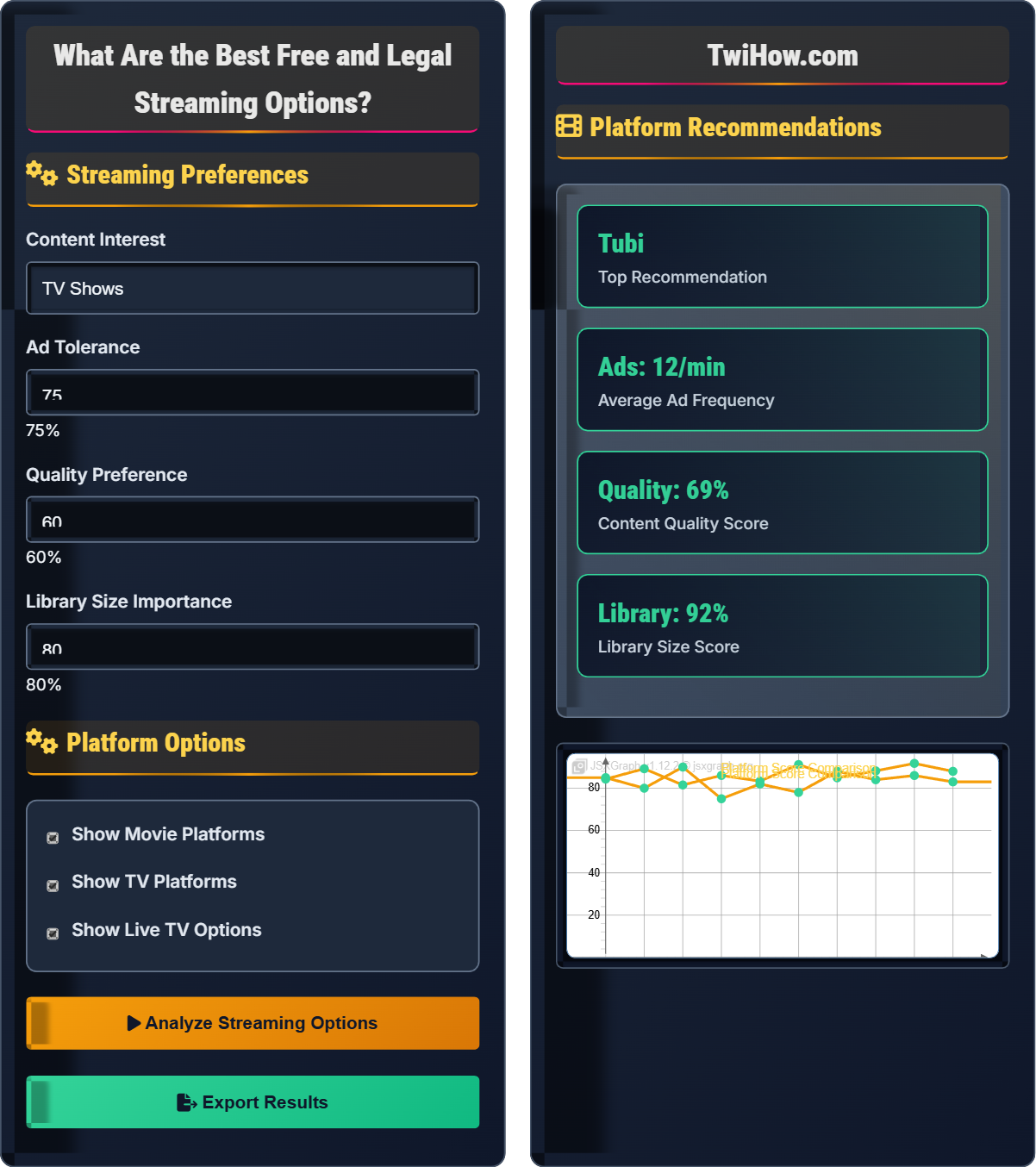
Streaming Preferences
Platform Options
Platform Recommendations
| Platform | Content | Ads | Quality |
|---|---|---|---|
| Tubi | Excellent | Medium | Good |
| Pluto TV | Very Good | High | Good |
| Kanopy | Excellent | None | Excellent |
| Crackle | Good | Medium | Fair |
| Peacock Free | Very Good | High | Good |
Content Quality: Ad-supported platforms may have older or less popular content.
Ad Impact: Frequent interruptions may affect viewing experience.
Free Legal Streaming Explained
Free legal streaming platforms offer entertainment content without subscription fees, funded through advertisements, sponsorships, or library partnerships. These services provide access to movies, TV shows, and original content while respecting copyright laws and licensing agreements.
Free platforms operate through several sustainable revenue models:
Where:
- Ad Impressions: Income from advertisements viewed
- Sponsorships: Brand partnerships and sponsored content
- Library Partnerships: Funding from public libraries
- Premium Upsells: Revenue from optional upgrades
Leading free legal streaming platforms include:
- Tubi: Largest free library with ad-supported content
- Pluto TV: Live TV channels and on-demand content
- Kanopy: Premium content through library cards
- Crackle: Sony's ad-supported streaming service
- Peacock Free: NBCUniversal content with ads
- IMDb TV: Amazon's ad-supported platform
- Plex: Live TV and on-demand with ads
- YouTube: Free movies and shows with ads
- Direct Registration: Sign up with email address
- Library Cards: Access through public library accounts
- Amazon Prime: Included with Prime membership
- Smart TV Apps: Built-in platform applications
- Mobile Apps: Download from app stores
- Web Browsers: Access through websites
Free Streaming Options
Ad-supported, library access, premium upsells, content licensing, regional restrictions.
Score = (Content Quality × 0.4) + (Ad Tolerance × 0.3) + (Library Size × 0.3)
Where Score = overall platform rating.
- All platforms must be legally licensed
- Content varies by region
- Ads fund the free service
Platform Comparison
Ad-supported, library-funded, premium-upsell, live TV, on-demand.
- Assess content library size
- Evaluate ad experience
- Check video quality
- Verify device compatibility
- Confirm regional availability
- Review additional features
- Ad frequency affects viewing experience
- Library content rotates regularly
- Some require library cards or other access
Free Streaming Learning Quiz
What distinguishes legal free streaming platforms from illegal ones?
Legal free streaming platforms are distinguished by their legitimate funding models, such as advertisements, sponsorships, library partnerships, or premium upsells. They have proper licensing agreements with content creators and distributors.
Illegal platforms typically redistribute copyrighted content without permission, while legal platforms have proper authorization to stream the content they offer.
The answer is B) They are funded through ads or partnerships.
Students should understand that the legality of a platform is determined by proper licensing and funding models, not by content quantity or quality. Legal platforms invest in proper content licensing and have sustainable business models, while illegal platforms violate copyright laws.
Legal Platform: Properly licensed content distribution
Content Licensing: Permission to distribute copyrighted material
Ad-Supported Model: Revenue through advertisements
• Legitimacy = proper licensing
• Ads fund free services
• Copyright laws must be respected
• Look for proper company information
• Check for licensing details
• Research business model
• Judging by content quantity
• Not understanding funding models
• Confusing quality with legality
Explain how Kanopy provides free premium content and what requirements users must meet to access it.
Kanopy Business Model: Kanopy operates through partnerships with public libraries and academic institutions. Libraries pay licensing fees to Kanopy, which then provides access to their patrons at no additional cost.
Access Requirements:
• Valid library card from a participating institution
• Library must subscribe to Kanopy service
• Geographic restrictions may apply
Content Offered:
• Independent films
• Documentaries
• Classic movies
• Educational content
Advantages:
• No ads
• High-quality content
• Curated selection
• Academic partnerships
This model leverages existing library infrastructure to provide premium content funded through library budgets rather than individual subscriptions.
Kanopy represents an innovative funding model that leverages institutional partnerships. Students should understand how libraries can provide value-added services to their patrons through such partnerships. This model demonstrates how free services can still offer premium content through alternative funding sources.
Institutional Partnership: Library-academic institution collaboration
Library Card Access: Authentication through library credentials
No-Ad Model: Content funded through other means
• Requires library card
• Premium content accessible
• Check your local library
• Academic libraries often participate
• No ads or waiting periods
• Not checking library access
• Assuming all libraries participate
• Confusing with ad-supported platforms
A user is considering switching from a paid streaming service to free ad-supported platforms. Calculate the impact of ads on viewing time if they watch 2 hours of content daily and each ad break lasts 3 minutes with 4 breaks per hour. How much actual content viewing time would they lose to ads per month?
Daily Ad Time Calculation:
• 2 hours of content daily
• 4 ad breaks per hour
• 3 minutes per ad break
• Daily ad time = 2 hours × 4 breaks/hour × 3 minutes/break = 24 minutes
Monthly Ad Time:
• Daily ad time: 24 minutes
• Monthly ad time: 24 minutes/day × 30 days = 720 minutes
• Monthly ad time in hours: 720 ÷ 60 = 12 hours
Impact Analysis:
• Without ads: 2 hours × 30 days = 60 hours of content
• With ads: 60 hours content + 12 hours ads = 72 hours total
• Ad time represents 16.7% of total viewing time
The user would lose approximately 12 hours per month to advertisements, which is equivalent to 6 full episodes of a typical hour-long show.
This example demonstrates the hidden cost of ad-supported platforms - time spent watching advertisements. Students should understand that while these services are "free" monetarily, they come with a time cost that may be significant for frequent viewers. This helps in comparing the true value of free vs. paid services.
Ad-Supported Model: Revenue through advertisement viewing
Ad Frequency: Number of ad breaks per viewing session
Hidden Cost: Time spent on advertisements
• Ad time adds up significantly
• Consider time cost vs. money cost
• Calculate total ad time
• Compare to subscription cost
• Consider ad-free alternatives
• Not accounting for ad time
• Only considering monetary cost
• Underestimating ad frequency impact
A user prefers documentaries and independent films with minimal ads, and has access to a library card. Which free platform would best suit their needs, and what factors should they consider in making their decision?
Best Platform Recommendation: Kanopy is the optimal choice for documentary and independent film enthusiasts with library access.
Why Kanopy:
• Extensive documentary collection
• Strong independent film catalog
• No advertisements
• High-quality content
• Academic partnerships
Factors to Consider:
• Library Participation: Verify your library subscribes to Kanopy
• Regional Restrictions: Content availability varies by location
• Device Compatibility: Check if Kanopy works on your devices
• Content Rotation: Library content rotates regularly
• Watch Limits: Some libraries impose monthly viewing limits
• Registration Process: May require library card verification
Alternative Options: If Kanopy isn't available through your library, consider Tubi for a good documentary selection, though it has ads.
This example shows how to match user preferences with platform capabilities. Students should understand that effective platform selection requires considering multiple factors including content type, ad preferences, access methods, and regional availability. The library card requirement for Kanopy is a key differentiator that may not apply to all users.
Documentary Focus: Content specializing in factual programming
Independent Films: Movies produced outside major studios
Library Access: Authentication through library credentials
• Match content to preferences
• Consider access requirements
• Verify regional availability
• Check library partnerships
• Look for ad-free options
• Verify content availability
• Not checking library access
• Assuming all platforms have same content
• Ignoring regional restrictions
Which factor most significantly affects content availability on free streaming platforms?
Geographic location and licensing agreements are the most significant factors affecting content availability on free streaming platforms. Content licensing is typically region-specific, meaning the same platform may offer completely different content libraries in different countries.
Each piece of content requires specific licensing agreements for each territory, which is why platforms like Tubi, Netflix, or any other service have different catalogs in different regions. These licensing agreements are often the most restrictive factor for content availability.
Internet speed affects streaming quality but not availability, device type affects access method, and time of day is not a factor.
The answer is B) Geographic location and licensing agreements.
Students should understand that content availability is primarily governed by licensing agreements rather than technical factors. This explains why the same platform can have dramatically different content offerings in different countries. The geographic licensing model is a fundamental aspect of the streaming industry that affects all platforms.
Licensing Agreement: Contract granting distribution rights
Geographic Restriction: Content availability by region
Territory Rights: Regional distribution permissions
• Content is region-licensed
• Same platform = different content by location
• Licensing drives availability
• Check regional availability
• VPNs may change available content
• Libraries may have different content
• Not understanding regional restrictions
• Confusing technical with licensing issues
• Assuming universal content availability
FAQ
Q: Are free streaming platforms safe to use?
A: Legal free streaming platforms are generally safe to use:
Safe Platforms: Tubi, Pluto TV, Kanopy, Crackle, Peacock Free, and other officially licensed services are secure.
Security Measures: These platforms use standard web security, encrypted streaming, and legitimate business models.
Red Flags to Avoid: Sites requiring software downloads, asking for personal information, or offering pirated content.
Safe Practices: Use official apps from app stores, keep software updated, and avoid clicking suspicious links.
Always verify the legitimacy of a platform before using it, and stick to well-known services from reputable companies.
Q: How do these platforms make money without charging users?
A: Free platforms employ several revenue models:
Advertisement Revenue: Sell ad space during content viewing (most common).
Library Partnerships: Public libraries pay for Kanopy access for their patrons.
Sponsored Content: Brand partnerships and product placement.
Premium Upselling: Offer paid upgrades with additional features.
Content Licensing: Earn money by licensing content to other platforms.
Merchandising: Sell branded merchandise related to content.
The ad-supported model is most prevalent, where platforms sell viewer attention to advertisers at rates that can make free services profitable despite having no subscription fees.