Ad-Supported vs Premium Tiers
Complete streaming guide • Feature comparisons
Streaming Tier Fundamentals:
Show Tier ComparisonStreaming services offer different pricing tiers to accommodate various user preferences and budgets. The main choice consumers face is between ad-supported free or low-cost tiers versus premium ad-free subscriptions.
Ad-supported tiers include commercial interruptions during content viewing, while premium tiers provide uninterrupted streaming experience with additional features. Understanding these differences helps users make informed decisions based on their viewing habits and budget.
Key differences include:
- Cost: Ad-supported tiers are often free or significantly cheaper
- User Experience: Premium tiers offer seamless, uninterrupted viewing
- Features: Premium often includes offline downloads, higher quality streams
- Content Availability: Some premium content may be exclusive to paid tiers
Modern streaming platforms use these tiered models to maximize revenue while providing options for different market segments. The choice between tiers depends on factors like viewing frequency, tolerance for ads, and willingness to pay.
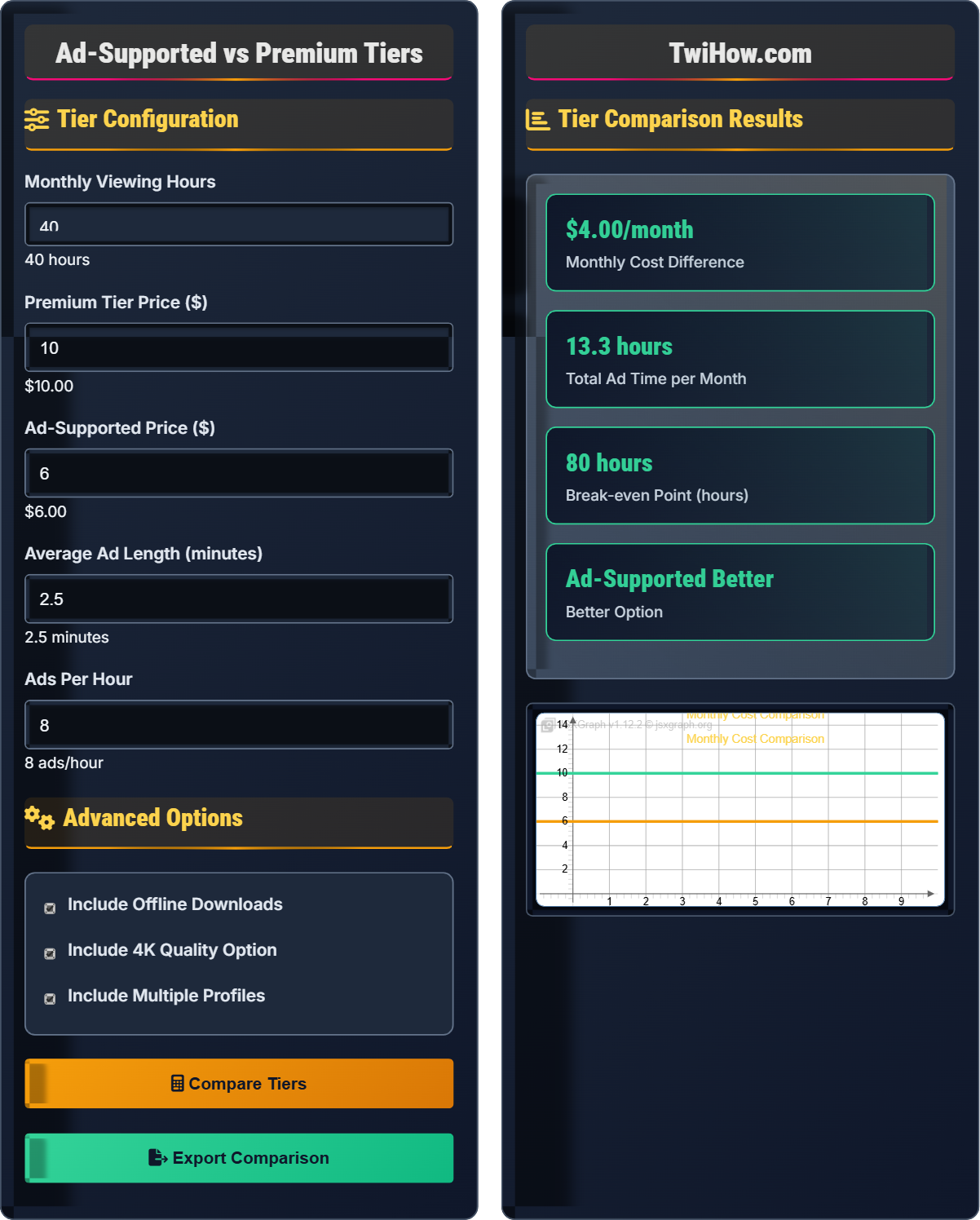
Tier Configuration
Advanced Options
Tier Comparison Results
| Feature | Ad-Supported | Premium |
|---|---|---|
| Monthly Cost | $6.00 | $10.00 |
| Ad-Free Viewing | No | Yes |
| Offline Downloads | Limited | Full Access |
| Video Quality | 720p Max | 4K Available |
| Simultaneous Streams | 1 | 3 |
• Lower monthly cost
• Interrupted viewing experience
• Limited features
• Suitable for casual viewers
• Higher monthly cost
• Seamless viewing experience
• Full feature access
• Better for frequent users
Understanding Streaming Tiers
Streaming services use tiered pricing to capture different market segments. The ad-supported tier provides basic access at reduced cost, subsidized by advertising revenue. The premium tier offers enhanced features and ad-free experience at a higher price point.
Where effective cost considers both monetary expense and time spent watching ads.
The break-even point indicates when the ad time becomes more valuable than the cost savings. Calculate this using:
Users who watch more than the break-even point typically benefit more from premium subscriptions.
Current trends in streaming tiers:
- Ad-Supported Growth: More services adding lower-tier ad-supported options
- Hybrid Models: Some platforms offering ad-free periods with ads during live events
- Freemium Approach: Free ad-supported tier to attract new users
- Feature Differentiation: Clear distinction between tiers to justify premium prices
- Ad-Supported: Lower cost entry, suitable for occasional viewers
- Premium: Enhanced experience, exclusive features, no interruptions
- Family Plans: Additional profiles and simultaneous streams
- Flexible Options: Ability to switch between tiers as needs change
Tier Differences Explained
Ad-supported vs premium tiers, subscription models, feature differentiation, value proposition.
Value = (Feature Access × Usage Frequency) - (Cost + Time Investment)
Where Feature Access = availability of desired features, Usage Frequency = how often they're used.
- More viewing hours favor premium tiers
- Low ad tolerance favors premium tiers
- Feature needs influence tier selection
Platform Examples
Netflix, Hulu, Disney+, HBO Max, Amazon Prime Video, YouTube Premium.
- Freemium model to attract users
- Feature differentiation to justify premium
- Ad-supported tier for price-sensitive customers
- Cross-tier conversion opportunities
- Content availability varies by tier
- Regional differences in offerings
- Promotional pricing periods
- Ability to switch between tiers
Streaming Tier Learning Quiz
Which of the following is typically NOT available in ad-supported tiers compared to premium tiers?
While ad-supported tiers often provide standard HD streaming, premium tiers typically offer enhanced features. Offline downloads are commonly restricted or unavailable in ad-supported tiers since they bypass advertising revenue. Multiple profiles and simultaneous streaming are often limited in ad-supported versions.
The answer is B) Offline downloads.
Streaming platforms use feature differentiation to create value propositions for each tier. The business model relies on ad revenue for lower tiers and subscription revenue for premium tiers. Understanding which features are tied to which tier helps users make informed decisions based on their viewing habits and needs.
Ad-Supported Tier: Service tier funded by advertisements with lower cost
Premium Tier: Paid service tier with enhanced features and no ads
Feature Differentiation: Distinct capabilities offered at each tier
• Ad revenue funds free/lower-cost tiers
• Premium features justify higher prices
• Feature availability varies by platform
• Check feature lists carefully before subscribing
• Consider your viewing patterns and needs
• Factor in time spent watching ads
• Assuming all features are available in ad-supported
• Not considering ad time as part of cost
• Overlooking regional differences
Explain the economic rationale behind ad-supported vs premium tier models in streaming services. Include the business benefits and user trade-offs for each approach.
Business Rationale: Ad-supported tiers lower the barrier to entry, attracting more users who might eventually upgrade to premium. Ads provide additional revenue streams, while premium tiers offer higher margins per subscriber.
User Trade-offs: Ad-supported users pay less monetarily but spend time watching ads. Premium users pay more but enjoy uninterrupted content and often additional features. The choice depends on individual valuations of time vs money.
Strategic Benefits: Platforms can segment markets, optimize revenue per user, and convert ad-supported users to premium subscribers over time.
The dual-tier model allows streaming services to capture different market segments. Price-sensitive users can access content through ad-supported tiers, while users willing to pay more get premium experiences. This maximizes total addressable market and revenue potential.
Market Segmentation: Dividing users into distinct groups with different pricing
Revenue Per User: Average income generated per subscriber
Conversion Rate: Percentage of users upgrading to premium
• Lower price increases user acquisition
• Premium features justify higher prices
• Ad revenue supplements subscription revenue
• Platforms balance ad load to avoid user churn
• Feature differentiation prevents tier overlap
• Promotional strategies drive upgrades
• Not accounting for ad time in cost calculations
• Assuming all platforms have same tier structures
• Overlooking promotional pricing periods
Sarah watches 25 hours of streaming content per month. She values her time at $20/hour. Ad-supported tier costs $7/month with 8 ads per hour lasting 2 minutes each. Premium tier costs $12/month with no ads. Which tier provides better value for Sarah?
Ad Time Calculation: 25 hours × 8 ads/hour × 2 minutes/ad = 400 minutes = 6.67 hours
Value of Ad Time: 6.67 hours × $20/hour = $133.40
Total Cost Ad-Supported: $7 + $133.40 = $140.40
Total Cost Premium: $12.00
Difference: $140.40 - $12.00 = $128.40
For Sarah, the premium tier provides significantly better value, saving her $128.40 worth of time per month.
This example demonstrates how time valuation affects tier choice. For users who watch frequently and value their time highly, premium tiers often provide better value despite higher sticker prices. The calculation includes both direct costs and opportunity costs of time spent watching ads.
Opportunity Cost: Value of time spent watching ads
Time Valuation: Personal rate assigned to time spent
Total Cost of Ownership: Direct cost plus time cost
• Higher viewing hours favor premium tiers
• Higher time valuation favors premium tiers
• Individual circumstances determine optimal choice
• Calculate effective hourly rate of your time
• Track actual viewing hours for accuracy
• Consider non-monetary factors (convenience)
• Only considering direct subscription costs
• Underestimating value of time
• Not accounting for viewing patterns
A streaming service has 1 million ad-supported users and 500,000 premium users. Ad-supported users generate $3/month in ad revenue, while premium users pay $10/month. The company is considering increasing ad load in the ad-supported tier to boost revenue. Analyze the potential impacts and recommend a strategy.
Current Revenue: (1M × $3) + (500K × $10) = $3M + $5M = $8M/month
Potential Impact: Increasing ad load could boost ad revenue per user but may cause user churn. Research suggests ad sensitivity varies among users.
Recommended Strategy: Gradual increase with A/B testing, focus on ad quality/relevance, consider offering premium features to ad-supported users to encourage upgrades. Conversion from ad-supported to premium generates more revenue than increased ad load.
Optimal Approach: Maintain reasonable ad load while optimizing conversion pathways to premium.
Streaming companies must balance short-term revenue gains with long-term user retention. While increasing ad load might boost immediate revenue, it risks user dissatisfaction and churn. The optimal strategy often focuses on converting ad-supported users to premium, which generates higher lifetime value.
Churn Rate: Percentage of users canceling service
Customer Lifetime Value: Total revenue expected from customerA/B Testing: Comparing different approaches with user samples
• User satisfaction affects retention
• Premium conversions are more valuable than ad revenue
• Ad load must balance revenue and user experience
• Test changes with small user groups first
• Focus on ad relevance over quantity
• Create clear upgrade paths to premium
• Maximizing short-term ad revenue at expense of retention
• Not measuring user satisfaction impacts
• Ignoring conversion opportunities to premium
Which trend is currently most significant in streaming tier strategies?
Major streaming platforms like Netflix, Disney+, and HBO Max have recently added or expanded ad-supported tiers to attract price-sensitive users and expand their addressable market. This trend allows platforms to serve broader audiences while maintaining premium options for users willing to pay more for ad-free experiences.
The answer is B) Addition of ad-supported tiers by premium-only services.
The streaming industry has evolved toward freemium models to maximize market penetration. By offering ad-supported options, platforms can capture users who might otherwise not subscribe, potentially converting them to premium users later. This strategy addresses market saturation and competition from multiple platforms.
Freemium Model: Free basic service with premium paid options
Market Penetration: Reaching maximum potential customers
Monetization Strategy: Approaches to generating revenue
• Market expansion requires multiple pricing tiers
• Ad-supported tiers lower entry barriers
• Conversion strategies are crucial for profitability
• Watch for new tier announcements from major platforms
• Consider promotional periods when evaluating tiers
• Evaluate feature differences carefully
• Assuming tier structures remain static
• Not tracking platform changes over time
• Ignoring regional availability differences
FAQ
Q: How do streaming services decide how many ads to show in ad-supported tiers?
A: Streaming services determine ad load based on several factors:
1. User Retention: Too many ads cause churn, so platforms find optimal balance
2. Advertiser Demand: Premium ad slots command higher rates
3. Content Type: Movies may have fewer ad breaks than TV shows
4. Time of Day: Viewers may tolerate more ads during off-peak hours
Platforms continuously A/B test different ad loads to optimize revenue per user while maintaining satisfaction. The goal is maximizing ad revenue without exceeding user tolerance.
Q: Are there any streaming services that offer family plans with mixed ad-support?
A: Currently, most streaming services maintain consistent ad support across all profiles within an account. However, some platforms are experimenting with flexible plans:
• Individual Profile Settings: Some allow customization of ad preferences per profile
• Hybrid Approaches: Certain services offer different ad loads based on time of day or content
• Upgrade Options: Family plans sometimes allow upgrading individual profiles
As competition intensifies, we may see more granular control options that allow families to mix ad-supported and premium experiences within a single account.