What Is the Future of Traditional TV vs Streaming Platforms?
Complete media guide • Step-by-step explanations
TV Industry Evolution:
Show Media Trend SimulatorThe television industry is experiencing a dramatic transformation as traditional cable and broadcast TV compete with streaming platforms for viewers and revenue. This shift is driven by changing consumer preferences, technological advances, and new content distribution models.
Key trends:
- Cord-Cutting: Declining traditional TV subscriptions
- Streaming Wars: Intense competition among platforms
- Original Content: Investment in exclusive programming
- Global Expansion: International market growth
The future will likely involve hybrid models, advanced personalization, and new advertising approaches as both traditional and streaming platforms adapt to changing consumer demands.
Market Parameters
Trend Options
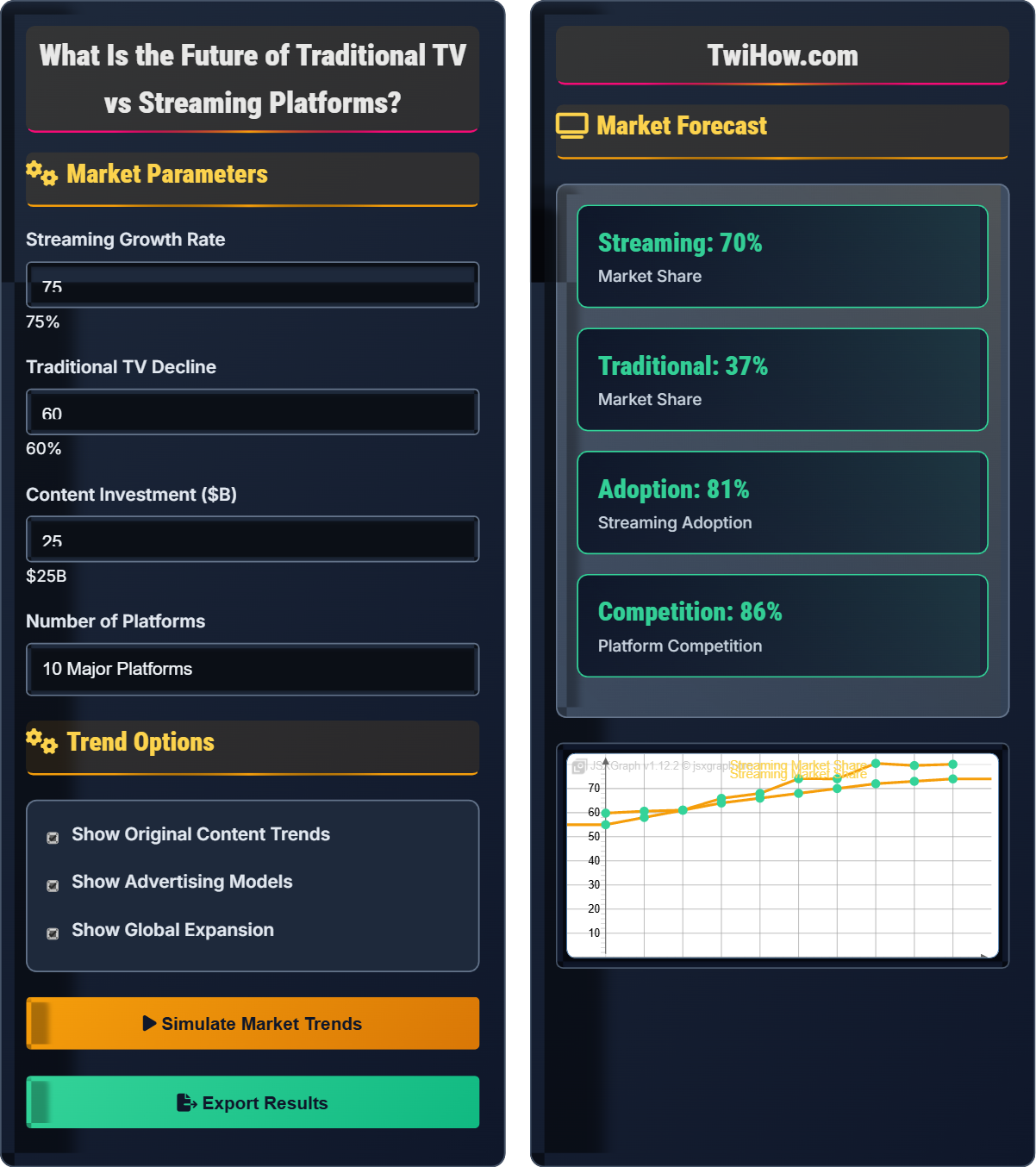
Market Forecast
| Year | Streaming | Traditional | Originals |
|---|---|---|---|
| 2023 | 55% | 45% | $120B |
| 2024 | 60% | 40% | $140B |
| 2025 | 65% | 35% | $160B |
| 2026 | 68% | 32% | $180B |
| 2027 | 72% | 28% | $200B |
Market Share: Streaming platforms gaining ground on traditional TV.
Viewing Behavior: Shift toward on-demand and mobile consumption.
TV Industry Transformation Explained
The television industry is undergoing a fundamental shift from traditional broadcast and cable models to streaming and on-demand services. This transformation is driven by changing consumer preferences, technological innovations, and new business models that prioritize convenience, personalization, and content variety.
Several factors are driving the transformation:
Where:
- Consumer Demand: Preference for on-demand, personalized content
- Technology: Improved internet, smart TVs, mobile devices
- Content: Exclusive and original programming
- Economics: Cost efficiency and revenue optimization
Major players in the streaming wars include:
- Netflix: Pioneer in streaming with global reach
- Disney+: Leverages popular franchises and content library
- Amazon Prime Video: Bundled with retail ecosystem
- HBO Max/Max: Premium content and original programming
- Apple TV+: High-quality originals with premium positioning
- Traditional Players: Comcast, AT&T, ViacomCBS adapting to new models
- Hybrid Models: Combining subscription and ad-supported tiers
- Global Content: International productions gaining prominence
- Interactive Content: Viewer participation and choice-based narratives
- Live Integration: Sports and live events on streaming platforms
- Technology Integration: AI-powered recommendations and personalization
- Bundle Services: Packages combining multiple services
Industry Transformation
Cord-cutting, streaming wars, original content, ad-supported models, market consolidation.
Streaming Share = f(Adoption Rate, Content Quality, Price, Convenience)
Where Share = percentage of total viewership.
- Consumer preferences drive market direction
- Content investment is crucial for success
- Hybrid models offer competitive advantage
Market Strategies
Original content, bundling, international expansion, ad-supported models.
- Content differentiation
- Subscriber acquisition
- Retention optimization
- Revenue diversification
- Market expansion
- Partnership development
- High content costs require scale
- Market saturation is approaching
- Consumer fatigue from multiple subscriptions
TV Industry Learning Quiz
What is "cord-cutting" in the context of television consumption?
Cord-cutting refers to the trend of consumers canceling their traditional cable or satellite TV subscriptions in favor of streaming services and other alternative content delivery methods. The term "cord" refers to the coaxial cable that delivers traditional TV signals.
This trend has been driven by the convenience of streaming, lower costs, and the availability of content on demand. It represents a fundamental shift in how consumers access television content.
The answer is B) Canceling traditional cable/satellite subscriptions.
Students should understand that cord-cutting represents a major behavioral shift in media consumption. The term is metaphorical - no actual cables are cut, but consumers are disconnecting from traditional distribution methods. This trend has significant implications for the entire television industry.
Cord-Cutting: Cancelling traditional TV subscriptions
Streaming: On-demand content delivered over internet
Traditional TV: Scheduled broadcast content
• Cord-cutting is a consumer behavior trend
• Represents shift to digital platforms
• Affects entire industry economics
• Think of "cord" as traditional cable connection
• Cutting = cancelling subscription
• Represents digital transformation
• Taking term literally
• Not understanding the behavioral shift
• Confusing with technical aspects
Explain the "streaming wars" phenomenon and analyze the competitive strategies employed by major platforms.
Streaming Wars Definition: The intense competition among streaming platforms for subscribers and market share, characterized by massive content investments and exclusive programming.
Competitive Strategies:
1. Original Content Investment: Platforms invest billions in exclusive original programming to differentiate themselves and retain subscribers.
2. Library Content Licensing: Securing exclusive rights to popular movies and TV shows.
3. International Expansion: Entering global markets to increase subscriber base.
4. Pricing Strategies: Offering different tiers (basic, premium) and ad-supported options.
5. Technology Integration: Improving user experience with better recommendations and interface.
6. Brand Leverage: Using existing intellectual property (Marvel, Star Wars, etc.).
Market Impact: Increased content quality, higher production budgets, and fragmentation of audiences across multiple platforms.
The streaming wars represent a classic competitive market dynamic where platforms compete for market share through differentiation. Students should understand that this competition drives innovation but also creates challenges for consumers managing multiple subscriptions.
Streaming Wars: Competition among streaming platforms
Original Content: Exclusively created programming
Market Fragmentation: Audiences spread across platforms
• Content is key differentiator
• Market is becoming saturated
• Follow the money - content investments
• Exclusive content = subscriber retention
• Competition drives quality improvements
• Not understanding content as competitive advantage
• Underestimating investment scale
• Ignoring consumer impact
A household currently spends $150/month on traditional cable TV but watches content from multiple genres. They're considering switching to streaming services. Calculate the cost of accessing equivalent content through streaming platforms, and discuss the trade-offs involved in this decision.
Streaming Cost Calculation:
• Netflix Premium: $19.99 (exclusive content)
• Disney+: $10.99 (family entertainment)
• HBO Max: $15.99 (premium content)
• Apple TV+: $6.99 (original content)
• ESPN+: $9.99 (sports)
• Total: ~$63.95/month for equivalent content
Trade-offs:
Advantages of Streaming:
• On-demand viewing
• No long-term contracts
• Better personalization
• No commercials (subscription tier)
Disadvantages of Streaming:
• Multiple subscriptions needed
• Content rotation and removal
• Internet dependency
• Potential for rising costs
The decision involves balancing cost savings with convenience and content availability.
This example illustrates the real-world decision-making process consumers face. Students should understand that while streaming may offer cost savings, it also introduces complexity through multiple subscriptions and content fragmentation. The convenience factor is often as important as cost.
Content Fragmentation: Content spread across multiple platforms
On-Demand: Content available anytime
Subscription Fatigue: Consumer overwhelm from multiple subscriptions
• Multiple subscriptions add up
• Content availability varies
• Convenience vs. cost trade-off
• Bundle services when possible
• Share accounts to reduce costs
• Consider ad-supported tiers
• Underestimating multiple subscription costs
• Not considering content availability
• Ignoring convenience factors
Explain how Netflix's content strategy differs from traditional TV networks and why this approach has been successful. Include analysis of original content investment, global expansion, and technology utilization.
Netflix Content Strategy:
1. Original Content Focus: Invests billions annually in exclusive original programming to differentiate from competitors and retain subscribers.
2. Global First Approach: Creates content with international appeal, expanding to global markets from the beginning.
3. Data-Driven Decisions: Uses viewer data to inform content creation and recommendations.
4. Binge-Worthy Format: Releases entire seasons at once, unlike traditional weekly episodes.
5. Technology Integration: Advanced recommendation algorithms and personalized user experience.
Success Factors:
• Eliminates dependence on licensed content
• Creates unique value proposition
• Enables global scalability
• Improves user retention
Comparison to Traditional Networks: Traditional networks rely on scheduled programming, advertising revenue, and licensed content, while Netflix focuses on subscription revenue, on-demand viewing, and owned content.
Netflix's strategy represents a fundamental shift from traditional broadcast models. Students should understand how technology enables new business models and how data-driven decisions can improve customer satisfaction and retention. This approach has disrupted traditional television economics.
Original Content: Programming created exclusively for platform
Data-Driven: Decisions based on user analytics
Binge-Worthy: Designed for consecutive viewing
• Content ownership provides competitive advantage
• Global approach enables scale
• Data improves user experience
• Own your content to control destiny
• Use data to understand audiences
• Think globally from the start
• Not understanding content as moat
• Underestimating global opportunities
• Ignoring data analytics importance
Which trend is most likely to characterize the future of television?
The most likely future involves hybrid models that combine elements of traditional TV and streaming. This includes:
• Traditional providers offering streaming options
• Streaming platforms adding live content
• Flexible pricing tiers (ad-supported and premium)
• Integration of live sports and news into streaming
• Bundling of multiple services
Neither traditional TV nor streaming will completely dominate; instead, they will converge to meet diverse consumer needs and preferences.
The answer is C) Hybrid models combining traditional and streaming.
Students should understand that technological transitions rarely result in complete replacement of old technologies. Instead, they often coexist and integrate. The future of TV will likely involve the best elements of both traditional and streaming models, adapted to consumer preferences.
Hybrid Model: Combination of different service approaches
Market Convergence: Technologies and services merging
Consumer-Centric: Services adapted to user preferences
• Technology evolution is gradual
• Consumer preferences drive adoption
• Best features often integrated
• Look for integration not replacement
• Consumer needs drive technology
• Best features get preserved
• Thinking in binary terms (either/or)
• Not considering gradual transition
• Ignoring consumer preferences
FAQ
Q: Will cable TV completely disappear?
A: Cable TV is unlikely to disappear completely, but will continue to shrink significantly:
Remaining Markets: Rural areas with limited broadband access may retain traditional TV longer.
Hybrid Services: Many cable companies now offer streaming options alongside traditional packages.
Niche Content: Live sports, news, and local programming may maintain some traditional TV audience.
Business Customers: Hotels, businesses, and institutions may continue using traditional services.
Demographic Differences: Older viewers may be slower to adopt streaming, maintaining some traditional TV base.
The transition will be gradual, with traditional TV becoming a niche service for specific use cases.
Q: How will the streaming wars end?
A: The streaming wars won't "end" but will evolve through several mechanisms:
Market Consolidation: Smaller platforms may merge or be acquired by larger ones.
Content Partnerships: Platforms may license content to each other instead of competing.
Service Bundling: Multiple services offered together to reduce consumer fatigue.
Global Standardization: Regional markets may develop their own dominant platforms.
Technology Convergence: Traditional and streaming services may become indistinguishable.
Profitability Focus: Companies will prioritize sustainable profits over market share.
The competition will shift from subscriber acquisition to retention and profitability.