What is the future of virtual reality and immersive entertainment?
Complete VR entertainment guide • Step-by-step predictions
VR & Immersive Entertainment Future:
Show VR Future PredictorThe future of virtual reality and immersive entertainment promises revolutionary changes in how we experience digital content. Key developments include lighter, more comfortable headsets with higher resolution displays, advanced haptic feedback systems, and seamless integration with augmented reality. The convergence of AI, spatial computing, and cloud streaming will create unprecedented levels of immersion and interactivity.
Emerging trends point toward persistent virtual worlds, social VR experiences, and mixed-reality environments that blend physical and digital spaces. Content delivery will shift toward cloud-based streaming, reducing hardware requirements and expanding accessibility. The industry is moving toward photorealistic rendering, real-time ray tracing, and AI-driven procedural content generation.
Future developments include:
- Lightweight Headsets: Glasses-like devices replacing bulky headsets
- Haptic Feedback: Full-body tactile experiences
- Spatial Computing: Seamless AR/VR integration
- AI Integration: Intelligent virtual companions and environments
- Cloud Streaming: Console-free VR experiences
- Social VR: Persistent virtual communities and spaces
These advancements will transform entertainment from passive consumption to active participation in dynamic, responsive virtual environments.
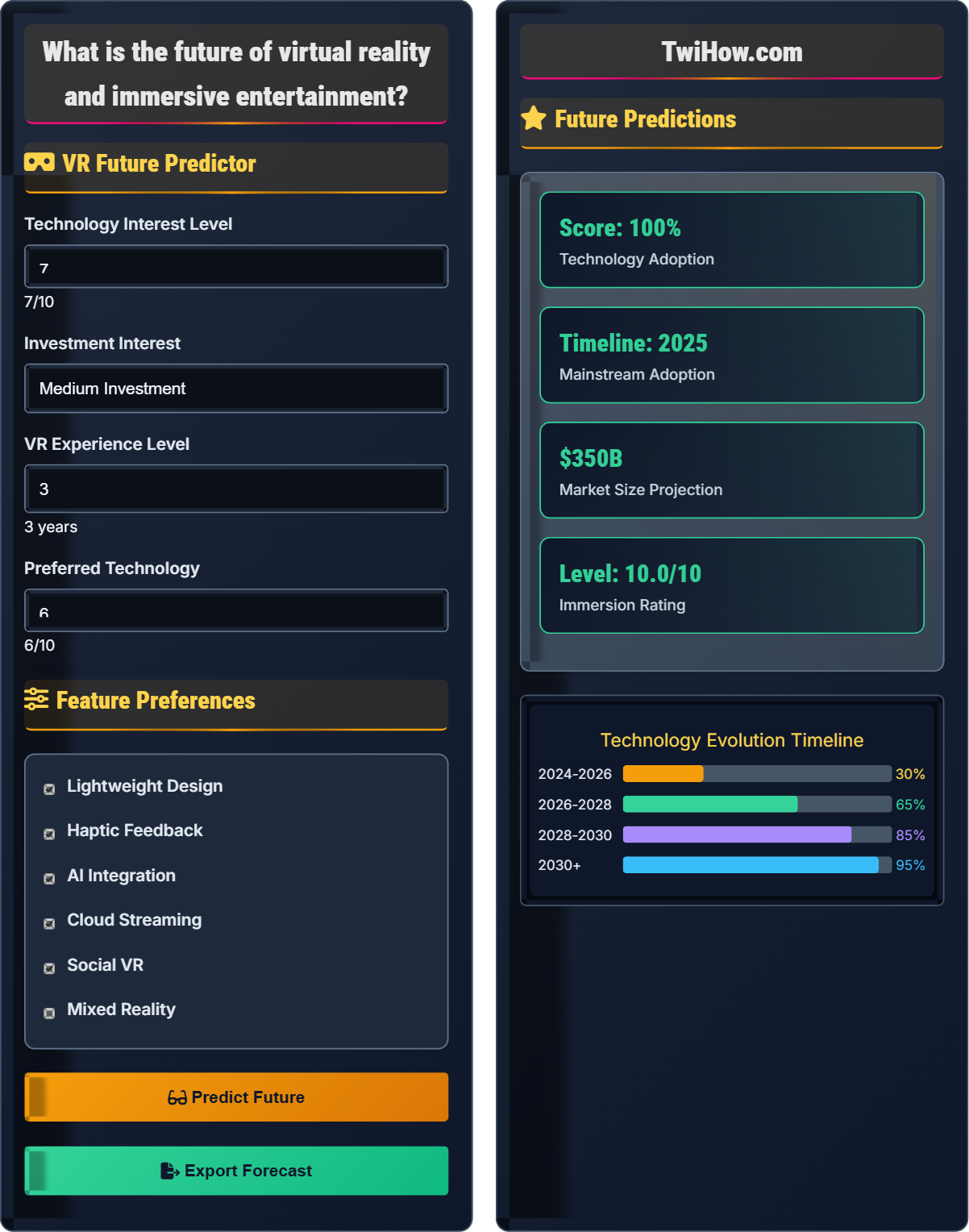
VR Future Predictor
Feature Preferences
Future Predictions
| Technology | Adoption | Timeline | Impact |
|---|---|---|---|
| Lightweight Headsets | High | 2026-2027 | Transformative |
| Haptic Suits | Medium | 2027-2029 | Revolutionary |
| AI Integration | Very High | 2025-2026 | Disruptive |
| Cloud VR | High | 2026-2028 | Game-Changing |
Key Features
Haptic Technology
Full-body tactile feedback creating realistic touch sensations.
AI Integration
Intelligent virtual companions and adaptive environments.
Spatial Computing
Seamless blending of AR and VR environments.
Cloud Streaming
Console-free VR experiences via internet streaming.
VR & Immersive Entertainment Future Explained
The future of virtual reality and immersive entertainment represents a convergence of multiple technological trends that will fundamentally transform how humans interact with digital content. From current bulky headsets to future glasses-like devices, the trajectory points toward seamless integration of virtual and physical realities. The evolution encompasses hardware miniaturization, software sophistication, and the development of new interaction paradigms that make virtual experiences indistinguishable from reality.
Where:
- Technology Maturity: Hardware and software readiness for mass deployment
- User Experience: Comfort, ease of use, and engagement quality
- Cost Effectiveness: Price-to-performance ratio for consumers
- Barriers to Entry: Technical complexity, infrastructure requirements, and adoption costs
The future of immersive entertainment spans multiple technological domains:
- Display Technology: Retinal projection, holographic displays, and light field rendering
- Haptic Systems: Full-body suits, ultrasonic mid-air haptics, and force feedback
- AI & Machine Learning: Adaptive environments, predictive content, and intelligent agents
- Networking: 6G connectivity, edge computing, and ultra-low latency streaming
- Interaction Methods: Brain-computer interfaces, eye tracking, and gesture recognition
- Content Creation: Procedural generation, AI-assisted creation, and real-time rendering
- Persistent Worlds: Virtual environments that continue existing when users disconnect
- Social VR: Mass virtual communities and collaborative experiences
- Enterprise Integration: VR in remote work, training, and collaboration
- Health & Wellness: Therapeutic applications and mental health support
- Educational VR: Immersive learning experiences and virtual classrooms
- Entertainment Evolution: Interactive storytelling and player-driven narratives
VR Fundamentals
Virtual reality, augmented reality, mixed reality, haptic feedback, spatial computing, immersive experiences, presence, six degrees of freedom.
Adoption Rate = (Technology Maturity × User Experience × Cost Effectiveness) / Barriers to Entry
Where Rate = measure of technology adoption speed and scale.
- Comfort and safety are paramount for widespread adoption
- Seamless integration with existing workflows drives adoption
- Price-to-performance ratios determine consumer adoption
Technology Predictions
Hardware evolution, software development, networking infrastructure, content creation, user experience design, market adoption.
- Assess current technology maturity levels
- Identify market demand and adoption barriers
- Project technological advancement trajectories
- Evaluate economic and social factors
- Forecast market adoption timelines
- Mass consumer adoption and mainstream acceptance
- Seamless integration with daily life activities
- Substantial market size and revenue growth
- Positive user experience and engagement metrics
VR Future Learning Quiz
Which technological advancement is most likely to drive mainstream VR adoption in the next 5 years?
Lightweight, glasses-like headsets represent the most significant barrier to VR adoption—current headsets are bulky, heavy, and uncomfortable for extended use. The transition to glasses-like form factors will eliminate the social stigma and physical discomfort associated with VR, making it practical for everyday use. This advancement addresses the primary adoption barrier of comfort and convenience while maintaining functionality. While other technologies are important, glasses-like headsets solve the most fundamental problem limiting mainstream adoption.
The answer is B) Lightweight, glasses-like headsets.
Understanding adoption barriers is crucial for predicting technological evolution. The most transformative changes often address the most fundamental limitations rather than adding new features. In VR's case, the form factor represents the primary adoption obstacle—people are reluctant to wear bulky, noticeable devices for extended periods. The shift to glasses-like devices removes this barrier while maintaining the core functionality, representing a breakthrough that enables mainstream adoption. This illustrates the principle that solving user experience problems often drives more adoption than adding advanced features.
Adoption Barrier: Factor preventing widespread technology acceptance
Form Factor: Physical design and size of a device
Mainstream Adoption: Widespread consumer acceptance and use
• Solve primary adoption barriers before adding features
• Form factor affects social acceptance
• Comfort drives extended use
• Focus on user experience improvements
• Consider social factors in adoption
• Address comfort and convenience first
• Assuming advanced features drive adoption
• Neglecting form factor and comfort
• Focusing on niche applications over mainstream use
Explain how AI integration will transform virtual reality entertainment and what implications this has for user experience.
AI Integration Transformations: AI will create adaptive virtual environments that respond intelligently to user behavior, preferences, and emotional states. Virtual characters will exhibit realistic personalities and engage in natural conversations. Content will be procedurally generated in real-time based on user interactions, creating unique experiences for each session.
User Experience Implications: AI integration will make VR experiences more personalized and engaging, with content adapting to individual preferences and skill levels. The technology will reduce the need for pre-scripted content, enabling infinite replayability and personalized storylines. AI will also optimize performance by predicting user actions and pre-loading relevant content.
Advanced Applications: AI will enable intelligent tutoring systems in educational VR, therapeutic applications in healthcare VR, and dynamic difficulty adjustment in gaming VR. The technology will also support real-time language translation and cultural adaptation for global VR experiences.
AI integration represents a paradigm shift from static, pre-programmed experiences to dynamic, responsive environments that adapt to individual users. This transformation moves VR from a passive consumption medium to an interactive, personalized experience that evolves with each user. The key insight is that AI doesn't just add features—it fundamentally changes the nature of the medium, making it more responsive, intelligent, and capable of delivering truly customized experiences. This evolution parallels the shift from traditional television to streaming platforms with personalized recommendations.
Adaptive Environments: Virtual spaces that change based on user behavior
Procedural Generation: Content created algorithmically in real-time
Personalized Experiences: Content tailored to individual preferences
• AI should enhance, not replace, human creativity
• Personalization must respect user privacy
• Adaptive systems need transparency in operation
• Design for gradual AI integration
• Maintain user control over AI decisions
• Test AI responsiveness thoroughly
• Over-relying on AI at expense of user agency
• Failing to explain AI-driven decisions
• Neglecting privacy considerations in AI systems
You're a technology analyst predicting how VR will disrupt traditional entertainment industries. Analyze the potential impact on gaming, cinema, live events, and theme parks over the next decade. Include specific disruption mechanisms and timeline estimates.
Gaming Disruption (2024-2027): VR will transform gaming from screen-based to fully immersive experiences, with presence-based gameplay replacing traditional mechanics. Cloud-based VR gaming will reduce hardware barriers, while social VR will create persistent virtual worlds that blend gaming with social interaction.
Cinema Impact (2025-2028): VR cinema will offer personalized viewing experiences with interactive narratives. Viewers will be able to choose perspectives, influence storylines, and experience films from characters' viewpoints. Traditional theaters may incorporate VR experiences for premium offerings.
Live Events (2026-2029): VR will democratize access to concerts, sports, and conferences, offering front-row experiences from home. Hybrid events will combine physical and virtual attendance, expanding audience reach while maintaining exclusivity for premium experiences.
Theme Parks (2027-2030): VR will enable unlimited ride variations and impossible attractions, while reducing physical infrastructure costs. Parks will blend physical and virtual elements, creating experiences impossible in real life while maintaining the social aspect of physical venues.
Technology disruption follows predictable patterns where new technologies initially complement existing solutions before eventually replacing them. VR's disruption of entertainment will be gradual but comprehensive, starting with gaming where the technology fits naturally, then expanding to other sectors as the technology matures and costs decrease. The key insight is that VR doesn't just digitize existing experiences—it creates entirely new forms of entertainment that were previously impossible. This represents a fundamental shift in how entertainment is conceived, produced, and consumed.
Technology Disruption: Fundamental change in industry structure by new technology
Presence-Based Gaming: Gameplay focused on immersive presence rather than screen interaction
Hybrid Experiences: Combining physical and virtual elements
• Disruption follows predictable adoption curves
• New technologies initially complement existing ones
• Timeline depends on cost and capability maturation
• Monitor cost trends for adoption barriers
• Consider complementary rather than replacement strategies
• Plan for gradual rather than sudden disruption
• Assuming immediate replacement of existing technologies
• Underestimating adoption timeline requirements
• Neglecting the role of complementary technologies
You're designing the next generation of VR headsets for consumer adoption. How would you balance cutting-edge technology with practical considerations like cost, comfort, and battery life? Include specific trade-offs and optimization strategies.
Design Priorities: Prioritize lightweight design and comfort above maximum specifications, as these are primary adoption barriers. Use advanced materials like carbon fiber composites and titanium frames to reduce weight while maintaining durability. Implement efficient thermal management to prevent overheating during extended use.
Technology Trade-offs: Balance display resolution with processing power and battery life—consider variable resolution rendering that prioritizes quality where the user is looking. Optimize for 6DOF tracking over full haptic feedback initially, as spatial presence is more important than tactile feedback for basic adoption.
Power Management: Implement intelligent power distribution that reduces performance during less demanding activities. Use modular design allowing battery swaps or tethered power for extended sessions. Optimize software to minimize unnecessary processing overhead.
Cost Optimization: Focus on core experience quality rather than feature quantity. Use proven components where possible while innovating in key differentiation areas. Implement scalable hardware that can be upgraded through software updates.
Product design for consumer adoption requires balancing multiple competing requirements where optimizing for one factor often degrades others. The key is identifying which trade-offs have minimal impact on user experience while maximizing the factors that drive adoption. This approach recognizes that perfect optimization is impossible and requires strategic decisions about which compromises to accept. The most successful products solve the most critical user problems while accepting limitations in less important areas.
Trade-off Analysis: Balancing competing design requirements
6DOF Tracking: Six degrees of freedom movement tracking
Variable Resolution: Rendering different quality levels based on gaze direction
• Solve primary adoption barriers first
• Optimize for user experience over specifications
• Accept trade-offs in less critical areas
• Prototype and test with real users frequently
• Focus on 80% of use cases that drive 80% of value
• Design for upgradeability and longevity
• Trying to optimize all parameters simultaneously
• Over-engineering for edge cases
• Neglecting user comfort for technical specifications
What is the most significant potential social impact of widespread VR adoption?
While VR presents potential negative impacts like reduced physical activity, the democratization of experiences represents the most significant positive social impact. VR can provide access to experiences that were previously impossible due to geography, cost, or physical limitations. People with disabilities can experience activities they couldn't otherwise participate in. Remote locations become accessible to anyone. Educational experiences become immersive and available globally. The technology has the potential to level access to experiences and opportunities across different populations and geographic regions.
The answer is B) Democratization of experiences and accessibility.
Technology's most profound impacts often emerge from its ability to eliminate traditional barriers to access and opportunity. VR's potential to democratize experiences extends far beyond entertainment into education, healthcare, travel, and professional opportunities. This represents a fundamental shift from scarcity-based access (limited by physical location, cost, or physical constraints) to abundance-based access (available to anyone with the technology). The democratization effect has the potential to create positive social change by providing equal access to enriching experiences regardless of individual circumstances.
Democratization: Making something accessible to all people regardless of barriers
Accessibility: Removing barriers to participation and access
Experience Equality: Equal access to enriching experiences
• Technology should expand access, not limit it
• Consider both positive and negative impacts
• Design for inclusive experiences
• Design for users with different abilities
• Consider global accessibility requirements
• Think beyond entertainment applications
• Focusing only on negative social impacts
• Neglecting accessibility considerations
• Assuming technology benefits are universally positive
FAQ
Q: When will VR headsets become as lightweight as regular glasses?
A: The transition to glasses-like VR devices is happening in stages:
1. 2024-2025: First-generation smart glasses with limited AR capabilities
2. 2025-2026: Mid-range devices with improved displays and processing
3. 2026-2027: High-end glasses with full VR/AR capabilities
4. 2027-2028: Mainstream adoption as prices drop and technology matures
The main challenges are battery life, heat dissipation, and display technology. Current prototypes from major companies show promise, but achieving the same optical quality as bulky headsets in a thin frame requires breakthroughs in micro-displays and efficient processors.
Q: Will VR replace traditional TVs and movie theaters?
A: VR will likely complement rather than completely replace traditional entertainment:
TV Replacement: VR will handle personalized, immersive content while traditional screens remain for shared viewing experiences and casual consumption.
Theater Experience: Movie theaters will evolve to offer hybrid experiences—combining traditional screenings with VR previews, interactive elements, and social VR experiences for remote attendees.
Coexistence Model: Different entertainment formats will serve different needs. VR excels at immersive, personalized experiences, while traditional media remains optimal for shared, passive consumption. The future likely involves multiple entertainment modalities serving different use cases rather than a complete replacement.
Q: Is VR safe for children and how will it affect their development?
A: VR safety for children involves several considerations:
Physical Safety: Most manufacturers recommend VR for ages 13+ due to eye development concerns. Prolonged use can cause eye strain and disorientation in developing visual systems.
Psychological Impact: VR's intensity can be overwhelming for children, potentially causing anxiety or difficulty distinguishing reality from virtual experiences.
Developmental Concerns: Excessive VR use may impact social development, physical activity, and real-world skill acquisition.
Future Safeguards: Next-generation VR systems will likely include age-appropriate content filters, time limits, and safety protocols specifically designed for developing minds and bodies.