What Is the Impact of Algorithms on What Content I See?
Complete algorithm guide • Step-by-step explanations
Algorithm Impact Overview:
Show Algorithm SimulatorAlgorithms profoundly shape our digital experiences by analyzing our behavior and preferences to curate personalized content. From social media feeds to streaming recommendations, these systems determine what we see, when we see it, and how often.
Key impacts include:
- Personalization: Content tailored to individual preferences
- Filter Bubbles: Isolation in familiar content ecosystems
- Engagement Optimization: Content designed to maximize time spent
- Discoverability: Influence on content visibility and reach
Understanding algorithmic influence helps users navigate digital platforms more consciously and make informed decisions about their content consumption.
Algorithm Parameters
Impact Options
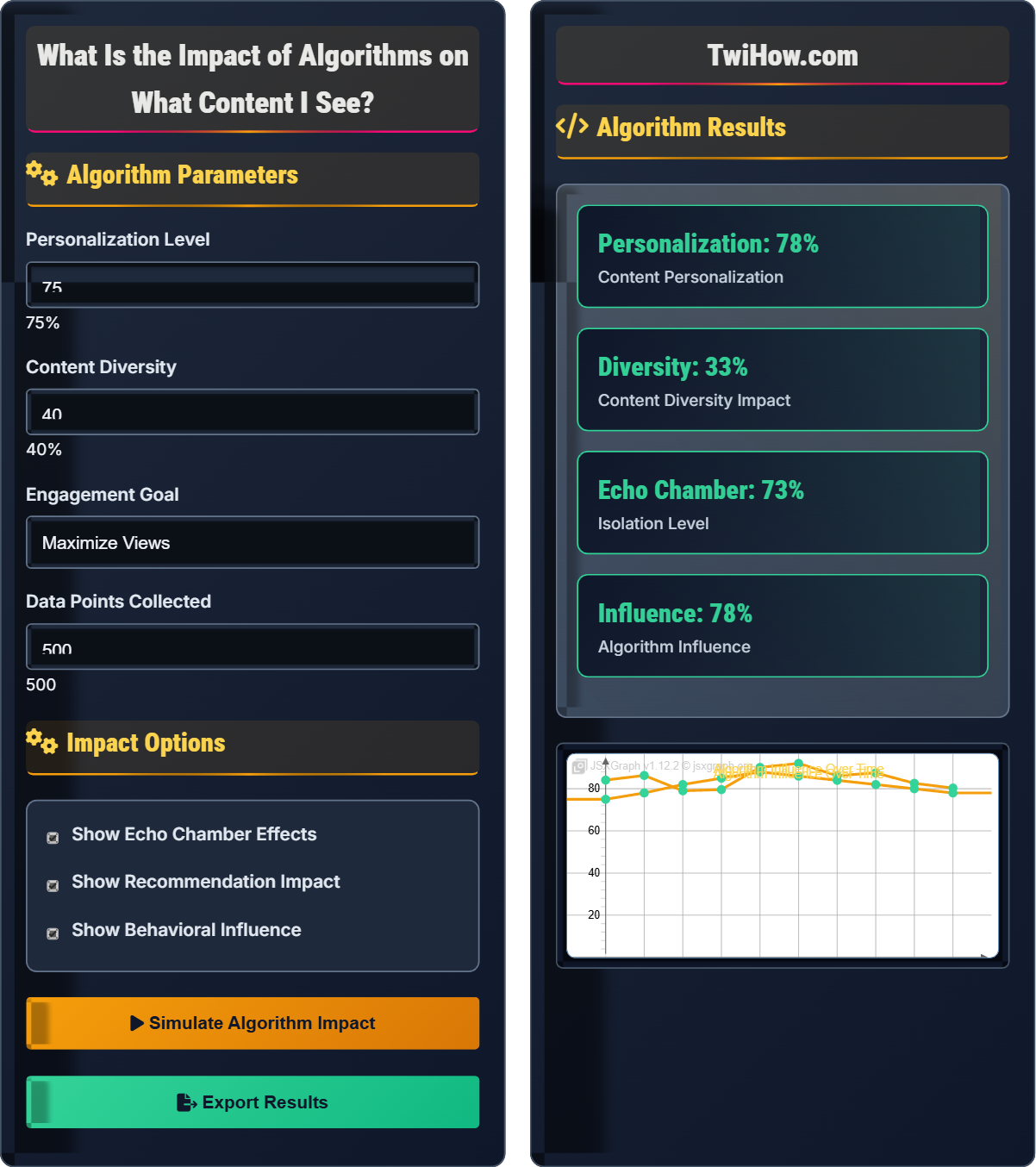
Algorithm Results
| Factor | Impact | Score | Effect |
|---|---|---|---|
| Personalization | High | 85% | Positive |
| Diversity | Low | 30% | Negative |
| Engagement | High | 90% | Neutral |
| Discovery | Medium | 50% | Positive |
| Isolation | High | 70% | Negative |
Recommendation Flow: Algorithms analyze behavior to suggest similar content.
Echo Chamber: Similar content reinforces existing preferences.
Content Algorithm Impact Explained
Content algorithms are computational systems that analyze user behavior, preferences, and content characteristics to curate and personalize digital experiences. These systems process vast amounts of data to predict what content users are most likely to engage with, shaping everything from social media feeds to streaming recommendations.
Content algorithms operate through several interconnected components:
Where:
- User Data: Behavior patterns, preferences, demographics
- Content Metadata: Tags, categories, descriptions, popularity
- Contextual Factors: Time, device, location, social signals
- Engagement Metrics: Clicks, likes, shares, watch time, completion rates
Content algorithms significantly impact multiple aspects of digital experiences:
- Content Discovery: Determines what new content users encounter
- Information Exposure: Shapes access to news and information
- Behavioral Influence: Encourages specific viewing or interaction patterns
- Social Dynamics: Affects how content spreads through networks
- Creator Economics: Influences which content creators succeed
- Psychological Effects: Can reinforce existing beliefs and preferences
- Positive: Personalized experiences, content discovery, time saving
- Negative: Echo chambers, filter bubbles, addiction-like behaviors
- Neutral: Engagement optimization, platform economics
- Concerning: Manipulation, privacy implications, polarization
- Beneficial: Relevant content, reduced decision fatigue
- Risky: Confirmation bias reinforcement, limited perspectives
Algorithm Impact
Personalization, echo chambers, filter bubbles, recommendation systems, engagement optimization.
Impact = (Personalization × Engagement) + (Diversity × Exploration) - (Isolation × Confirmation Bias)
Where Impact = overall algorithmic influence on content consumption.
- Algorithms learn from user behavior
- Personalization can reduce diversity
- Feedback loops amplify existing patterns
Algorithm Process
Data collection, feature extraction, similarity matching, ranking, delivery, feedback.
- Collect user interaction data
- Extract relevant features
- Calculate content similarities
- Rank content by relevance
- Deliver personalized feed
- Update models based on new data
- Continuous learning and adaptation
- Real-time processing requirements
- Privacy and data protection concerns
Algorithm Learning Quiz
How do content algorithms primarily determine what content to show users?
Content algorithms primarily determine what to show users based on their behavior patterns and preferences. The algorithms analyze data such as viewing history, time spent, clicks, likes, shares, and other engagement metrics to predict what content a user is most likely to interact with.
They also consider content characteristics, social signals, and contextual factors to make recommendations. This creates personalized experiences but can also lead to echo chambers and filter bubbles.
The answer is B) Based on user behavior patterns and preferences.
Students should understand that algorithms use data-driven approaches to personalize experiences. The key insight is that algorithms analyze user behavior to predict future preferences, creating feedback loops that can reinforce existing patterns. This explains why similar content appears together in feeds.
Content Algorithm: System that curates personalized content
Behavior Pattern: Recognizable sequence of user actions
Engagement Metric: Measure of user interaction with content
• Algorithms learn from user behavior
• Personalization is based on data analysis
• Feedback loops reinforce patterns
• Your actions train the algorithm
• Engagement data is most important
• Similar content reinforces patterns
• Thinking algorithms are random
• Not understanding behavior tracking
• Underestimating data collection scope
Explain what echo chambers are, how algorithms contribute to them, and what effects they have on users and society.
Echo Chambers: Situations where users are exposed primarily to information and opinions that reinforce their existing beliefs and preferences.
Algorithm Contribution:
• Similarity Matching: Algorithms show content similar to what users have engaged with
• Engagement Optimization: Prioritize content that generates strong reactions
• Feedback Loops: Reinforce patterns through continuous reinforcement
• Filter Bubbles: Isolate users from diverse perspectives
Effects on Users:
• Confirmation bias reinforcement
• Reduced exposure to opposing viewpoints
• Potential for radicalization
• Decreased critical thinking
Effects on Society:
• Increased polarization
• Fragmented information landscape
• Reduced common ground
• Political and social divisions
Algorithms contribute to echo chambers by continuously reinforcing existing preferences and limiting exposure to diverse content.
Echo chambers represent a significant consequence of algorithmic personalization. Students should understand that algorithms don't intentionally create polarization, but the optimization for engagement can inadvertently reinforce existing beliefs. This creates a feedback loop where users see more of what they already like, confirming their preferences.
Echo Chamber: Information environment with minimal diverse viewpoints
Confirmation Bias: Tendency to seek confirming evidence
Filter Bubble: Personalized information universe
• Algorithms optimize for engagement
• Similar content reinforces preferences
• Diversity reduces polarization
• Actively seek diverse content
• Challenge algorithm suggestions
• Follow diverse sources
• Not recognizing algorithm influence
• Assuming all content is neutral
• Not seeking diverse perspectives
A user watches several action movies on a streaming platform. Explain how the algorithm will likely respond and what the long-term effects might be on the user's content exposure. Include the feedback loop mechanism.
Algorithm Response:
• Pattern Recognition: Algorithm identifies preference for action genre
• Similarity Matching: Finds other action movies with similar characteristics
• Recommendation Generation: Prioritizes action content in suggestions
• Engagement Optimization: Shows content expected to maintain high engagement
Feedback Loop:
1. User watches action movies → Algorithm identifies pattern
2. Algorithm shows more action content → User engages more
3. User engagement confirms algorithm's assumptions → Algorithm reinforces pattern
4. Cycle continues, strengthening action movie preferences
Long-term Effects:
• Reduced exposure to other genres
• Difficulty discovering new content types
• Potential genre fatigue
• Confirmation of existing preferences
• Possible content addiction to familiar types
This demonstrates how algorithms can limit content diversity through positive feedback loops.
This example illustrates the self-reinforcing nature of algorithmic recommendations. Students should understand that algorithms are designed to maximize engagement, which can lead to increasingly narrow content exposure. The feedback loop mechanism is crucial to understanding how algorithms shape long-term content consumption.
Feedback Loop: Self-reinforcing algorithmic pattern
Genre Preference: User tendency toward specific content types
Content Diversity: Range of different content types
• Algorithms optimize for engagement
• Feedback loops strengthen patterns
• Diversity requires intentional effort
• Deliberately explore new genres
• Rate diverse content positively
• Use different profiles for variety
• Not understanding feedback mechanisms
• Assuming algorithm is neutral
• Not recognizing pattern reinforcement
Explain what data content algorithms collect about users and how this information is used to personalize experiences. Discuss privacy implications and user control options.
Data Collected:
Explicit Data:
• Ratings, likes, shares, comments
• Search queries and keywords
• Watch time and completion rates
• Skip behavior and rewind patterns
Implicit Data:
• Page dwell time and scrolling patterns
• Device information and settings
• Location and time of access
• Social connections and interactions
• Third-party data integration
Usage for Personalization:
• Content similarity calculations
• User clustering and segmentation
• Preference modeling and prediction
• Contextual relevance scoring
Privacy Implications:
• Detailed behavioral profiling
• Potential for manipulation
• Data breach risks
• Third-party data sharing
User Control Options:
• Privacy settings adjustment
• Data deletion requests
• Opt-out mechanisms
• Incognito browsing
• Account activity management
Users should understand what data is collected and exercise available controls.
This example shows the extensive data collection that enables algorithmic personalization. Students should understand that algorithms require substantial data to function effectively, raising important privacy considerations. The trade-off between personalization and privacy is a key consideration in digital platform use.
Explicit Data: Directly provided user information
Implicit Data: Inferred from user behavior
Behavioral Profiling: Creating user preference models
• More data = better personalization
• Privacy controls exist but vary
• Data collection is extensive
• Review privacy settings regularly
• Understand data collection practices
• Use privacy controls proactively
• Not understanding data collection scope
• Not reviewing privacy settings
• Assuming platforms don't track extensively
Which of the following is the most effective way to break out of algorithmic filter bubbles?
Actively engaging with diverse content and sources is the most effective way to break out of algorithmic filter bubbles. This approach works because:
• Algorithms learn from user behavior and preferences
• Engaging with diverse content signals different interests
• The algorithm will begin to recommend more varied content
• This creates a new feedback loop with broader content exposure
Effective Strategies:
• Like, share, and comment on diverse content
• Follow sources with different perspectives
• Search for topics outside comfort zone
• Rate diverse content positively
• Explore recommended content occasionally
Simply using incognito mode doesn't address the core algorithmic mechanisms, and complete avoidance isn't practical for most users.
The answer is B) Actively engage with diverse content and sources.
Students should understand that algorithms respond to user behavior, so changing behavior can influence algorithmic output. This is a practical approach that allows users to maintain platform benefits while reducing filter bubble effects. The key is intentional diversification of engagement patterns.
Filter Bubble: Personalized information environment
Algorithmic Feedback: System response to user behavior
Content Diversification: Exposure to varied content types
• Algorithms respond to user behavior
• Diverse engagement changes recommendations
• Intentional diversification is effective
• Follow diverse sources actively
• Engage with varied content
• Search for different topics
• Thinking algorithms are unchangeable
• Not understanding behavior influence
• Assuming incognito mode fixes everything
FAQ
Q: Can I completely turn off algorithms on social media platforms?
A: You cannot completely turn off algorithms, but you can significantly reduce their influence:
Available Options:
• Chronological feed settings (where available)
• Privacy settings to limit data collection
• Following accounts manually without suggestions
• Using search instead of feed discovery
Platform Variations:
• Twitter: Offers chronological timeline option
• Instagram: Limited chronological options
• YouTube: Algorithm can be partially bypassed
• Reddit: Subreddit-based chronological feeds
Reality Check: Some level of algorithmic curation exists in almost all digital platforms. The goal is managing rather than eliminating algorithmic influence.
Q: Do algorithms really manipulate what I think and believe?
A: Algorithms influence information exposure, which can affect beliefs, but the relationship is complex:
Confirmed Effects:
• Exposure to similar content reinforces existing preferences
• Limited diversity can reduce perspective-taking
• Emotional content gets prioritized (can increase anxiety/stress)
• Confirmation bias is amplified
Important Limitations:
• Individual agency still exists in interpretation
• Pre-existing beliefs influence algorithm training
• Algorithms respond to user behavior more than shape it
• Critical thinking can counter algorithmic influence
Research Findings: Studies show algorithmic influence on voting behavior, news consumption, and purchasing decisions, but individual differences in susceptibility vary significantly.