What is the impact of content fragmentation across platforms?
Complete streaming fragmentation guide • Step-by-step analysis
Streaming Content Fragmentation:
Show Fragmentation AnalyzerContent fragmentation across platforms occurs when entertainment content is distributed across multiple streaming services, forcing consumers to subscribe to multiple platforms to access desired content. This phenomenon has intensified since the rise of streaming wars, where traditional studios and new players created exclusive content libraries.
The impact of fragmentation extends beyond inconvenience to affect viewing behavior, subscription patterns, and content consumption. Consumers now manage multiple subscriptions, navigate complex content libraries, and often miss content due to platform exclusivity. The industry has shifted from bundling content to unbundling it across specialized platforms.
Key impacts include:
- Subscription Fatigue: Multiple monthly fees straining budgets
- Content Discovery: Difficulty finding desired content across platforms
- Consumer Behavior: Changing viewing patterns and expectations
- Industry Economics: Altered revenue models and competition dynamics
- Content Creation: Shift toward platform-specific original content
- Viewer Experience: Increased friction in accessing entertainment
Understanding these impacts helps consumers navigate the fragmented landscape and informs industry strategies for sustainable growth.
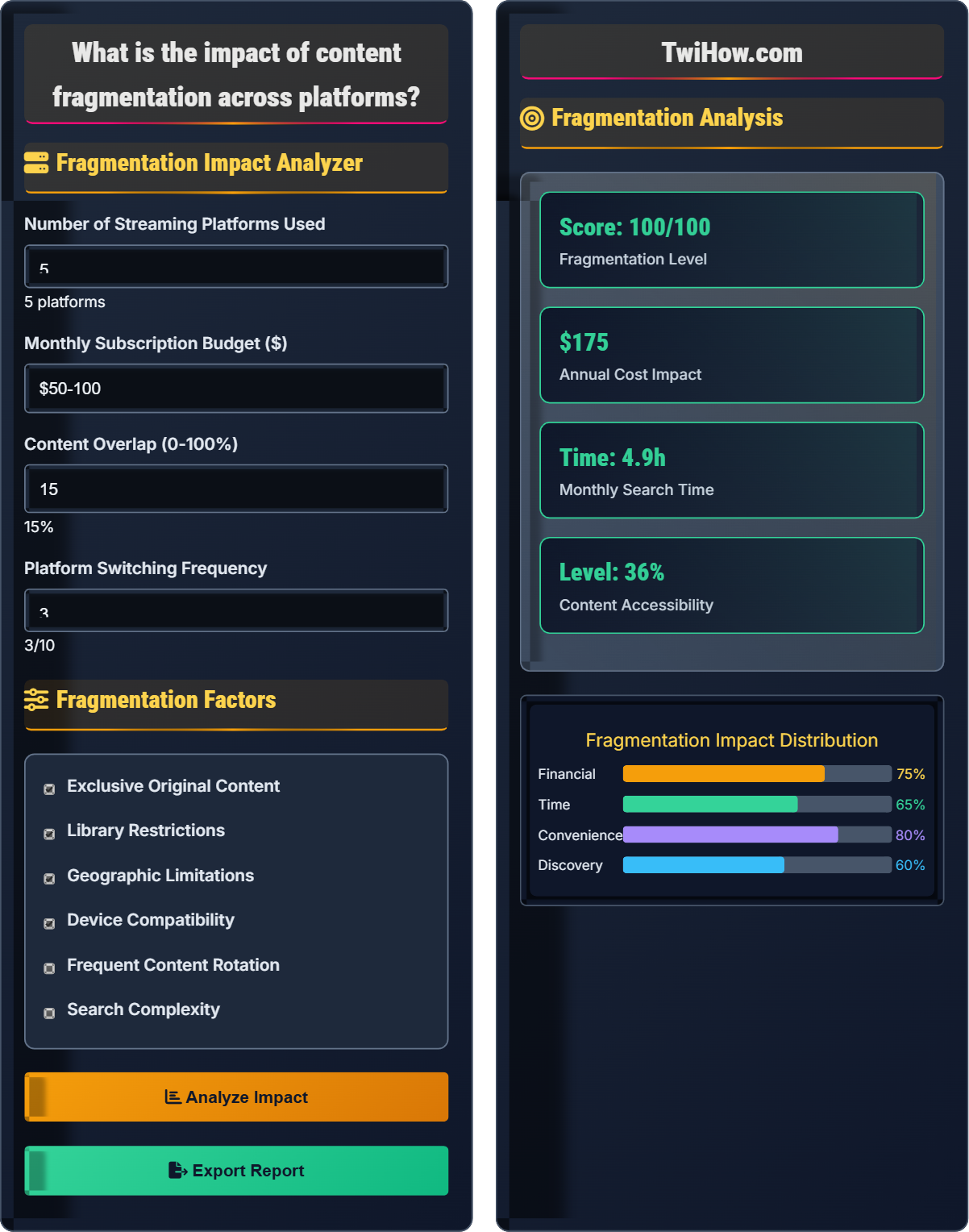
Fragmentation Impact Analyzer
Fragmentation Factors
Fragmentation Analysis
| Impact Area | Severity | Frequency | Mitigation |
|---|---|---|---|
| Subscription Costs | High | Daily | Bundle Management |
| Content Discovery | Medium | Weekly | Tracking Services |
| Platform Switching | Medium | Daily | Smart Devices |
| Content Availability | High | Monthly | Calendar Planning |
Mitigation Strategies
Financial
Rotate subscriptions, shared accounts, and tiered plans.
Time Management
Plan viewing schedules and use content tracking tools.
Discovery Tools
JustWatch, Reelgood, and streaming aggregators.
Convenience
Unified remotes and smart TV integrations.
Content Fragmentation Across Platforms Explained
Content fragmentation refers to the distribution of entertainment content across multiple streaming platforms rather than centralized access. This occurs when content owners (studios, networks, creators) distribute their content exclusively or preferentially across different platforms, creating a scattered landscape where consumers must access multiple services to find desired content. The phenomenon emerged as streaming services competed for exclusive content and market share.
Where:
- Platform Count: Number of platforms required for desired content
- Content Dispersion: How widely content is spread across platforms
- Access Friction: Difficulty in accessing content across platforms
- Consumer Value: Value received per platform subscribed
- Convenience Factor: Ease of accessing and managing content
Content fragmentation affects multiple dimensions of the entertainment experience:
- Financial Impact: Multiple subscription costs, hidden fees, and payment complexity
- Time Investment: Searching across platforms, account management, and content discovery
- Convenience: Device switching, login management, and interface inconsistencies
- Content Access: Geographic restrictions, content rotation, and exclusive availability
- Discovery Experience: Inability to search across platforms, missed content, and fragmented recommendations
- Consumer Behavior: Subscription fatigue, decision paralysis, and changed viewing patterns
- Platform Consolidation: Mergers and acquisitions to reduce fragmentation
- Content Licensing: Cross-platform licensing agreements
- Aggregation Services: Third-party tools for content discovery
- Flexible Subscriptions: Tiered pricing and rotating content libraries
- International Expansion: Global content availability to reduce regional fragmentation
- API Integration: Cross-platform search and management tools
Fragmentation Fundamentals
Content fragmentation, streaming wars, subscription fatigue, content exclusivity, platform distribution, consumer value, access friction.
Fragmentation Impact = (Platform Count × Content Dispersion × Access Friction) / (Consumer Value × Convenience Factor)
Where Impact = measure of fragmentation burden on consumers.
- Fragmentation increases exponentially with platform count
- Exclusive content drives platform-specific subscriptions
- Consumer value decreases with access friction
Impact Analysis
Financial impact, time investment, convenience factors, content accessibility, discovery challenges, behavioral changes.
- Quantify current platform usage
- Calculate total subscription costs
- Measure time spent on platform management
- Assess content availability gaps
- Evaluate convenience factors
- High monthly subscription costs
- Significant time spent searching content
- Difficulty accessing desired content
- Stress from account management
Fragmentation Learning Quiz
What is the primary financial impact of content fragmentation across streaming platforms?
The primary financial impact of content fragmentation is increased subscription costs. As content is distributed across multiple platforms, consumers must subscribe to multiple services to access desired content. This creates a "subscription cascade" effect where the total monthly cost increases significantly. While individual platform costs may seem reasonable, the cumulative effect of multiple subscriptions creates substantial financial burden. The average consumer now pays for 3-5 streaming services, multiplying costs beyond what would be affordable for a single comprehensive platform.
The answer is B) Increased subscription costs.
Understanding the financial impact requires recognizing the cumulative effect of multiple subscriptions. Each platform adds its own monthly fee, and the total cost grows linearly with the number of platforms needed. This creates a scenario where consumers pay significantly more for less comprehensive content than they would for traditional cable bundles. The economic principle at work is the shift from bundled pricing (paying for comprehensive access) to à la carte pricing (paying for specific content), which can be more expensive overall.
Subscription Cascade: Accumulation of multiple subscription costs
À La Carte Pricing: Paying for individual content rather than bundles
Bundle vs. Unbundle: Comprehensive vs. selective content access
• Total costs increase with platform count
• Individual platform costs multiply across subscriptions
• Bundled pricing often costs less than multiple à la carte options
• Track total monthly subscription costs
• Rotate subscriptions seasonally
• Share accounts to reduce per-person costs
• Underestimating cumulative subscription costs
• Focusing only on individual platform prices
• Not considering opportunity costs of paying for unused platforms
Explain how content fragmentation affects time investment in entertainment consumption and what strategies can mitigate this impact.
Time Investment Impact: Fragmentation significantly increases time spent on entertainment-related activities beyond actual viewing. This includes time spent searching for content across platforms, logging in to different services, switching between devices and interfaces, managing multiple accounts, and dealing with content availability issues.
Quantified Impact: Average consumers spend 15-30 minutes per viewing session just on platform navigation and content discovery. With multiple platforms, this accumulates to 10-20 hours monthly on non-viewing activities.
Mitigation Strategies: Use content aggregation services like JustWatch or Reelgood, create standardized viewing schedules, utilize platform-specific features like "My List" across services, maintain a content tracking spreadsheet, and coordinate viewing times to minimize platform switching during shared viewing.
The time investment impact of fragmentation represents "opportunity cost" - time spent on administrative tasks that could be used for actual entertainment. This creates a paradox where more content options lead to less actual viewing time. The cognitive load of managing multiple platforms also creates mental fatigue that reduces overall entertainment satisfaction. Effective time management in a fragmented environment requires systematic approaches that consolidate and streamline the discovery and access process.
Opportunity Cost: Value of time spent on non-primary activities
Cognitive Load: Mental effort required for platform management
Administrative Tasks: Non-viewing activities required for content access
• Time investment increases with platform count
• Administrative tasks reduce actual viewing time
• Systematic approaches reduce cognitive load
• Use third-party content tracking tools
• Create standardized viewing routines
• Batch platform management tasks
• Not accounting for non-viewing time investment
• Failing to implement systematic approaches
• Ignoring the cumulative effect of small time losses
You're a consumer researcher studying how content fragmentation affects viewing behavior. A household has subscriptions to Netflix, Disney+, HBO Max, Hulu, Apple TV+, and Amazon Prime Video. They want to watch a specific show that aired on HBO but is now available on multiple platforms. How would you analyze their decision-making process and predict their behavior in this fragmented environment?
Decision-Making Process: The household must first identify all platforms where the show is available, then evaluate which of their existing subscriptions include it, and finally decide whether to use an existing platform or acquire a new subscription.
Behavioral Factors: Past subscription patterns, budget constraints, platform loyalty, content urgency, and willingness to wait for content rotation. The household may choose to use an existing platform even if it's not their preferred interface, or they may cancel and restart subscriptions to access the content.
Predicted Behaviors: If the show is on an existing platform, they'll likely use it. If it requires a new subscription, they may delay viewing, search for alternatives, or temporarily subscribe and cancel. The decision complexity often leads to viewing abandonment or substitution with readily available content.
Fragmentation creates decision complexity that affects consumer behavior through "choice overload." When faced with multiple options and complex access requirements, consumers often resort to satisficing (choosing an adequate rather than optimal option) or avoidance (not watching content at all). This demonstrates how structural factors (platform distribution) influence behavioral outcomes (viewing decisions). The research shows that more options don't necessarily lead to better outcomes when the decision process becomes too complex.
Choice Overload: Decreased decision quality with too many options
Satisficing: Accepting adequate rather than optimal choices
Decision Complexity: Difficulty in evaluating multiple options
• More options don't guarantee better outcomes
• Complexity leads to decision avoidance
• Behavioral patterns change with fragmentation
• Track viewing abandonment rates
• Monitor subscription churn patterns
• Measure decision complexity tolerance
• Assuming more options always improve satisfaction
• Not accounting for decision-making complexity
• Overlooking behavioral changes from fragmentation
You're a streaming platform executive analyzing how content fragmentation affects your business model. Your platform competes with others for exclusive content, but fragmentation is increasing consumer costs and reducing satisfaction. How would you balance the benefits of exclusivity with the risks of contributing to fragmentation?
Strategic Balance: Develop a portfolio strategy with core exclusive content that differentiates your platform, while licensing popular content from other platforms for cross-access. Focus on creating content that is genuinely unique to your platform rather than simply exclusive.
Revenue Optimization: Offer tiered pricing that allows access to premium exclusive content while providing more affordable options for general content. Consider revenue-sharing agreements with other platforms to reduce consumer costs while maintaining exclusive value.
Consumer Retention: Emphasize platform-specific features, user experience, and community aspects rather than just content exclusivity. Invest in superior recommendation algorithms, interface design, and customer service to create value beyond content availability.
Industry Collaboration: Explore content sharing agreements, cross-platform access features, and industry standards that reduce fragmentation while maintaining competitive differentiation.
The business challenge of fragmentation represents a classic tension between competitive advantage and market sustainability. Exclusive content provides differentiation and retention value, but contributes to market-wide problems that reduce overall consumer satisfaction. Successful platforms must find ways to maintain competitive advantage without contributing to market dysfunction. This requires strategic thinking that considers both direct benefits and systemic effects of business decisions.
Portfolio Strategy: Balanced approach to content acquisition and creation
Cross-Platform Access: Content available across multiple services
Revenue-Sharing Agreements: Profit distribution between platforms
• Competitive advantage shouldn't harm market sustainability
• Differentiation requires genuine value addition
• Industry collaboration can benefit all players
• Focus on unique platform value beyond content
• Explore collaborative business models
• Monitor market-wide consumer satisfaction
• Prioritizing short-term competitive gains over long-term sustainability
• Assuming exclusive content automatically provides value
• Ignoring systemic effects of business decisions
Which consumer response to content fragmentation is most economically efficient?
Rotating subscriptions based on content needs is the most economically efficient response to fragmentation. This strategy allows consumers to access desired content while minimizing ongoing costs. By subscribing only when specific content is available and canceling when not needed, consumers can access premium content at a fraction of the cost of maintaining multiple permanent subscriptions. This approach requires more active management but optimizes the cost-to-value ratio while maintaining access to desired content.
The answer is B) Rotating subscriptions based on content needs.
The economically efficient response to fragmentation requires active management and strategic thinking. The rotation strategy exemplifies how consumers can adapt to structural market changes through behavioral adjustments. This approach recognizes that content has temporal value (most valuable when new) and that permanent subscriptions may pay for content that loses relevance over time. The strategy requires more effort but optimizes resource allocation, demonstrating how individual consumers can respond strategically to market inefficiencies.
Economic Efficiency: Optimal allocation of resources for maximum value
Temporal Value: Value that changes over time
Resource Allocation: Distribution of limited resources for maximum benefit
• Active management can optimize passive costs
• Temporal value affects subscription strategies
• Strategic responses can counteract market inefficiencies
• Use subscription tracking tools
• Plan viewing calendars around content releases
• Automate cancellation reminders
• Assuming permanent subscriptions are always most convenient
• Not considering the temporal value of content
• Failing to track subscription costs and usage
FAQ
Q: How much money am I really spending on streaming services?
A: The average consumer spends $60-80 monthly on streaming services, with heavy users spending $100-150. To calculate your actual spending:
1. List all subscriptions: Include Netflix, Disney+, HBO Max, Hulu, Amazon Prime, Apple TV+, etc.
2. Add family/shared costs: Account for your portion of shared accounts
3. Include add-ons: Premium channels, ad-free versions, extra screens
4. Calculate annual totals: Multiply monthly costs by 12
Many consumers underestimate their streaming spending because they think of monthly costs as small, but they add up significantly over time. Consider tracking your usage alongside costs to ensure value alignment.
Q: How do I manage streaming for kids when content is everywhere?
A: Managing kids' streaming across platforms requires organization:
Centralized Lists: Create a master list of kid-friendly content across all platforms
Parental Controls: Use built-in parental controls on each platform to restrict content
Viewing Schedules: Plan which platform to use for specific times to reduce switching
Platform Rotation: Focus on one platform per week to simplify management
Content Tracking: Use apps like Common Sense Media to identify kid-safe content across platforms
The key is creating predictable routines that reduce the complexity of platform management while ensuring safe, appropriate content access.
Q: Will streaming platforms ever consolidate again?
A: Consolidation is already occurring in some forms:
Mergers & Acquisitions: Disney acquired 21st Century Fox, Comcast owns NBCUniversal, AT&T merged WarnerMedia
Cross-Platform Licensing: Content sharing agreements between competitors
Bundle Partnerships: Platforms offering packages or discounted combinations
API Integration: Cross-platform search and management tools
However, complete consolidation back to single platforms is unlikely due to competitive pressures and the value of exclusive content. The industry is more likely to evolve toward interoperable ecosystems rather than unified platforms, allowing content discovery across services while maintaining brand differentiation.