Role of Fan Communities in Shaping Content and Franchises
Complete influence guide • Step-by-step explanations
Fan Community Influence:
Show Influence SimulatorFan communities play a crucial role in shaping entertainment content and franchises through feedback, demand, and collective voice. Modern streaming platforms and social media have amplified fan influence, creating a dynamic relationship between creators and audiences that impacts storylines, character development, casting choices, and even franchise continuation.
Key influence areas include:
- Content Creation: Fan feedback driving plot decisions and character arcs
- Franchise Decisions: Campaigns saving cancelled shows or demanding sequels
- Character Development: Representation demands and character preferences
- Platform Strategies: Streaming service decisions based on fan engagement
- Marketing Direction: Promotional focus based on popular elements
Understanding this influence helps creators and fans navigate the evolving entertainment landscape.
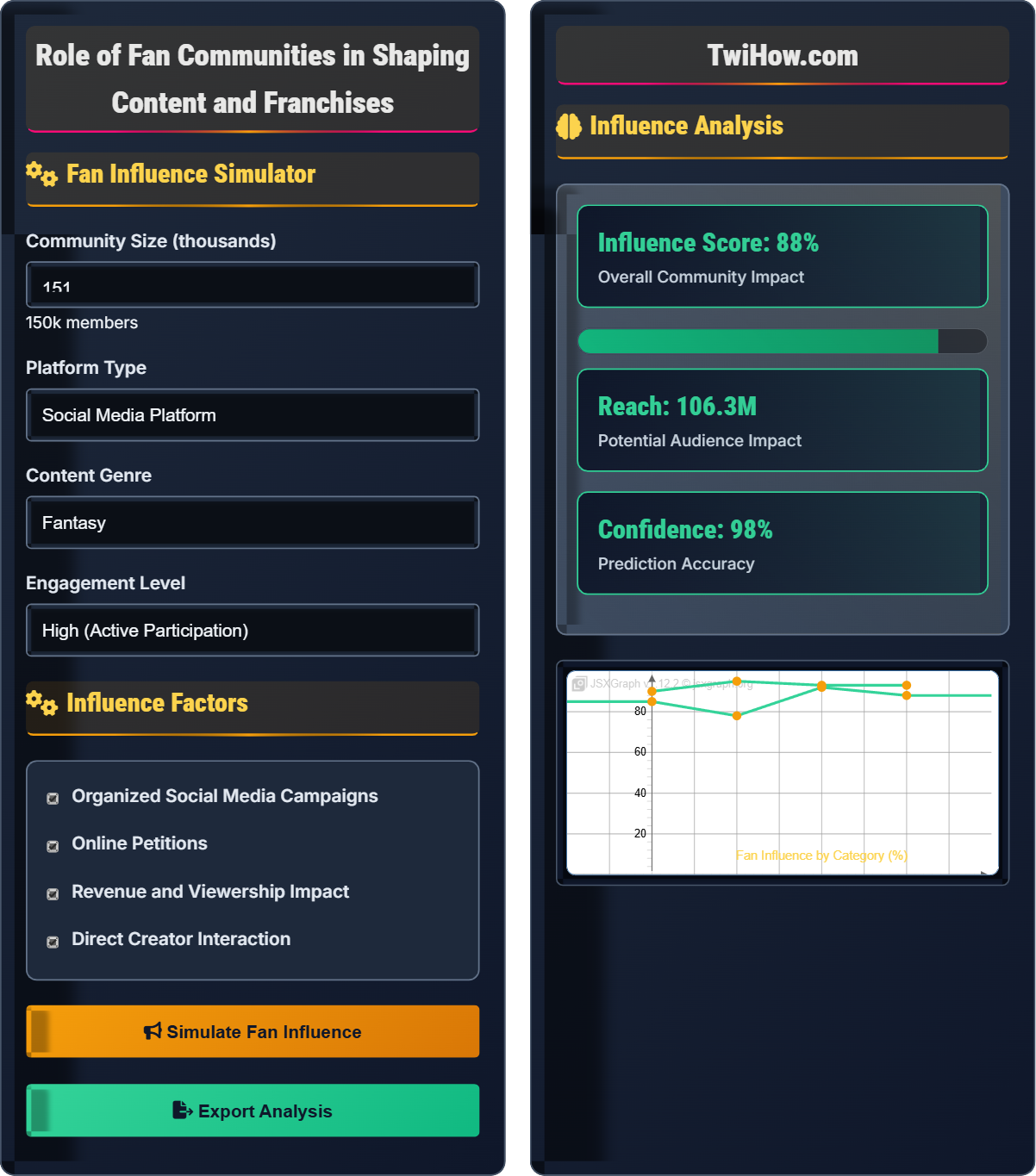
Fan Influence Simulator
Influence Factors
Influence Analysis
| Influence Area | Score | Impact | Strategy |
|---|---|---|---|
| Content Changes | 85% | High | Social campaigns |
| Character Arcs | 78% | High | Direct feedback |
| Franchise Continuation | 92% | Very High | Viewership data |
| Representation | 88% | High | Advocacy efforts |
Hashtag movements and coordinated social media efforts can drive significant change
Online petitions demonstrate organized community support for specific changes
Streaming and viewership data directly impacts franchise decisions
Creator-fan interactions provide immediate feedback loops
Fan Influence Calculation Model
Fan influence on content and franchises is determined by multiple factors working together:
Where:
- Community Size: Number of active community members
- Engagement Level: Frequency and intensity of participation
- Platform Reach: Visibility and accessibility of communication channels
- Feedback Quality: Constructiveness and specificity of feedback
- Organizational Power: Ability to coordinate collective action
Key factors that increase fan community influence:
- Demographic Significance: Communities representing valuable market segments
- Monetization Power: Willingness to purchase related products
- Media Attention: Coverage of fan campaigns by news outlets
- Creator Accessibility: Direct communication channels with creators
- Platform Integration: Tools for measuring and responding to feedback
- Consistent Communication: Regular updates and feedback requests
- Transparency: Open discussions about content decisions
- Recognition: Acknowledging community contributions
- Collaboration: Involving fans in creative processes
- Responsive Action: Demonstrating impact of fan feedback
Core Influence Mechanisms
Social campaigns, petitions, revenue impact, creator interaction, advocacy efforts.
Influence = (Community Size + Engagement Level) × Platform Reach × Organizational Power
Where Community Size = Active Members, Engagement Level = Participation Frequency.
- Larger communities have greater potential influence
- Organized campaigns are more effective than scattered feedback
- Constructive feedback is more likely to be implemented
- Direct creator communication amplifies influence
Real-World Applications
Show revivals, character development changes, franchise expansions, content adaptations.
- Identify passionate community segments
- Understand specific feedback priorities
- Establish communication channels
- Measure engagement and response rates
- Implement responsive content changes
- Not all fan desires can be accommodated
- Community preferences may conflict
- Commercial viability vs. fan wishes
- Long-term franchise sustainability
Interactive Platform Influence
Example: Successful Fan Campaign
Fans of "Brooklyn Nine-Nine" successfully lobbied for its revival after cancellation through social media campaigns and viewing statistics.
1. Organized hashtag campaigns (#SaveBrooklynNineNine)
2. Coordinated streaming efforts to demonstrate demand
3. Direct outreach to network executives
4. Celebrity endorsements and media coverage
The show was picked up by NBCUniversal's streaming service Peacock, demonstrating the power of organized fan influence in the modern streaming landscape.
Fan Community Influence Quiz
Which of the following is the most effective way for fan communities to influence content creators?
Organized campaigns with specific, constructive feedback are the most effective way for fan communities to influence content creators. This approach demonstrates organized support, provides clear direction for changes, and shows the community's commitment to the franchise. Individual complaints lack coordination, negative reviews may be ignored, and alternative content doesn't directly influence official content.
The answer is B) Organized campaigns with specific, constructive feedback.
Effective fan influence requires organization, clear communication, and constructive engagement. Creators are more likely to respond to well-organized feedback that provides specific suggestions rather than general complaints. The success of fan campaigns depends on demonstrating both the community's passion and their ability to articulate meaningful improvements or changes.
Fan Influence: Impact of community feedback on content decisions
Constructive Feedback: Suggestions that improve rather than just criticize
Organized Campaign: Coordinated community effort toward a specific goal
• Organized feedback is more effective than scattered comments
• Constructive suggestions are preferred over criticism alone
• Specific requests are clearer than vague desires
• Focus on positive outcomes and improvements
• Demonstrate community support with concrete actions
• Engage with creators respectfully and professionally
• Demanding changes without considering feasibility
• Focusing solely on complaints without solutions
• Becoming hostile or aggressive with creators
Explain how different platforms (social media, streaming services, forums) affect the influence of fan communities on content creators. Include specific examples of platform advantages and limitations.
Social Media Platforms: Twitter, Facebook, Instagram, TikTok provide immediate, wide-reaching communication. Advantages include rapid viral spread and direct creator interaction. Limitations include character limits and potential for negative backlash.
Streaming Services: Netflix, Hulu, Disney+ use viewing data as direct influence indicators. Advantages include concrete metrics showing demand. Limitations include limited direct communication channels.
Community Forums: Reddit, specialized fan sites offer detailed discussion spaces. Advantages include in-depth feedback and organized community efforts. Limitations include smaller reach beyond the community.
Success Factors: Multi-platform campaigns that leverage the strengths of each platform tend to be most effective, combining the reach of social media with the depth of forums and the metrics of streaming services.
Different platforms serve different functions in the fan influence ecosystem. Social media provides visibility and momentum, streaming platforms provide concrete evidence of demand, and forums provide detailed feedback and organization. Successful campaigns often utilize multiple platforms strategically, maximizing reach while providing depth of support and specific feedback.
Platform Reach: Extent of audience accessible through a communication channel
Viewing Metrics: Data measuring content consumption and engagement
Multi-Platform Strategy: Using multiple communication channels simultaneously
• Each platform serves different communication needs
• Combining platforms maximizes influence potential
• Platform-specific strategies optimize effectiveness
• Use social media for awareness and momentum
• Leverage streaming data to prove demand
• Utilize forums for detailed planning and organization
• Relying on a single platform exclusively
• Not adapting messaging to platform-specific audiences
• Ignoring the limitations of each platform type
A fan community has 200,000 active members with high engagement levels (85% activity rate). The community uses multiple platforms and organizes coordinated campaigns. Using the standard influence formula (Community Size × Engagement × Organization Factor), where Organization Factor = 1.2 for coordinated efforts, calculate the community's influence score and predict their impact potential.
Calculation:
Community Size = 200,000
Engagement Level = 85% (0.85)
Organization Factor = 1.2
Influence Score: 200,000 × 0.85 × 1.2 = 204,000
Impact Potential: With a score of 204,000, this community has Very High influence potential, capable of significantly impacting content decisions, character development, and franchise continuation.
This calculation demonstrates how the combination of large community size, high engagement, and effective organization creates maximum influence potential. The organization factor amplifies the base influence, showing how coordinated efforts multiply the impact of individual community members.
Influence Score: Quantitative measure of community impact potential
Engagement Rate: Percentage of community members actively participating
Organization Factor: Multiplier representing coordination effectiveness
• Large size alone isn't sufficient without engagement
• Organization amplifies the effect of size and engagement
• All factors must be present for maximum influence
• Focus on both growing membership and increasing engagement
• Develop organizational structures for coordinated efforts
• Measure and track all influence factors over time
• Assuming large communities automatically have influence
• Neglecting engagement in favor of membership numbers
• Not organizing efforts for maximum impact
A beloved sci-fi series is cancelled after three seasons, but fans want to continue the story. Design a comprehensive campaign strategy that leverages fan community influence to get the show revived, including specific platforms, tactics, and measurement approaches.
Phase 1: Organization Establish dedicated social media accounts and hashtags (#SaveOurSeries). Create a central hub for fan activities and information sharing.
Phase 2: Awareness Launch coordinated social media campaigns featuring fan art, quotes, and episode highlights. Encourage creators and cast to share and support the movement.
Phase 3: Demonstration Organize streaming/viewing parties to boost metrics on official platforms. Show sustained interest through consistent viewership of reruns.
Phase 4: Advocacy Create online petitions with specific requests. Reach out to network executives through appropriate channels with organized proposals.
Phase 5: Sustained Effort Maintain momentum through ongoing content creation, merchandise purchases, and positive engagement to prove long-term viability.
Measurement: Track hashtag usage, petition signatures, streaming metrics, and official responses from creators/networks.
Successful revival campaigns require strategic planning across multiple phases and platforms. The key is demonstrating not just interest but sustained, organized support that proves commercial viability. Networks are more likely to revive shows when they see evidence of continued demand and potential profitability.
Revival Campaign: Organized effort to restore cancelled content
Commercial Viability: Proof of financial potential for content
Network Decision: Corporate choice based on multiple factors
• Demonstrate sustained interest beyond initial reaction
• Prove commercial potential through metrics and engagement
• Maintain respectful and constructive approach
• Create compelling content that showcases fan creativity
• Engage with creators and cast members respectfully
• Show long-term commitment to the franchise
• Assuming emotional appeals alone will succeed
• Not proving commercial viability with concrete metrics
• Becoming hostile when facing resistance
What is the most important factor that determines whether creators respond to fan community feedback?
The commercial viability demonstrated by the community is the most important factor determining whether creators respond to fan feedback. While community size, politeness, and creativity are important, creators and studios ultimately make decisions based on financial sustainability and market demand. Concrete evidence of viewership, revenue potential, and sustained interest provides the business justification needed for content changes.
The answer is B) The commercial viability demonstrated by the community.
Entertainment is fundamentally a business, and creators must justify content decisions to stakeholders. Fan communities that can demonstrate commercial value—through viewership metrics, merchandise sales, or other revenue indicators—are more likely to influence content decisions. This doesn't diminish the importance of genuine fan passion, but it explains why some communities achieve their goals while others don't.
Commercial Viability: Potential for financial success and sustainability
Market Demand: Consumer desire for specific content
Stakeholder Justification: Business rationale for content decisions
• Entertainment is a business driven by commercial considerations
• Fan passion must be coupled with commercial proof
• Sustainable influence requires ongoing demonstration of value
• Focus on demonstrating economic value to creators
• Combine passion with practical business arguments
• Show long-term commitment and market stability
• Assuming emotional appeal alone will drive decisions
• Not providing concrete evidence of commercial value
• Focusing only on short-term reactions
FAQ
Q: How can small fan communities still have influence when competing with larger ones?
A: Small fan communities can have significant influence through several key strategies:
Quality Over Quantity: Highly engaged, passionate fans who consistently consume content and purchase merchandise often have more commercial value than larger, less engaged communities.
Specialization: Niche communities often represent valuable demographic segments that creators want to retain.
Organization: Small communities can be more cohesive and coordinated in their efforts, creating more impactful campaigns.
Direct Communication: Smaller communities often have better access to creators and can provide more specific, actionable feedback.
Longevity: Long-term, dedicated fans who stick with a franchise through multiple seasons demonstrate sustainable value.
Q: What's the difference between fan influence on traditional TV vs. streaming platforms?
A: The fundamental difference lies in the data and decision-making processes:
Traditional TV: Relied heavily on Nielsen ratings and scheduled viewing. Fan influence was indirect and often delayed, requiring network executives to interpret viewer sentiment without precise data.
Streaming Platforms: Provide detailed, real-time data on viewing habits, completion rates, and geographic distribution. Fan influence can be measured directly through viewing metrics, making the connection between fan demand and business decisions more immediate.
Response Time: Streaming platforms can respond more quickly to fan feedback due to direct data access and more flexible content strategies. Traditional TV required longer lead times for scheduling and production changes.
Content Control: Streaming platforms often have more flexibility to create exclusive content based on fan demand, while traditional TV was constrained by broadcast schedules and advertising requirements.