What shows or movies are worth watching right now?
Complete entertainment guide • Step-by-step explanations
Trending Entertainment Guide:
Show RecommendationsDiscovering what to watch requires considering current trends, critical acclaim, personal preferences, and available platforms. Today's entertainment landscape offers diverse content across multiple genres and platforms, from award-winning series to hidden gems waiting to be discovered.
The best entertainment often combines compelling storytelling, high production values, and cultural relevance. Understanding how to navigate the vast array of options helps you find content that matches your interests and mood.
Current trends include:
- Genre Diversity: From sci-fi to historical dramas
- Platform Originals: Exclusive content from streaming services
- International Content: Global productions gaining popularity
- Franchise Revivals: Sequels and reboots of beloved properties
Smart viewers use multiple sources and rating systems to discover the best content suited to their tastes and available time.
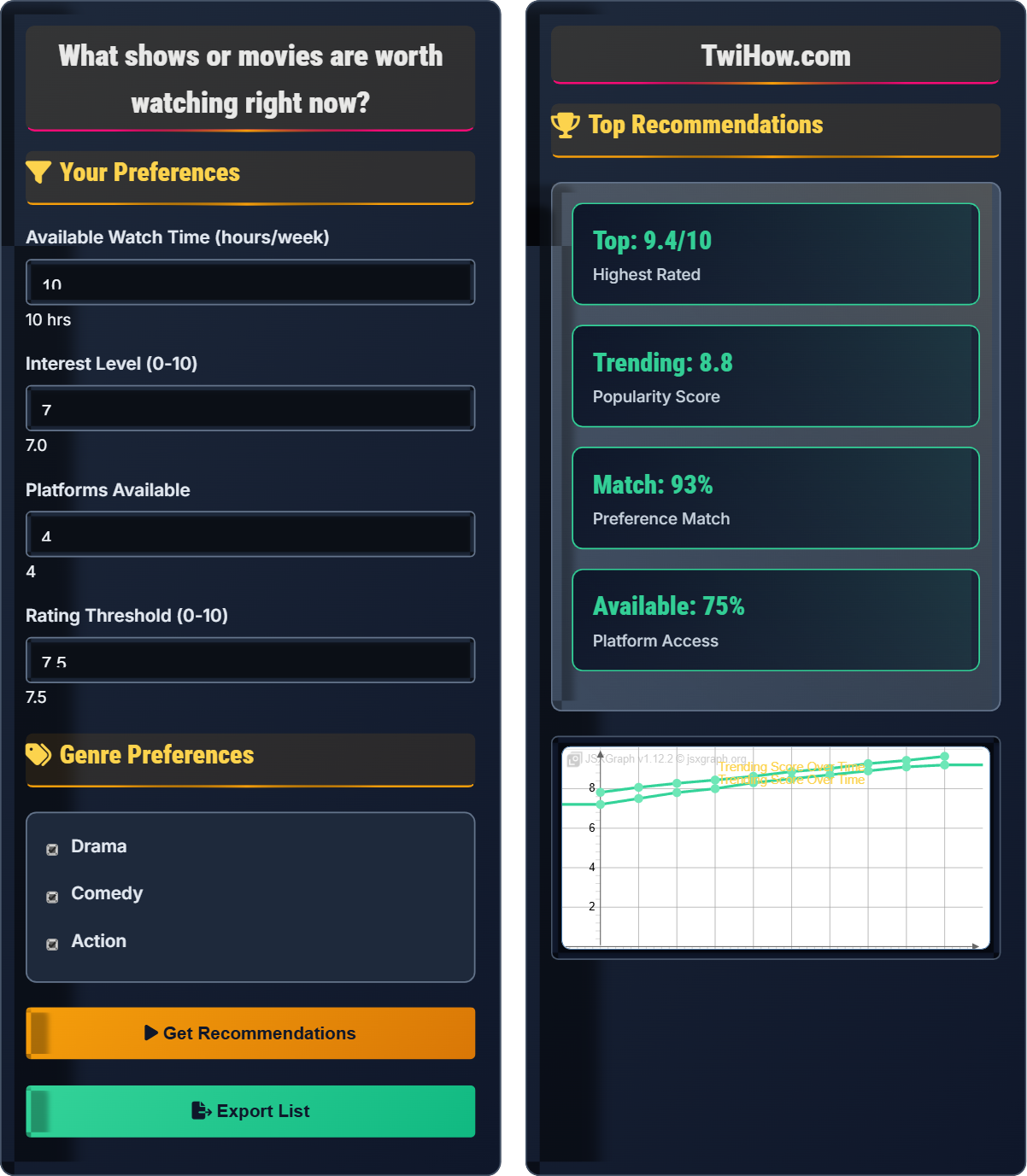
Your Preferences
Genre Preferences
Top Recommendations
| Title | Rating | Genre | Platform |
|---|---|---|---|
| The Bear | 8.9/10 | Drama | Hulu |
| Succession | 8.8/10 | Drama | HBO Max |
| Yellowjackets | 8.5/10 | Thriller | Showtime |
| Severance | 8.7/10 | Sci-Fi | Apple TV+ |
Based on your preferences:
- Everything Everywhere All at Once
- Top Gun: Maverick
- The Batman
- Minari
Recommended for your preferences:
- Hulu - Drama & Comedy
- HBO Max - Premium Content
- Netflix - Variety
- Disney+ - Family Content
Entertainment Recommendations Explained
High-quality entertainment combines compelling storytelling, skilled acting, excellent production values, and cultural relevance. The best content resonates with audiences on multiple levels, offering both immediate enjoyment and lasting impact. Critical acclaim, audience ratings, and cultural buzz all contribute to determining what's worth watching.
The value of entertainment content can be modeled as:
Where:
- Quality: Production values, acting, direction, writing
- Relevance: Cultural significance, timeliness, social impact
- Availability: Access through subscribed platforms
- Personal Interest: Alignment with viewer preferences
Popular categories and current hits:
- Dramas: The Bear, Succession, Yellowjackets, Severance
- Comedies: Ted Lasso, Abbott Elementary, The Good Place
- Action/Sci-Fi: The Last of Us, House of the Dragon, Andor
- Movies: Everything Everywhere All at Once, Top Gun: Maverick
- Documentaries: The Last Dance, Cheer, Tiger King
- International: Squid Game, Money Heist, Dark
- Critics' Lists: Rotten Tomatoes, Metacritic, critics' year-end lists
- Community Recommendations: Reddit, Letterboxd, social media
- Streaming Algorithms: Netflix, Hulu, and other platform suggestions
- Awards Season: Oscar, Emmy, and Golden Globe contenders
- Word of Mouth: Friends, family, and trusted reviewers
- Trailers and Previews: Official promotional materials
Entertainment Fundamentals
Trending content, ratings, genre preferences, platform availability, personal interest matching.
WW = f(Q, R, A, PI)
Where WW = worth watching, Q = quality, R = relevance, A = availability, PI = personal interest.
- Combine multiple rating sources
- Consider genre preferences
- Check platform availability
Applications
Entertainment selection, time management, budget optimization, family viewing, personal enrichment.
- Content research
- Rating evaluation
- Platform selection
- Time allocation
- Changing content availability
- Personal taste evolution
- Seasonal viewing patterns
- Family member preferences
Entertainment Recommendations Quiz
What is the difference between critic ratings and audience ratings on platforms like Rotten Tomatoes?
Critics typically evaluate films and shows based on technical excellence, artistic merit, cultural significance, and cinematic craft. Audience ratings reflect general viewers' personal enjoyment and entertainment value. Critics may appreciate complex storytelling or artistic experimentation that general audiences don't enjoy as much, leading to different ratings.
The answer is B) Critics evaluate artistic merit while audiences rate enjoyment.
Understanding the difference between critic and audience ratings helps viewers interpret what they're seeing. Critics often value artistic achievement, innovation, and craftsmanship, while audiences typically rate based on personal entertainment value. Both perspectives are valuable for making informed viewing decisions.
Critic Rating: Professional evaluation of artistic and technical merit
Audience Rating: General viewer satisfaction and enjoyment
Rotten Tomatoes: Aggregation platform for movie and TV reviews
• Critics value artistic achievement
• Audiences rate personal enjoyment
• Consider both critic and audience scores
• Read specific reviews for details
• Look for consensus in ratings
• Only looking at one type of rating
• Assuming critics are always right
• Ignoring audience reactions
Explain how understanding your genre preferences can improve your entertainment selection process. Include examples of how different genres fulfill different emotional and intellectual needs.
Genre Preferences: Understanding your preferred genres helps you efficiently find content that matches your mood and expectations.
Emotional Fulfillment: Dramas provide emotional catharsis and character development; comedies offer stress relief and humor; thrillers provide excitement and tension release.
Intellectual Stimulation: Sci-fi explores future possibilities and philosophical concepts; documentaries educate and inform; mysteries engage problem-solving skills.
Mood Matching: Action for high energy; horror for controlled fear; romance for emotional comfort; fantasy for escapism.
Personal Growth: Historical dramas provide cultural context; biographical films offer inspiration; foreign films broaden perspectives.
Knowing your preferences allows you to prioritize content that aligns with your current needs and interests.
Genres serve as emotional and intellectual signposts that help viewers find content matching their current needs. Different genres fulfill different psychological functions, from relaxation to intellectual stimulation. Understanding your preferences helps you make more satisfying viewing choices and allocate your limited time effectively.
Genre: Category of entertainment with specific conventions
Emotional Catharsis: Release of emotional tension through art
Mood Matching: Selecting content that fits current emotional state
• Different genres serve different needs
• Mood influences genre preference
• Preferences can evolve over time
• Experiment with new genres occasionally
• Track what you enjoy most
• Consider your mood when selecting
• Never trying new genres
• Assuming all content in a genre is the same
• Ignoring mood when selecting content
You have 15 hours per week for entertainment and want to watch a mix of TV shows and movies. TV shows average 45 minutes per episode, while movies average 2 hours. If you want to spend 60% of your time on TV shows and 40% on movies, how many episodes and movies can you watch per week? How does this translate to completing series versus watching individual films?
Time Allocation:
TV Shows: 15 hours × 0.60 = 9 hours (540 minutes)
Movies: 15 hours × 0.40 = 6 hours (360 minutes)
Calculations:
TV Episodes: 540 minutes ÷ 45 minutes per episode = 12 episodes
Movies: 360 minutes ÷ 120 minutes per movie = 3 movies
Series Completion: With 12 episodes per week, you could complete a 10-episode season in about 1 week, allowing for 2-3 episodes of other shows. For movies, you could watch 3 films per week, potentially completing a movie trilogy in 3 weeks.
This allocation allows for both binge-watching series and sampling multiple films.
This problem demonstrates the importance of time management in entertainment consumption. Understanding the time requirements of different content types helps viewers plan their viewing schedule effectively. It also highlights the different consumption patterns between TV shows (serial) and movies (individual).
Binge-Watching: Watching multiple episodes consecutively
Serial Content: Stories told over multiple episodes/seasons
Time Allocation: Distributing available time among different activities
• TV shows take less commitment per session
• Plan viewing based on available time blocks
• Match content length to available time
• Plan series completion timeline
• Balance serial and individual content
• Not accounting for episode/movie length
• Starting too many series at once
• Overestimating available time
You currently subscribe to Netflix and Hulu but want to expand to include content from other platforms without exceeding your $40 monthly budget. Design a platform strategy that maximizes your content access while staying within budget. Consider that you prefer dramas, documentaries, and original content.
Current Subscriptions: Netflix ($15.99) + Hulu ($6.99) = $22.98
Remaining Budget: $40 - $22.98 = $17.02
Recommended Additions:
1) Disney+ ($7.99): For Marvel, Star Wars, and Pixar content
2) HBOMax ($9.99): Premium dramas like Succession, The White Lotus
Alternative Strategy: Maximize current subscriptions first, then rotate platforms seasonally.
Free Options: Utilize free trials and free platforms like Tubi, Pluto TV for additional content.
Total Cost: $22.98 + $7.99 + $9.99 = $40.96 (slightly over budget, so choose one premium service)
Optimized Strategy: Netflix + Hulu + Disney+ = $30.97, leaving $9.03 for occasional premium rentals.
This problem illustrates the importance of strategic platform selection. Viewers must balance their content preferences with budget constraints. The key is identifying which platforms offer the most value for their specific interests while avoiding overspending on overlapping content.
Platform Strategy: Planned approach to service selection
Content Overlap: Same content available on multiple services
Subscription Rotation: Canceling and restarting services for free trials
• Calculate total monthly costs
• Consider content uniqueness per platform
• Budget for premium content rentals
• Use free trials strategically
• Check for bundle deals
• Share family plans to reduce costs
• Subscribing to too many services
• Not considering content overlap
• Exceeding budget limits
Which streaming platform is known for featuring the most diverse international content?
Netflix has made significant investments in international content, producing original series and films in dozens of countries. Notable examples include "Squid Game" (South Korea), "Money Heist" (Spain), "Dark" (Germany), and "Sacred Games" (India). Netflix's global strategy includes content production in multiple countries to serve diverse international audiences.
The answer is A) Netflix.
International content has become increasingly important in the streaming landscape. Netflix's global approach to content production has resulted in some of the most popular and critically acclaimed international series. Understanding which platforms prioritize international content helps viewers discover diverse perspectives and storytelling traditions.
International Content: Productions from outside the US
Global Strategy: Content approach targeting worldwide audiences
Cultural Perspective: Different viewpoints and storytelling traditions
• Netflix leads in international originals
• International content often wins awards
• Subtitles enhance accessibility
• Try international content regularly
• Use subtitles for language learning
• Explore different cultures through media
• Only watching English-language content
• Assuming international content is low quality
• Not giving subtitled content a chance
FAQ
Q: How do I keep track of shows and movies I want to watch?
A: Here are effective tracking methods:
Platform Lists: Use each streaming service's "My List" or "Watchlist" feature to save content for later viewing.
Third-Party Apps: Letterboxd, Trakt, or MyMovieList for comprehensive tracking across platforms.
Spreadsheet Tracking: Create a simple spreadsheet with columns for title, platform, rating, and status.
Mobile Notes: Use your phone's notes app with categories for different content types.
Browser Extensions: Tools like JustWatch Browser Extension show availability across platforms.
Social Media: Follow entertainment accounts on Twitter or Instagram for recommendations.
Choose a system that's simple enough to maintain consistently, and update it regularly as your interests evolve.
Q: How do we find content that appeals to different family members?
A: Successful family entertainment selection includes:
Compromise Content: Choose shows and movies that appeal to multiple age groups, like animated films with adult humor.
Rotation System: Allow each family member to pick content for a designated night or time slot.
Individual Profiles: Use streaming service features to create separate profiles for different family members.
Pre-Viewing: Watch previews or read reviews to ensure content is appropriate for all family members.
Interactive Viewing: Choose content that encourages discussion and engagement for all ages.
Flexible Scheduling: Allow for different viewing times based on individual preferences.
Balance popular family favorites with individual interests to keep everyone satisfied.