Best Investment Strategies?
Complete investing guide • Step-by-step explanations
Investment Strategy Fundamentals:
Show Strategy SimulatorInvestment strategies are systematic approaches to building wealth through financial markets. The best strategies depend on individual goals, risk tolerance, time horizon, and market conditions. This guide explores proven strategies that have generated consistent returns over time, helping you make informed decisions about your investment approach.
Key investment strategy categories:
- Passive Strategies: Index investing, dollar-cost averaging
- Active Strategies: Value investing, growth investing, momentum
- Defensive Strategies: Dividend investing, bonds, REITs
- Alternative Strategies: Commodities, real estate, crypto
Selecting the right investment strategy requires careful consideration of your personal circumstances, financial goals, and risk tolerance. This guide will help you evaluate different approaches and find the best fit for your situation.
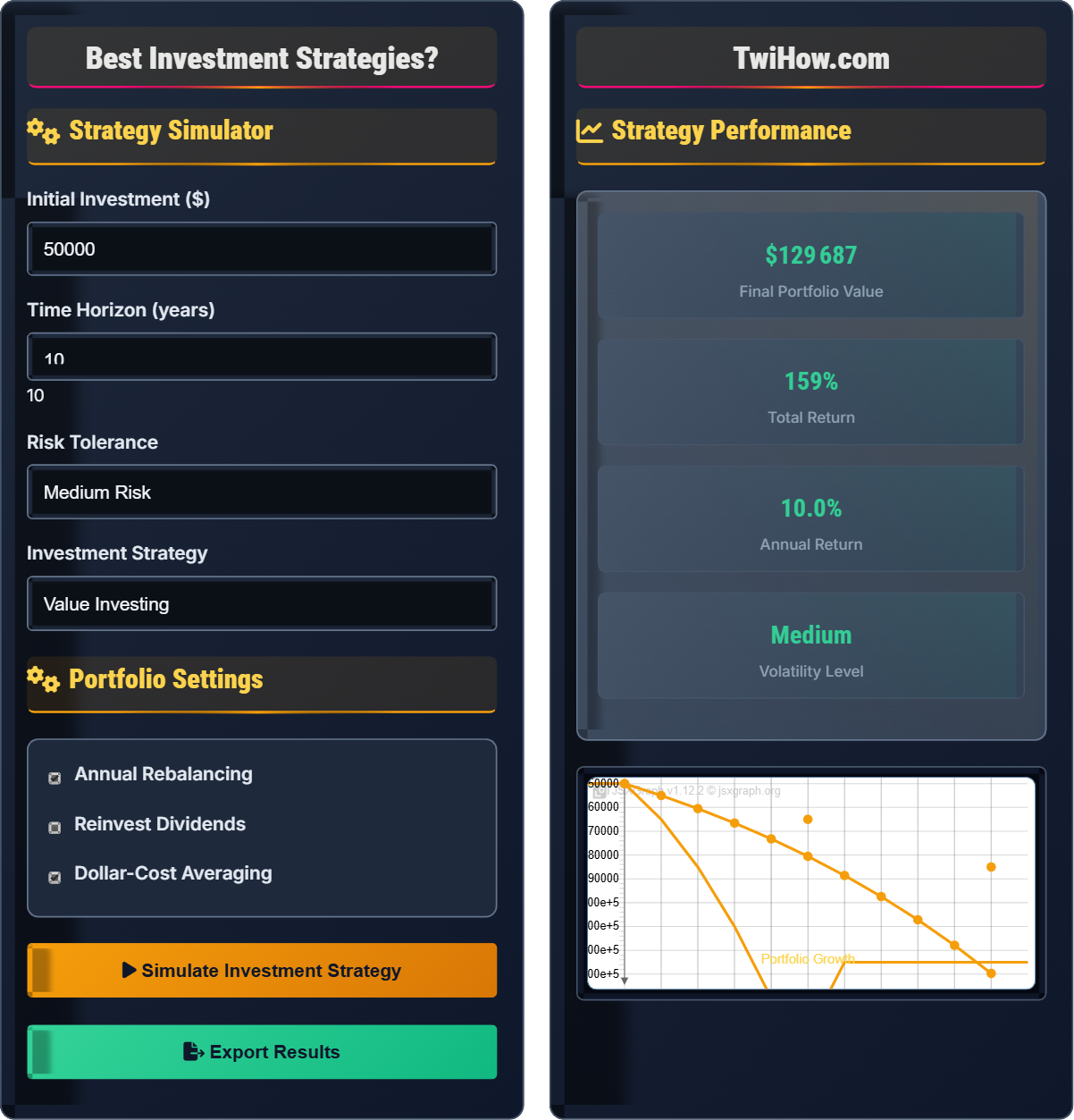
Strategy Simulator
Portfolio Settings
Strategy Performance
Low-cost, diversified approach that tracks market performance. Ideal for long-term investors seeking steady growth.
Focus on undervalued companies with strong fundamentals. Requires patience but offers potential for superior returns.
Invest in companies with high growth potential. Higher risk but potential for significant returns.
Investment Strategies Explained
Investment strategies are systematic approaches to allocating capital to achieve specific financial goals. These strategies vary based on risk tolerance, time horizon, and investment objectives. The best investment strategy combines diversification, proper asset allocation, and disciplined execution.
Effective investment strategies balance risk and return while adapting to changing market conditions and personal circumstances.
Where:
- Future Value: Value of investment after time period
- Present Value: Initial investment amount
- r: Annual rate of return
- t: Time period in years
Investment strategies vary in their risk-return profiles:
- Low Risk: Index funds, bonds, CDs (lower returns, more stable)
- Medium Risk: Balanced funds, dividend stocks (moderate returns)
- High Risk: Growth stocks, small caps (higher returns, more volatility)
- Very High Risk: Crypto, options, penny stocks (highest potential returns)
- Age: Younger investors can take more risk
- Time Horizon: Longer periods allow for riskier strategies
- Risk Tolerance: Comfort level with volatility
- Financial Goals: Income needs, retirement planning
- Knowledge Level: Active vs. passive management
Investment Strategy Types
Index investing, value investing, growth investing, dividend investing, dollar-cost averaging, asset allocation.
Future Value = Present Value × (1 + r)^t
Where r is annual return and t is time period in years.
- Diversify across asset classes
- Match strategy to risk tolerance
- Maintain long-term perspective
- Minimize costs and taxes
Strategy Implementation
Assessment, research, allocation, monitoring, rebalancing.
- Define investment goals
- Assess risk tolerance
- Select appropriate strategy
- Execute and monitor
- Start with index funds
- Keep costs low
- Rebalance annually
- Stay disciplined
Investment Strategy Learning Quiz
Which investment strategy is most appropriate for a 25-year-old investor with a 30-year time horizon and high risk tolerance?
For a 25-year-old with a 30-year time horizon and high risk tolerance, growth stock investing is most appropriate. Young investors have time to recover from market volatility and can benefit from the higher potential returns of growth stocks. The long time horizon allows for riding out market cycles, and high risk tolerance means they can handle the inherent volatility of growth investments.
The answer is B) Growth stock investing.
Investment strategy selection should match the investor's age, time horizon, and risk tolerance. Young investors benefit from taking more risk because they have decades to recover from market downturns. Growth stocks, while volatile, have historically provided superior long-term returns compared to safer investments. As investors age, they typically shift toward more conservative strategies to preserve capital as retirement approaches.
Time Horizon: Length of time until funds are needed
Risk Tolerance: Comfort level with volatility
Growth Stocks: Companies with high growth potential
• Match strategy to time horizon
• Young investors can take more risk
• Consider risk tolerance
• Use age-based allocation rules
• Consider target-date funds
• Start with index funds
• Being too conservative young
• Taking too much risk near retirement
• Not matching strategy to goals
Explain the concept of asset allocation and describe how it changes as an investor ages from 25 to 65. Include specific allocation recommendations for different age groups.
Asset Allocation: The distribution of investments across different asset classes (stocks, bonds, cash, etc.) to optimize risk-adjusted returns.
Age-Based Allocation:
• Ages 25-35: 80-90% stocks, 10-20% bonds (high growth focus)
• Ages 35-45: 70-80% stocks, 20-30% bonds (balanced growth)
• Ages 45-55: 60-70% stocks, 30-40% bonds (conservative shift)
• Ages 55-65: 50-60% stocks, 40-50% bonds (income focus)
• Age 65+: 40-50% stocks, 50-60% bonds (capital preservation)
This approach balances growth potential when young with capital preservation as retirement approaches.
Asset allocation is the most important decision in portfolio construction. The "age in bonds" rule suggests that your bond allocation should roughly match your age, though this is a guideline rather than a hard rule. The goal is to maintain appropriate risk levels throughout life stages, taking advantage of compounding when young while protecting principal as retirement nears.
Asset Allocation: Distribution across asset classes
Asset Classes: Different investment categories
Rebalancing: Adjusting allocation over time
• Diversify across asset classes
• Adjust allocation with age
• Rebalance regularly
• Use target-date funds for simplicity
• Rebalance annually
• Consider international diversification
• Not diversifying enough
• Not adjusting with age
• Failing to rebalance
An investor puts $10,000 into a portfolio with an average annual return of 8%. If they add $500 monthly for 20 years, calculate the final portfolio value. Then compare this to a scenario where they only invested the initial $10,000 without monthly additions.
Scenario 1: With Monthly Contributions
Using the future value of annuity formula:
FV = PV×(1+r)^n + PMT×[((1+r)^n-1)/r]
Where: PV = $10,000, PMT = $500, r = 0.08/12 = 0.00667, n = 20×12 = 240
FV = $10,000×(1.00667)^240 + $500×[((1.00667)^240-1)/0.00667]
FV = $10,000×5.03 + $500×589.02 = $50,300 + $294,510 = $344,810
Scenario 2: Initial Investment Only
FV = $10,000×(1.08)^20 = $10,000×4.66 = $46,610
Difference: $344,810 - $46,610 = $298,200
The monthly contributions resulted in nearly $300,000 more than the initial investment alone.
This calculation demonstrates the power of dollar-cost averaging and compound growth. Regular contributions significantly boost final portfolio value by increasing the total amount invested and benefiting from the compounding effect. This is why starting early and investing regularly are fundamental principles of successful investing.
Compound Growth: Earning returns on previous returns
Dollar-Cost Averaging: Regular investing regardless of price
Future Value: Value of investment after time period
• Start investing early
• Invest regularly
• Benefit from compounding
• Automate monthly investments
• Use employer matching
• Maximize tax-advantaged accounts
• Starting too late
• Not investing regularly
• Missing compounding benefits
An investor has $100,000 to invest and wants to use a 60/40 stock/bond allocation. If they want to maintain this allocation after their portfolio grows to $150,000, explain how they should rebalance. Also discuss why rebalancing is important and potential consequences of not rebalancing.
Target Allocation:
Stocks: 60% × $150,000 = $90,000
Bonds: 40% × $150,000 = $60,000
Rebalancing Process:
If stocks grew to $100,000 and bonds to $50,000 (total $150,000), the investor needs to sell $10,000 of stocks and buy $10,000 of bonds to return to 60/40 allocation.
Importance of Rebalancing:
1. Maintains desired risk level
2. Prevents over-concentration in performing assets
3. Forces selling high and buying low
4. Keeps portfolio aligned with goals
Consequences of Not Rebalancing:
Portfolio may become too risky or too conservative, potentially missing opportunities or taking excessive risk.
Rebalancing is crucial for maintaining risk levels and preventing portfolio drift. Without rebalancing, winning investments grow disproportionately, increasing risk. The discipline of rebalancing also creates a systematic approach to selling high and buying low, which can enhance returns over time.
Rebalancing: Adjusting portfolio to target allocation
Portfolio Drift: Deviation from target allocation
Risk Level: Volatility of portfolio returns
• Rebalance annually
• Maintain target allocation
• Monitor portfolio regularly
• Use threshold-based rebalancing
• Rebalance tax-efficiently
• Consider target-date funds
• Not rebalancing regularly
• Letting winners run too long
• Missing risk management
Which investment strategy typically has the lowest ongoing costs?
Index fund investing typically has the lowest ongoing costs because these funds simply track market indices rather than employing expensive portfolio managers to pick individual stocks. Index funds have low expense ratios (often 0.03%-0.20%) compared to actively managed funds (typically 0.5%-2.0%+) and hedge funds (often 2%+ plus performance fees).
The answer is C) Index fund investing.
Costs are a critical factor in long-term investment returns. The difference between a 0.1% expense ratio and a 1.0% expense ratio can result in hundreds of thousands of dollars in lost returns over a lifetime. Index funds are cost-effective because they don't require expensive research teams or active management, making them ideal for long-term wealth building.
Expense Ratio: Annual fee as percentage of assets
Management Fees: Costs for portfolio management
Cost Efficiency: Low-cost investment approach
• Minimize investment costs
• Check expense ratios
• Understand all fees
• Look for expense ratios below 0.5%
• Avoid sales loads
• Use tax-advantaged accounts
• Ignoring expense ratios
• Paying high management fees
• Not understanding all costs
FAQ
Q: Should I start with individual stocks or index funds?
A: For beginners, index funds are typically the better choice because they:
1. Provide instant diversification across hundreds or thousands of stocks
2. Have lower costs than actively managed funds
3. Require minimal research and monitoring
4. Offer consistent returns that match market performance
5. Are tax-efficient due to low turnover
Once you've built a solid foundation with index funds and gained more experience, you can consider adding individual stocks to your portfolio.
Q: What's the difference between passive and active investing?
A: The key differences are:
Passive Investing: Seeks to match market returns by tracking indices, lower costs, less trading, tax efficiency.
Active Investing: Attempts to beat market returns through stock selection and timing, higher costs, more trading, potential tax inefficiency.
Research shows that most active managers fail to beat their benchmarks over long periods, making passive investing attractive for most investors. However, active management may be beneficial in certain market segments or for specific goals.
Q: How should my investment strategy change as I approach retirement?
A: As you approach retirement, your strategy should gradually shift toward:
1. Reduced Risk: Increase bond allocation to preserve capital
2. Income Focus: Emphasize dividend-paying stocks and bonds
3. Liquidity: Maintain accessible cash for emergencies
4. Withdrawal Planning: Prepare for systematic withdrawals
A common approach is to gradually shift from 70-80% stocks in your 40s to 50-60% stocks in retirement, with the remainder in bonds and cash. The goal shifts from growth to preservation and income generation.