How to Build Portfolio?
Complete portfolio building guide • Step-by-step explanations
Portfolio Building Fundamentals:
Show Portfolio BuilderBuilding an investment portfolio is the process of selecting and combining different assets to achieve your financial goals while managing risk. A well-constructed portfolio balances various asset classes, considers your risk tolerance, time horizon, and investment objectives. Successful portfolio construction involves diversification, strategic asset allocation, and regular rebalancing to maintain optimal performance.
Key portfolio building components:
- Asset Allocation: Distributing investments across asset classes
- Diversification: Spreading risk across different investments
- Risk Management: Balancing risk and return
- Rebalancing: Maintaining target allocation
- Performance Monitoring: Tracking portfolio performance
- Cost Management: Minimizing fees and taxes
Effective portfolio building requires a systematic approach that aligns with your financial goals and risk tolerance.
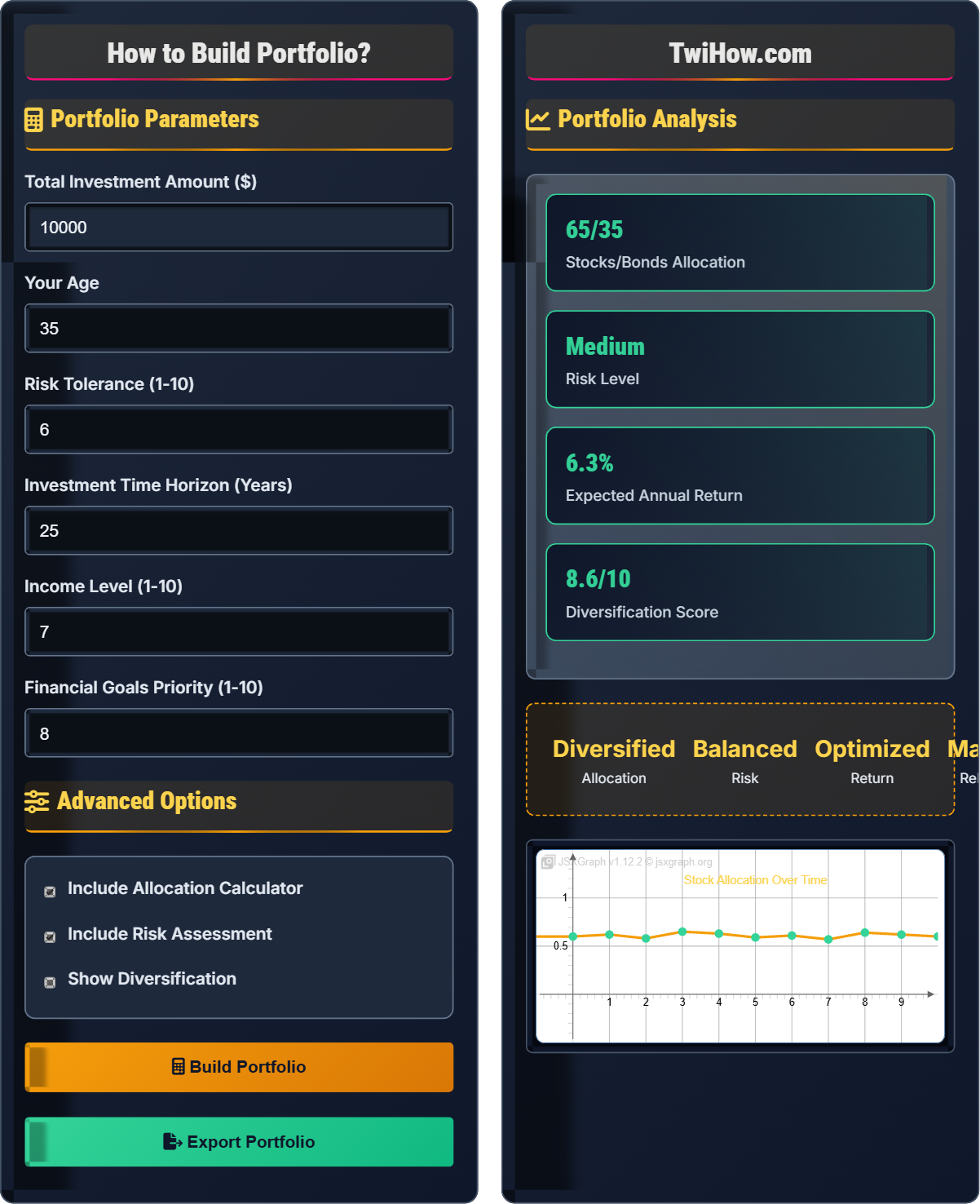
Portfolio Parameters
Advanced Options
Portfolio Analysis
Key concepts for portfolio building:
- Asset allocation is the primary driver of portfolio performance
- Diversification reduces risk without sacrificing returns
- Rebalancing maintains target allocation
- Time horizon affects risk tolerance
- Costs significantly impact long-term returns
- Regular review and adjustment is essential
| Asset Class | Target % | Amount ($) | Recommendation |
|---|---|---|---|
| Domestic Stocks | 40% | $4,000 | Large-cap index fund |
| International Stocks | 20% | $2,000 | Global index fund |
| Bonds | 30% | $3,000 | Intermediate-term bonds |
| REITs | 5% | $500 | Real estate fund |
| Cash | 5% | $500 | High-yield savings |
How Portfolio Building Works
Portfolio building is the strategic process of selecting and combining different investment assets to achieve specific financial goals while managing risk. It involves determining the appropriate mix of stocks, bonds, and other assets based on factors such as age, risk tolerance, time horizon, and financial objectives. A well-built portfolio balances potential returns with acceptable levels of risk.
Where:
- Asset Allocation: Percentage of portfolio in each asset class
- Weight_i: Proportion of asset class i in portfolio
- Return_i: Expected return of asset class i
- Portfolio Return: Weighted average of asset class returns
Popular portfolio building strategies include:
- Age-Based Allocation: Stocks decrease as you age (100-age rule)
- Target-Date Funds: Automatic rebalancing over time
- Three-Fund Portfolio: Domestic, international, and bonds
- Core-Satellite: Core index funds with satellite active funds
- Factor Investing: Target specific risk factors
- ESG Investing: Environmental, social, governance considerations
- Start Simple: Begin with low-cost index funds
- Minimize Costs: Focus on expense ratios and trading fees
- Stay Diversified: Spread investments across asset classes
- Rebalance Regularly: Maintain target allocation
- Think Long-Term: Avoid market timing
- Automate Investing: Set up regular contributions
Portfolio Building Fundamentals
Asset allocation, diversification, risk tolerance, time horizon, rebalancing, correlation, volatility.
Asset Allocation = (Amount in Asset Class / Total Portfolio Value) × 100%
Portfolio Return = Σ(Weight_i × Return_i)
Where Portfolio Return is weighted average of asset class returns.
- Asset allocation drives portfolio performance
- Diversification reduces risk without sacrificing returns
- Rebalance annually to maintain targets
- Minimize investment costs
- Align portfolio with your goals and timeline
Portfolio Building Applications
Retirement planning, wealth building, income generation, risk management, financial independence.
- Define specific financial goals
- Assess risk tolerance and time horizon
- Determine asset allocation
- Select low-cost investments
- Implement portfolio strategy
- Monitor performance regularly
- Rebalance as needed
- Use low-cost index funds
- Maintain discipline with allocations
- Regular portfolio reviews
- Adjust strategy as life circumstances change
Portfolio Building Tools
Calculate optimal asset allocation based on age and risk tolerance.
Assess the risk level of your portfolio allocation.
Measure how diversified your portfolio is across different asset classes.
Determine when and how to rebalance your portfolio.
Estimate expected portfolio returns based on asset allocation.
Portfolio Building Learning Quiz
According to the traditional 60/40 rule, what percentage of a portfolio should be allocated to stocks?
The traditional 60/40 rule allocates 60% of a portfolio to stocks and 40% to bonds. This allocation aims to balance growth potential from stocks with stability from bonds. However, modern portfolio theory suggests that asset allocation should be customized based on individual factors like age, risk tolerance, and time horizon.
The answer is C) 60%.
The 60/40 rule is a historical benchmark that emerged from studies showing this allocation provided a good balance of growth and stability. However, it's important to understand that this is not a one-size-fits-all solution. The allocation should be adjusted based on individual circumstances. Younger investors might choose a higher stock allocation for growth, while older investors might prefer more bonds for stability.
Asset Allocation: Distribution of investments across asset classes
Stocks: Equity investments representing company ownership
Bonds: Fixed-income investments representing debt
• Customize allocation to your situation
• Rebalance regularly to maintain targets
• Consider your time horizon
• Use age-based allocation as a starting point
• Adjust based on your risk tolerance
• Consider target-date funds for simplicity
• Using 60/40 without customization
• Not rebalancing regularly
• Ignoring personal circumstances
Explain the concept of diversification and why it's considered a fundamental principle of portfolio building. How does diversification reduce risk without necessarily sacrificing returns?
Diversification Definition: Diversification is the practice of spreading investments across different asset classes, sectors, geographic regions, and securities to reduce risk.
How It Reduces Risk: By holding multiple investments, the poor performance of one investment is offset by the better performance of others. This reduces the overall volatility of the portfolio.
Why It Doesn't Sacrifice Returns: Diversification reduces unsystematic risk (specific to individual companies/securities) while maintaining exposure to systematic risk (market-wide), which is necessary for returns.
Benefits: Lower portfolio volatility, reduced chance of large losses, smoother returns over time.
Diversification is often called the only "free lunch" in investing because it reduces risk without necessarily reducing expected returns. The key insight is that different investments don't move in perfect correlation - when some go down, others may go up or stay steady. This statistical benefit comes from the correlation between assets being less than perfect (less than 1.0). The goal is to find assets that don't move in sync while still providing growth potential.
Diversification: Spreading investments to reduce risk
Correlation: Degree to which investments move together
Unsystematic Risk: Risk specific to individual investments
• Don't put all eggs in one basket
• Diversify across asset classes
• Geographic diversification matters
• Use index funds for instant diversification
• Diversify across market caps
• Consider international exposure
• Thinking diversification eliminates all risk
• Over-diversification diluting returns
• Not diversifying enough
You have a $100,000 portfolio with a target allocation of 60% stocks and 40% bonds. After a year of strong stock market performance, your portfolio is now 70% stocks and 30% bonds. If you use a 5% deviation threshold for rebalancing, what action should you take? Calculate the dollar amounts needed to restore the target allocation.
Current Situation: 70% stocks, 30% bonds (10% deviation from target)
Decision: Since 10% > 5% threshold, rebalancing is needed
Target Allocation: 60% stocks ($60,000), 40% bonds ($40,000)
Current Allocation: 70% stocks ($70,000), 30% bonds ($30,000)
Action Required: Sell $10,000 of stocks and buy $10,000 of bonds
This restores the portfolio to the target 60/40 allocation, reducing risk by bringing the allocation back to intended levels.
This example demonstrates why rebalancing is crucial for maintaining risk levels. Without rebalancing, market movements can shift your portfolio away from your target risk level. In this case, the portfolio became more aggressive (higher stock allocation) than intended. Rebalancing sells appreciated assets and buys underperforming ones, which can seem counterintuitive but helps maintain discipline and risk control.
Rebalancing: Adjusting portfolio to maintain target allocation
Deviation Threshold: Maximum allowed allocation drift
Target Allocation: Desired asset distribution
• Rebalance when thresholds are exceeded
• Consider tax implications
• Maintain discipline with rebalancing
• Use 5% deviation threshold as a starting point
• Rebalance in tax-advantaged accounts first
• Consider annual rebalancing as minimum
• Not rebalancing regularly
• Rebalancing too frequently
• Ignoring tax consequences
You're 35 years old with a 30-year investment horizon until retirement. According to the "age-based allocation" rule (100 minus age for stocks), what should be your target stock allocation? How would this allocation change if you were more conservative or aggressive in your risk tolerance? What additional factors should you consider beyond this simple rule?
Age-Based Rule: 100 - 35 = 65% in stocks, 35% in bonds
Conservative Adjustment: Reduce stocks by 10-15% → 50-55% stocks
Aggressive Adjustment: Increase stocks by 10-15% → 75-80% stocks
Additional Factors:
• Expected retirement expenses
• Other sources of income (Social Security, pensions)
• Health and longevity expectations
• Personality and emotional reaction to volatility
• Financial obligations (mortgage, children's education)
• Professional stability and earning potential
The age-based allocation rule is a simple starting point, but it shouldn't be used in isolation. The underlying logic is that younger people can take more risk because they have time to recover from market downturns. However, individual circumstances vary greatly. Some people at 35 may need to be more conservative due to high financial obligations, while others might take more risk due to stable income and few dependents.
Time Horizon: Length of time until funds are needed
Risk Tolerance: Comfort level with investment volatility
Age-Based Rule: Allocation based on investor's age
• Use rules as guidelines, not absolute
• Consider multiple factors
• Adjust for personal circumstances
• Start with rules, then customize
• Consider your sleep factor
• Review allocation annually
• Following rules blindly
• Not considering personal factors
• Ignoring life changes
How do investment costs impact long-term portfolio performance?
Investment costs compound over time and significantly impact long-term returns. For example, a 1% annual fee on a $100,000 portfolio growing at 7% annually would cost about $30,000 over 20 years. The impact is multiplicative because fees are charged on the growing portfolio value each year. This is why low-cost index funds often outperform higher-cost actively managed funds over long periods.
The answer is B) Costs compound over time and significantly impact returns.
This is one of the most important concepts in investing. Costs are the only thing investors can control with certainty. While returns are uncertain, fees are guaranteed to be deducted. The compounding effect of fees means that small differences in expense ratios can result in large differences in final portfolio value over decades. This is why expense ratios should be a primary consideration when selecting investments.
Expense Ratio: Annual fee as percentage of investment
Compound Effect: Growth on previously earned returns
Cost Impact: Reduction in net returns
• Minimize investment costs
• Understand all fees involved
• Consider costs as guaranteed reductions
• Look for expense ratios under 0.2%
• Avoid front-end loads when possible
• Consider tax implications of trading costs
• Ignoring small fees over time
• Not understanding all cost components
• Paying high fees for unproven performance
FAQ
Q: How many stocks should I own to be properly diversified?
A: Research shows that most diversification benefits are achieved with 20-30 individual stocks, but for most investors, the optimal approach is:
1. Index Funds: 1-2 broad market index funds for instant diversification
2. Individual Stocks: If picking individual stocks, aim for 15-20 across different sectors
3. Hybrid Approach: Core index funds with 5-10 individual stock picks
The key is not just quantity but quality diversification across sectors, market caps, and geographies. For beginning investors, broad index funds provide the easiest path to proper diversification.
Q: Should I rebalance my portfolio monthly, quarterly, or annually?
A: The frequency depends on your portfolio size and costs:
Annual Rebalancing: Recommended for most investors (sufficient for most situations)
Threshold-Based: Rebalance when allocations deviate by 5% or more
Quarterly: Only if you have a large portfolio and low trading costs
Monthly: Generally not recommended due to transaction costs
Many investors use a hybrid approach: annual calendar rebalancing plus threshold rebalancing if deviations exceed 5%. This provides discipline while avoiding excessive trading costs.
Q: Is it better to use target-date funds or build my own portfolio?
A: Both approaches have merits:
Target-Date Funds:
• Pros: Automatic rebalancing, professionally managed, simple
• Cons: Higher fees, less control, one-size-fits-all approach
DIY Portfolio:
• Pros: Lower costs, customization, tax efficiency
• Cons: Requires knowledge, time, discipline
For investors who prefer hands-off management, target-date funds are excellent. For those who enjoy managing investments and want to minimize costs, DIY portfolios work well. Consider your time, knowledge, and preferences when deciding.