How to Invest in Real Estate?
Complete real estate investing guide • Step-by-step explanations
Real Estate Investment Fundamentals:
Show Investment AnalysisReal estate investing involves purchasing, owning, managing, renting, or selling real estate for profit. It's one of the most popular ways to build wealth, offering both income generation and appreciation potential. Real estate investments can provide steady cash flow through rental income, long-term appreciation, tax advantages, and portfolio diversification. Success requires market knowledge, financial planning, and proper property management.
Key real estate investment components:
- Rental Properties: Generating income through tenants
- Appreciation: Property value increases over time
- REITs: Real Estate Investment Trusts for diversification
- Market Analysis: Researching location and trends
- Financing: Mortgages and leverage strategies
- Tax Benefits: Depreciation and expense deductions
Successful real estate investing requires a combination of financial analysis, market research, and effective property management skills.
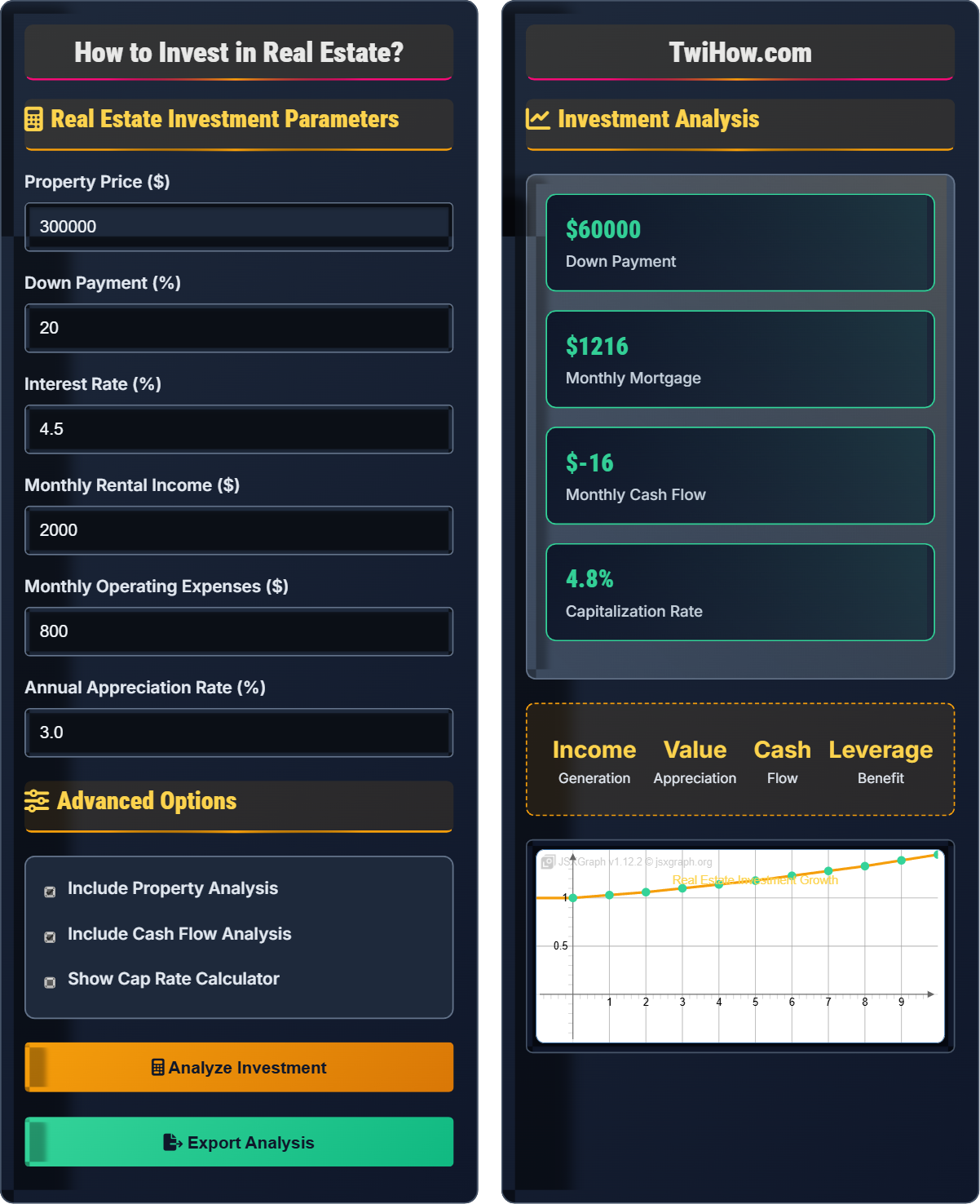
Real Estate Investment Parameters
Advanced Options
Investment Analysis
Key concepts for real estate investing:
- Rental income provides steady cash flow
- Appreciation increases property value over time
- Leverage amplifies returns on investment
- Market analysis is crucial for success
- Tax benefits reduce effective costs
- Property management affects profitability
| Item | Amount | Annual | Percentage |
|---|---|---|---|
| Property Price | $300,000 | - | 100% |
| Down Payment | $60,000 | - | 20% |
| Mortgage | $240,000 | - | 80% |
| Monthly Rent | $2,000 | $24,000 | - |
| Monthly Expenses | $800 | $9,600 | - |
| Monthly Cash Flow | $784 | $9,408 | - |
How Real Estate Investing Works
Real estate investing is the practice of purchasing, owning, managing, renting, or selling real estate for profit. It can be done through various methods including direct property ownership, Real Estate Investment Trusts (REITs), real estate crowdfunding platforms, or real estate investment partnerships. The primary goals are to generate rental income, achieve property appreciation, and build long-term wealth.
Where:
- Cash Flow: Monthly income after expenses
- Cap Rate: Return on investment property
- Net Operating Income: Income minus operating expenses
- Total Investment: Down payment and closing costs
Popular real estate investment strategies include:
- Rental Properties: Buy and rent for steady income
- Flipping: Buy, renovate, and sell for profit
- REITs: Invest in real estate through stocks
- Real Estate Crowdfunding: Pool money with other investors
- Commercial Real Estate: Office, retail, industrial properties
- Real Estate Partnerships: Joint ventures with other investors
- Location Matters: Invest in growing markets with strong fundamentals
- Do Your Homework: Research neighborhoods, schools, employment trends
- Have a Buffer: Maintain reserves for repairs and vacancies
- Understand the Market: Study local supply and demand dynamics
- Consider Professional Management: Hire property managers for hands-off investing
- Plan Exit Strategy: Know how you'll exit the investment
Real Estate Investment Fundamentals
Real estate investing, rental income, appreciation, cap rate, cash flow, leverage, ROI, market analysis.
Cash Flow = Rental Income - Operating Expenses - Mortgage Payment
Cap Rate = (Net Operating Income / Property Value) × 100%
ROI = (Annual Cash Flow + Appreciation) / Total Investment × 100%
Where Cash Flow represents monthly income after expenses.
- Always research the local market
- Keep reserves for unexpected expenses
- Calculate all costs before investing
- Consider tax implications
- Plan for property management
Real Estate Investment Applications
Rental income, wealth building, retirement planning, portfolio diversification, inflation hedge.
- Assess financial situation
- Get pre-approved for financing
- Research local markets
- Find and analyze properties
- Secure financing
- Manage properties effectively
- Use proper due diligence
- Maintain discipline with investments
- Regular property inspections
- Adjust strategy as market changes
Real Estate Investment Tools
Calculate key metrics for evaluating real estate investment properties.
Calculate monthly and annual cash flow for rental properties.
Calculate the capitalization rate to evaluate investment returns.
Calculate the return on investment for real estate properties.
Calculate mortgage payments and financing costs.
Real Estate Investment Learning Quiz
What does the capitalization rate (cap rate) measure in real estate investing?
The capitalization rate (cap rate) measures the expected return on investment for a property if purchased with cash (without leverage). It's calculated as Net Operating Income divided by Property Value. The cap rate allows investors to compare different properties based on their income potential relative to their cost, regardless of financing.
The answer is B) Return on investment without leverage.
The cap rate is a fundamental metric in real estate investing that provides a standardized way to evaluate properties. It strips out the effects of financing, allowing for pure comparison of property performance. A higher cap rate generally indicates a better return, but may also indicate higher risk. Cap rates vary by market and property type, so it's important to compare to local market standards. The cap rate is most useful for income-producing properties like rentals.
Cap Rate: Annual return without financing
Net Operating Income: Income minus operating expenses
Without Leverage: Assumed cash purchase
• Compare cap rates within same market
• Higher cap rate usually means higher risk
• Consider market conditions when evaluating
• Research local market cap rates
• Compare to similar properties
• Factor in property condition
• Not adjusting for market differences
• Including financing costs in NOI
• Ignoring property condition
Explain the importance of positive cash flow in rental property investments. What expenses should be included in cash flow calculations, and why is it important to have a buffer?
Importance of Positive Cash Flow: Positive cash flow means rental income exceeds all expenses, providing immediate returns and financial security. It indicates the property is performing well and can cover its costs.
Expenses to Include:
• Mortgage payment
• Property taxes
• Insurance
• Maintenance and repairs
• Property management fees
• Vacancy costs
Buffer Importance: Unexpected expenses (major repairs, vacancies, tenant issues) can significantly impact cash flow. A buffer ensures the property remains profitable during difficult periods and prevents financial strain.
Cash flow is the lifeblood of rental property investments. It's the money left over after all expenses are paid, representing your actual return. Positive cash flow provides financial security and the ability to handle unexpected costs. The buffer is crucial because real estate expenses are unpredictable - roofs leak, furnaces break, and tenants sometimes don't pay rent. Having extra income ensures you can cover these costs without impacting your finances or forcing you to sell.
Cash Flow: Income minus expenses
Positive Cash Flow: Income exceeds expenses
Buffer: Extra funds for unexpected expenses
• Always calculate all expenses
• Include vacancy and repair reserves
• Plan for unexpected costs
• Budget 10-15% of rent for maintenance
• Set aside 5% for vacancy
• Plan for property management costs
• Forgetting to include all expenses
• Not planning for repairs
• Underestimating vacancy costs
You're considering a rental property priced at $250,000. You plan to put 25% down ($62,500) and finance the rest with a 30-year mortgage at 4.5% interest. The property rents for $1,800/month, with estimated expenses of $700/month (excluding mortgage). Calculate the monthly cash flow, cap rate, and explain if this is a good investment based on these metrics.
Mortgage Payment: $1,267/month
Monthly Cash Flow: $1,800 - $700 - $1,267 = -$167/month
Net Operating Income: ($1,800 - $700) × 12 = $13,200/year
Cap Rate: $13,200 / $250,000 = 5.28%
Analysis: This property has negative cash flow of $167/month, meaning you'd pay money out of pocket each month. While the 5.28% cap rate is reasonable, the negative cash flow makes this a risky investment that could strain your finances. This property may only be viable if you expect significant appreciation or plan to hold long-term.
This example demonstrates the importance of calculating all costs before investing. A seemingly reasonable cap rate can mask negative cash flow. The monthly outflow of $167 means you're subsidizing this investment, which is risky and unsustainable long-term. This property would only make sense if you expect substantial appreciation or have other reasons to hold despite the negative cash flow. It highlights why cash flow analysis is crucial for real estate investments.
Negative Cash Flow: Expenses exceed income
Subsidizing: Paying for investment losses
Appreciation: Property value increase
• Always calculate cash flow before investing
• Negative cash flow is risky
• Consider appreciation separately
• Aim for positive cash flow
• Factor in all expenses
• Consider market appreciation potential
• Not calculating all expenses
• Accepting negative cash flow
• Relying solely on appreciation
You're evaluating two markets: Market A has 3% annual appreciation and 4.5% cap rates, while Market B has 6% appreciation and 6.5% cap rates. Both markets have similar population growth and employment stability. Which market would be better for a long-term rental investment, and what factors should you consider beyond these metrics?
Market B appears better with higher appreciation and cap rates. However, consider these additional factors:
Market B Advantages:
• Higher immediate returns (6.5% vs 4.5%)
• Better long-term appreciation (6% vs 3%)
Additional Factors to Consider:
• Property taxes and HOA fees
• Local rental regulations
• Competition from other investors
• Future development plans
• Economic diversity and job stability
• Property management costs
Market B likely offers better returns, but thorough due diligence is essential before investing.
While higher cap rates and appreciation look attractive, real estate investing requires comprehensive analysis. Market B offers better immediate returns and growth potential, but may also have higher competition and costs. The higher appreciation rate suggests stronger demand, which could mean more competition from other investors. It's crucial to consider all factors, including local regulations, market saturation, and your ability to manage properties in that market. The best investment isn't always the one with the highest numbers.
Market Analysis: Researching local conditions
Due Diligence: Thorough property investigation
Market Saturation: Too much competition
• Analyze multiple factors
• Consider market conditions
• Research local regulations
• Visit the market in person
• Talk to local realtors
• Research future development
• Relying only on numbers
• Not researching local market
• Ignoring regulatory environment
Which real estate investment strategy is most appropriate for a beginner investor with limited capital and time?
REITs are the most appropriate strategy for beginners with limited capital and time. They offer diversification across multiple properties, professional management, liquidity (can be bought/sold like stocks), and require no hands-on management. REITs allow investors to participate in real estate without the complexities of property management, large down payments, or extensive market knowledge.
The answer is C) REITs (Real Estate Investment Trusts).
REITs provide an excellent entry point for new investors. They trade on stock exchanges, offer professional management, and provide diversification across many properties. Unlike direct property ownership, REITs require no hands-on management, no large down payments, and no dealing with tenants. House flipping requires significant capital and expertise, commercial real estate needs substantial investment and knowledge, and raw land development is highly speculative. REITs offer the benefits of real estate investing with lower barriers to entry.
REIT: Real Estate Investment Trust
Diversification: Spreading investment across assets
Liquidity: Ease of buying/selling
• Start with simpler investments
• Learn before making large commitments
• Consider time and capital requirements
• Research different REIT types
• Consider REIT ETFs for more diversification
• Learn about direct property investing later
• Starting with complex investments
• Not understanding investment requirements
• Over-leveraging initially
FAQ
Q: How much money do I need to start investing in real estate?
A: The amount depends on your chosen strategy:
REITs: Can start with $100-500 through ETFs
Direct Property: 20% down payment ($60K for $300K property)
House Hacking: 3.5-20% down depending on loan type
Crowdfunding: $500-10,000 minimums
Additional Costs: Don't forget closing costs, repairs, and reserves. Having $10,000+ in reserves is recommended for property investments. Start small with REITs to learn the market before committing large amounts to direct property.
Q: Is real estate investing better than stock market investing?
A: Neither is universally better; they serve different purposes:
Real Estate Advantages:
• Tangible asset you can see
• Potential for tax benefits
• Steady rental income
• Hedge against inflation
Stock Market Advantages:
• Higher liquidity
• Lower capital requirements
• Greater diversification
• Professional management
The best approach is diversification across both asset classes based on your goals, risk tolerance, and time horizon.
Q: Should I manage my rental properties myself or hire a property manager?
A: The decision depends on several factors:
Self-Manage When:
• You have time and expertise
• Properties are nearby
• You enjoy property management
• You can handle emergencies
Hire Manager When:
• You have multiple properties
• Properties are distant
• You prefer passive income
• You lack time/expertise
Property managers typically charge 8-12% of rent but can save you time and reduce stress. Consider your situation and calculate if the cost is worth the time saved.