How to Minimize Risk?
Complete investing guide • Step-by-step explanations
Risk Management Fundamentals:
Show Risk SimulatorRisk management is the cornerstone of successful investing, involving strategies to protect capital while pursuing returns. Effective risk minimization combines diversification, asset allocation, position sizing, and protective measures to reduce potential losses. This guide explores proven techniques to safeguard your investments while maintaining growth potential.
Key risk management approaches:
- Diversification: Spreading investments across assets
- Asset Allocation: Balancing risk and return
- Position Sizing: Controlling trade size
- Protective Measures: Stop losses, hedging
Successful risk management requires balancing protection with opportunity, ensuring you don't eliminate all risk (which would eliminate all returns) while maintaining appropriate safeguards for your financial goals.
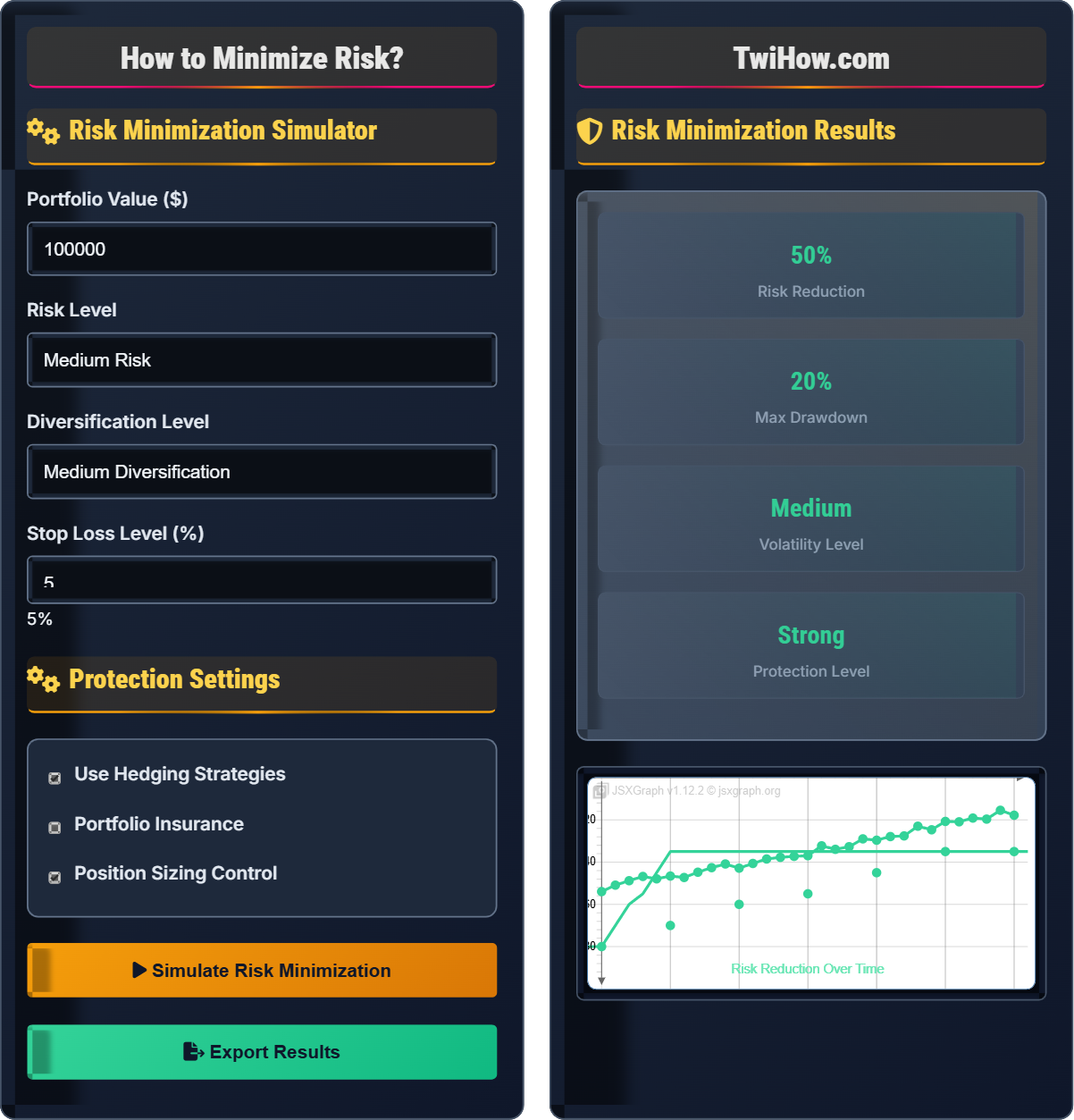
Risk Minimization Simulator
Protection Settings
Risk Minimization Results
With proper risk management, portfolio decline limited to 15% during market crash.
Controlled position sizing prevents single trade from impacting portfolio more than 2%.
Across sectors and geographies reduces correlation risk.
Risk Minimization Strategies
Investment risk refers to the possibility of losing money on an investment or the uncertainty of returns. Risk encompasses various factors including market volatility, inflation, interest rate changes, and specific investment risks. Effective risk management involves identifying, measuring, and controlling these risks while maintaining the potential for reasonable returns.
Understanding and managing risk is crucial for long-term investment success.
Where:
- Sharpe Ratio: Measure of risk-adjusted return
- Expected Return: Anticipated return on investment
- Risk-Free Rate: Return on risk-free assets
- Standard Deviation: Measure of volatility/risk
Types of investment risk:
- Market Risk: Overall market fluctuations affecting all investments
- Credit Risk: Possibility of issuer default
- Liquidity Risk: Difficulty selling assets quickly
- Inflation Risk: Erosion of purchasing power
- Interest Rate Risk: Changes affecting bond values
- Concentration Risk: Overexposure to single asset or sector
- Time Horizon: Longer periods can tolerate more risk
- Risk Tolerance: Personal comfort with volatility
- Financial Goals: Specific objectives and needs
- Age: Younger investors can take more risk
- Income Stability: Dependence on investment returns
- Overall Portfolio: How investment fits with others
Risk Management Techniques
Diversification, asset allocation, stop losses, position sizing, hedging, rebalancing.
Sharpe Ratio = (Expected Return - Risk-Free Rate) / Standard Deviation
Measures risk-adjusted return of investment.
- Never risk more than 2% per position
- Diversify across asset classes
- Use stop losses consistently
- Match risk to time horizon
Implementation Guide
Assessment, planning, diversification, monitoring, adjustment.
- Assess risk tolerance
- Set diversification targets
- Implement protective measures
- Monitor and adjust
- Rebalance annually
- Review risk regularly
- Keep emergency funds
- Stay disciplined
Risk Management Learning Quiz
What is the primary benefit of diversification in portfolio management?
The primary benefit of diversification is reducing unsystematic risk (company-specific or industry-specific risk) without necessarily sacrificing returns. Diversification cannot eliminate all risk (systematic/market risk remains), nor does it guarantee profits or increase returns. However, it can significantly reduce portfolio volatility by spreading investments across different assets that don't move in perfect correlation.
The answer is C) Reducing unsystematic risk.
Diversification is often called the "free lunch" of investing because it reduces risk without necessarily reducing expected returns. The key principle is that different assets don't move in perfect correlation, so when some investments decline, others may rise, smoothing out overall portfolio volatility. However, diversification only eliminates unsystematic risk (specific to individual companies or industries), not systematic risk (affecting the entire market).
Unsystematic Risk: Company or industry-specific risk
Systematic Risk: Market-wide risk that affects all investments
Diversification: Spreading investments across different assets
• Diversification reduces specific risk
• Cannot eliminate market risk
• Requires different asset classes
• Diversify across sectors
• Include different geographic regions
• Mix asset types (stocks, bonds, etc.)
• Thinking diversification eliminates all risk
• Diversifying across similar assets
• Not diversifying enough
Explain the concept of stop loss orders, their advantages and disadvantages, and when they should be used. Include specific scenarios where stop losses are particularly beneficial.
Stop Loss Orders: Automatic sell orders placed at a predetermined price level to limit losses on a position.
Advantages:
1. Emotion-Free Trading: Removes emotional decision-making during market stress
2. Loss Limitation: Guarantees maximum loss amount
3. Time-Saving: No need to monitor positions constantly
4. Discipline: Enforces consistent risk management
Disadvantages:
1. Whipsaw Effect: Getting stopped out during temporary volatility
2. No Control: May exit at worse price than intended
3. False Signals: Temporary breaks triggering stops
Beneficial Scenarios:
• Highly volatile stocks
• When unable to monitor markets
• Short-term trading strategies
• High-risk investments
Stop loss orders are crucial risk management tools that automate loss control. They're particularly valuable for investors who can't monitor markets continuously or those trading volatile securities. However, they're not foolproof and can result in premature exits during normal market fluctuations. The key is setting appropriate stop levels based on the security's volatility and your risk tolerance.
Stop Loss Order: Automatic sell order at preset price
Whipsaw Effect: Premature exit due to volatility
Trailing Stop: Moving stop loss that follows price
• Set stops based on risk tolerance
• Consider volatility when placing stops
• Use mental stops as backup
• Use percentage-based stops (2-5%)
• Consider trailing stops for trending stocks
• Set stops at technical support levels
• Setting stops too tight
• Not adjusting for volatility
• Ignoring market conditions
An investor has a $200,000 portfolio and follows the 2% risk rule. If they want to buy a stock trading at $80 per share with a stop loss at $72 (10% stop), calculate the maximum number of shares they can purchase according to proper risk management. Also, determine the dollar value of this position.
Calculate Maximum Risk Amount:
Maximum risk per trade = Portfolio value × Risk percentage
Maximum risk = $200,000 × 0.02 = $4,000
Calculate Position Size:
Stop loss distance = $80 - $72 = $8 per share
Maximum shares = Maximum risk ÷ Stop loss distance
Maximum shares = $4,000 ÷ $8 = 500 shares
Calculate Position Value:
Position value = Number of shares × Share price
Position value = 500 × $80 = $40,000
Verification:
Risk amount = 500 shares × $8 stop loss = $4,000 (2% of portfolio)
The investor can buy 500 shares for a total value of $40,000 while adhering to the 2% risk rule.
This calculation demonstrates proper position sizing based on risk management principles. The formula ensures that regardless of the stop loss distance, the investor never exceeds their predetermined risk tolerance. As stop losses become wider (more volatile stocks), the position size decreases proportionally to maintain the same risk level. This systematic approach prevents overexposure to any single position.
Position Sizing: Determining how many shares to buy
Stop Loss Distance: Difference between entry and stop price
Risk Per Trade: Maximum loss acceptable per trade
• Calculate position size before entering trade
• Use position sizing calculators
• Round down to nearest whole share
• Consider minimum trade increments
• Calculating position size after entry
• Ignoring stop loss distance
• Risking too much per trade
An investor is 35 years old with a 30-year investment horizon, stable income, and high risk tolerance. They're considering investing in a single biotech stock that represents 25% of their portfolio. Analyze this risk and recommend alternative approaches that would better balance risk and return for their situation.
Risk Analysis:
• Concentration Risk: 25% allocation to single stock is excessive (recommended max 2-5%)
• Industry Risk: Biotech is highly volatile and unpredictable
• Individual Risk: Single stock could go to zero
Positive Factors:
• Age allows for recovery from losses
• High risk tolerance matches strategy
Recommended Approaches:
1. Biotech ETF: Diversified exposure to multiple companies (limit to 10-15% of portfolio)
2. Healthcare Sector Fund: Broader exposure including medical devices, pharma
3. Smaller Position: Limit to 2-3% of portfolio if investing in individual biotech
4. Staggered Entry: Build position gradually over time
5. Stop Loss: Implement strict stop loss at 15-20% to limit downside
This scenario illustrates the importance of matching investment approach to risk profile while avoiding concentration risk. Even with high risk tolerance and long time horizon, diversification remains crucial. The biotech sector, while offering high potential returns, carries specific risks that require mitigation through diversification rather than concentration. The key is finding the right balance between risk and return for the individual's circumstances.
Concentration Risk: Overexposure to single asset
Biotech Risk: High volatility in pharmaceutical sectorDiversification: Spreading investments across assets
• Limit individual stocks to 2-5% of portfolio
• Match risk to personal circumstances
• Maintain diversification even with high tolerance
• Use sector ETFs for concentrated exposure
• Gradually build positions
• Maintain stop losses on risky assets
• Concentrating too much in one stock
• Ignoring diversification with high tolerance
• Not considering worst-case scenarios
Which of the following is the most effective way to reduce portfolio risk without significantly reducing expected returns?
Diversifying across uncorrelated assets is the most effective way to reduce portfolio risk without significantly reducing expected returns. This strategy reduces unsystematic risk (specific to individual investments) while maintaining exposure to market returns. Uncorrelated assets don't move in sync, so when some decline, others may rise, smoothing overall portfolio volatility. This is the essence of modern portfolio theory.
The answer is B) Diversifying across uncorrelated assets.
Diversification across uncorrelated assets is the "free lunch" of investing because it reduces risk without necessarily reducing expected returns. The key is finding assets that don't move in perfect correlation. When assets have low correlation, portfolio volatility decreases while maintaining expected returns. This is why a balanced portfolio of stocks, bonds, international investments, and other assets often performs better than concentrating in a single asset class.
Correlation: Degree to which assets move together
Uncorrelated Assets: Assets that don't move together
Modern Portfolio Theory: Diversification reduces risk
• Seek low-correlation assets
• Diversification reduces specific risk
• Maintain market exposure
• Include international investments
• Mix asset classes
• Consider different sectors
• Diversifying across correlated assets
• Not diversifying enough
• Diversifying too much (dilution)
FAQ
Q: How much of my portfolio should be in cash for risk management?
A: The amount of cash to hold depends on your situation:
• Emergency Fund: 3-6 months of expenses (separate from investment portfolio)
• Investment Portfolio: 5-10% for liquidity and opportunities
• Retirees: 10-20% for immediate expenses
• Young Investors: 2-5% is often sufficient
Too much cash reduces returns over time due to inflation, while too little leaves you unprepared for opportunities or emergencies. The key is finding the right balance for your specific needs and risk tolerance.
Q: What's the difference between risk management and risk avoidance?
A: The key differences are:
Risk Management: Accepting appropriate levels of risk while implementing controls to limit potential losses. Goal is to optimize the risk-return tradeoff.
Risk Avoidance: Completely eliminating risk by not investing, which also eliminates potential returns. This approach often results in missed opportunities.
Effective investing involves risk management rather than risk avoidance. The goal is to accept calculated risks that offer appropriate compensation while implementing strategies to limit potential downside.
Q: How should risk management change during retirement?
A: During retirement, risk management should focus on:
1. Preservation of Capital: Protecting accumulated wealth
2. Income Generation: Creating reliable income stream
3. Sequence Risk: Protecting against early losses
4. Inflation Protection: Maintaining purchasing power
Typical changes include shifting to 40-60% bonds, maintaining 1-2 years of expenses in cash, using annuities for guaranteed income, and reducing equity exposure to 40-60%.