How to Start Trading?
Complete investing guide • Step-by-step explanations
Trading Fundamentals:
Show Trading SimulatorTrading is the act of buying and selling financial instruments like stocks, bonds, commodities, or currencies to generate profits. Successful trading requires understanding market dynamics, developing strategies, managing risk, and maintaining discipline. This guide covers the essential steps to start trading safely and effectively.
Key aspects of trading:
- Capital: Starting amount needed for trading
- Strategy: Approach to buying and selling
- Risk Management: Protecting capital from losses
- Education: Continuous learning and skill development
Starting trading requires careful preparation, realistic expectations, and a commitment to learning. This guide will walk you through the essential steps to begin your trading journey safely and successfully.
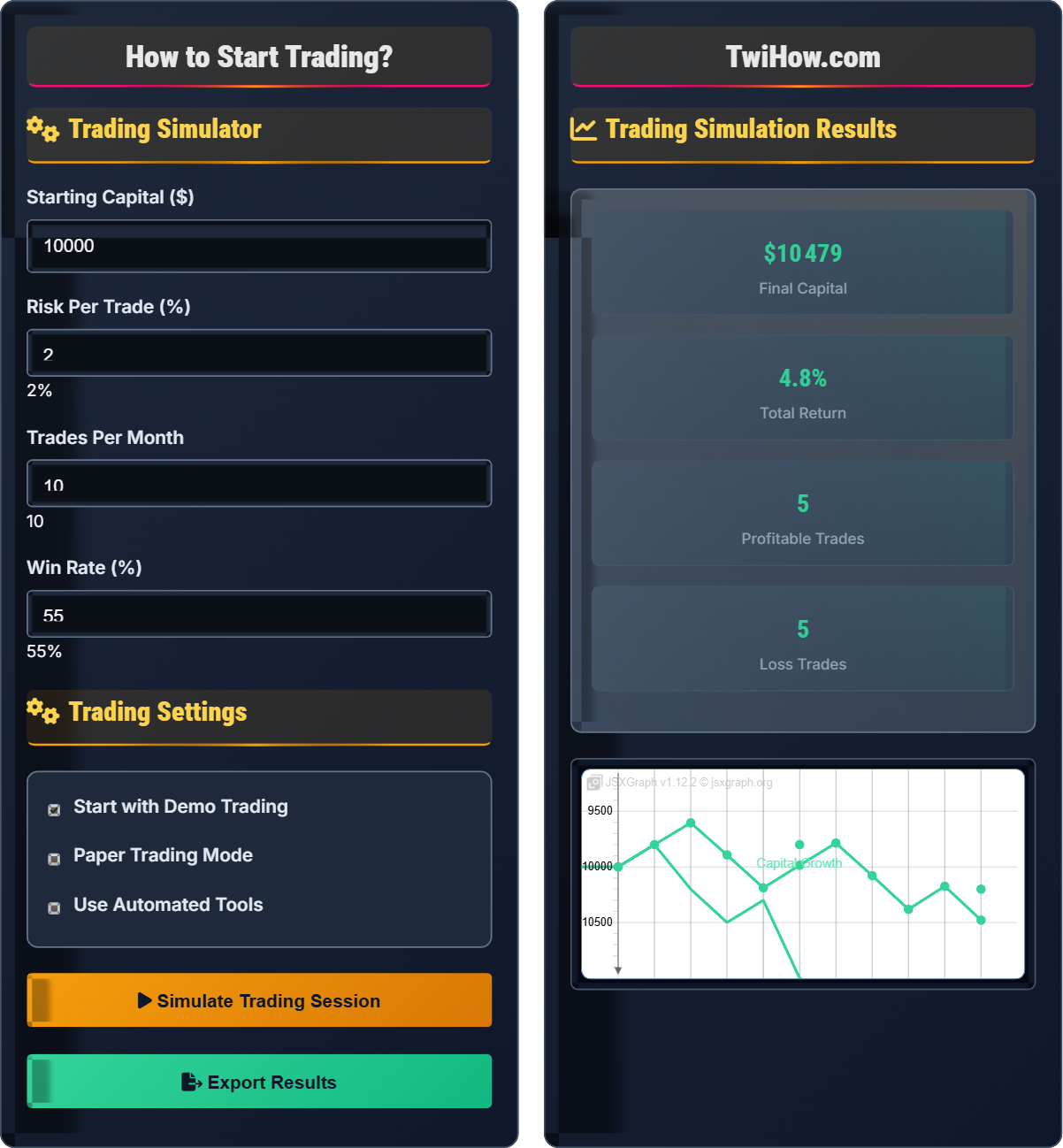
Trading Simulator
Trading Settings
Trading Simulation Results
Buy and sell securities within the same trading day to capitalize on intraday price movements.
Hold positions for several days to weeks to capture short-to-medium-term price swings.
Long-term approach holding positions for weeks to months based on fundamental analysis.
How to Start Trading
Trading is the act of buying and selling financial instruments to generate profits from price movements. Unlike investing, which focuses on long-term wealth building, trading aims to capitalize on short-term price fluctuations. Traders analyze market trends, use technical and fundamental analysis, and execute transactions based on their strategies.
Successful trading requires understanding market dynamics, developing strategies, managing risk, and maintaining discipline. It's important to note that trading involves significant risk and is not suitable for everyone.
Where:
- Account Balance: Total capital available for trading
- Risk %: Percentage of capital to risk per trade (typically 1-2%)
- Stop Loss Distance: Difference between entry price and stop loss level
Common trading strategies:
- Day Trading: Buy and sell within the same day
- Swing Trading: Hold positions for days to weeks
- Scalping: Make many trades for small profits
- Position Trading: Long-term approach with weeks to months
- Technical Analysis: Using charts and indicators
- Fundamental Analysis: Based on financial statements and news
- Never risk more than 1-2% of capital per trade
- Always use stop-loss orders
- Don't trade with money you can't afford to lose
- Maintain a trading journal
- Control emotions and stick to your plan
Trading Essentials
Capital, strategy, risk management, market analysis, position sizing, stop losses, profit targets.
Position Size = (Account Balance × Risk %) / Stop Loss Distance
Where Risk % is typically 1-2% of total capital.
- Never risk more than 2% per trade
- Always have a stop loss
- Practice before going live
- Keep emotions out of trading
Getting Started
Education, broker selection, account setup, strategy development, demo practice.
- Learn market fundamentals
- Choose a reliable broker
- Create a trading plan
- Practice with virtual money
- Start with a demo account
- Keep a trading journal
- Focus on one strategy initially
- Manage risk carefully
Trading Learning Quiz
According to best practices, what is the maximum percentage of your trading capital you should risk on a single trade?
According to risk management best practices, traders should never risk more than 1-2% of their total trading capital on a single trade. This conservative approach helps preserve capital and allows traders to withstand losing streaks without significant damage to their account. Risking more than 2% per trade significantly increases the probability of substantial account drawdowns.
The answer is B) 1-2%.
Risk management is the cornerstone of successful trading. The 1-2% rule is a fundamental principle that protects traders from catastrophic losses. Even with a win rate of 50%, a trader risking 10% per trade could lose 50% of their account after just 7 consecutive losses. However, with only 2% risk per trade, the same losing streak would result in only a 14% account decline. This demonstrates why position sizing is more important than finding winning trades.
Position Sizing: Determining how much capital to risk per trade
Drawdown: Reduction in account value from peak to trough
Risk Management: Protecting capital through position sizing
• Risk 1-2% maximum per trade
• Never risk more than you can afford to lose
• Adjust position size based on stop distance
• Calculate position size before entering trade
• Use stop losses religiously
• Reduce position size during volatile periods
• Risking too much per trade
• Not using stop losses
• Increasing position size after losses
Explain the components of a comprehensive trading plan and why it's essential for successful trading. Include specific elements that should be included.
Trading Plan Components: A comprehensive trading plan should include:
1. Goals: Specific, measurable objectives (monthly/yearly returns, risk tolerance)
2. Strategies: Entry/exit criteria, technical/fundamental analysis methods
3. Risk Management: Position sizing rules, stop loss placement, maximum daily/monthly loss limits
4. Markets: Which instruments to trade (stocks, forex, commodities)
5. Timeframes: Intraday, swing, or position trading
6. Record Keeping: Trading journal format and review process
Why It's Essential: A trading plan removes emotion from decision-making, provides discipline, and creates a framework for consistent performance evaluation.
A trading plan serves as a roadmap for your trading activities, similar to how a business plan guides a company. Without a plan, traders often make impulsive decisions based on emotions rather than analysis. The plan helps maintain consistency, provides a framework for evaluating performance, and allows for systematic improvements to trading methods. It's particularly important for beginners who are prone to emotional decision-making.
Trading Plan: Document outlining trading approach and rules
Position Sizing: Amount of capital per trade
Stop Loss: Order to close trade at predetermined loss level
• Follow the plan consistently
• Review and update regularly
• Backtest strategies before implementation
• Keep the plan simple and actionable
• Include specific entry/exit rules
• Define success metrics
• Not having a written plan
• Deviating from the plan
• Having unrealistic expectations
An investor has a $25,000 trading account and follows the 2% risk rule. If they plan to buy a stock at $50 per share with a stop loss at $47 (3-point stop), calculate the maximum number of shares they can purchase according to proper risk management.
Calculate Maximum Risk Amount:
Maximum risk per trade = Account balance × Risk percentage
Maximum risk = $25,000 × 0.02 = $500
Calculate Position Size:
Stop loss distance = $50 - $47 = $3 per share
Maximum shares = Maximum risk ÷ Stop loss distance
Maximum shares = $500 ÷ $3 = 166.67 shares
Since you can't buy fractional shares, round down to 166 shares.
Verification:
Risk amount = 166 shares × $3 stop loss = $498 (within 2% limit)
The investor can buy a maximum of 166 shares while adhering to the 2% risk rule.
This calculation demonstrates the practical application of risk management in trading. The formula ensures that regardless of the stop loss distance, the trader never exceeds their predetermined risk tolerance. As stop losses become wider (more volatile stocks), the position size decreases proportionally to maintain the same risk level. This systematic approach prevents overexposure to any single trade.
Position Sizing: Determining how many shares to buy
Stop Loss Distance: Difference between entry and stop price
Risk Per Trade: Maximum loss acceptable per trade
• Calculate position size before entering trade
• Use position sizing calculators
• Round down to nearest whole share
• Consider minimum trade increments
• Calculating position size after entry
• Ignoring stop loss distance
• Risking too much per trade
A new trader experiences 5 consecutive losing trades and decides to double their position size on the next trade to recover losses quickly. Analyze this behavior, explain why it's problematic, and suggest better alternatives for managing emotions during losing streaks.
Analysis of Behavior:
The trader is exhibiting "revenge trading" - attempting to recover losses quickly by increasing risk. This is a classic psychological trap that often leads to larger losses.
Problems with This Approach:
1. Increased Risk: Doubling position size doubles potential losses
2. Emotional Decision: Trading based on frustration rather than analysis
3. Compounding Losses: If the next trade fails, losses increase exponentially
4. Violates Risk Management: Exceeds predetermined risk limits
Better Alternatives:
1. Take a Break: Step away from trading to regain composure
2. Review Strategy: Analyze if losing streak indicates strategy flaws
3. Reduce Position Size: Trade smaller to rebuild confidence
4. Stick to Plan: Follow predetermined risk management rules
Trading psychology is often the biggest obstacle to success. Emotional reactions to losses can lead to dangerous behaviors like revenge trading, which typically results in even greater losses. Successful traders maintain discipline during both winning and losing streaks, adhering to their risk management rules regardless of recent outcomes. Understanding and managing emotions is crucial for long-term trading success.
Revenge Trading: Increasing risk to recover losses
Emotional Trading: Decisions based on feelingsDiscipline: Following rules despite emotions
• Never chase losses
• Maintain discipline during streaks
• Follow risk management rules
• Take breaks after losing streaks
• Keep a trading journal
• Focus on process, not results
• Doubling down after losses
• Abandoning strategy during stress
• Not tracking emotions
Which of the following is the MOST important step before starting live trading?
While all steps are important, developing a comprehensive trading plan is the most critical first step. A trading plan establishes your goals, strategies, risk management rules, and decision-making framework. Without a plan, other activities like practicing or opening accounts lack direction and purpose. The plan serves as your foundation and roadmap for all trading activities.
The answer is C) Developing a trading plan.
Creating a trading plan before any other activity is essential because it defines your approach, risk tolerance, and objectives. Without a plan, traders often make inconsistent decisions, fail to manage risk properly, and lack a framework for evaluating performance. The plan should be developed first, then practiced extensively with a demo account, and finally implemented with real money once consistent profitability is demonstrated in simulation.
Trading Plan: Comprehensive strategy document
Risk Management: Capital preservation methodology
Strategy Framework: Guideline for trade decisions
• Plan before executing
• Practice before risking capital
• Follow plan consistently
• Write the plan before opening accounts
• Test plan with paper trading
• Update plan based on experience
• Starting without a plan
• Jumping to live trading
• Not backtesting strategies
FAQ
Q: How much money do I need to start trading?
A: The amount needed varies by broker and market, but here are general guidelines:
1. Stock Trading: Many brokers now offer $0 commissions, so you can start with $500-$1,000 for basic trading
2. Day Trading: FINRA requires $25,000 minimum for pattern day trading in the US
3. Forex Trading: Can start with $100-$500, but more is recommended for proper risk management
4. Options Trading: $1,000-$5,000 minimum is typically recommended
However, it's strongly recommended to start with more than the minimum to allow for proper diversification and risk management.
Q: What's the difference between trading and investing?
A: The key differences between trading and investing are:
Time Horizon: Investing is typically long-term (years to decades), while trading focuses on shorter periods (days to months).
Goal: Investing builds wealth over time through compound growth, while trading seeks to profit from market volatility.
Strategy: Investing relies on fundamental analysis and company growth, while trading often uses technical analysis and market timing.
Risk: Trading generally carries higher risk due to frequent transactions and market timing requirements.
Both approaches can coexist in a portfolio, but they require different skills and mindsets.
Q: What are the most important skills for successful trading?
A: The most important skills for successful trading include:
1. Risk Management: Ability to protect capital and limit losses
2. Emotional Control: Managing fear, greed, and other emotions
3. Discipline: Following your plan consistently
4. Analysis Skills: Both technical and fundamental analysis
5. Adaptability: Adjusting to changing market conditions
6. Record Keeping: Tracking performance and learning from mistakes
While analytical skills are important, psychological and risk management skills are often more critical to long-term success.