Is Crypto Safe?
Complete crypto safety guide • Step-by-step explanations
Cryptocurrency Safety Fundamentals:
Show Safety AnalysisThe safety of cryptocurrency depends on how you use it. While the underlying blockchain technology is secure, crypto investments face numerous risks including technical vulnerabilities, human error, scams, and regulatory uncertainty. Crypto can be safe when proper security measures are implemented, but it requires vigilance and knowledge of potential threats.
Key crypto safety components:
- Wallet Security: Protecting private keys and recovery phrases
- Exchange Security: Choosing reputable platforms
- Scam Awareness: Identifying fraudulent schemes
- Phishing Protection: Avoiding fake websites and emails
- Multi-Factor Authentication: Adding security layers
- Education: Understanding risks and best practices
Safety in crypto requires a combination of technical knowledge, security best practices, and awareness of potential threats.
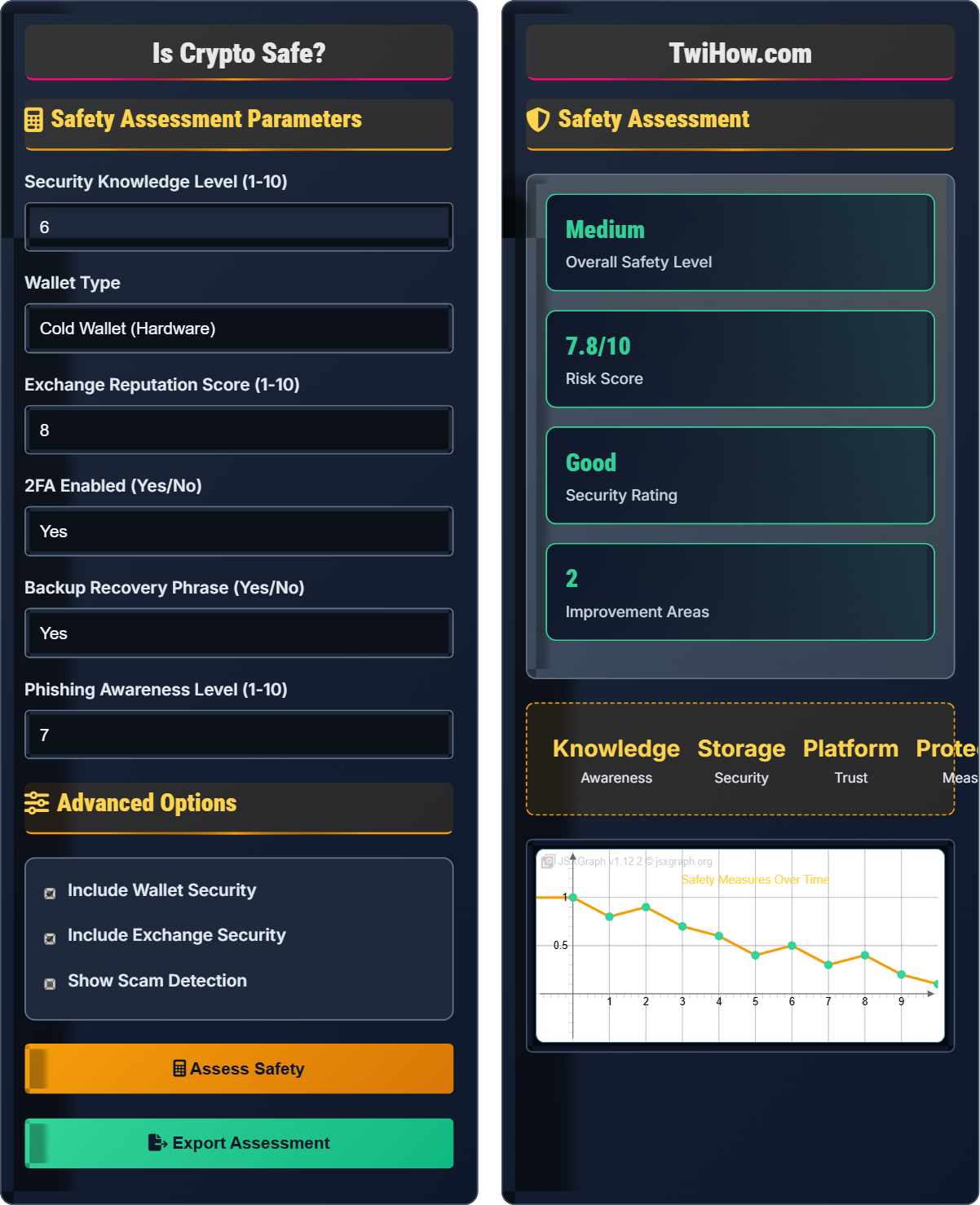
Safety Assessment Parameters
Advanced Options
Safety Assessment
Key concepts for crypto safety:
- Private keys control access to crypto assets
- Recovery phrases are irreplaceable backups
- Exchanges hold custody of funds
- Phishing attempts target crypto users
- Scams exploit knowledge gaps
- Security is a continuous process
| Category | Score | Recommendation | Risk Level |
|---|---|---|---|
| Knowledge | 6/10 | Improve education | Medium |
| Wallet Security | 8/10 | Good choice | Low |
| Exchange Trust | 8/10 | Good selection | Low |
| 2FA Enabled | 10/10 | Excellent | Very Low |
| Backup Security | 5/10 | Improve backup | High |
How Crypto Safety Works
The safety of cryptocurrency depends on how you interact with it. The underlying blockchain technology is mathematically secure and resistant to tampering. However, the ecosystem around crypto—including exchanges, wallets, and user practices—introduces various risks. Crypto can be safe when proper security measures are implemented, but it requires vigilance and knowledge of potential threats.
Where:
- Safety Score: Overall security rating
- Security Measures: Protective actions taken
- Risk Factors: Potential threats and vulnerabilities
- User Knowledge: Understanding of security best practices
Effective crypto safety strategies include:
- Multi-Layer Security: Combine different protection methods
- Principle of Least Privilege: Minimize exposure to risks
- Regular Updates: Keep software and knowledge current
- Backup and Recovery: Ensure access recovery options
- Education and Awareness: Stay informed about new threats
- Slow and Deliberate Actions: Verify transactions carefully
- Never Share Private Keys: Anyone with your keys controls your funds
- Verify Addresses: Double-check addresses before sending
- Use Hardware Wallets: For significant holdings
- Enable 2FA: Always use multi-factor authentication
- Secure Backups: Store recovery phrases safely
- Be Skeptical: Question unsolicited offers and deals
Cryptocurrency Safety Fundamentals
Private keys, recovery phrases, cold storage, hot wallets, 2FA, phishing, scams, security measures.
Safety Score = (Security Measures / Risk Factors) × User Knowledge
Risk Exposure = Asset Value × Threat Probability × Vulnerability
Where Safety Score indicates overall security level.
- Never share private keys or recovery phrases
- Use hardware wallets for significant holdings
- Always enable 2FA on accounts
- Verify addresses before sending funds
- Be skeptical of unsolicited offers
Safety Applications
Wallet security, exchange safety, scam prevention, phishing protection, backup strategies.
- Learn about crypto security threats
- Choose appropriate wallet type
- Set up multi-factor authentication
- Securely store recovery phrases
- Select reputable exchanges
- Monitor accounts regularly
- Use hardware wallets for large amounts
- Keep software updated
- Verify all transactions carefully
- Stay informed about new threats
Safety Analysis Tools
Calculate the security level of different wallet types and configurations.
Assess the safety level of cryptocurrency exchanges.
Identify potential scam risks in crypto investments.
Calculate overall crypto investment risk level.
Plan for crypto asset recovery in case of loss or theft.
Crypto Safety Learning Quiz
What is the most important thing to remember about your private key?
Your private key is the ultimate authority over your cryptocurrency. Anyone who gains access to your private key can control and transfer your crypto assets. Unlike traditional banking where you can recover access through customer service, crypto assets are lost forever if the private key is compromised and funds are transferred. This is why keeping private keys secret and secure is paramount in crypto safety.
The answer is B) Anyone with it controls your funds.
This question emphasizes the fundamental difference between traditional finance and cryptocurrency. In banks, there are recovery mechanisms and customer service to help retrieve access. In crypto, the decentralized nature means there's no central authority to call. Your private key is literally the key to your digital assets. The mathematical relationship between private keys and crypto addresses makes this absolute control possible, but also creates the security imperative to never share or expose these keys.
Private Key: Secret number that allows spending crypto
Public Key: Derived from private key, visible to others
Decentralized: No central authority controlling assets
• Never share private keys with anyone
• Store private keys securely offline
• Treat private keys like physical cash
• Use hardware wallets for significant holdings
• Write down recovery phrases on paper
• Store backups in multiple secure locations
• Sharing private keys online
• Storing keys in plain text
• Not backing up recovery phrases
What factors should you consider when evaluating the safety of a cryptocurrency exchange? Why is exchange safety critical to crypto security?
Factors for Exchange Safety:
1. Security Audits: Third-party security assessments
2. Insurance Coverage: Protection for customer funds
3. Regulatory Compliance: Following legal requirements
4. History of Breaches: Past security incidents
5. Withdrawal Policies: How funds are protected
Criticality: When you leave crypto on an exchange, you're trusting the exchange with custody of your funds. Exchanges have been hacked repeatedly, resulting in billions of dollars stolen. Unlike personal wallets where you control the private keys, exchanges hold custody of your assets, making their security crucial to your safety.
Exchange safety is crucial because exchanges are prime targets for hackers due to the concentration of valuable assets. The saying "not your keys, not your crypto" emphasizes this risk. When you trade on an exchange, you're essentially giving them custody of your assets. The exchange's security measures, operational practices, and financial stability directly affect your fund safety. This is why security-conscious users often practice "cold storage" by moving funds to personal wallets after trading.
Exchange: Platform for buying, selling crypto
Custody: Holding control over assets
Hot Wallet: Online wallet connected to internet
• Keep only trading amounts on exchanges
• Research exchange security before depositing
• Enable all security features available
• Use well-established exchanges with proven track records
• Enable 2FA and use authenticator apps
• Withdraw funds to personal wallets after trading
• Leaving large amounts on exchanges
• Not researching exchange security
• Using weak passwords and no 2FA
You receive an email claiming to be from your crypto exchange, stating there's suspicious activity on your account and asking you to click a link to "verify" your account. The email address looks slightly different from the official one. What should you do, and what are the signs that indicate this might be a phishing attempt?
Immediate Action: Do NOT click the link or provide any information. Instead, navigate directly to the official exchange website through your bookmarks or by typing the URL manually.
Phishing Indicators:
1. Spoofed Email Address: Slight variations in domain names
2. Urgency Tactics: Claims of immediate action required
3. Generic Greetings: "Dear Customer" instead of your name
4. Suspicious Links: URLs that don't match official site
5. Threatening Language: Account closure if not acted upon
Verification: Contact the exchange through official channels to confirm the legitimacy of the communication.
Phishing is one of the most common threats in the crypto space. Attackers often impersonate legitimate services to steal login credentials or private information. The key to identifying phishing is looking for inconsistencies: slight misspellings in domains, generic greetings, urgent language, and requests for sensitive information. Legitimate companies rarely ask for sensitive information via email. The safest approach is always to go directly to the official website rather than clicking links in emails.
Phishing: Fraudulent attempt to obtain sensitive info
Spoofing: Fake email addresses mimicking legitimate ones
2FA: Two-Factor Authentication for security
• Never click links in unsolicited emails
• Always verify by contacting companies directly
• Check URLs carefully before entering info
• Bookmark official websites for direct access
• Hover over links to see actual destination
• Enable email filtering for known senders
• Clicking links without verifying sender
• Providing credentials on fake sites
• Not recognizing spoofed domains
You're considering a hardware wallet for your crypto investments. Compare the security benefits of hardware wallets versus software wallets. What are the potential vulnerabilities of hardware wallets, and how should you properly set up and maintain one for maximum security?
Hardware Wallet Benefits:
1. Offline Storage: Private keys never touch internet-connected device
2. Physical Button Confirmation: Prevents unauthorized transactions
3. Secure Chip: Protected from malware on connected devices
4. Recovery Phrase: Backup for accessing funds
Potential Vulnerabilities:
• Physical theft of device
• Counterfeit hardware wallets
• Malware on connecting computer
• Social engineering attacks
Setup Recommendations:
• Purchase from official source only
• Verify device authenticity
• Write recovery phrase on paper
• Store backup in multiple secure locations
Hardware wallets represent the gold standard for crypto storage security. They address the fundamental weakness of software wallets—exposure to internet-based threats. The offline signing process ensures that private keys never exist on a device connected to the internet. However, hardware wallets aren't invulnerable—they still require proper physical security and careful setup procedures. The recovery phrase is both a security feature and a vulnerability point, requiring careful handling and storage.
Hardware Wallet: Physical device storing private keys offline
Software Wallet: Digital wallet on internet-connected device
Recovery Phrase: Backup words to restore wallet access
• Buy hardware wallets only from manufacturers
• Never enter recovery phrase online
• Verify device authenticity before setup
• Test recovery phrase before storing large amounts
• Use tamper-evident packaging
• Keep firmware updated
• Purchasing from unofficial sources
• Storing recovery phrase digitally
• Not testing recovery procedure
Which of the following is the most secure method for implementing multi-factor authentication (2FA) for crypto accounts?
Authenticator apps generate time-based one-time passwords (TOTP) locally on your device without relying on network communication. This makes them more secure than SMS or email, which can be intercepted through SIM swapping or email account compromises. Authenticator apps are considered the gold standard for 2FA security, though they should be backed up properly to prevent account lockout.
The answer is C) Authenticator app (Google Authenticator, Authy).
While all forms of 2FA are better than none, the security level varies significantly. SMS-based 2FA is vulnerable to SIM swapping attacks where attackers convince carriers to transfer phone numbers. Email 2FA can be compromised if email accounts are breached. Authenticator apps generate codes locally without network transmission, making them much harder to intercept. However, users must ensure they have backup recovery options in case they lose access to their authenticator device.
2FA: Two-Factor Authentication for security
TOTP: Time-based One-Time Password
SIM Swapping: Fraudulent phone number transfer
• Use authenticator apps over SMS/email
• Secure backup codes properly
• Don't store 2FA secrets on same device as crypto
• Use cloud-synced authenticator apps for recovery
• Print backup codes and store securely
• Consider hardware security keys for critical accounts
• Using SMS 2FA for high-value accounts
• Not securing backup recovery codes
• Storing 2FA seeds in same location as crypto
FAQ
Q: What's the safest way to store cryptocurrency for beginners?
A: For beginners, I recommend a staged approach:
1. Start Small: Begin with small amounts to learn
2. Hot Wallet: Use a reputable mobile wallet initially
3. Learn Security: Master backup procedures
4. Upgrade: Move to hardware wallet for larger amounts
5. Practice: Test recovery procedures
Popular beginner-friendly hardware wallets include Ledger Nano S/X and Trezor. The key is learning proper security practices before holding significant amounts. Never rush into storing large sums without understanding the recovery process.
Q: How can I tell if a crypto investment opportunity is a scam?
A: Warning signs of crypto scams:
1. Guaranteed Returns: "Risk-free" or "guaranteed" high returns
2. Urgency Pressure: "Act now" or "limited time" tactics
3. Unsolicited Offers: Unexpected investment opportunities
4. Complexity Claims: "Secret" technology or strategies
5. Referral Bonuses: "Earn by bringing others"
6. Poor Communication: Unprofessional websites/messages
7. Regulatory Issues: No proper licensing or registration
If it sounds too good to be true, it probably is. Legitimate crypto investments carry risks and don't promise guaranteed returns.
Q: What should I do if I think I've been hacked or scammed?
A: Immediate actions if compromised:
1. Stop Activity: Cease all transactions immediately
2. Secure Other Accounts: Change passwords on related accounts
3. Document Evidence: Screenshots, transaction IDs, communications
4. Contact Support: Reach out to affected platforms/exchanges
5. Report Incident: File complaints with relevant authorities
6. Monitor Accounts: Watch for further unauthorized activity
7. Learn Recovery: If you have recovery phrases, move funds
Note: Unlike traditional banking, crypto transactions are irreversible, so prevention is more important than recovery.