What is Bear Market?
Complete investing guide • Step-by-step explanations
Bear Market Fundamentals:
Show Bear Market SimulatorA bear market is a market condition characterized by declining prices, typically defined as a drop of 20% or more from recent highs. The term comes from the way bears attack their prey—swiping their paws downward. Bear markets are associated with economic downturns, reduced investor confidence, and pessimistic sentiment.
Key characteristics of bear markets:
- Price Decline: Sustained drop of 20% or more from peak values
- Duration: Usually lasts months to years
- Economic Factors: Often accompanied by recession or economic slowdown
- Psychology: Pessimism and fear drive selling pressure
Bear markets are part of the natural market cycle and historically have been followed by bull markets. Understanding bear markets helps investors prepare for downturns and make informed decisions about risk management and portfolio allocation.
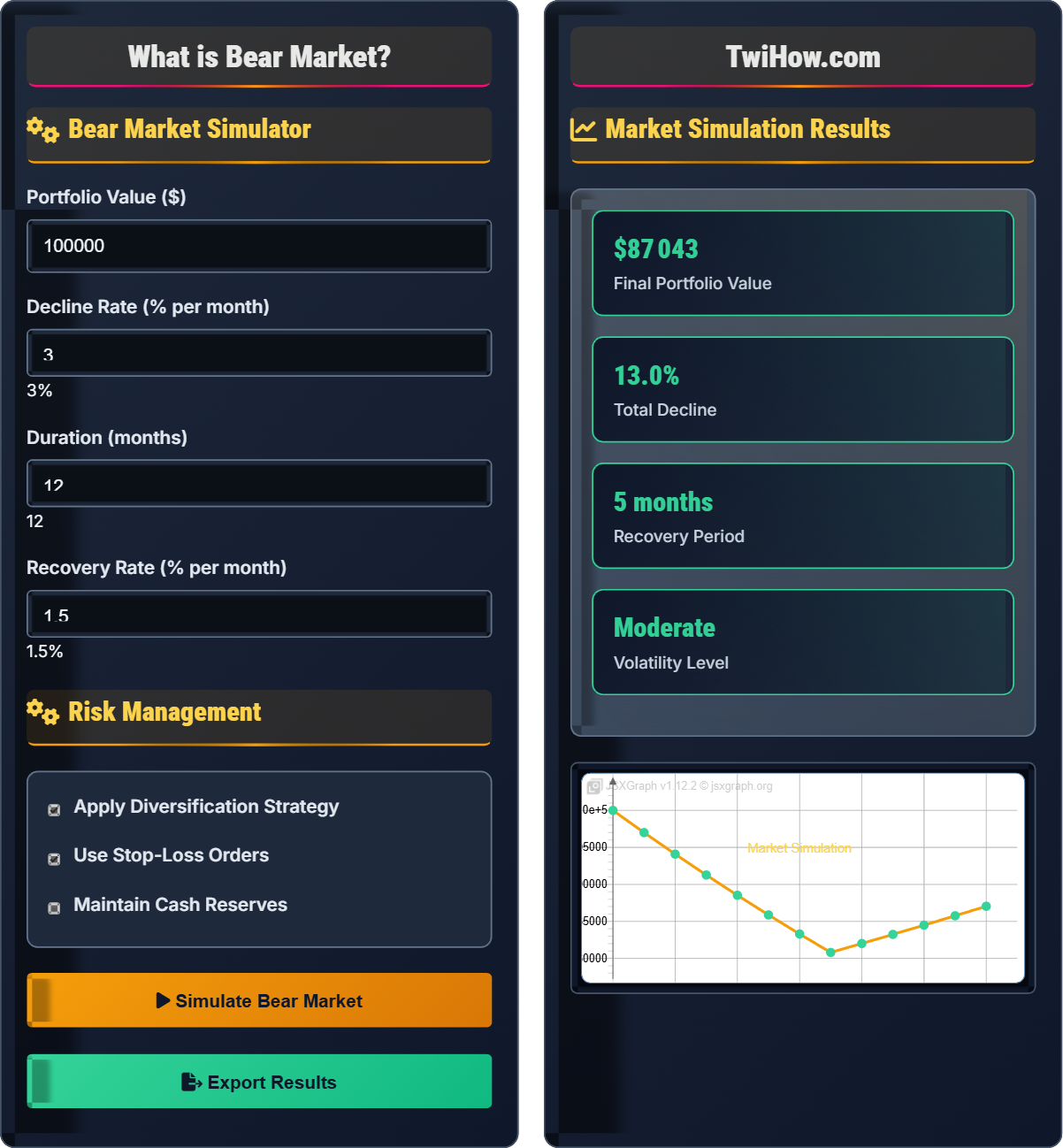
Bear Market Simulator
Risk Management
Market Simulation Results
Maintain a diversified portfolio with defensive assets like bonds, utilities, and consumer staples during bear markets.
Continue investing regularly regardless of market conditions to average out purchase prices over time.
Reduce leverage, increase cash reserves, and set stop-loss orders to limit potential losses.
Bear Market Explained
A bear market is a market condition in which securities prices fall and widespread pessimism causes the negative sentiment to be self-sustaining. It is defined as a decline of 20% or more from recent highs. The term originates from the way bears attack their prey—swiping their paws downward.
Bear markets are part of the natural market cycle and historically occur periodically. They are often accompanied by economic recessions, rising unemployment, and reduced corporate earnings.
Where:
- Peak Price: Highest price point before decline
- Current Price: Current market price
- Decline: Must be ≥ 20% to qualify as bear market
Common triggers of bear markets:
- Economic Recession: GDP contraction, rising unemployment
- Interest Rate Hikes: Central bank policy tightening
- Inflation: Rising costs eroding purchasing power
- Geopolitical Events: Wars, political instability
- Corporate Earnings: Declining profits and guidance
- Market Sentiment: Shift from optimism to pessimism
- Great Depression (1929-1932): 89% decline
- Dot-com Bubble (2000-2002): 49% decline
- Global Financial Crisis (2007-2009): 57% decline
- COVID-19 Crash (2020): 34% decline (brief but sharp)
Bear Market Characteristics
Declining prices, high volatility, increased trading volume, pessimistic sentiment, rising unemployment, falling corporate earnings.
Decline = ((Peak Price - Current Price) / Peak Price) × 100%
Where Decline ≥ 20% indicates bear market conditions.
- 20% decline from peak defines bear market
- Bear markets eventually recover
- Diversification reduces risk exposure
- Long-term perspective helps weather volatility
Investment Strategies
Dollar-cost averaging, diversification, defensive stocks, cash reserves, stop-loss orders.
- Reduce portfolio risk
- Increase defensive positions
- Look for buying opportunities
- Maintain emergency reserves
- Don't panic sell
- Stay invested for recovery
- Focus on quality companies
- Consider tax-loss harvesting
Bear Market Learning Quiz
What percentage decline from recent highs defines a bear market?
A bear market is technically defined as a decline of 20% or more from recent highs. This is the standard threshold used by analysts and economists to identify bear market conditions. The 20% benchmark represents a significant enough decline to indicate a sustained downward trend rather than normal market volatility.
The answer is C) 20% decline.
Understanding the precise definition of a bear market is crucial for investors because it helps distinguish between normal market corrections and more serious downturns. The 20% threshold is widely accepted because it represents a meaningful loss of wealth that typically correlates with broader economic concerns. Corrections (less than 20%) are considered normal market adjustments, while bear markets often signal deeper economic issues.
Bear Market: A market condition with prices declining by 20% or more from recent highs
Correction: A decline of 10-20% from recent highs
Bull Market: A market condition with rising prices and optimistic sentiment
• Bear market = 20% or more decline from peak
• Corrections are smaller temporary declines
• Duration matters alongside percentage
• Remember: 20% decline = bear market
• Look at major indices for confirmation
• Consider both percentage and duration
• Confusing corrections with bear markets
• Applying definition to individual stocks
• Ignoring the duration aspect
Explain the dollar-cost averaging strategy and why it's beneficial during bear markets. Include specific advantages and potential drawbacks.
Dollar-Cost Averaging (DCA): This strategy involves investing a fixed amount of money at regular intervals regardless of market conditions. During bear markets, DCA becomes particularly advantageous because you're purchasing more shares when prices are low.
Advantages during bear markets:
1. Lower Average Cost: You buy more shares when prices are down, reducing your average cost basis
2. Reduced Timing Risk: You don't need to predict market bottoms
3. Psychological Benefits: Regular investing reduces emotional decision-making
4. Consistent Approach: Maintains discipline during volatile periods
Drawbacks: Potential missed opportunities if market continues rising, transaction costs may be higher, and it may take longer to see gains compared to lump-sum investing.
Dollar-cost averaging is a powerful strategy during bear markets because it takes advantage of lower prices without requiring perfect market timing. By investing fixed amounts regularly, you naturally buy more shares when prices are low and fewer when prices are high. This approach helps smooth out market volatility and reduces the risk of making poor investment decisions based on emotion during turbulent times.
Dollar-Cost Averaging: Investing fixed amounts at regular intervals regardless of market price
Average Cost Basis: Average price paid for shares over time
Timing Risk: Risk of investing at wrong time
• Invest fixed amounts regularly
• Ignore short-term price movements
• Maintain consistent schedule
• Automate investments for consistency
• Use during both up and down markets
• Combine with asset allocation
• Stopping during market downturns
• Changing schedule based on emotions
• Not considering transaction costs
An investor has a $50,000 portfolio that enters a bear market with a 35% decline. If the investor had maintained 20% in cash reserves and the rest in stocks, calculate the portfolio's value after the decline. Then determine how much additional decline was avoided compared to a 100% stock portfolio.
Initial Allocation:
Cash: $50,000 × 20% = $10,000
Stocks: $50,000 × 80% = $40,000
After 35% Stock Decline:
Cash: $10,000 (unchanged)
Stocks: $40,000 × (1 - 0.35) = $40,000 × 0.65 = $26,000
Total Portfolio: $10,000 + $26,000 = $36,000
For 100% Stock Portfolio:
$50,000 × (1 - 0.35) = $50,000 × 0.65 = $32,500
Additional Decline Avoided:
$36,000 - $32,500 = $3,500
The investor avoided $3,500 in losses by maintaining cash reserves.
This calculation demonstrates the protective effect of diversification and cash reserves during bear markets. By holding some portion of the portfolio in cash (which maintains its value during stock market declines), the investor reduces overall portfolio risk. The example shows that even a modest 20% cash allocation can significantly reduce losses during severe market downturns.
Portfolio Allocation: Distribution of investments across asset classes
Cash Reserves: Liquid assets held for safety and opportunity
Diversification: Spreading investments to reduce risk
• Higher cash allocation = less volatility
• Opportunity cost during bull markets
• Balance protection vs. growth
• Maintain 10-20% cash in volatile times
• Rebalance during market extremes
• Use reserves for buying opportunities
• Too little cash during bear markets
• Not rebalancing during volatility
• Missing opportunity to buy low
A bear market begins when an index is at 10,000 points and falls to 6,500 points over 18 months. It then recovers to 12,000 points over the next 24 months. Calculate the total percentage decline during the bear market, the recovery rate per month, and explain why the recovery period might be longer than the decline phase.
Total Percentage Decline:
((10,000 - 6,500) / 10,000) × 100% = (3,500 / 10,000) × 100% = 35%
Recovery Rate Per Month:
From 6,500 to 12,000 over 24 months
Total gain: 12,000 - 6,500 = 5,500
Monthly gain: 5,500 / 24 = 229.17 points per month
Percentage monthly gain: (229.17 / 6,500) × 100% ≈ 3.5% per month
Why Recovery Takes Longer:
1. Economic fundamentals need time to repair
2. Investor confidence rebuilds slowly
3. Corporate earnings recovery lags
4. Credit markets need healing
5. Psychological damage takes time to overcome
Bear market recoveries typically take longer than the decline phase due to the time required to rebuild economic fundamentals and investor confidence. While declines can happen quickly due to panic selling, recovery requires sustained economic improvement, corporate earnings growth, and renewed investor optimism. This asymmetry is a key characteristic of market cycles.
Market Decline: Rapid price reduction phase
Market Recovery: Gradual price rebuilding phaseInvestor Confidence: Collective belief in market stability
• Declines are usually faster than recoveries
• Economic fundamentals drive recovery
• Patience is required for full recovery
• Stay invested during recovery periods
• Focus on quality during downturns
• Expect longer recovery than decline
• Expecting quick recovery
• Selling before recovery begins
• Ignoring economic indicators
Which of the following is LEAST likely to occur during a bear market?
During bear markets, investor confidence typically decreases rather than rises. Bear markets are characterized by pessimism, fear, and uncertainty among investors. The other options are all common characteristics of bear markets: increased volatility, declining corporate earnings, and economic recessions often accompany bear market conditions.
The answer is B) Rising investor confidence.
Understanding the psychological aspects of bear markets is crucial for investors. Bear markets are driven by fear and uncertainty, which lead to decreased investor confidence. This creates a feedback loop where declining prices cause more selling, further driving prices down. Recognizing this pattern helps investors avoid panic selling and maintain a long-term perspective during difficult periods.
Investor Confidence: Collective belief in future market performance
Market Volatility: Degree of price fluctuation
Feedback Loop: Self-reinforcing market mechanism
• Bear markets = decreased confidence
• Volatility increases during downturns
• Economic factors influence markets
• Focus on fundamentals, not emotions
• Maintain long-term perspective
• Look for contrarian opportunities
• Letting emotions drive decisions
• Confusing corrections with bear markets
• Selling at market bottoms
FAQ
Q: Should I sell all my stocks when a bear market starts?
A: Generally, selling everything during a bear market is not advisable because it locks in losses and prevents participation in the eventual recovery. Instead, consider these approaches:
1. Reassess your risk tolerance and asset allocation
2. Reduce exposure gradually rather than selling everything
3. Increase cash reserves for opportunities
4. Focus on quality companies with strong balance sheets
Historically, markets have recovered from every bear market, and those who stayed invested typically recovered their losses and achieved gains over the long term.
Q: How do bear markets affect retirement portfolios differently?
A: Bear markets pose unique challenges for retirees due to the "sequence of returns risk." When withdrawing money from a declining portfolio, you're selling assets at low prices, which can permanently damage long-term sustainability. Retirees should:
1. Maintain larger cash buffers (2-5 years of expenses)
2. Focus on income-producing assets like dividend stocks and bonds
3. Adjust withdrawal rates during downturns
4. Consider annuities for guaranteed income streams
The key is preserving capital while maintaining sufficient income during retirement years.
Q: Is a bear market a good time to invest for young people?
A: Yes, bear markets can present excellent opportunities for young investors with long time horizons. Here's why:
1. Lower entry prices mean you can buy quality assets at discounts
2. Dollar-cost averaging becomes more effective when prices are low
3. Long-term perspective allows time to ride out volatility
4. Learning experience provides valuable market education
However, maintain a balanced approach: continue regular contributions, focus on quality companies, and avoid trying to time the exact bottom. The key is staying invested for the long-term recovery.