What is Bull Market?
Complete investing guide • Step-by-step explanations
Bull Market Fundamentals:
Show Bull Market SimulatorA bull market is a market condition characterized by rising prices, typically defined as a rise of 20% or more from recent lows. The term comes from the way bulls attack their prey—thrusting their horns upward. Bull markets are associated with economic growth, increased investor confidence, and optimistic sentiment.
Key characteristics of bull markets:
- Price Rise: Sustained increase of 20% or more from trough values
- Duration: Usually lasts months to years
- Economic Factors: Often accompanied by economic expansion and low unemployment
- Psychology: Optimism and greed drive buying pressure
Bull markets are part of the natural market cycle and historically have followed bear markets. Understanding bull markets helps investors capitalize on rising trends and make informed decisions about portfolio growth and opportunity identification.
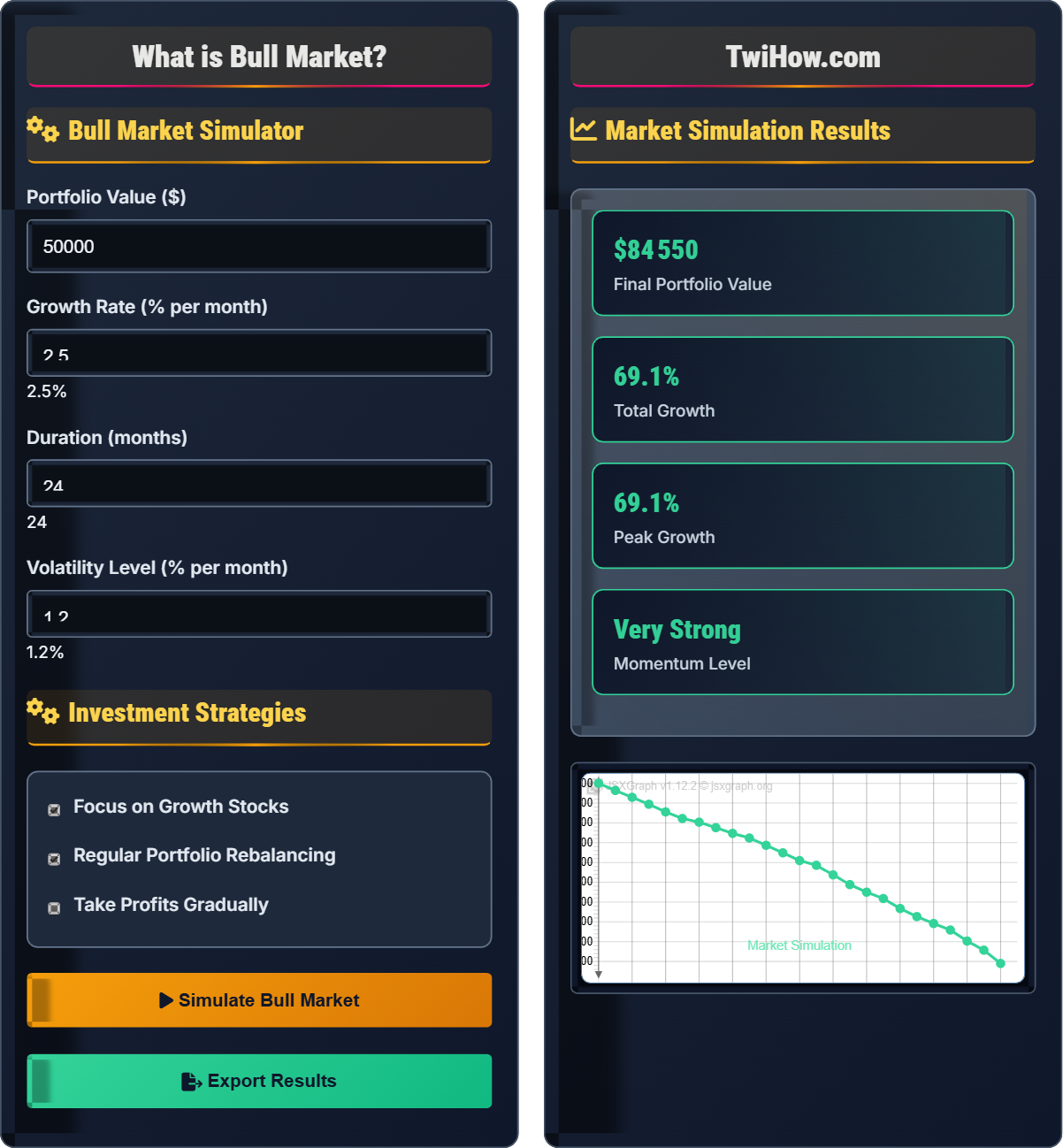
Bull Market Simulator
Investment Strategies
Market Simulation Results
Focus on companies with high growth potential during bull markets when investor appetite for risk is elevated.
Periodically adjust portfolio allocation to maintain desired risk level as asset values change.
Gradually realize gains to lock in profits and reduce risk as portfolio grows.
Bull Market Explained
A bull market is a market condition in which securities prices rise and widespread optimism causes the positive sentiment to be self-sustaining. It is defined as a rise of 20% or more from recent lows. The term originates from the way bulls attack their prey—thrusting their horns upward.
Bull markets are part of the natural market cycle and historically occur periodically. They are often accompanied by economic expansions, low unemployment, and rising corporate earnings.
Where:
- Trough Price: Lowest price point before recovery
- Current Price: Current market price
- Growth: Must be ≥ 20% to qualify as bull market
Common triggers of bull markets:
- Economic Expansion: GDP growth, falling unemployment
- Interest Rate Cuts: Central bank policy easing
- Corporate Earnings: Rising profits and guidance
- Technological Innovation: New industries and opportunities
- Political Stability: Favorable policies and regulations
- Market Sentiment: Shift from pessimism to optimism
- Post-WWII Boom (1949-1956): 265% gain
- Technology Revolution (1982-2000): 1017% gain
- Recovery from Tech Crash (2002-2007): 102% gain
- Post-Financial Crisis (2009-2020): 400% gain
Bull Market Characteristics
Rising prices, increasing trading volume, optimistic sentiment, economic expansion, declining unemployment, rising corporate earnings.
Growth = ((Current Price - Trough Price) / Trough Price) × 100%
Where Growth ≥ 20% indicates bull market conditions.
- 20% rise from trough defines bull market
- Bull markets eventually face corrections
- Growth investing performs well
- Opportunities arise during expansions
Investment Strategies
Growth investing, sector rotation, momentum trading, IPO participation, international diversification.
- Focus on growth stocks
- Increase equity allocation
- Take advantage of opportunities
- Maintain discipline
- Don't get carried away by euphoria
- Monitor for signs of overheating
- Keep some defensive positions
- Plan for eventual corrections
Bull Market Learning Quiz
What percentage increase from recent lows defines a bull market?
A bull market is technically defined as a rise of 20% or more from recent lows. This is the standard threshold used by analysts and economists to identify bull market conditions. The 20% benchmark represents a significant enough increase to indicate a sustained upward trend rather than normal market volatility.
The answer is C) 20% increase.
Understanding the precise definition of a bull market is crucial for investors because it helps distinguish between normal market rallies and more significant uptrends. The 20% threshold is widely accepted because it represents a meaningful gain that typically correlates with broader economic improvements. This definition helps investors identify when to adjust their strategies for optimal performance during rising markets.
Bull Market: A market condition with prices rising by 20% or more from recent lows
Rally: A shorter-term increase in prices
Bear Market: A market condition with declining prices and pessimistic sentiment
• Bull market = 20% or more increase from low
• Rallies are smaller temporary increases
• Duration matters alongside percentage
• Remember: 20% increase = bull market
• Look at major indices for confirmation
• Consider both percentage and duration
• Confusing rallies with bull markets
• Applying definition to individual stocks
• Ignoring the duration aspect
Explain the growth investing strategy and why it's beneficial during bull markets. Include specific advantages and potential risks.
Growth Investing: This strategy focuses on companies with above-average growth potential in revenue, earnings, or book value. During bull markets, growth stocks tend to outperform because investor optimism drives demand for high-growth opportunities.
Advantages during bull markets:
1. Capital Appreciation: Growth stocks can deliver substantial price increases during rising markets
2. Investor Appetite: Bull markets favor riskier, higher-growth investments
3. Valuation Premium: Investors pay premium multiples for growth prospects
4. Market Leadership: Growth stocks often lead market advances
Risks: Higher volatility, potential overvaluation, sensitivity to interest rate changes, and vulnerability during market corrections.
Growth investing is particularly effective during bull markets because rising markets reward companies with strong growth prospects. Investors are willing to pay higher prices for growth potential when optimism prevails. However, this strategy carries higher risk since growth stocks are often valued at premium prices, making them more vulnerable to corrections when market sentiment shifts.
Growth Investing: Strategy focused on companies with above-average growth potential
Valuation Premium: Higher price paid for growth prospects
Market Leadership: Stocks driving overall market direction
• Focus on earnings growth potential
• Look for sustainable competitive advantages
• Compare growth rates to industry averages
• Watch for signs of overvaluation
• Chasing momentum without fundamentals
• Ignoring valuation levels
• Concentrating too heavily in growth
An investor has a $75,000 portfolio entering a bull market with a 45% total increase over 18 months. If the investor had allocated 30% to growth stocks (which grew 60%), 50% to value stocks (which grew 40%), and 20% to bonds (which grew 8%), calculate the portfolio's final value and the additional return gained compared to equal allocation across all asset classes.
Initial Allocation:
Growth Stocks: $75,000 × 30% = $22,500
Value Stocks: $75,000 × 50% = $37,500
Bonds: $75,000 × 20% = $15,000
After Growth:
Growth Stocks: $22,500 × (1 + 0.60) = $36,000
Value Stocks: $37,500 × (1 + 0.40) = $52,500
Bonds: $15,000 × (1 + 0.08) = $16,200
Total Portfolio: $36,000 + $52,500 + $16,200 = $104,700
Equal Allocation Scenario:
$75,000 × (1 + 0.45) = $108,750
Actual vs Equal Allocation:
$104,700 - $108,750 = -$4,050
The optimized allocation underperformed equal allocation by $4,050 in this scenario.
This calculation demonstrates how asset allocation affects portfolio performance during bull markets. The example shows that while growth stocks performed exceptionally well, the overall portfolio underperformed an equal allocation due to the heavy weighting in bonds which had minimal growth. This illustrates the importance of strategic asset allocation based on expected returns and risk tolerance.
Asset Allocation: Distribution of investments across asset classes
Growth Stocks: Companies with above-average growth potential
Value Stocks: Companies trading below intrinsic value
• Higher growth allocation = higher potential returns
• Diversification reduces risk
• Match allocation to risk tolerance
• Increase growth allocation in bull markets
• Rebalance during significant moves
• Consider tax implications
• Overconcentrating in one asset class
• Not rebalancing during growth
• Chasing past performance
A bull market begins when an index is at 4,000 points and rises to 6,800 points over 24 months. It then experiences a 15% correction over 6 months before resuming growth to 7,500 points over the next 12 months. Calculate the total percentage gain during the full bull market, the recovery rate after the correction, and explain why corrections are normal during bull markets.
Total Percentage Gain:
((7,500 - 4,000) / 4,000) × 100% = (3,500 / 4,000) × 100% = 87.5%
Recovery After Correction:
Correction: 6,800 × (1 - 0.15) = 5,780
Recovery: From 5,780 to 7,500 over 12 months
Total gain: 7,500 - 5,780 = 1,720
Monthly gain: 1,720 / 12 = 143.33 points per month
Percentage monthly gain: (143.33 / 5,780) × 100% ≈ 2.5% per month
Why Corrections Are Normal:
1. Profit-taking by investors
2. Overbought conditions
3. Minor economic concerns
4. Technical resistance levels
5. Natural market rhythm
Corrections during bull markets are normal and healthy for the market ecosystem. They allow for profit-taking, reset overbought conditions, and bring in new investors at more reasonable prices. A 10-20% correction is considered normal during bull markets and doesn't necessarily indicate the end of the bull trend. Understanding this pattern helps investors maintain confidence during temporary setbacks.
Market Correction: 10-20% decline during bull market
Healthy Bull Market: Includes periodic correctionsProfit-Taking: Selling to realize gains
• Corrections are normal during bull markets
• Don't panic during minor declines
• Corrections can create buying opportunities
• View corrections as buying opportunities
• Maintain long-term perspective
• Use dollar-cost averaging
• Panicking during minor corrections
• Selling at first sign of weakness
• Confusing corrections with bear markets
Which of the following is LEAST likely to occur during a bull market?
During bull markets, investor pessimism typically decreases rather than rises. Bull markets are characterized by optimism, confidence, and enthusiasm among investors. The other options are all common characteristics of bull markets: decreasing unemployment, rising corporate earnings, and economic expansion often accompany bull market conditions.
The answer is B) Rising investor pessimism.
Understanding the psychological aspects of bull markets is crucial for investors. Bull markets are driven by optimism and confidence, which create a feedback loop where rising prices encourage more buying. This positive sentiment often extends beyond financial markets into the broader economy, influencing business investment, employment, and consumer spending. Recognizing this pattern helps investors participate in market advances while maintaining discipline.
Investor Confidence: Collective belief in future market performance
Market Sentiment: Overall attitude toward market direction
Feedback Loop: Self-reinforcing market mechanism
• Bull markets = increased confidence
• Economic factors drive market trends
• Psychology influences market direction
• Focus on fundamentals, not just sentiment
• Maintain long-term perspective
• Avoid getting carried away by euphoria
• Letting emotions drive excessive risk
• Confusing rallies with bull markets
• Buying at market peaks
FAQ
Q: Should I invest all my money in growth stocks during a bull market?
A: While growth stocks typically perform well during bull markets, it's generally not advisable to allocate all funds to a single sector. Consider these approaches:
1. Strategic allocation: Increase growth stock percentage while maintaining diversification
2. Quality focus: Choose growth stocks with strong fundamentals
3. Regular rebalancing: Adjust allocations as portfolio weights shift
4. Gradual shifts: Slowly increase growth allocation over time
Diversification helps manage risk even during favorable market conditions and protects against sector-specific downturns.
Q: How do I identify when a bull market is approaching its peak?
A: While timing market peaks is extremely difficult, watch for these warning signs:
1. Extreme valuations: P/E ratios significantly above historical averages
2. Speculative behavior: IPO frenzy, meme stocks, margin debt increases
3. Monetary tightening: Central bank raising rates
4. Leading indicators: Yield curve inversion, manufacturing slowdown
5. Contrarian sentiment: Everyone bullish, few skeptics remain
Remember, markets often continue rising longer than expected, so gradual adjustments are better than sudden shifts.
Q: Is a bull market a good time to start investing for beginners?
A: Yes, bull markets can be excellent for beginning investors, but approach strategically:
1. Start with basics: Index funds or ETFs provide diversification
2. Dollar-cost averaging: Invest regularly to smooth out timing
3. Learn fundamentals: Use the rising market to understand concepts
4. Build habits: Establish consistent investment practices
5. Stay disciplined: Avoid chasing hot tips or market timing
The key is starting with a long-term perspective and maintaining consistent contributions regardless of market conditions.