What is Crypto?
Complete cryptocurrency guide • Step-by-step explanations
Cryptocurrency Fundamentals:
Show Crypto AnalysisCryptocurrency is a digital or virtual form of currency that uses cryptography for security. A cryptocurrency is difficult to counterfeit because of this security feature. A defining characteristic of a cryptocurrency, and arguably its biggest allure, is its organic nature; it is not issued by any central authority, rendering it theoretically immune to government interference or manipulation.
Key cryptocurrency components:
- Blockchain Technology: Distributed ledger system
- Cryptography: Security and verification methods
- Decentralization: No central authority control
- Mining: Creation of new coins and transaction validation
- Digital Wallets: Storage and management of crypto assets
- Smart Contracts: Self-executing contracts on blockchain
Cryptocurrencies represent a revolutionary approach to money and value transfer, offering new possibilities for financial inclusion, programmable money, and decentralized applications.
Crypto Analysis Parameters
Advanced Options
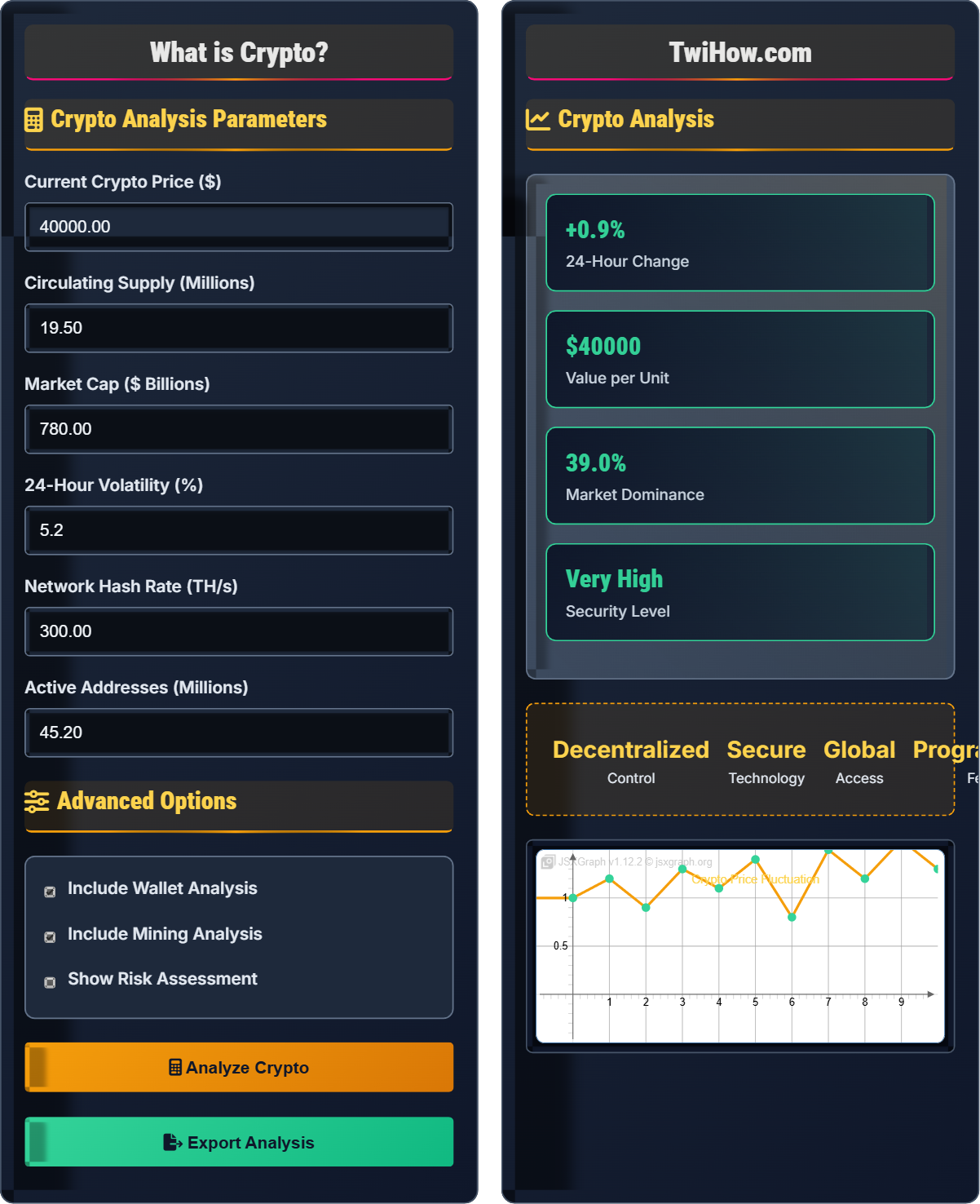
Crypto Analysis
Key concepts to understand about cryptocurrency:
- Digital assets using blockchain technology
- Decentralized networks with no central authority
- Highly volatile price movements
- Security through cryptographic proof
- Various use cases beyond store of value
- Regulatory landscape still evolving
| Indicator | Value | Interpretation | Significance |
|---|---|---|---|
| Price | $40,000 | High value | Current market value |
| Market Cap | $780B | Large cap | Network size indicator |
| Volatility | 5.2% | High | Price fluctuation risk |
| Hash Rate | 300 TH/s | Very Strong | Network security level |
| Adoption | 45.2M | High | User engagement |
How Cryptocurrency Works
Cryptocurrency is a digital or virtual currency that uses cryptography for security. A cryptocurrency is difficult to counterfeit because of this security feature. A defining characteristic of a cryptocurrency, and arguably its biggest allure, is its organic nature; it is not issued by any central authority, rendering it theoretically immune to government interference or manipulation. Bitcoin, created in 2009, was the first decentralized cryptocurrency.
Where:
- Block Hash: Unique identifier for each block
- Previous Block Hash: Link to previous block in chain
- Transaction Data: List of transactions in block
- Nonce: Number used once to solve proof-of-work puzzle
Popular crypto investment strategies include:
- HODLing: Long-term holding regardless of price fluctuations
- Dollar-Cost Averaging: Consistent investment timing regardless of price
- Day Trading: Short-term trading for quick profits
- Staking: Earning rewards by participating in network validation
- Yield Farming: Earning rewards in decentralized finance protocols
- Diversification: Spreading investments across different crypto assets
- Only Invest What You Can Afford to Lose: Crypto markets are highly volatile
- Secure Your Assets: Use hardware wallets for large holdings
- Do Your Own Research: Don't rely solely on social media tips
- Understand the Technology: Know what problem the project solves
- Stay Updated: Follow regulatory and technological developments
- Control Your Emotions: Avoid panic selling during market volatility
Cryptocurrency Fundamentals
Blockchain, cryptocurrency, mining, wallet, decentralization, smart contracts, consensus mechanism.
Block Hash = Hash(Previous Block Hash + Transaction Data + Nonce)
Market Cap = Price Per Coin × Circulating Supply
Where Block Hash creates immutable chain of records.
- Never invest more than you can afford to lose
- Secure your private keys
- Research before investing
- Be aware of regulatory risks
- Control your emotions during volatility
Crypto Investment Applications
Store of value, medium of exchange, smart contracts, DeFi, NFTs, cross-border payments, financial inclusion.
- Learn blockchain fundamentals
- Choose secure wallet
- Start with major cryptocurrencies
- Research projects thoroughly
- Implement risk management
- Stay updated on regulations
- Use hardware wallets for large amounts
- Maintain discipline with investments
- Regularly update security practices
- Adjust strategy as market evolves
Crypto Analysis Tools
Calculate the security level of different wallet types for storing crypto assets.
Calculate potential profits from cryptocurrency mining operations.
Assess the volatility risk of different cryptocurrencies.
Assess the overall risk level of a cryptocurrency investment.
Calculate how to diversify your cryptocurrency investments across different assets.
Cryptocurrency Learning Quiz
What is the primary purpose of cryptography in blockchain technology?
Cryptography is the fundamental security mechanism in blockchain technology. It ensures that transactions are secure, verifies the authenticity of participants, and maintains the integrity of the blockchain by making it virtually impossible to alter past transactions. Without cryptography, the decentralized trust model of blockchain would not be possible.
The answer is B) To secure and verify transactions.
Cryptography in blockchain serves multiple security functions: hashing ensures data integrity, digital signatures verify identity, and encryption protects privacy. The cryptographic hash of each block contains a reference to the previous block, creating an immutable chain. This security model allows blockchain to operate without a central authority while maintaining trust among participants who may not know each other.
Cryptography: Secure communication using codes and algorithms
Hashing: One-way function creating unique identifiers
Immutable: Cannot be changed or altered
• Cryptography enables trustless verification
• Hash functions ensure data integrity
• Digital signatures verify transaction authenticity
• Remember cryptography is the backbone of blockchain
• Understand the difference between hashing and encryption
• Learn about public/private key pairs
• Confusing cryptography with encryption only
• Not understanding immutability concept
• Ignoring security implications
Explain the concept of decentralization in cryptocurrency and why it's considered a fundamental feature. What are the benefits and challenges of decentralized systems?
Decentralization Definition: Decentralization in cryptocurrency means that no single entity or authority controls the network. Instead, the network is maintained by a distributed group of participants (nodes) around the world.
Benefits:
1. Resilience: No single point of failure
2. Transparency: Public ledger accessible to all
3. Reduced Censorship: Transactions can't be blocked by authorities
4. Trust: Verification through consensus, not central authority
Challenges:
1. Scalability: Slower transaction processing
2. Energy Consumption: High resource requirements
3. Coordination: Difficulty in implementing changes
4. Regulatory Uncertainty: Complex legal landscape
Decentralization is the core innovation of cryptocurrency that distinguishes it from traditional financial systems. In traditional banking, a central authority (like a bank or government) validates and records transactions. In a decentralized system, this responsibility is distributed among network participants who collectively maintain the ledger through consensus mechanisms. This eliminates the need for intermediaries and creates a trustless system where participants can interact without needing to trust each other.
Decentralization: Distribution of control across network participants
Nodes: Computers participating in the network
Consensus: Agreement mechanism for validating transactions
• Decentralization removes single points of failure
• Consensus mechanisms ensure network agreement
• Trade-offs exist between decentralization and efficiency
• Think of decentralization as shared governance
• Understand the trade-offs between centralization and decentralization
• Consider how decentralization affects scalability
• Assuming decentralization means no governance
• Not understanding scalability challenges
• Ignoring energy consumption concerns
Sarah invests $5,000 in a cryptocurrency that experiences a 30% daily price swing. If she bought at $100 per coin and the price drops to $70 (30% decrease), then recovers to $130 (30% increase from the lowest point), what is her return on investment? What does this demonstrate about cryptocurrency volatility?
Initial Purchase: $5,000 ÷ $100 = 50 coins
After 30% Drop: $100 × 0.7 = $70 per coin
Value at Lowest Point: 50 coins × $70 = $3,500
After 30% Recovery: $70 × 1.3 = $91 per coin
Final Value: 50 coins × $91 = $4,550
ROI: ($4,550 - $5,000) ÷ $5,000 = -9%
This demonstrates that even symmetrical price movements can result in losses due to the mathematical nature of percentage changes. A 30% drop followed by a 30% recovery results in a net loss, highlighting the risk of high volatility.
This example illustrates the asymmetric nature of percentage changes in volatile markets. When an asset loses value and then recovers by the same percentage, the investor doesn't break even. This mathematical reality is crucial for crypto investors to understand, as it demonstrates why volatility can erode portfolio value even when prices eventually recover. The lesson is that volatility is not just about price swings—it can actually harm returns over time.
Volatility: Degree of variation in trading prices
Asymmetric Returns: Unequal gains and losses from same percentage movesROI: Return on Investment calculation
• High volatility increases risk of permanent loss
• Percentage changes are not symmetric
• Consider volatility when sizing positions
• Use dollar-cost averaging to reduce volatility impact
• Only invest what you can afford to lose
• Consider volatility when setting stop-losses
• Not understanding asymmetric percentage changes
• Underestimating volatility risk
• Investing too much in volatile assets
You're considering investing in a DeFi protocol that offers 15% APY on your crypto deposit. The protocol uses smart contracts to manage funds. What are the key risks you should evaluate before investing? How would you assess the security of the smart contract, and what safeguards should be in place?
Key Risks to Evaluate:
1. Smart Contract Risk: Bugs or vulnerabilities in code
2. DeFi Risk: Flash loan attacks, oracle manipulation
3. Smart Contract Risk: Code vulnerabilities
4. Liquidity Risk: Ability to withdraw funds
Security Assessment:
- Code audit by reputable firms
- Bug bounty programs
- Transparent governance
- Insurance coverage
Safeguards: Multi-signature wallets, timelocks, pause functions.
Smart contract risk is one of the most significant dangers in DeFi investing. Unlike traditional finance where legal recourse exists, smart contracts execute exactly as programmed—bugs become exploits. The famous DAO hack demonstrated how a single vulnerability can result in millions of dollars lost. Investors must evaluate not just the yield offered but the security measures protecting their funds. This requires understanding technical aspects of the protocol and trusting that proper security measures are in place.
Smart Contract: Self-executing contract with terms written in code
DeFi: Decentralized Finance protocols
Flash Loan: Borrow without collateral for one transaction
• Always research smart contract security
• Look for third-party audits
• Understand the protocol mechanics
• Check DeFi platforms for audit reports
• Look for insurance coverage
• Start with well-established protocols
• Chasing high APY without considering risks
• Not researching smart contract security
• Ignoring DeFi-specific vulnerabilities
Which of the following is the most accurate statement about cryptocurrency regulation?
Cryptocurrency regulation varies dramatically across different countries and jurisdictions. Some countries like El Salvador have embraced Bitcoin as legal tender, while others like China have banned cryptocurrency transactions entirely. Many countries are in the process of developing regulatory frameworks, making this an evolving landscape. Investors must be aware of the regulatory environment in their jurisdiction as well as any countries where the crypto projects they invest in operate.
The answer is C) Regulatory approaches vary significantly by country and are evolving.
Regulatory uncertainty is one of the biggest risks in cryptocurrency investing. The regulatory landscape is complex and constantly changing. Some governments view cryptocurrencies as commodities, others as securities, and some ban them entirely. This creates a patchwork of regulations that can affect everything from taxation to trading access. Investors must stay informed about regulatory developments that could impact their investments, as sudden regulatory changes can cause significant price movements.
Regulatory Framework: Laws governing crypto activities
Compliance: Adhering to regulatory requirements
Legal Tender: Currency officially recognized by government
• Research local regulations before investing
• Stay updated on regulatory changes
• Consider jurisdictional risks
• Follow regulatory news from official sources
• Consider using compliant exchanges
• Consult with legal experts for large investments
• Ignoring regulatory risks
• Not researching local laws
• Assuming regulations are uniform globally
FAQ
Q: Is cryptocurrency a good investment for beginners?
A: Cryptocurrency can be suitable for beginners if approached cautiously:
1. Start Small: Invest only what you can afford to lose completely
2. Learn First: Understand the technology before investing
3. Choose Major Coins: Start with Bitcoin and Ethereum
4. Secure Storage: Use reputable exchanges and secure wallets
5. Long-Term Perspective: Don't expect quick profits
Beginners should consider crypto as a speculative investment, allocate only a small portion of their portfolio (typically 1-5%), and focus on learning the technology. The high volatility and complexity make it unsuitable for risk-averse investors.
Q: What's the difference between Bitcoin and altcoins?
A: Bitcoin vs. Altcoins:
Bitcoin:
• First cryptocurrency, launched in 2009
• Largest market cap and most recognized
• Limited to 21 million coins
• Primarily digital gold/store of value
Altcoins:
• All other cryptocurrencies besides Bitcoin
• Include Ethereum, Ripple, Litecoin, etc.
• Often offer additional features beyond Bitcoin
• More volatile but potentially higher returns
Bitcoin is often considered "digital gold," while altcoins may offer utility for specific use cases like smart contracts, payments, or decentralized applications.
Q: How do I securely store my cryptocurrency?
A: Crypto storage security levels:
Hot Wallets: Online wallets (mobile, desktop) - convenient but less secure
Cold Wallets: Hardware wallets (Ledger, Trezor) - most secure for large amounts
Best Practices:
1. Hardware Wallet: For holdings over $1,000
2. Backup: Store recovery phrase offline in multiple locations
3. Two-Factor: Enable 2FA on all accounts
4. Phishing: Verify websites before entering credentials
5. Updates: Keep wallet software updated
Never share your private keys or recovery phrase with anyone. If someone has these, they have complete access to your funds.