What is Dividend?
Complete dividend investing guide • Step-by-step explanations
Dividend Fundamentals:
Show Dividend AnalysisA dividend is a portion of a company's earnings that is distributed to shareholders. It represents a return on investment that companies pay to their shareholders, typically on a quarterly basis. Dividends provide investors with a steady income stream and are often seen as a sign of a company's financial health and stability. Not all companies pay dividends - some prefer to reinvest profits back into the business for growth.
Key dividend components:
- Dividend Payment: Cash distributed to shareholders
- Dividend Yield: Return expressed as percentage of stock price
- Dividend Growth: Increases in dividend payments over time
- Dividend Policy: Company's approach to dividend distribution
- Ex-Dividend Date: Date to buy stock to receive dividend
- Dividend Reinvestment: Using dividends to buy more shares
Dividend investing is a strategy focused on building income-generating portfolios through companies that consistently pay dividends.
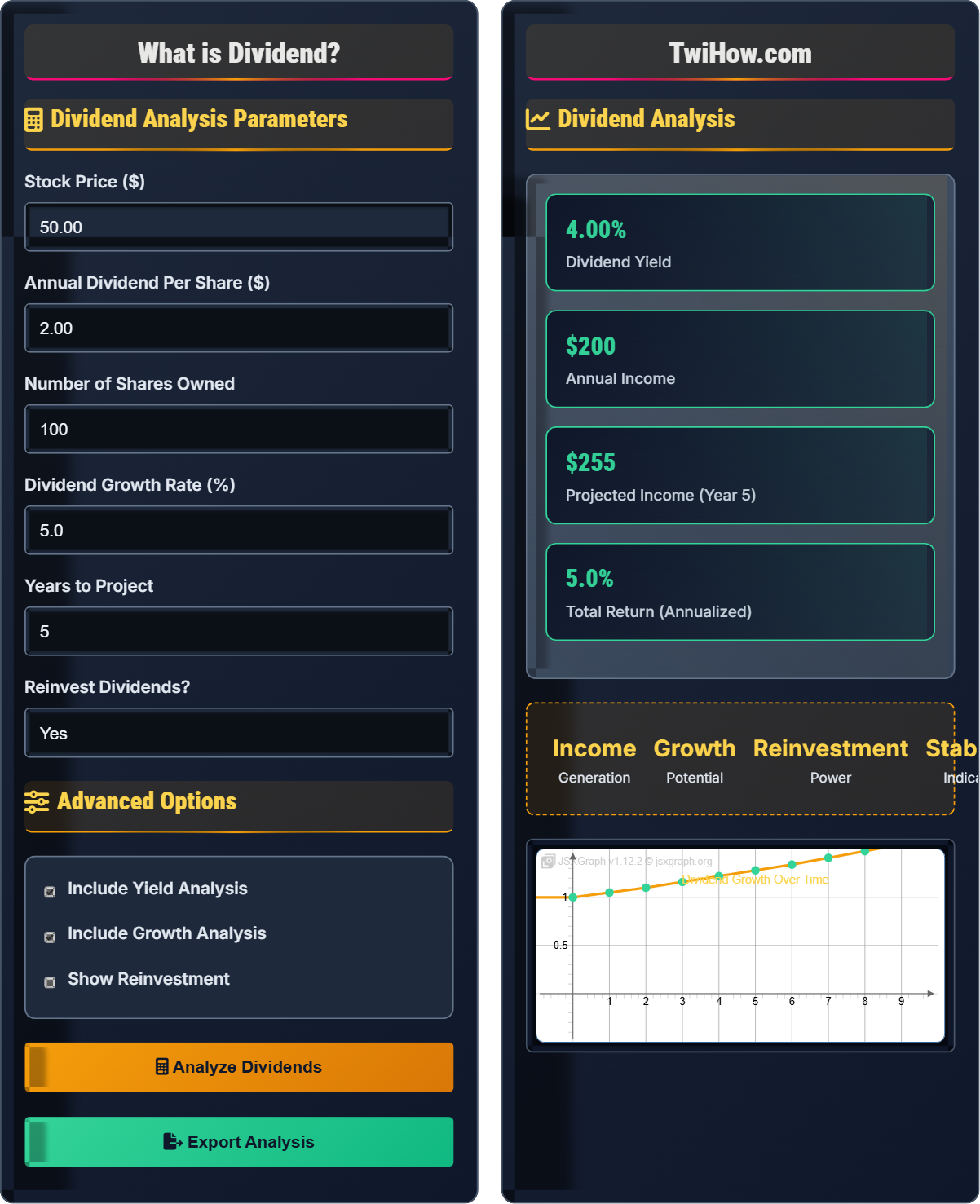
Dividend Analysis Parameters
Advanced Options
Dividend Analysis
Key concepts for dividend investing:
- Dividends provide steady income streams
- Dividend yield measures income return
- Dividend growth enhances returns over time
- Dividend reinvestment accelerates wealth building
- Dividend sustainability indicates company health
- Dividend aristocrats have consistent payout history
| Year | Dividend/Share | Annual Income | Cumulative Income |
|---|---|---|---|
| 1 | $2.00 | $200 | $200 |
| 2 | $2.10 | $210 | $410 |
| 3 | $2.21 | $221 | $631 |
| 4 | $2.32 | $232 | $863 |
| 5 | $2.43 | $243 | $1,106 |
How Dividends Work
A dividend is a portion of a company's earnings that is distributed to shareholders. It represents a return on investment that companies pay to their shareholders, typically on a quarterly basis. Dividends provide investors with a steady income stream and are often seen as a sign of a company's financial health and stability. Companies that pay dividends regularly are typically mature, profitable businesses with predictable cash flows.
Where:
- Dividend Yield: Annual return expressed as percentage
- Annual Dividend Income: Total income from dividends
- Future Dividend: Projected dividend after growth
- Growth Rate: Annual increase in dividend
- n: Number of years
Popular dividend investment strategies include:
- High-Yield Investing: Focus on stocks with highest dividend yields
- Dividend Growth: Invest in companies with growing dividends
- Dividend Aristocrats: Focus on companies with consistent dividend increases
- Dividend Reinvestment: Automatically reinvest dividends to buy more shares
- Dividend ETFs: Invest in diversified dividend-focused funds
- Quality Dividends: Focus on financially strong companies
- Look for Sustainability: Focus on companies with strong financials
- Consider Payout Ratio: Ensure dividends are covered by earnings
- Diversify Holdings: Don't concentrate in single sectors
- Reinvest Dividends: Use compounding to accelerate growth
- Monitor Growth: Look for companies increasing dividends
- Understand Tax Implications: Dividends may be taxed differently
Dividend Fundamentals
Dividend, dividend yield, payout ratio, dividend growth, ex-dividend date, dividend reinvestment.
Dividend Yield = (Annual Dividend Per Share / Price Per Share) × 100%
Annual Dividend Income = Dividend Per Share × Number of Shares
Future Dividend = Current Dividend × (1 + Growth Rate)^n
Where Dividend Yield measures income return relative to stock price.
- Always check payout ratio for sustainability
- Look for consistent dividend history
- Consider dividend growth potential
- Reinvest dividends for compound growth
- Diversify dividend holdings across sectors
Dividend Applications
Income generation, retirement planning, wealth building, portfolio diversification.
- Research dividend-paying companies
- Calculate dividend yield and sustainability
- Build diversified dividend portfolio
- Set up dividend reinvestment
- Monitor dividend payments regularly
- Reinvest dividends for growth
- Focus on dividend sustainability
- Maintain discipline with reinvestment
- Regularly review portfolio performance
- Adjust strategy as life circumstances change
Dividend Analysis Tools
Calculate dividend yield to compare income returns across different stocks.
Project future dividend payments based on historical growth rates.
Calculate compound growth from reinvesting dividends over time.
Analyze key dividend metrics to assess investment quality.
Compare different dividend investment strategies for portfolio building.
Dividend Learning Quiz
If a stock is trading at $50 per share and pays an annual dividend of $2 per share, what is its dividend yield?
Dividend yield is calculated as: (Annual Dividend Per Share / Price Per Share) × 100%. In this case: ($2 / $50) × 100% = 0.04 × 100% = 4%. Dividend yield measures the income return relative to the investment cost.
The answer is B) 4%.
Dividend yield is a fundamental metric for income investors. It allows comparison of income potential across different stocks regardless of their price. A 4% yield means you earn $4 in dividends for every $100 invested. This percentage remains constant regardless of how many shares you own, making it a useful standardized measure for comparing income-producing investments.
Dividend Yield: Annual return as percentage of stock price
Annual Dividend: Total dividends paid per share in one year
Income Return: Return generated through dividends
• Higher yield isn't always better
• Check payout ratio for sustainability
• Compare yields within same industry
• Look for yields between 2-6% for stability
• Verify dividend history and consistency
• Consider tax implications of dividends
• Chasing extremely high yields without checking sustainability
• Not considering payout ratio
• Ignoring company fundamentals
Explain what the payout ratio measures, why it's important for dividend analysis, and what levels indicate dividend sustainability.
Payout Ratio Definition: The payout ratio measures the percentage of net income that a company pays out as dividends. It's calculated as: (Total Dividends / Net Income) × 100% or (Dividends Per Share / Earnings Per Share) × 100%.
Importance: The payout ratio indicates how much of a company's earnings are returned to shareholders versus retained for business growth. It helps assess dividend sustainability.
Sustainability Levels: 20-40% indicates conservative payout; 40-60% indicates moderate payout; 60-80% indicates aggressive payout; above 80% indicates potential sustainability risk.
The payout ratio is crucial for dividend sustainability analysis. A company that pays out 80% of its earnings in dividends has little room for business reinvestment and is vulnerable to earnings fluctuations. Conversely, a company paying out only 20% of earnings has substantial room to increase dividends or weather temporary downturns. The ideal payout ratio varies by industry, with utilities and REITs typically having higher ratios due to regulatory requirements.
Payout Ratio: Percentage of earnings paid as dividends
Dividend Sustainability: Ability to maintain dividend payments
Retained Earnings: Earnings not paid as dividends
• Lower ratios generally indicate more sustainability
• Compare to industry averages
• Consider business cyclicality
• Look for consistent payout ratios over time
• Check free cash flow coverage too
• Consider industry-specific norms
• Ignoring payout ratio when evaluating high-yield stocks
• Not considering industry differences
• Focusing only on current yield
Sarah owns 200 shares of a company that pays $1.50 per share annually in dividends. She reinvests all dividends to buy more shares at the current price of $30 per share. If the dividend remains constant, how many additional shares will she own after 3 years, and what will be her total annual dividend income at that time?
Year 1: Dividend income = 200 × $1.50 = $300
Additional shares purchased = $300 ÷ $30 = 10 shares
Year 2: Total shares = 210, Dividend income = 210 × $1.50 = $315
Additional shares purchased = $315 ÷ $30 = 10.5 shares
Year 3: Total shares = 220.5, Dividend income = 220.5 × $1.50 = $330.75
Additional shares purchased = $330.75 ÷ $30 = 11.025 shares
Total Additional Shares: 10 + 10.5 + 11.025 = 31.525 shares
Total Annual Income: (200 + 31.525) × $1.50 = $347.29
Sarah will own approximately 31.5 additional shares with total annual income of $347.29.
This example demonstrates the power of dividend reinvestment and compound growth. By reinvesting dividends, Sarah increases her share count each year, which generates more dividends in subsequent years. This creates an accelerating growth effect where the income grows not just from the original investment but from the accumulated reinvested dividends. The compounding effect becomes more pronounced over longer time periods.
Dividend Reinvestment: Using dividends to buy more shares
Compound Growth: Growth on previous growth
Accelerating Returns: Increasing growth over time
• Reinvestment accelerates wealth building
• More shares generate more dividends
• Time amplifies compounding effects
• Use dividend reinvestment plans (DRIPs)
• Start early to maximize compounding
• Track reinvestment performance
• Not reinvesting dividends for compound growth
• Withdrawing dividends instead of reinvesting
• Not tracking reinvestment performance
You're evaluating two dividend stocks: Company A has paid dividends for 20 consecutive years and increased them annually, with a current yield of 3.5%. Company B has paid dividends for 5 years with 2 years of increases, yielding 5.2%. Both companies have similar financials and payout ratios. Which stock would be better for a long-term dividend investor, and why?
Company A would be better for a long-term dividend investor because:
1. Proven Track Record: 20 years of consistent payments and increases
2. Dividend Aristocrat Status: Demonstrates commitment to shareholders
3. Reliability: Has survived multiple economic cycles
4. Management Commitment: Shows dedication to returning value
While Company B offers a higher yield, Company A provides greater reliability and predictability. The longer track record indicates stronger business fundamentals and management commitment to dividend payments. For long-term income generation, consistency is more valuable than higher yield.
This question highlights the importance of dividend history and consistency. Dividend aristocrats (companies with 25+ years of consecutive dividend increases) represent the gold standard for dividend investors. While a higher yield might be attractive, it's meaningless if the company cannot sustain the payments. A proven track record of dividend increases indicates financial strength, stable business models, and management commitment to shareholders. The market often rewards these qualities with premium valuations.
Dividend Aristocrat: Company with 25+ years of dividend increases
Consistency: Regular dividend payments over time
Track Record: History of dividend performance
• Prioritize consistency over yield
• Consider business sustainability
• Research dividend history going back decades
• Look for companies that increased dividends during recessions
• Consider dividend growth rate trends
• Chasing high yields without checking history
• Ignoring dividend consistency
• Not considering business fundamentals
What is the ex-dividend date and why is it important for dividend investors?
The ex-dividend date is the date on which shares trade without the right to the upcoming dividend. To receive a dividend, you must own the stock before the ex-dividend date. On and after the ex-dividend date, new buyers will not receive the upcoming dividend payment. The stock price typically drops by the dividend amount on the ex-dividend date to reflect the dividend payment.
The answer is B) The date you must own shares to receive the dividend.
The ex-dividend date is critical for dividend investors to understand. If you buy shares on or after the ex-dividend date, you won't receive the next dividend payment - only the seller will. The stock price adjusts downward by approximately the dividend amount on the ex-dividend date to account for the value that's being distributed. This ensures that there's no free money to be made by buying shares just before the dividend and selling immediately after.
Ex-Dividend Date: Date to own shares to receive dividend
Record Date: Date company records shareholdersPayment Date: Date dividends are distributed
• Must own shares before ex-dividend date
• Stock price adjusts on ex-dividend date
• Check dates carefully for dividend capture
• Mark ex-dividend dates on your calendar
• Consider settlement time for purchases
• Plan purchases well in advance
• Buying on ex-dividend date expecting dividend
• Not understanding settlement timing
• Missing ex-dividend dates
FAQ
Q: Is it better to reinvest dividends or take them as cash?
A: The choice depends on your financial situation:
Reinvest Dividends When:
• You're still accumulating wealth
• You don't need immediate income
• You want to benefit from compounding
• You're in a tax-advantaged account
Take Dividends as Cash When:
• You need regular income (retirement)
• You want to diversify into other investments
• You're in a high tax bracket
• You prefer to control allocation
For long-term wealth building, reinvestment typically provides better returns through compounding.
Q: What's a good dividend yield to look for?
A: Generally, look for yields between 2-6%:
2-4%: Conservative, sustainable yields
4-6%: Moderate yields with growth potential
6-8%: Higher yields, check sustainability
Above 8%: Potentially risky, investigate carefully
Focus on dividend growth and sustainability rather than just yield. Extremely high yields often indicate potential problems or unsustainable payouts. Always check the payout ratio and company fundamentals.
Q: Should I focus on dividend stocks or growth stocks?
A: The choice depends on your goals and life stage:
Dividend Stocks:
• Pros: Regular income, stability, lower volatility
• Cons: Lower growth potential, interest rate sensitivity
• Best for: Income needs, retirement, risk aversion
Growth Stocks:
• Pros: Higher potential returns, capital appreciation
• Cons: No income, higher volatility, uncertain returns
• Best for: Long-term growth, higher risk tolerance
Many investors benefit from a balanced approach with both dividend and growth stocks based on their specific needs and timeline.