How to Avoid Debt?
Complete debt avoidance guide • Step-by-step explanations
Debt Avoidance Fundamentals:
Show Debt Avoidance PlanAvoiding debt is the foundation of financial freedom and stability. It involves creating a lifestyle where your spending never exceeds your income, building emergency funds to handle unexpected expenses, and making thoughtful financial decisions. Debt avoidance strategies focus on living within your means, saving before spending, and building wealth through positive cash flow rather than borrowed money.
Key debt avoidance components:
- Budgeting: Tracking income and expenses to live within means
- Saving: Building reserves for purchases and emergencies
- Spending Discipline: Distinguishing between wants and needs
- Emergency Preparedness: Maintaining financial buffers
- Credit Management: Using credit responsibly
- Financial Education: Understanding money management
Successful debt avoidance requires commitment to financial principles and consistent application of healthy money habits that protect you from accumulating debt.
Debt Prevention Parameters
Advanced Options
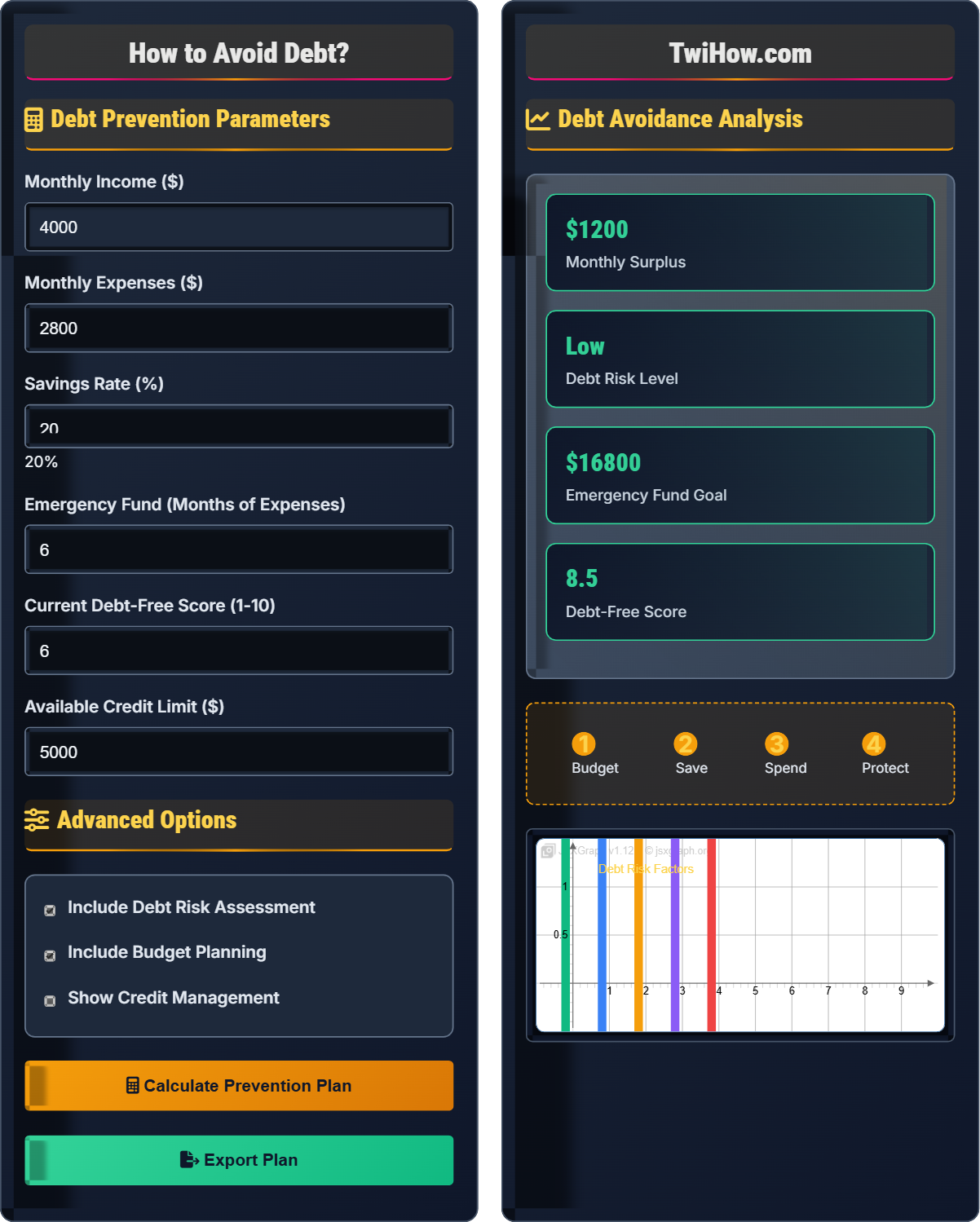
Debt Avoidance Analysis
Based on your inputs, here are your debt avoidance recommendations:
- Maintain monthly surplus of $800
- Build $16,800 emergency fund in 21 months
- Keep credit utilization under 30%
- Continue 20% savings rate
- Review budget monthly
| Strategy | Status | Implementation | Impact |
|---|---|---|---|
| Budget Tracking | Good | Use apps or spreadsheets | Reduces overspending by 20% |
| Emergency Fund | Building | Automate monthly transfers | Prevents emergency debt |
| Spending Limits | Needs Improvement | Set category caps | Controls impulse purchases |
| Credit Card Usage | Good | Pay full balance monthly | Avoids interest charges |
| Major Purchases | Good | Save before buying | Prevents financing needs |
How Debt Avoidance Works
Debt avoidance is a proactive financial strategy that prevents the accumulation of debt by ensuring your spending never exceeds your income. It involves creating a lifestyle of financial discipline, building emergency funds, and making conscious spending decisions. Rather than relying on credit to bridge financial gaps, debt avoidance focuses on living within your means and building wealth through positive cash flow.
Where:
- Income: All sources of regular revenue
- Expenses: All regular and irregular expenditures
- Positive Cash Flow: Essential for debt avoidance
- Emergency Fund: Protection against unexpected expenses
Effective debt avoidance strategies include:
- Paycheck-to-Paycheck Living: Spend less than you earn consistently
- Cash Envelope System: Physical separation of budget categories
- Wait Period Rule: Delay non-essential purchases by 24-48 hours
- Emergency Fund First: Build protection before investing
- No New Debt Policy: Commit to never taking on new debt
- Buy Used First: Consider secondhand options for major purchases
- Automate Savings: Set up automatic transfers to build reserves
- Track Spending Daily: Monitor expenses in real-time
- Shop with Lists: Avoid impulse purchases
- Cancel Unused Subscriptions: Eliminate unnecessary recurring expenses
- Use Cash for Discretionary Spending: Physical money limits spending
- Regular Financial Reviews: Assess and adjust monthly
Debt Avoidance Fundamentals
Cash flow management, budgeting, emergency fund, spending discipline, credit utilization, debt-to-income ratio.
Cash Flow = Income - Expenses > 0
Emergency Fund = Monthly Expenses × Months of Coverage
Where Cash Flow must remain positive to avoid debt accumulation.
- Never spend more than you earn
- Always maintain an emergency fund
- Pay credit cards in full monthly
- Save before making purchases
- Regularly review financial habits
Debt Avoidance Applications
Budgeting, emergency planning, credit management, major purchases, lifestyle choices.
- Calculate monthly cash flow
- Track income and expenses for 30 days
- Set up emergency fund
- Create and follow a budget
- Establish spending discipline
- Use credit responsibly
- Review and adjust monthly
- Automate financial processes
- Maintain discipline with spending
- Regularly review financial progress
- Adjust plans as life circumstances change
Debt Avoidance Tools
Calculate your risk of falling into debt based on spending and saving habits.
Plan your budget to ensure you never spend more than you earn.
Determine how much you need to save for emergencies to avoid debt.
Calculate how to manage credit responsibly to avoid debt accumulation.
Calculate your overall debt prevention score based on financial habits.
Debt Avoidance Learning Quiz
What is the most important factor in avoiding debt?
The most important factor in avoiding debt is spending less than you earn. Regardless of your income level, if your expenses exceed your income, you will eventually accumulate debt. This fundamental principle of personal finance ensures positive cash flow, which is essential for debt avoidance and financial stability.
The answer is B) Spending less than you earn.
This question addresses the core principle of debt avoidance. Many people believe that earning more money solves financial problems, but without proper spending discipline, higher income simply leads to higher debt. The key to financial success is maintaining positive cash flow by ensuring expenses never exceed income. This principle applies to everyone, regardless of their income level.
Cash Flow: Difference between income and expenses
Positive Cash Flow: Income exceeds expenses
Spending Discipline: Controlling expenses to match income
• Always ensure expenses are less than income
• Track income and expenses regularly
• Create a budget that enforces this principle
• Use the 50/30/20 rule as a starting point
• Automate savings to ensure positive cash flow
• Review your budget monthly
• Believing high income prevents debt
• Not tracking expenses regularly
• Lifestyle inflation with income increases
Explain why an emergency fund is crucial for debt avoidance. How much should you save, and what types of expenses does it cover?
Importance of Emergency Fund: An emergency fund is the primary defense against debt. When unexpected expenses arise (medical bills, car repairs, job loss), having liquid savings prevents you from relying on credit cards or loans.
Amount to Save: Most financial experts recommend 3-6 months of essential expenses. For those with unstable income or families, 6-12 months may be appropriate.
Types of Expenses Covered: Job loss, medical emergencies, major home repairs, car breakdowns, family crises.
Without an emergency fund, a single unexpected expense can spiral into significant debt that takes years to repay.
The emergency fund serves as a financial buffer that prevents debt accumulation during unexpected events. It's the foundation of debt avoidance because it removes the need to borrow money when life throws curveballs. The fund should be kept in easily accessible accounts like high-yield savings accounts, separate from regular checking to avoid temptation. The amount depends on individual circumstances, job stability, and family responsibilities.
Emergency Fund: Liquid savings for unexpected expenses
Essential Expenses: Minimum costs to survive (housing, food, utilities)
Liquid Account: Easily accessible without penalties
• Keep emergency fund in liquid accounts
• Don't invest emergency funds in volatile assets
• Rebuild after using emergency funds
• Start with $1,000 as a mini-emergency fund
• Automate monthly contributions
• Keep separate account number private
• Not having an emergency fund
• Investing emergency funds in risky assets
• Not replenishing after use
Tom has a credit card with a $5,000 limit and carries a $1,500 balance. He charges $300 monthly for gas and groceries but pays only the $30 minimum payment each month. If the interest rate is 18%, how much debt will Tom accumulate in one year, and what debt avoidance strategy should he implement?
Current Situation: Tom is accumulating debt rapidly with minimum payments.
Debt Accumulation: With minimum payments of $30 and 18% interest, Tom's $1,500 balance would grow to approximately $1,800 after one year, with $270 in interest charges alone.
Debt Avoidance Strategy: Tom should switch to a debit card or cash for discretionary spending, pay the full balance monthly, and avoid adding new charges until the existing balance is paid off. He should implement the debt snowball or avalanche method to eliminate the current balance quickly.
This strategy prevents further interest charges and stops debt from growing.
This example demonstrates how minimum payments lead to significant debt growth due to compound interest. The key insight is that minimum payments barely cover interest charges, meaning most payments go toward interest rather than principal. Credit cards should be used like debit cards - charged only when you have money in the bank to pay the full balance immediately. This prevents interest charges and maintains debt-free status.
Credit Utilization: Percentage of available credit being used
Minimum Payment: Lowest amount required to avoid penalty
Compound Interest: Interest charged on previous interest
• Pay credit card balance in full monthly
• Keep credit utilization under 30%
• Set up automatic full payments
• Use debit cards for daily purchases
• Cancel unused credit cards
• Making only minimum payments
• Not understanding interest charges
• Using credit for everyday expenses
Jennifer wants to buy a $3,000 car but only has $500 saved. She could finance the car with a loan at 6% interest over 3 years. Alternatively, she could save for 6 months to pay cash. Her monthly income is $3,500 with $2,800 in expenses, giving her $700 in monthly surplus. Which option would better support her debt avoidance goals, and why?
Financing Option: 36 payments of approximately $89.50 = $3,222 total (including $222 interest)
Cash Option: Save $500/month for 5 months = $3,000
Recommendation: Jennifer should save for cash payment. Although financing would mean only $89.50/month, it introduces debt, interest charges, and monthly obligations. With $700 monthly surplus, she can save the $2,500 needed in just 4 months. This approach avoids interest, eliminates debt, and builds stronger financial discipline.
The cash approach supports debt avoidance goals by maintaining debt-free status and building savings habits.
This scenario illustrates the trade-off between convenience and debt avoidance. While financing seems easier, it introduces interest costs and debt obligations. The key insight is that Jennifer's positive cash flow ($700 surplus) makes saving feasible. This demonstrates that debt avoidance often requires patience but leads to better long-term financial outcomes. The discipline of saving builds wealth while financing erodes it through interest payments.
Positive Cash Flow: Income exceeds expenses
Opportunity Cost: What you lose by choosing one option over another
Debt Obligation: Required monthly payment
• Save before making major purchases
• Avoid financing for items that lose value
• Use positive cash flow for savings
• Set up automatic savings for goals
• Consider used alternatives
• Wait for sales and discounts
• Financing items that depreciate
• Not considering opportunity cost
• Underestimating savings potential
Which of the following is NOT an early warning sign that you might fall into debt?
A savings rate of 25% is actually a positive financial habit that helps prevent debt. Having a high savings rate means you're consistently spending less than you earn and building financial reserves. The other options are all warning signs: spending close to income leaves no buffer, frequent credit card use can lead to balances, and insufficient emergency savings increases debt risk during unexpected events.
The answer is B) Having a savings rate of 25%.
This question tests the ability to distinguish between healthy and unhealthy financial habits. A high savings rate is protective against debt because it indicates positive cash flow and financial discipline. The other options represent behaviors that increase debt risk: living paycheck to paycheck, relying on credit for daily expenses, and lacking emergency buffers. Recognizing these warning signs early allows for preventive action.
Savings Rate: Percentage of income set aside for savings
Warning Sign: Indicator of potential financial trouble
Positive Cash Flow: Essential for debt avoidance
• Maintain a healthy savings rate
• Monitor spending patterns regularly
• Build adequate emergency funds
• Set savings rate targets (20%+ recommended)
• Track spending weekly
• Review financial health monthly
• Not recognizing early warning signs
• Confusing positive and negative indicators
• Waiting until crisis to take action
FAQ
Q: I make $50,000/year and have $15,000 in student loans. Is this considered debt, and should I be worried about it?
A: Student loans are considered "good debt" because they represent an investment in education that can increase earning potential. However, you should still manage this debt responsibly:
1. Make Payments Consistently: Never miss payments to avoid default
2. Consider Refinancing: If you have good credit, you might get a lower rate
3. Don't Add New Debt: Avoid credit cards and other loans while paying this down
4. Build Emergency Fund: Have 3-6 months of expenses saved
With a $50,000 income, your debt-to-income ratio is manageable at 30%. Focus on building good financial habits while making consistent payments on your student loans.
Q: I'm 22 and just started my first job. How can I avoid debt when everything seems to cost so much?
A: Starting early gives you a huge advantage! Here's how to avoid debt at your age:
1. Live Below Your Means: Even if you can afford something, ask if you need it
2. Use Debit Cards: Avoid credit cards until you're ready to use them responsibly
3. Start Small Emergency Fund: Even $1,000 can prevent minor emergencies from becoming debt
4. Buy Used First: Cars, furniture, electronics - consider secondhand options
5. Automate Savings: Set up automatic transfers to build the habit
Remember, your 20s are for building good habits that last a lifetime. The earlier you start avoiding debt, the more financial freedom you'll have in the future.
Q: My spouse likes to shop, but I want to avoid debt. How can we manage our finances together without fighting?
A: Financial differences are common in relationships. Try these strategies:
1. Separate Discretionary Funds: Each partner gets a "fun money" allowance
2. Joint Goals Meeting: Monthly financial discussions about shared objectives
3. Compromise Approach: Agree on spending limits for different categories
4. Wait Period Rule: Require 24-48 hours for purchases over $100
5. Shared Emergency Fund: Both contribute to and agree on usage
Focus on shared financial goals rather than controlling each other's spending. Communication and mutual respect are key to financial harmony.