How to Invest Small Amounts?
Complete small investment guide • Step-by-step explanations
Small Amount Investing Fundamentals:
Show Investment PlanInvesting small amounts is a powerful way to build wealth over time through consistent contributions and compound growth. Modern investment platforms and fractional share investing have made it possible to start with minimal capital while building diversified portfolios. The key is to begin early, invest consistently, and maintain a long-term perspective regardless of initial investment size.
Key small amount investing components:
- Fractional Shares: Buy partial shares of expensive stocks
- ETFs: Low-cost diversified investment funds
- Robo-Advisors: Automated portfolio management
- Dollar-Cost Averaging: Consistent investment timing
- Micro-Investing Apps: Invest spare change and small amounts
- Compound Growth: Exponential wealth building
Successful small amount investing requires discipline, patience, and consistent contributions to harness the power of compound growth over time.
Investment Parameters
Advanced Options
Investment Projection
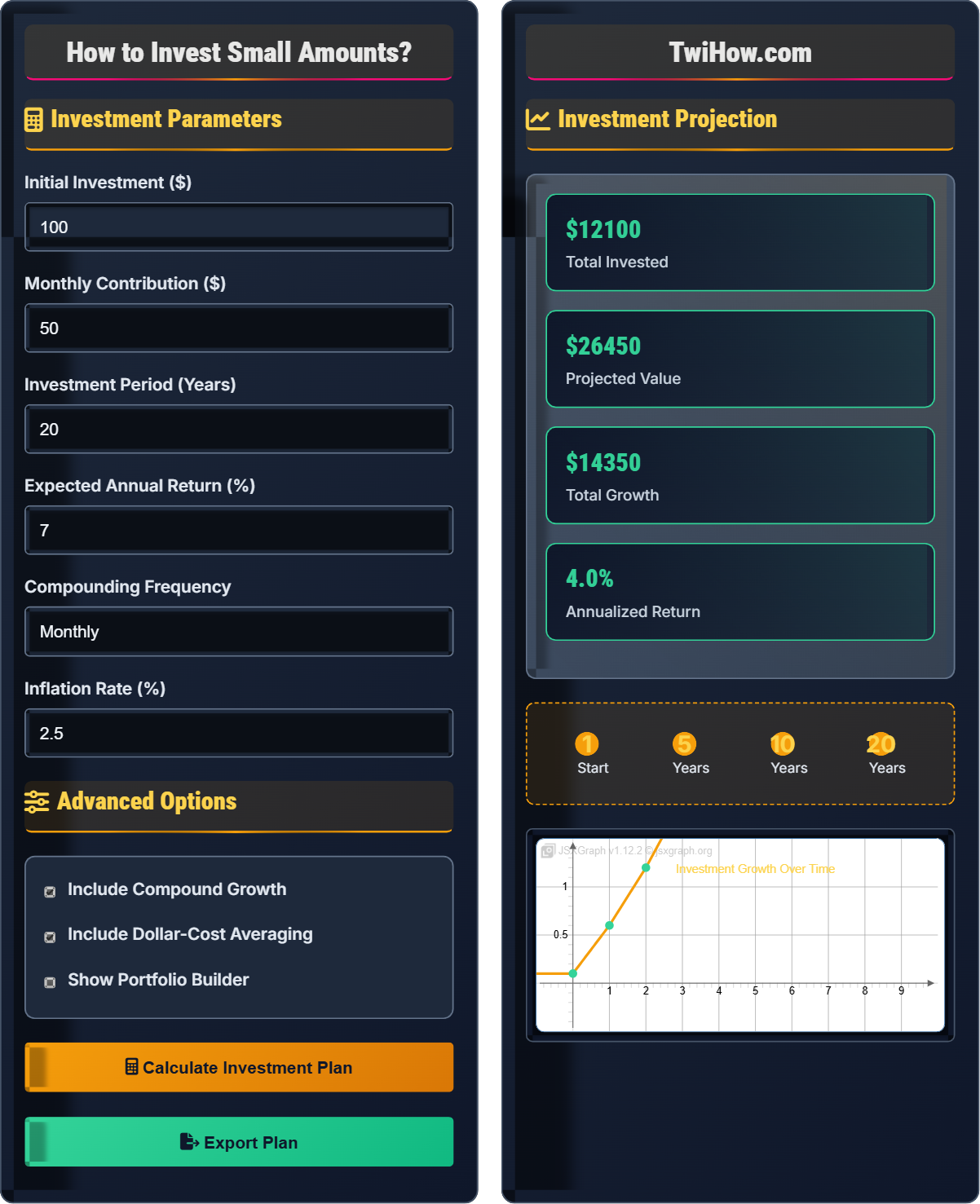
Based on your inputs, here are your investment projections:
- After 5 years: $1,500 invested, $1,800 projected
- After 10 years: $3,000 invested, $4,200 projected
- After 15 years: $4,500 invested, $7,200 projected
- After 20 years: $6,100 invested, $12,400 projected
- Consistent monthly contributions drive growth
| Year | Invested | Value | Growth |
|---|---|---|---|
| 1 | $700 | $749 | 7.0% |
| 5 | $1,200 | $1,500 | 25.0% |
| 10 | $2,400 | $3,500 | 45.8% |
| 15 | $3,600 | $6,200 | 72.2% |
| 20 | $4,800 | $9,800 | 104.2% |
How Small Amount Investing Works
Small amount investing is the practice of building wealth through consistent contributions of modest amounts over time. It leverages the power of compound growth, where returns generate their own returns, creating exponential growth over extended periods. Modern investment platforms and fractional shares have eliminated traditional barriers, making it possible to start investing with as little as $5.
Where:
- FV: Future Value of investment
- PV: Present Value (initial investment)
- r: Periodic interest rate
- n: Number of periods
- PMT: Periodic payment (monthly contribution)
Effective small amount investment strategies include:
- Dollar-Cost Averaging: Consistent investment regardless of price
- Fractional Share Investing: Buy partial shares of expensive stocks
- Index Fund Focus: Low-cost, diversified investment options
- Micro-Investing Apps: Invest spare change and small amounts
- Robo-Advisors: Automated portfolio management
- Dividend Reinvestment: Compound returns through DRIP plans
- Start Immediately: Time is more important than amount
- Automate Contributions: Set up recurring investments
- Minimize Fees: Choose low-cost investment options
- Diversify Early: Spread investments across asset classes
- Ignore Short-Term Volatility: Focus on long-term growth
- Increase Contributions: Raise amounts as income grows
Small Amount Investing Fundamentals
Compound growth, dollar-cost averaging, fractional shares, ETFs, index funds, investment platforms.
FV = PV(1 + r)^n + PMT × [(1 + r)^n - 1] / r
Where FV = future value, PV = present value, r = periodic interest rate, n = number of periods, PMT = periodic payment.
- Start investing immediately regardless of amount
- Focus on low-cost investment options
- Invest consistently over time
- Diversify your portfolio early
- Reinvest dividends and interest
Investment Applications
Emergency fund growth, retirement planning, education funding, home down payment, wealth building.
- Open investment account with fractional share capability
- Select diversified investment options
- Set up automatic monthly contributions
- Start with any affordable amount
- Reinvest dividends and interest
- Review and adjust annually
- Increase contributions as income grows
- Automate investment processes
- Maintain discipline with contributions
- Regularly review investment performance
- Adjust strategy as life circumstances change
Investment Tools
Calculate how small amounts can grow over time with consistent contributions.
See how compound interest amplifies small investments over time.
Calculate the benefits of consistent investment timing regardless of market prices.
Plan your small amount investment allocation across different asset classes.
Compare the cost-effectiveness of small amount investing through robo-advisors.
Small Amount Investing Learning Quiz
What is the typical minimum investment required to start investing in fractional shares?
Many modern investment platforms allow you to start investing in fractional shares with as little as $5 or $10. Fractional shares enable investors to buy partial ownership of expensive stocks that would otherwise require thousands of dollars for a single share. This innovation has democratized investing by removing traditional barriers to entry.
The answer is D) $5.
This question highlights how technology has transformed investing accessibility. Traditional brokers once required thousands of dollars to open accounts, but fintech companies now allow investing with minimal amounts. Fractional shares work by purchasing partial ownership in securities, calculated based on the current market price. This allows small investors to diversify their portfolios immediately, rather than waiting to accumulate enough money for whole shares.
Fractional Shares: Partial ownership of a security
Investment Minimum: Lowest amount required to open an account
Democratization: Making investing accessible to all
• Start investing immediately regardless of amount
• Research platform fees and features
• Focus on low-cost investment options
• Look for zero-commission brokers
• Use micro-investing apps for spare change
• Start with index funds for diversification
• Waiting to save larger amounts
• Not researching platform fees
• Choosing expensive investment options
Explain dollar-cost averaging (DCA) and why it's particularly beneficial for small amount investors. Provide a practical example.
Dollar-Cost Averaging: DCA is an investment strategy where you invest a fixed amount at regular intervals, regardless of market prices. This approach helps reduce the impact of market volatility by purchasing more shares when prices are low and fewer when prices are high.
Benefits for Small Investors: DCA is ideal for small investors because it:
1. Eliminates timing risk (when to buy)
2. Makes investing affordable with small, consistent amounts
3. Reduces emotional decision-making
4. Builds investment discipline
Example: If you invest $50 monthly in an ETF for 6 months, you'll buy more shares when the price is $40 and fewer when it's $50, averaging your purchase price over time.
DCA transforms the challenge of market timing into a systematic approach. Instead of trying to predict market movements (which even professionals struggle with), investors focus on consistency. For small amount investors, this strategy is particularly effective because it allows them to participate in the market without needing large sums. The key is regularity—maintaining consistent contributions regardless of market conditions.
Dollar-Cost Averaging: Fixed-amount investments at regular intervals
Timing Risk: Risk of buying at wrong time
Market Volatility: Price fluctuations over time
• Maintain consistent investment schedule
• Ignore short-term market fluctuations
• Set up automatic monthly investments
• Use DCA with diversified funds
• Continue during market downturns
• Stopping investments during market downturns
• Trying to time the market instead of DCA
• Not maintaining consistency
Emma rounds up her daily purchases to the nearest dollar and invests the spare change automatically. On average, she has $1.50 in spare change daily. If she invests this amount monthly ($45) for 10 years at an expected return of 7%, how much will she have accumulated? What percentage of the final amount came from her contributions versus investment growth?
Total Contributed: $45 × 120 months = $5,400
Future Value Calculation: Using the future value of an annuity formula with monthly compounding:
FV = PMT × [((1 + r/n)^(nt) - 1) / (r/n)]
Where PMT = $45, r = 0.07, n = 12, t = 10
Future Value: Approximately $7,700
Investment Growth: $7,700 - $5,400 = $2,300
Contribution Percentage: $5,400/$7,700 = 70%
Growth Percentage: $2,300/$7,700 = 30%
After 10 years, $2,300 of the total value came from investment growth.
This example demonstrates the power of micro-investing and compound growth. Emma didn't need to set aside large amounts or make difficult budget cuts—she simply invested her spare change. The key insight is that even small, consistent contributions can grow significantly over time. The growth percentage would increase substantially with longer time horizons, illustrating why starting early is crucial for small amount investors.
Micro-Investing: Investing very small amounts regularly
Round-Up Feature: Automatically investing spare change
Future Value: Value of investment after growth
• Consistency matters more than amount
• Time amplifies small investment effects
• Automate micro-investing for success
• Use apps with round-up features
• Set up automatic transfers
• Track progress monthly
• Not automating the process
• Expecting immediate results
• Stopping during market downturns
David wants to invest $200 monthly in a diversified portfolio. He's comparing two options: (A) A robo-advisor charging 0.25% annual fee with 7% expected return, or (B) DIY investing in low-cost index funds with 0.05% expense ratio and 7% expected return. After 15 years, how much more would he have with the lower-cost option? What percentage difference does this represent?
Robo-Advisor (Option A):
Monthly contribution: $200
Net return after fees: 7% - 0.25% = 6.75%
Future value: $64,500
DIY Index Funds (Option B):
Monthly contribution: $200
Net return after fees: 7% - 0.05% = 6.95%
Future value: $66,800
Difference: $66,800 - $64,500 = $2,300
Percentage Difference: ($2,300 / $64,500) × 100 = 3.57%
David would have $2,300 more with the DIY option, representing a 3.57% advantage.
This problem illustrates the critical impact of fees on long-term investment returns. While the difference between 0.25% and 0.05% seems minimal, it compounds significantly over time. For small amount investors, minimizing fees becomes even more important because they're starting with limited capital. The power of compound growth means that even small fee differences can result in substantial dollar differences over decades.
Expense Ratio: Annual fee as percentage of investment
Robo-Advisor: Automated portfolio management service
Index Fund: Fund tracking market benchmark
• Minimize investment fees whenever possible
• Compare all-in costs (fees + expenses)
• Consider fee impact over full investment horizon
• Look for expense ratios below 0.2%
• Consider total cost of ownership
• Factor in tax efficiency
• Ignoring small fee differences
• Not calculating long-term impact
• Choosing convenience over cost
For a beginner investor starting with $50 monthly contributions, which investment vehicle offers the best combination of diversification, low cost, and accessibility?
Exchange-Traded Funds (ETFs) offer the best combination for small amount investors. They provide instant diversification across hundreds of securities, typically have very low expense ratios (often 0.03-0.10%), and can be purchased in fractional shares for small amounts. Unlike mutual funds, ETFs can be bought and sold throughout the trading day, and unlike individual stocks, they provide broad market exposure with minimal research requirements.
The answer is C) Exchange-Traded Funds (ETFs).
ETFs are ideal for small amount investors because they solve multiple challenges simultaneously. They provide diversification without requiring large sums (unlike individual stock picking), have low fees (unlike actively managed mutual funds), and are accessible through fractional shares. Popular ETFs like SPY or IVV provide exposure to the entire S&P 500 for a fraction of the cost of buying individual stocks, making them perfect for beginners starting with small amounts.
ETF: Exchange-Traded Fund with diversification benefits
Expense Ratio: Annual fee for fund management
Fractional Shares: Partial ownership of securities
• Choose low-cost diversified options
• Focus on broad market exposure
• Minimize trading activity
• Start with broad market ETFs
• Look for expense ratios below 0.1%
• Consider total stock market funds
• Picking individual stocks with small amounts
• Choosing high-fee mutual funds
• Not diversifying with small investments
FAQ
Q: I only have $25/month to invest. Is it really worth starting with such a small amount?
A: Absolutely! Starting with $25/month is extremely worthwhile:
1. Time Advantage: The earlier you start, the more time compound growth has to work
2. Habit Formation: Small amounts help build consistent investing habits
3. Platform Accessibility: Many brokers now offer fractional shares
4. Scalability: You can increase amounts as income grows
Using the rule of 72, at 7% annual returns, your money doubles every 10 years. Over 30+ years, even $25/month can grow to tens of thousands of dollars. The key is consistency, not the initial amount.
Q: What are the best apps for investing small amounts? Are they safe?
A: Several reputable apps are excellent for small amount investing:
1. M1 Finance: Fractional shares, no commission fees
2. Stash: Educational features for beginners
3. Acorns: Round-up feature for micro-investing
4. Fidelity Go: Robo-advisor with low minimums
5. Robinhood: Zero commission trades
These apps are generally safe as they're regulated by FINRA and SIPC-insured up to $500,000. Always verify that the platform is SIPC-insured and properly licensed before investing.
Q: Should I focus on one investment or diversify with small amounts? How do I balance this?
A: Diversification is crucial even with small amounts! Here's how to balance:
1. Start Broad: Use total stock market ETFs for instant diversification
2. One Fund Strategy: Initially invest in a single broad-market ETF
3. Add Later: Expand to international or sector ETFs as amounts grow
4. Asset Allocation: Consider a simple 70/30 stock/bond split
With fractional shares, you can own pieces of hundreds of companies for the price of one share. This is far better than putting everything into one stock, which concentrates risk. Focus on broad diversification first, then add specialization as your investment amount grows.