How to Manage Salary?
Complete salary management guide • Step-by-step explanations
Salary Management Fundamentals:
Show Salary ManagerSalary management is the strategic process of optimizing your earned income through effective budgeting, saving, investing, and expense control. It involves creating a comprehensive plan to allocate your salary across different financial priorities while building wealth and achieving long-term financial goals.
Key salary management components:
- Tax Planning: Understanding deductions and optimizing take-home pay
- Budgeting: Allocating income to different expense categories
- Saving: Setting aside money for short-term and long-term goals
- Investing: Growing wealth through various investment vehicles
- Debt Management: Strategically handling loans and credit
- Emergency Preparedness: Maintaining financial security buffers
Effective salary management requires discipline, planning, and regular review of your financial situation to ensure you're maximizing the value of every dollar earned.
Salary Parameters
Advanced Options
Salary Analysis
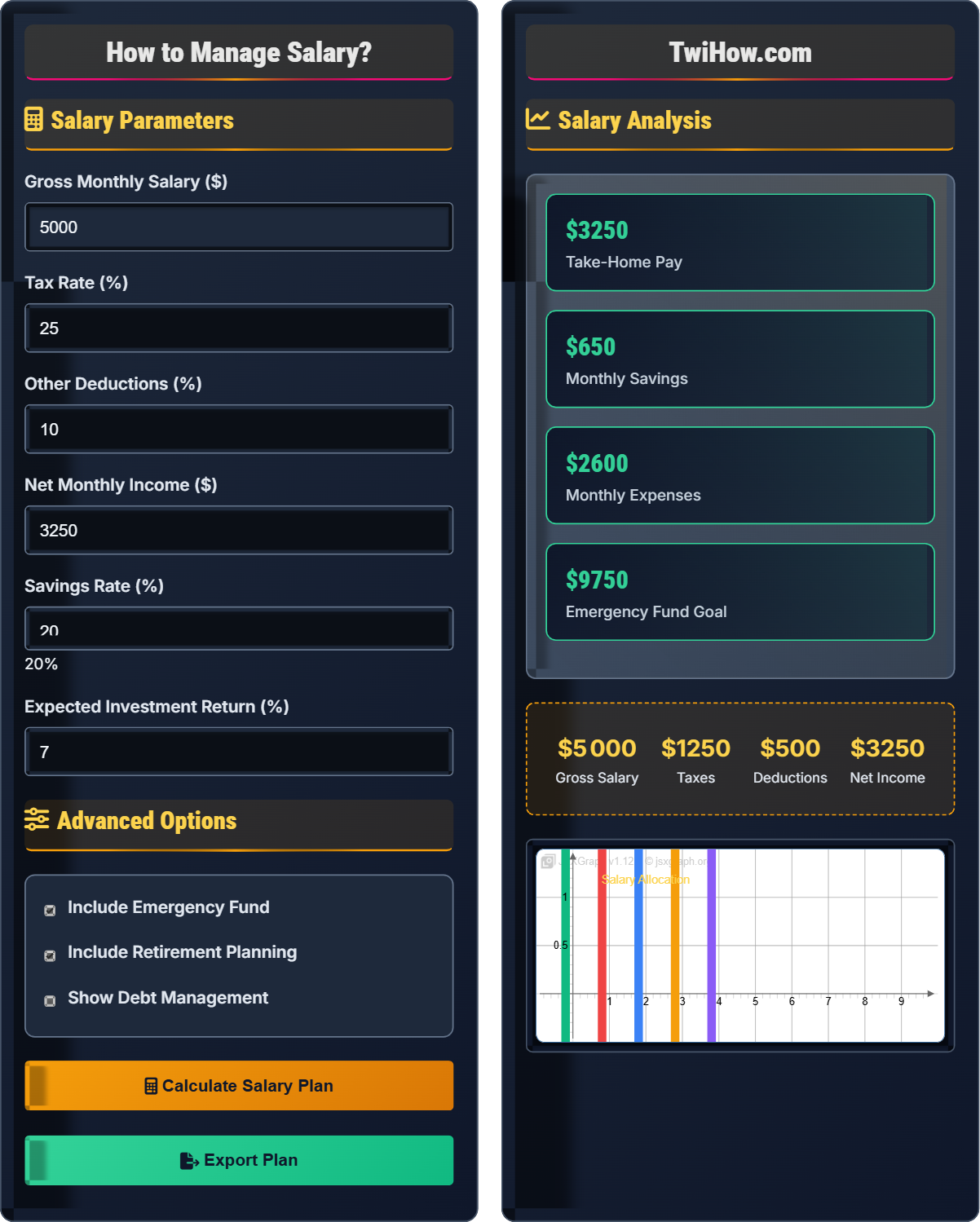
Based on your salary, here are your recommended financial goals:
- Build $9,750 emergency fund in 15 months
- Save $20,000 for major purchase in 2 years
- Invest $500 monthly for long-term growth
- Retire with $1,000,000 in 30 years
| Category | Amount | Percentage | Action |
|---|---|---|---|
| Gross Salary | $5,000 | 100% | Track sources |
| Taxes | $1,250 | 25% | Optimize deductions |
| Other Deductions | $500 | 10% | Review regularly |
| Take-Home Pay | $3,250 | 65% | Manage strategically |
| Savings | $650 | 20% | Automate transfers |
| Expenses | $2,600 | 80% | Monitor closely |
How Salary Management Works
Salary management is the strategic process of optimizing your earned income through effective budgeting, saving, investing, and expense control. It involves creating a comprehensive plan to allocate your salary across different financial priorities while building wealth and achieving long-term financial goals. Effective salary management maximizes the value of every dollar earned and helps you build financial security.
Where:
- Gross Salary: Total earnings before deductions
- Taxes: Federal, state, and local tax obligations
- Other Deductions: Insurance, retirement contributions, etc.
- Savings Rate: Percentage of net income set aside for savings
Popular salary allocation methods include:
- 50/30/20 Rule: 50% needs, 30% wants, 20% savings/debt
- 60/20/20 Rule: 60% living expenses, 20% savings, 20% debt repayment
- Zero-Based Budgeting: Assign every dollar a purpose
- Envelope Method: Physical separation of budget categories
- Automated Allocation: Automatic transfers to different accounts
- Pay Yourself First: Automate savings to ensure consistent contributions
- Track Spending: Use apps or spreadsheets to monitor expenses
- Negotiate Benefits: Maximize employer-provided perks and matching
- Tax Optimization: Contribute to tax-advantaged accounts
- Emergency Fund: Maintain 3-6 months of expenses in liquid accounts
- Regular Reviews: Assess your plan monthly or quarterly
Salary Management Fundamentals
Net income, gross salary, tax optimization, budget allocation, emergency fund, investment strategy.
Net Income = Gross Salary - Taxes - Other Deductions
Savings Rate = (Savings Amount / Net Income) × 100%
Where Net Income = actual take-home pay, Savings Rate = percentage of income saved.
- Always save a portion of your salary
- Build an emergency fund first
- Pay off high-interest debt
- Invest for long-term growth
- Regularly review and adjust your plan
Salary Management Applications
Budgeting, debt reduction, retirement planning, college funding, home buying, emergency preparedness.
- Calculate net income after all deductions
- Track income and expenses for 30 days
- Set SMART financial goals
- Create and follow a budget
- Build emergency fund
- Develop debt repayment strategy
- Start investing for long-term goals
- Automate financial processes
- Maintain discipline with spending
- Regularly review financial progress
- Adjust plans as life circumstances change
Salary Management Tools
Calculate your take-home pay and how to allocate your salary effectively.
Determine optimal allocation of your salary across different categories.
Determine how much you need to save monthly to reach your financial goals.
See how your salary-based investments can grow over time with compound interest.
Calculate how long it will take to pay off debt using your salary.
Salary Management Learning Quiz
According to the popular 50/30/20 budgeting rule, what percentage of net income should be allocated to savings and debt repayment?
The 50/30/20 rule allocates 50% of net income to needs (essential expenses), 30% to wants (non-essential spending), and 20% to savings and debt repayment. This allocation provides a balanced approach to managing salary while building wealth and maintaining lifestyle.
The answer is B) 20%.
The 50/30/20 rule is a widely accepted budgeting guideline that simplifies salary allocation. The 20% for savings and debt repayment ensures you're building wealth while eliminating debt. This allocation strikes a balance between immediate needs, lifestyle desires, and future financial security. The rule is flexible and can be adjusted based on individual circumstances.
Net Income: Take-home pay after all deductions
Needs: Essential expenses (housing, food, utilities)
Wants: Non-essential expenses (entertainment, dining out)
• Prioritize needs over wants
• Always save before spending on wants
• Adjust percentages based on your situation
• Automate the 20% savings allocation
• Track spending to stay within limits
• Use apps to monitor categories
• Spending wants before saving
Explain how to optimize your salary through tax planning and deduction strategies. What are the most effective ways to increase your take-home pay?
Tax Optimization Strategies:
1. Maximize Pre-tax Contributions: Contribute to 401(k), HSA, and other pre-tax accounts to reduce taxable income.
2. Utilize Tax Credits: Claim available credits like Child Tax Credit, Earned Income Tax Credit, and education credits.
3. Itemize Deductions: If exceeding standard deduction, itemize for medical expenses, state taxes, mortgage interest, and charitable contributions.
4. Flexible Spending Accounts: Use FSA for medical and dependent care expenses.
5. Employer Benefits: Take advantage of commuter benefits, wellness programs, and other tax-advantaged perks.
These strategies can significantly increase your take-home pay by legally reducing your tax burden.
Tax optimization is a crucial aspect of salary management that many people overlook. By reducing your taxable income through legitimate deductions and credits, you effectively increase your take-home pay without increasing your gross salary. The key is to plan ahead and take advantage of all available tax-advantaged accounts and benefits offered by employers.
Pre-tax Deduction: Reduces taxable income before taxes are calculated
Tax Credit: Directly reduces tax liability dollar-for-dollar
Standard Deduction: Fixed amount that reduces taxable income
• Maximize employer 401(k) match first
• Contribute to HSA if eligible
• Keep receipts for itemizable expenses
• Use tax software to identify missed opportunities
• Consult with a tax professional for complex situations
• Adjust withholding to avoid large refunds
• Not maximizing employer benefits
• Forgetting to track deductible expenses
• Overlooking tax-advantaged accounts
Emma receives a monthly net salary of $4,000 after all deductions. She has $1,200 in monthly expenses for necessities (rent, utilities, groceries), $800 for discretionary spending, $300 in student loan payments, and wants to start saving for a house down payment. How should Emma allocate her remaining salary to maximize financial stability while saving for her goal?
Total Allocated: $1,200 (necessities) + $800 (discretionary) + $300 (student loans) = $2,300
Remaining Salary: $4,000 - $2,300 = $1,700
Recommendation: Emma should follow these steps:
1. Build a $6,000 emergency fund (3 months of expenses) at $500/month for 12 months
2. After emergency fund is complete, save $800/month for house down payment
3. Invest remaining $400/month for long-term growth
This allocation ensures financial security while progressing toward her homeownership goal. The emergency fund protects against setbacks that could derail her savings plan.
This problem demonstrates the importance of prioritizing financial needs. Emma's allocation follows the principle of building financial foundations first (emergency fund) before pursuing longer-term goals (house down payment). The key is to balance immediate needs with future aspirations while maintaining financial security. The emergency fund acts as a buffer that prevents her from going into debt when unexpected expenses arise.
Net Salary: Take-home pay after all deductions
Emergency Fund: Liquid savings for unexpected expenses
House Down Payment: Initial payment for purchasing property
• Build emergency fund before long-term goals
• Continue debt payments as scheduled
• Automate savings for consistency
• Use high-yield savings for emergency fund
• Set up automatic transfers
• Track progress toward house goal
• Skipping emergency fund for other goals
• Not accounting for irregular expenses
• Failing to automate savings
David currently earns $50,000 annually and saves 15% of his salary. He expects a 3% annual raise for the next 5 years. How should David adjust his savings strategy to take advantage of his increasing income? Calculate his total savings over 5 years and suggest an optimal allocation strategy.
Year 1: $50,000 × 15% = $7,500 savings
Year 2: $51,500 × 15% = $7,725 savings
Year 3: $53,045 × 15% = $7,957 savings
Year 4: $54,636 × 15% = $8,195 savings
Year 5: $56,275 × 15% = $8,441 savings
Total 5-Year Savings: $39,818
Optimal Strategy: As income grows, David should consider increasing his savings rate to 20% by year 3. This takes advantage of the "pay yourself more" principle where increased income leads to proportionally higher savings, accelerating wealth building.
This scenario illustrates the power of salary growth combined with disciplined saving. The key insight is that as income increases, maintaining the same savings rate means saving more dollars each year. However, the optimal strategy is to gradually increase the savings rate as income grows, allowing for accelerated wealth building. This approach leverages the fact that lifestyle inflation often matches income increases, so intentional savings rate increases are necessary to maximize the benefit of raises.
Salary Growth: Increase in compensation over time
Lifestyle Inflation: Increasing spending as income rises
Pay Yourself More: Increasing savings rate with income growth
• Increase savings rate with salary increases
• Automate savings to avoid lifestyle inflation
• Review and adjust allocation annually
• Set up automatic savings increases with raises
• Use bonuses for lump-sum savings
• Diversify investments as savings grow
• Letting lifestyle match salary increases
• Not adjusting savings strategy for growth
• Failing to capitalize on raises
For someone in their 30s managing their salary for long-term wealth building, what percentage of their monthly salary should typically be invested in growth-oriented assets?
For someone in their 30s with a long investment horizon (30+ years until retirement), financial experts typically recommend investing 15-20% of gross salary in growth-oriented assets. This allocation takes advantage of the power of compound growth while providing sufficient time to recover from market downturns. The combination of salary management and aggressive investing in the 30s sets the foundation for substantial wealth accumulation.
The answer is C) 15-20%.
The 30s represent a crucial decade for wealth building due to the extended time horizon for investments to compound. The recommended allocation of 15-20% of salary to investments balances the need for current financial stability with long-term growth. This percentage allows for significant wealth accumulation while still permitting adequate spending for lifestyle needs and other financial goals. The key is consistency in investing regardless of market conditions.
Growth-Oriented Assets: Investments focused on long-term appreciation
Compound Growth: Earning returns on previous returns
Investment Horizon: Time period for investment growth
• Maintain consistent investment habits
• Diversify across asset classes
• Stay invested through market cycles
• Maximize employer 401(k) match first
• Use low-cost index funds
• Rebalance portfolio annually
• Not starting to invest early enough
• Being too conservative with long-term investments
• Stopping investments during market downturns
FAQ
Q: I just got my first job with a salary of $45,000/year. How should I prioritize managing this salary as a recent graduate?
A: Congratulations on your first job! Here's how to prioritize managing your salary:
1. Emergency Fund: Start with $1,000-$2,000 in a high-yield savings account
2. Employer Benefits: Maximize any employer 401(k) match - it's free money
3. Student Loans: Make minimum payments on time, consider extra payments if interest rates are high
4. Basic Budget: Use 50/30/20 rule (50% needs, 30% wants, 20% savings/debt)
5. Automate: Set up automatic transfers to savings and investments
At this stage, focus on building good financial habits. Even small amounts saved consistently will grow significantly over your career. Start investing as soon as possible to take advantage of compound growth.
Q: I'm married with two kids and we have a combined salary of $120,000/year. How should we coordinate our salaries for maximum financial benefit?
A: For a dual-income family with children, consider these strategies:
1. Joint vs. Individual Accounts: Maintain joint accounts for shared expenses and individual accounts for personal spending
2. Maximize Tax Advantages: Utilize both spouses' contribution limits to tax-advantaged accounts
3. Emergency Fund: Build 6-9 months of expenses given family responsibilities
4. Child-Related Savings: Open 529 plans for education expenses
5. Insurance: Ensure adequate life and disability insurance for both earners
Consider the "bucket" approach: allocate specific portions of each salary to different purposes (e.g., housing from primary earner, savings from secondary earner). Regular financial meetings ensure both partners are aligned on goals and progress.
Q: My salary is quite high ($150,000+/year) but I have significant student loan debt. Should I prioritize debt payoff or investment?
A: With a high salary and student loans, use a hybrid approach:
1. Match Employer 401(k): Always capture employer matching funds first
2. High-Interest Debt: Pay off loans with rates above 6-7% aggressively
3. Tax-Advantaged Accounts: Maximize Roth IRA and HSA contributions
4. Balance Approach: 60% debt payoff, 40% investment if loan rates are 5-7%
5. Refinance Opportunity: Consider refinancing high-rate loans if you qualify
Given your high income, you can likely handle both simultaneously. The key is to ensure you're not missing out on valuable tax advantages while paying down debt. Consider consulting a financial advisor for your specific situation.