How to Plan Finances?
Complete personal finance guide • Step-by-step explanations
Financial Planning Fundamentals:
Show Financial PlannerFinancial planning is the process of managing your money to achieve your life goals. It involves creating a comprehensive strategy for spending, saving, investing, and protecting your financial resources. Effective financial planning helps you build wealth, prepare for emergencies, and secure your future.
Key financial planning components:
- Budgeting: Tracking income and expenses to live within means
- Saving: Setting aside money for short-term and long-term goals
- Investing: Growing wealth through various investment vehicles
- Debt Management: Managing and reducing debt strategically
- Insurance: Protecting against financial risks
- Retirement Planning: Ensuring financial security in later years
Successful financial planning requires setting clear goals, assessing your current situation, creating actionable plans, and regularly reviewing and adjusting your strategies.
Financial Parameters
Advanced Options
Financial Analysis
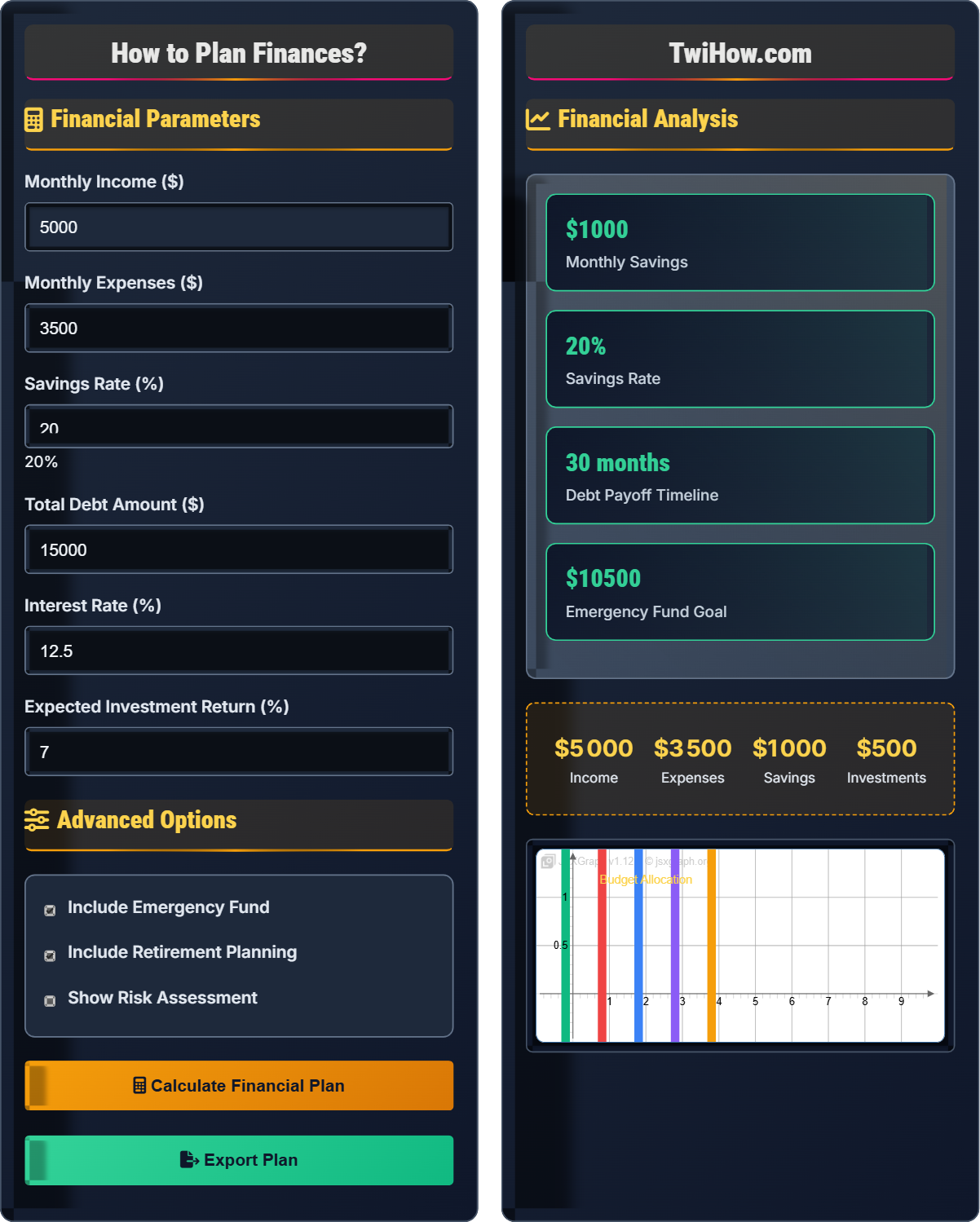
Based on your inputs, here are your recommended financial goals:
- Build $15,000 emergency fund in 10 months
- Pay off $15,000 debt in 5 years
- Save $50,000 for major purchase in 3 years
- Retire with $1,000,000 in 30 years
| Category | Amount | Percentage | Action |
|---|---|---|---|
| Income | $5,000 | 100% | Track sources |
| Fixed Expenses | $2,500 | 50% | Minimize where possible |
| Variable Expenses | $1,000 | 20% | Monitor closely |
| Savings | $1,000 | 20% | Automate transfers |
| Investments | $500 | 10% | Diversify portfolio |
How Financial Planning Works
Financial planning is the process of creating a roadmap for your financial future. It involves setting goals, assessing your current financial situation, and developing strategies to achieve those goals. A comprehensive financial plan considers all aspects of your financial life, including budgeting, saving, investing, insurance, taxes, and estate planning.
Where:
- Assets: Everything you own (cash, investments, property)
- Liabilities: Everything you owe (debts, loans)
- Savings Rate: Percentage of income set aside for savings
Effective financial planning covers these key areas:
- Budgeting: Creating and maintaining a spending plan
- Saving: Building liquid reserves for goals and emergencies
- Investing: Growing wealth through various investment vehicles
- Debt Management: Strategically handling loans and credit
- Insurance: Protecting against financial risks
- Tax Planning: Minimizing tax obligations legally
- Retirement Planning: Securing financial independence
- Estate Planning: Ensuring proper asset distribution
- Pay Yourself First: Automate savings to ensure consistent contributions
- Emergency Fund: Maintain 3-6 months of expenses in liquid accounts
- Debt Avalanche: Pay minimums on all debts, extra on highest interest
- Asset Allocation: Diversify investments based on risk tolerance and timeline
- Compound Interest: Start investing early to maximize growth
- Regular Reviews: Assess and adjust plan quarterly or annually
Financial Planning Fundamentals
Net worth, cash flow, compound interest, diversification, risk management, financial goals.
Net Worth = Assets - Liabilities
Cash Flow = Income - Expenses
Where Net Worth = financial health indicator, Assets = everything owned, Liabilities = everything owed.
- Always spend less than you earn
- Build an emergency fund first
- Pay off high-interest debt
- Start investing early for retirement
- Regularly review and adjust your plan
Financial Planning Applications
Budgeting, debt reduction, retirement planning, college funding, home buying, emergency preparedness.
- Calculate current net worth
- Track income and expenses
- Set SMART financial goals
- Create and follow a budget
- Build emergency fund
- Develop debt repayment strategy
- Start investing for long-term goals
- Automate financial processes
- Maintain discipline with spending
- Regularly review financial progress
- Adjust plans as life circumstances change
Financial Planning Tools
Calculate how long it will take to pay off your debt based on your monthly payment capacity.
Determine how much you need to save monthly to reach your financial goals.
See how your investments can grow over time with compound interest.
Determine how much you should have in your emergency fund.
Estimate how much you'll need for retirement and how to get there.
Understand your comfort level with investment risk.
Financial Planning Learning Quiz
According to financial experts, what percentage of gross income should ideally be allocated to savings?
Financial experts generally recommend allocating 10-20% of gross income to savings. This follows the "pay yourself first" principle, where you prioritize saving by setting aside money before paying other expenses. The exact percentage depends on individual circumstances, but 10-20% provides a good balance between building wealth and maintaining a reasonable standard of living.
The answer is B) 10-20%.
Understanding savings rates is crucial for financial stability. The 10-20% guideline helps people build an emergency fund, save for short-term goals, and invest for long-term objectives. Starting with a smaller percentage and gradually increasing it can make the process more manageable. The key is to make saving automatic and consistent rather than sporadic.
Gross Income: Total income before taxes and deductions
Savings Rate: Percentage of income set aside for savings
Emergency Fund: Liquid savings for unexpected expenses
• Pay yourself first by automating savings
• Build emergency fund before investing
• Adjust savings rate based on life circumstances
• Start with whatever amount you can afford
• Increase savings rate when income increases
• Use high-yield savings accounts for emergency funds
• Not saving anything (0% savings rate)
• Saving inconsistently
• Not adjusting savings rate for inflation
Explain the purpose of an emergency fund, how much should be saved, and where it should be kept. Why is this the first priority in financial planning?
Purpose: An emergency fund serves as financial protection against unexpected events like job loss, medical emergencies, or major repairs. It prevents you from going into debt when unexpected expenses arise.
Amount: Most financial experts recommend 3-6 months of essential expenses. The exact amount depends on job stability, family situation, and risk tolerance.
Location: Emergency funds should be kept in easily accessible, liquid accounts like high-yield savings accounts or money market funds. They should be separate from regular checking accounts to prevent temptation.
First Priority: Emergency funds are the foundation of financial planning because they provide stability and peace of mind. Without this buffer, you're vulnerable to setbacks that could derail all other financial goals.
The emergency fund is the cornerstone of financial stability. It creates a financial cushion that allows you to handle life's uncertainties without derailing your long-term goals. Before investing or paying down low-interest debt, you should establish this safety net. The psychological benefit of having this fund cannot be overstated—it reduces financial stress and provides confidence to pursue other financial objectives.
Emergency Fund: Liquid savings for unexpected expenses
Liquid Account: Easily accessible without penaltiesEssential Expenses: Minimum costs to survive (housing, food, utilities)
• Keep emergency fund in liquid accounts
• Don't invest emergency funds in volatile assets
• Rebuild after using emergency funds
• Start with $1,000 as a mini-emergency fund
• Automate monthly contributions
• Keep separate account number private
• Not having an emergency fund
• Investing emergency funds in risky assets
• Not replenishing after use
Sarah earns $5,000 per month and has $10,000 in credit card debt at 18% interest. She also has $2,000 in a savings account earning 1% interest. Her monthly expenses are $3,500, leaving $1,500 available for financial goals. What should Sarah's financial priority be, and how should she allocate her $1,500 monthly surplus?
Priority: Sarah should prioritize paying off her high-interest debt before saving or investing. The 18% interest on her credit card debt far exceeds the 1% she's earning on savings, creating a negative arbitrage situation.
Strategy: First, build a small emergency fund of $1,000-$2,000. Then, focus aggressively on debt repayment using the debt avalanche method (highest interest rate first).
Allocation: $500 for emergency fund until it reaches $2,000, then $1,500 toward debt payments. Once debt is paid off, redirect the full amount to savings and investments.
Calculation: With $1,500 monthly payments, Sarah could eliminate her $10,000 debt in approximately 7 months, saving over $1,000 in interest charges.
This scenario illustrates the debt vs. savings dilemma many people face. The key principle is to compare interest rates: pay off high-interest debt before saving in low-interest accounts. Sarah's 18% credit card interest is significantly higher than her 1% savings interest, making debt repayment the financially superior choice. However, maintaining a small emergency fund provides protection against new debt accumulation.
Debt Avalanche: Pay minimums on all debts, extra on highest interest
Negative Arbitrage: Paying more in interest than earning on savings
Minimum Viable Emergency Fund: Small buffer to prevent new debt
• Pay high-interest debt before low-interest savings
• Maintain small emergency fund during debt payoff
• Focus on one financial goal at a time
• Negotiate lower interest rates on credit cards
• Consider balance transfer to lower rate card
• Cut expenses to increase debt payments
• Saving while carrying high-interest debt
• Making only minimum payments
• Not tracking spending during debt payoff
Michael is 35 years old with a 30-year investment horizon until retirement. He has $50,000 to invest initially and can contribute $500 monthly. His risk tolerance is moderate. How should Michael allocate his investments between stocks, bonds, and other assets? Explain the rationale behind your allocation and how it might change over time.
Recommended Allocation: 70% stocks, 20% bonds, 10% international/reits
Rationale: At age 35 with a 30-year horizon, Michael can tolerate more risk for potentially higher returns. Stocks provide growth potential, bonds offer stability, and international diversification reduces risk.
Time Adjustment: As Michael ages, he should gradually shift toward more conservative allocations (e.g., 60/30/10 at age 45, 50/40/10 at age 55) to protect gains as retirement approaches.
Specific Investments: Broad index funds for domestic stocks (S&P 500), international developed markets, and intermediate-term bonds for simplicity and low costs.
Asset allocation is the most important investment decision. The allocation should match both risk tolerance and time horizon. Young investors can afford more stock exposure because they have time to recover from market downturns. As retirement approaches, the allocation should become more conservative to preserve capital. This gradual shift is called a "glide path" and helps balance growth potential with risk management.
Asset Allocation: Distribution of investments among asset classes
Rebalancing: Adjusting portfolio back to target allocation
Glide Path: Gradual shift to conservative allocation over time
• Match allocation to time horizon and risk tolerance
• Rebalance annually to maintain targets
• Use low-cost index funds when possible
• Start with simple 3-fund portfolio
• Automate monthly contributions
• Review allocation annually
• Too conservative for long time horizons
• Not rebalancing regularly
• Overconcentrating in single assets
According to the 4% rule, how much should someone have saved for retirement if they want to withdraw $40,000 annually in retirement?
The 4% rule suggests that retirees can safely withdraw 4% of their retirement savings annually, adjusted for inflation, without running out of money for 30 years. To find the required savings amount, divide the desired annual withdrawal by 4%: $40,000 ÷ 0.04 = $1,000,000.
The answer is B) $1,000,000.
The 4% rule is a widely accepted retirement planning guideline that balances the desire for income with the need to preserve capital. It assumes a diversified portfolio of 60% stocks and 40% bonds. While not guaranteed to work in all market conditions, it provides a useful starting point for retirement planning. The rule helps people understand how much they need to save based on their desired retirement lifestyle.
4% Rule: Safe withdrawal rate for retirement savings
Safe Withdrawal Rate: Annual amount that can be withdrawn without depleting funds
Retirement Replacement Rate: Percentage of pre-retirement income needed in retirement
• Follow the 4% rule for sustainable withdrawals
• Adjust for inflation annually
• Consider sequence of returns risk
• Plan for 30+ years of retirement
• Factor in healthcare costs
• Consider part-time work in early retirement
• Underestimating retirement expenses
• Not accounting for inflation
• Ignoring healthcare costs
FAQ
Q: I'm 25 and just started my career. Should I focus on paying off student loans or start investing now?
A: The best approach depends on your student loan interest rates. If your loans have low interest rates (below 4-5%), it's generally better to start investing immediately while making minimum payments on loans. The power of compound interest over 30-40 years far outweighs the modest interest savings from early loan payoff.
However, if your loans have high interest rates (above 6-7%), prioritize paying those off first before investing. For rates in between, consider splitting your efforts: invest enough to get any employer 401(k) match, then focus on debt payoff.
At 25, time is your greatest asset for investing, so don't delay unnecessarily. Even investing $200-300 monthly can make a significant difference over decades.
Q: What's the difference between good debt and bad debt, and how do I know which is which?
A: Good debt typically has these characteristics: it appreciates in value or generates income, has relatively low interest rates, and helps build wealth over time. Examples include mortgages (real estate typically appreciates) and student loans (increases earning potential).
Bad debt usually: depreciates in value, has high interest rates, doesn't generate income, and decreases your net worth. Credit cards, car loans, and personal loans for consumption are typically bad debt.
However, the distinction isn't always clear-cut. A mortgage for a house in a declining area might be bad debt, while business loans for expansion could be good debt if profitable. The key is whether the debt helps you build wealth or consume beyond your means.
Q: How should I adjust my investment strategy now that I'm retired and drawing down my savings?
A: In retirement, your investment strategy should shift from growth to preservation and income generation. Consider the "bucket strategy": keep 1-3 years of expenses in cash/money markets, 3-10 years in bonds and dividend-paying stocks, and the remainder in growth-oriented investments.
Reduce equity exposure compared to pre-retirement levels, but maintain some growth investments to combat inflation over a 20-30 year retirement. Consider annuities for guaranteed income, but don't put all assets in them.
Implement a systematic withdrawal strategy, such as the 4% rule, and adjust based on market conditions. In down markets, consider reducing withdrawals temporarily to preserve principal.