What is Diversification?
Complete diversification guide • Step-by-step explanations
Diversification Fundamentals:
Simulate PortfolioDiversification is a risk management strategy that mixes a wide variety of investments within a portfolio. The rationale behind this technique is that a portfolio constructed of different kinds of investments will, on average, yield higher long-term returns and lower the risk of any individual holding or security.
Diversification stems from the adage "Don't put all your eggs in one basket." By spreading investments across various asset classes, sectors, geographical regions, and investment types, investors can reduce the impact of a single poor-performing investment on their overall portfolio.
Key principles:
- Spread Risk: Reduce concentration in any single investment
- Correlation: Choose assets that don't move in perfect sync
- Asset Allocation: Distribute investments across different categories
- Geographic Diversification: Invest in different countries and regions
Proper diversification can help smooth out unsystematic risk events in a portfolio, so that the positive performance of some investments neutralizes the negative performance of others.
Risk Reduction
Spreading investments reduces the impact of any single poor performer on your portfolio.
Asset Allocation
Distribute investments across different asset classes to balance risk and return.
Geographic Spread
Invest in different countries and regions to reduce country-specific risks.
Sector Diversification
Allocate across different industries to avoid sector concentration.
Portfolio Structure Example
Well-diversified portfolio composition:
Stocks
30%
Stocks
20%
25%
15%
10%
This diversified structure helps reduce overall portfolio risk
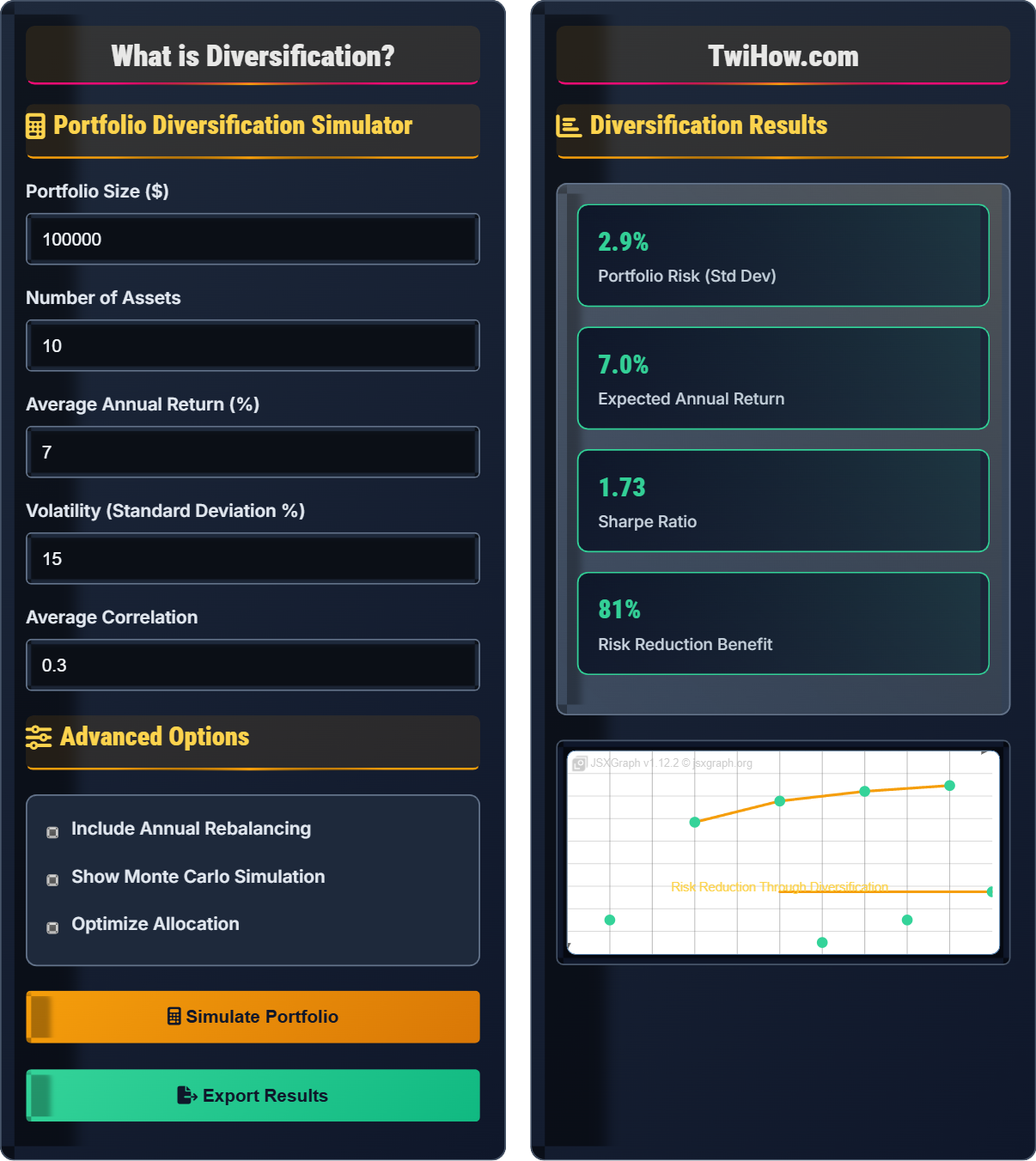
Portfolio Diversification Simulator
Advanced Options
Diversification Results
Asset Allocation
Portfolio Simulation
Simulated portfolio performance over 10 years:
Spread investments across different asset classes like stocks, bonds, real estate, and commodities. Each asset class responds differently to market conditions, reducing overall portfolio risk.
Invest in different countries and regions to reduce exposure to any single economy. International diversification can provide exposure to faster-growing markets.
Allocate investments across different sectors like technology, healthcare, finance, and consumer goods. This protects against sector-specific downturns.
Composition: 100% in tech stocks
Risk: Very high - dependent on single sector performance
Example: If tech sector crashes, entire portfolio suffers
- High volatility
- No protection against sector risks
- Poor risk-adjusted returns
Composition: 30% US stocks, 20% Intl stocks, 25% bonds, 15% REITs, 10% commodities
Risk: Low to moderate - well-distributed across asset classes
Example: Poor performance in one area offset by others
- Lower volatility
- Protection against sector risks
- Better risk-adjusted returns
Diversification Explained
Diversification is a risk management strategy that involves spreading investments across various financial instruments, industries, and other categories to optimize returns and minimize risk. The rationale behind this technique is that a portfolio constructed of different kinds of investments will, on average, yield higher long-term returns and lower the risk of any individual holding or security.
Mathematically, the risk of a portfolio is not simply the weighted average of the risks of individual assets, but also depends on how the assets' returns move in relation to each other.
The variance of a portfolio with n assets is given by:
Where:
- \(\sigma_p^2\): Portfolio variance
- \(w_i, w_j\): Weights of assets i and j
- \(\sigma_{ij}\): Covariance between assets i and j
Common diversification strategies:
- Horizontal Diversification: Adding new products/services in current market
- Vertical Diversification: Controlling different stages of production
- Geographic Diversification: Expanding to new markets
- Product Diversification: Entering new product lines
- Asset Class Diversification: Different investment types
- Time Diversification: Dollar-cost averaging
Benefits:
- Reduces portfolio volatility
- Minimizes impact of individual security failures
- Provides exposure to various market segments
- Improves risk-adjusted returns
- Protects against economic downturns in specific sectors
Limitations:
- Doesn't eliminate systematic risk
- May reduce potential returns
- Requires ongoing management
- Can increase transaction costs
- Over-diversification can dilute performance
Diversification Fundamentals
Diversification, risk management, portfolio theory, correlation, covariance, asset allocation, systematic risk, unsystematic risk.
σ²ₚ = ΣᵢΣⱼ wᵢwⱼσᵢⱼ
Where σ²ₚ = portfolio variance, wᵢ,wⱼ = asset weights, σᵢⱼ = covariance between assets.
- Don't put all eggs in one basket
- Choose low-correlation assets
- Rebalance regularly
Diversification Strategies
Asset class diversification, geographic diversification, sector diversification, time diversification, dollar-cost averaging.
- Assess risk tolerance
- Define investment goals
- Choose appropriate diversification strategy
- Implement and monitor
- Balance risk and return
- Avoid over-diversification
- Consider correlation between assets
Diversification Learning Quiz
What happens to portfolio risk when the correlation between assets increases?
When the correlation between assets increases, they tend to move more in sync with each other, reducing the diversification benefit. Higher correlation means that when one asset performs poorly, others are more likely to perform poorly as well, increasing overall portfolio risk. The diversification benefit is greatest when assets have low or negative correlations.
The answer is B) Portfolio risk increases.
The key to effective diversification is choosing assets that don't move in perfect correlation. When assets are highly correlated, they rise and fall together, eliminating the risk-reduction benefits of diversification. The closer the correlation coefficient is to +1.0, the more the assets move in tandem, and the less effective diversification becomes.
Correlation: Statistical measure of how two assets move in relation to each other
Diversification Benefit: Risk reduction achieved by combining uncorrelated assets
Portfolio Risk: Overall volatility of a portfolio
• Lower correlation = better diversification
• Perfect correlation eliminates diversification
• Negative correlation provides maximum benefit
• Look for correlation coefficients below 0.5
• Monitor correlation changes over time
• Assuming all stocks are uncorrelated
• Not monitoring changing correlations
• Ignoring correlation during crisis periods
Explain Modern Portfolio Theory (MPT) and how it relates to diversification. Describe the efficient frontier and its significance in portfolio construction.
Modern Portfolio Theory: Developed by Harry Markowitz, MPT shows that an investor can construct a portfolio to maximize expected return for a given level of risk.
Key Principles: MPT emphasizes that risk is not just about individual securities but about how they interact in a portfolio. The theory shows that diversification can reduce risk without sacrificing expected return.
Efficient Frontier: The set of optimal portfolios offering the highest expected return for a defined level of risk. Portfolios on the frontier are optimally diversified.
Significance: MPT provides the mathematical framework for diversification, showing that the optimal portfolio is not necessarily the one with the highest return, but the one that offers the best return for a given level of risk.
MPT revolutionized investing by showing that risk and return should be evaluated at the portfolio level, not just at the individual security level. The theory demonstrates mathematically that diversification can improve the risk-return tradeoff of a portfolio. The efficient frontier represents the boundary of optimal portfolios, and any portfolio below the frontier is suboptimal because it either has too much risk for its return or too little return for its risk.
Modern Portfolio Theory: Mathematical framework for optimal portfolio construction
Efficient Frontier: Set of optimal risk-return combinations
Systematic Risk: Market-wide risk that cannot be diversified away
• Diversification reduces unsystematic risk
• Optimal portfolios lie on efficient frontier
• Risk should be evaluated at portfolio level
• Use MPT to guide asset allocation
• Consider risk-return tradeoffs
• Focus on portfolio-level metrics
• Evaluating securities individually
• Ignoring correlation between assets
• Not considering portfolio-level risk
You have $100,000 to invest. You're considering two portfolios: Portfolio A (100% in Tech stocks with 20% expected return and 30% volatility) and Portfolio B (50% Tech stocks, 50% Bonds with 12% expected return and 15% volatility). The correlation between Tech stocks and Bonds is 0.2. Calculate which portfolio offers a better risk-adjusted return using the Sharpe ratio (assuming risk-free rate of 2%).
Portfolio A: Expected Return = 20%, Volatility = 30%
Sharpe Ratio = (20% - 2%) / 30% = 18% / 30% = 0.60
Portfolio B: Expected Return = (0.5 × 20%) + (0.5 × 4%) = 12%
Portfolio Volatility = √[(0.5² × 30%²) + (0.5² × 8%²) + (2 × 0.5 × 0.5 × 30% × 8% × 0.2)]
= √[0.25 × 0.09 + 0.25 × 0.0064 + 0.5 × 0.024 × 0.2]
= √[0.0225 + 0.0016 + 0.0024] = √0.0265 = 16.3%
Sharpe Ratio = (12% - 2%) / 16.3% = 10% / 16.3% = 0.61
Portfolio B offers a better risk-adjusted return (Sharpe ratio of 0.61 vs 0.60), demonstrating the value of diversification.
This example shows that while Portfolio A had higher expected returns, the diversification in Portfolio B resulted in a better risk-adjusted return. The Sharpe ratio accounts for both return and risk, showing that Portfolio B provides more return per unit of risk. This demonstrates that diversification can improve risk-adjusted performance even if it reduces absolute returns.
Sharpe Ratio: Risk-adjusted return measure (excess return/volatility)
Risk-Adjusted Return: Return adjusted for level of risk taken
Portfolio Volatility: Standard deviation of portfolio returns
• Higher Sharpe ratio = better risk-adjusted return
• Diversification can improve risk-adjusted returns
• Consider both return and risk
• Use Sharpe ratio for portfolio comparisons
• Consider correlation when calculating portfolio risk
• Diversification often improves risk-adjusted returns
• Only considering expected returns
• Not accounting for correlation in risk calculation
• Ignoring risk-adjusted performance
An investor has 90% of their portfolio in US stocks and 10% in international stocks. During a global crisis, US stocks fell 35% while international stocks fell 40%. The correlation between US and international stocks increased to 0.8 during the crisis. Explain why geographic diversification didn't provide the expected protection and suggest improvements to the allocation.
Why Diversification Failed: 1) The allocation was heavily concentrated in US stocks (90%), limiting the diversification benefit. 2) Correlations increased during the crisis, causing international stocks to move more in sync with US stocks. 3) Both markets were affected by the same global crisis.
Improvements: 1) Increase international allocation to 30-40% for meaningful diversification. 2) Include emerging markets for additional diversification. 3) Add other asset classes like bonds, REITs, and commodities. 4) Consider geographic regions with different economic drivers.
This example demonstrates that diversification effectiveness can vary based on market conditions. During crisis periods, correlations often increase as all risky assets are sold off. True diversification requires not just geographic spread but also asset class diversification. The key is to have assets that respond differently to various market conditions.
Geographic Diversification: Spreading investments across different countries
Correlation Increase: Assets move more in sync during crisis
Safe Haven Assets: Assets that maintain value during crises
• Geographic diversification requires meaningful allocation
• Correlations increase during crises
• Combine geographic and asset class diversification
• Aim for 20-40% international exposure
• Include emerging markets for diversification
• Consider currency hedging strategies
• Too little international allocation
• Not adjusting for changing correlations
• Concentrating in developed markets only
Which type of risk CANNOT be eliminated through diversification?
Systematic risk, also known as market risk or non-diversifiable risk, affects the entire market and cannot be eliminated through diversification. This includes risks like economic recessions, political events, and broad market movements. Unsystematic risk (company-specific or industry risk) can be reduced through diversification because these risks are unique to individual companies or industries.
The answer is B) Systematic Risk.
Understanding the difference between systematic and unsystematic risk is fundamental to portfolio theory. Systematic risk affects all investments in the market and cannot be diversified away because it's inherent to the market system itself. Unsystematic risk is specific to individual companies or industries and can be reduced by holding a diversified portfolio of assets. This is why diversification has limits - it can only eliminate the risks that are unique to individual securities.
Systematic Risk: Market-wide risk that affects all investments
Unsystematic Risk: Company or industry-specific risk
Diversifiable Risk: Risk that can be reduced through diversification
• Diversification eliminates unsystematic risk
• Systematic risk remains regardless of diversification
• There's a limit to risk reduction
• Focus diversification on unsystematic risks
• Accept that some risk cannot be eliminated
• Balance diversification with other strategies
• Believing diversification eliminates all risk
• Not understanding systematic vs unsystematic risk
• Over-diversifying to eliminate market risk
FAQ
Q: How many stocks do I need to be properly diversified?
A: The number of stocks needed for diversification depends on your approach:
Academic Research: Studies suggest that 20-30 well-chosen stocks can eliminate most unsystematic risk. However, this requires significant research and monitoring.
Practical Approach: For most individual investors, diversified ETFs or mutual funds are more practical. A single broad market ETF provides instant diversification across 500+ or even 3,000+ stocks.
Quality vs Quantity: It's better to have 10 well-diversified ETFs than 50 individual stocks that are all in the same sector.
Key Considerations: Diversification isn't just about the number of holdings, but also about their correlation and representation across sectors, asset classes, and geographies.
Q: Is there such a thing as over-diversification?
A: Yes, over-diversification is a real concern:
Diminishing Returns: After a certain point (typically 20-30 stocks), adding more holdings provides minimal additional risk reduction while increasing complexity.
Tracking Difficulty: Managing 100+ individual positions is challenging and costly in terms of time and transaction fees.
Performance Dilution: Adding too many holdings can dilute the impact of your best ideas and bring your returns closer to market averages.
Key Principle: Diversification should reduce risk without significantly reducing expected returns. The goal is optimal diversification, not maximum diversification.
Practical Tip: Focus on diversification across asset classes, sectors, and geographies rather than just increasing the number of individual stocks.
Q: How often should I rebalance my diversified portfolio?
A: The optimal rebalancing frequency depends on your situation:
Annual Rebalancing: Most common approach for long-term investors. It captures significant drift while minimizing transaction costs.
Threshold Rebalancing: Rebalance when allocations drift more than 5% from targets. This is more responsive to market moves.
Quarterly Rebalancing: Good for more active investors or those with significant portfolio drift.
Factors to Consider:
• Transaction costs and tax implications
• Market volatility (more volatile markets may need more frequent rebalancing)
• Your risk tolerance and investment goals
• Tax-advantaged vs taxable accounts
Best Practice: Annual rebalancing is suitable for most investors, with threshold rebalancing as a backup for significant drift.