What is ETF?
Complete ETF guide • Step-by-step explanations
ETF Fundamentals:
Explore ETFsAn Exchange-Traded Fund (ETF) is a type of investment fund and exchange-traded product, with shares that trade on stock exchanges. ETFs hold underlying assets such as stocks, commodities, or bonds, and operate with an authorized participant to redeem or issue shares.
ETFs offer several advantages over traditional mutual funds, including lower expense ratios, intraday trading capability, and greater transparency. They provide investors with diversified exposure to various markets and sectors at a fraction of the cost of buying individual securities.
Key characteristics:
- Trading: Bought and sold like stocks throughout the trading day
- Transparency: Holdings disclosed daily
- Low Cost: Typically lower expense ratios than mutual funds
- Diversification: Instant exposure to multiple assets
ETFs have become increasingly popular among both institutional and retail investors due to their efficiency and flexibility.
Trade Like Stocks
ETFs can be bought and sold throughout the trading day like individual stocks, providing flexibility and liquidity.
Instant Diversification
One ETF can provide exposure to hundreds or thousands of securities across different sectors.
Low Costs
ETFs typically have lower expense ratios than actively managed mutual funds.
Transparency
ETF holdings are disclosed daily, unlike mutual funds which report monthly.
ETF Structure
How ETFs are created and maintained:
ETF providers create shares by exchanging baskets of underlying securities with authorized participants
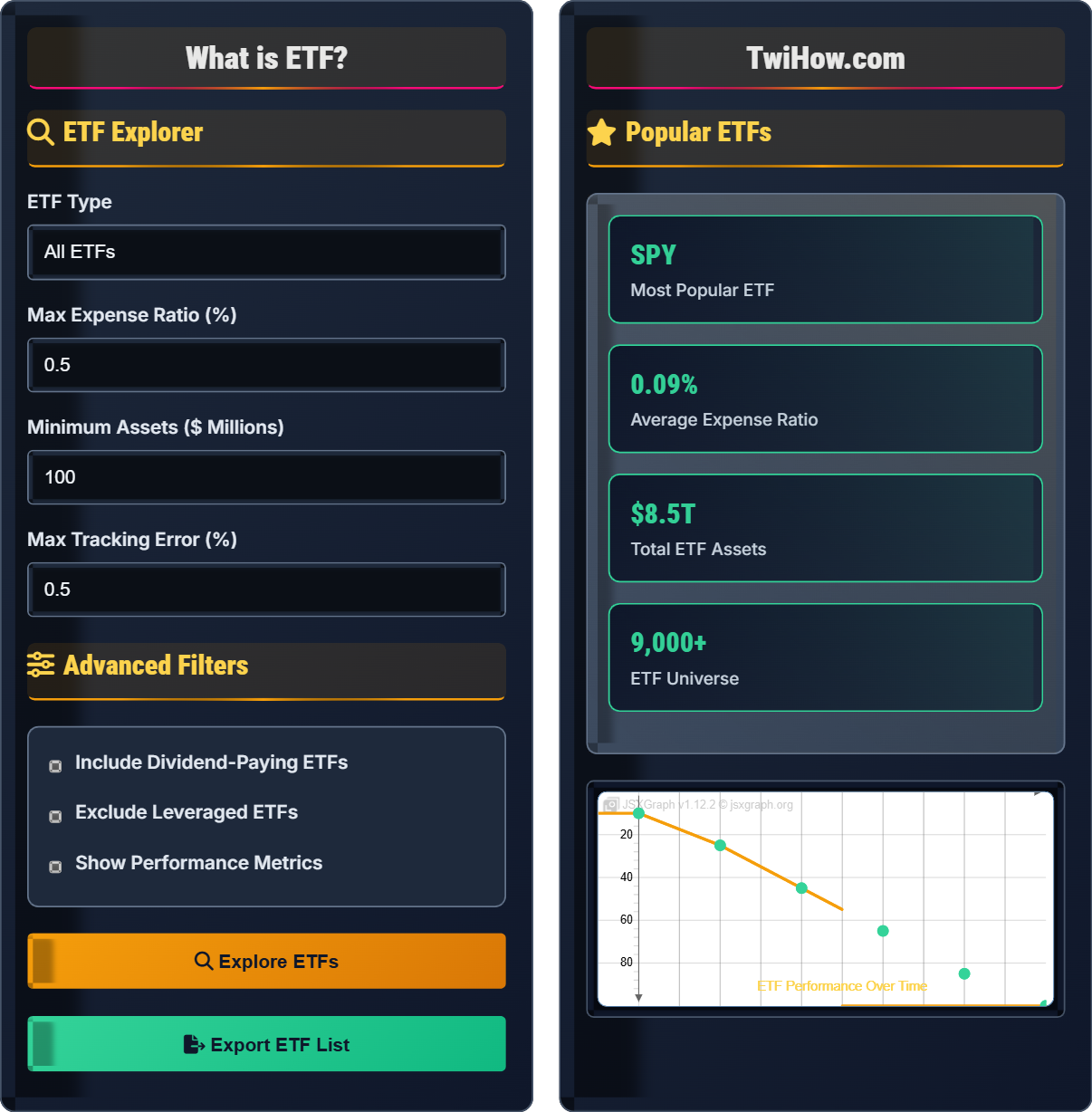
ETF Explorer
Advanced Filters
Popular ETFs
| Feature | ETF | Mutual Fund |
|---|---|---|
| Trading | Throughout the day | Once daily after market close |
| Expense Ratios | Generally lower | Often higher |
| Minimum Investment | One share | Often $1,000+ |
| Tax Efficiency | More tax-efficient | Less tax-efficient |
| Transparency | Daily disclosure | Monthly disclosure |
Authorized participants create ETF shares by delivering a basket of underlying securities to the ETF issuer in exchange for new ETF shares.
ETF shares trade on stock exchanges throughout the trading day at market prices determined by supply and demand.
Authorized participants can exchange ETF shares for the underlying securities, helping maintain price stability.
Performance Comparison
Historical performance of major ETF categories:
ETF Explained
An Exchange-Traded Fund (ETF) is a type of investment fund and exchange-traded product, with shares that trade on stock exchanges. ETFs hold underlying assets such as stocks, commodities, or bonds, and operate with an authorized participant to redeem or issue shares.
ETFs are similar in many ways to mutual funds, except that they are listed on exchanges and ETF shares trade throughout the day like common stock. ETFs may be structured to track stocks, bonds, commodities, or a basket of securities like an index.
The creation and redemption process is what makes ETFs unique:
ETFs use an in-kind creation/redemption mechanism that helps keep market prices close to NAV. This process involves authorized participants who can create or redeem ETF shares in large blocks called creation units.
Common categories of ETFs:
- Index ETFs: Track specific market indices
- Actively Managed ETFs: Portfolio managers make investment decisions
- Bond ETFs: Invest in various types of bonds
- Commodity ETFs: Provide exposure to physical commodities
- International ETFs: Offer exposure to foreign markets
- Thematic ETFs: Focus on specific themes or sectors
Advantages:
- Lower expense ratios than mutual funds
- High liquidity and intraday trading
- Greater transparency with daily holdings disclosure
- Flexibility to buy/sell anytime during market hours
- Tax efficiency due to in-kind redemption process
Disadvantages:
- Trading costs when buying/selling individual shares
- Potential tracking error from index
- Some ETFs have low trading volume
- Complex structures may be difficult to understand
ETF Fundamentals
ETF, exchange-traded fund, index tracking, expense ratio, NAV, creation units, authorized participants.
NAV = (Total Assets - Total Liabilities) / Number of Shares Outstanding
Where NAV = Net Asset Value representing per-share value of the fund.
- ETFs trade like stocks during market hours
- Lower costs than most mutual funds
- Holdings disclosed daily
ETF Types
Index ETFs, bond ETFs, commodity ETFs, international ETFs, thematic ETFs, leveraged ETFs.
- Expense ratio comparison
- Tracking error assessment
- Trading volume evaluation
- Asset size consideration
- Match ETF to investment objectives
- Consider tax implications
- Evaluate liquidity needs
ETF Learning Quiz
When can ETFs be bought and sold?
ETFs trade throughout the trading day like individual stocks, providing investors with flexibility to buy and sell at any time during market hours. This is different from mutual funds, which are priced and traded only once per day after market close.
The answer is B) Throughout the trading day.
This is one of the key advantages of ETFs over mutual funds. The intraday trading capability allows investors to take advantage of market movements, place limit orders, and manage their positions more actively. This flexibility makes ETFs suitable for both long-term investors and those who want to make tactical adjustments to their portfolios.
ETF: Exchange-Traded Fund that trades on stock exchanges
Intraday Trading: Buying and selling during market hours
Market Hours: Standard trading time for stock exchanges
• ETFs trade like stocks during market hours
• Prices fluctuate throughout the day
• Unlike mutual funds, no daily cutoff time
• Use limit orders to control purchase price
• Morning and afternoon tend to have wider spreads
• Confusing ETF trading with mutual fund trading
• Not considering bid-ask spreads
• Trading too frequently without purpose
Compare the main differences between ETFs and mutual funds, including expense ratios, trading flexibility, tax efficiency, and transparency. Explain why ETFs are often considered more tax-efficient.
Key Differences:
Expense Ratios: ETFs typically have lower expense ratios due to passive management and operational efficiency.
Trading: ETFs trade throughout the day like stocks; mutual funds trade once daily after market close.
Tax Efficiency: ETFs are more tax-efficient due to the in-kind creation/redemption process that minimizes capital gains distributions.
Transparency: ETF holdings are disclosed daily; mutual funds report monthly or quarterly.
Tax Efficiency Explanation: ETFs use an in-kind redemption process where authorized participants exchange ETF shares for underlying securities, avoiding the sale of securities that would trigger capital gains taxes.
The tax efficiency of ETFs is due to their unique creation/redemption mechanism. When investors want to sell their ETF shares, they don't have to sell underlying securities in the fund. Instead, authorized participants can exchange shares for the underlying securities directly, which avoids realizing capital gains that would be distributed to all shareholders. This is a key advantage for taxable accounts.
Expense Ratio: Annual fee expressed as percentage of assets
Tax Efficiency: Minimizing tax impact on investment returns
In-kind Redemption: Exchanging shares for underlying securities
• ETFs generally have lower costs
• ETFs trade throughout the day
• ETFs are more tax-efficient in taxable accounts
• Use ETFs in taxable accounts for tax benefits
• Consider expense ratios when selecting funds
• Look for high trading volume for liquidity
• Not considering tax implications
• Trading low-volume ETFs with wide spreads
• Ignoring expense ratios
John invests $10,000 in an ETF with a 0.10% expense ratio and $10,000 in a mutual fund with a 1.00% expense ratio. Both investments earn 7% annually before expenses. Calculate the difference in value after 10 years. How much more does John keep by choosing the ETF?
ETF Value: $10,000 × (1.069)^10 = $10,000 × 1.967 = $19,670
Mutual Fund Value: $10,000 × (1.06)^10 = $10,000 × 1.791 = $17,910
Difference: $19,670 - $17,910 = $1,760
By choosing the ETF, John keeps $1,760 more after 10 years. This demonstrates the significant impact of expense ratios over time, especially with the compounding effect of fees reducing investment growth.
This example shows how even small differences in expense ratios can have a dramatic impact over long investment periods due to the compounding effect. The 0.9% difference in fees ($90 vs $10 annually) compounds over time, resulting in nearly $1,800 more in the ETF after 10 years. This is why expense ratios are so important in long-term investing.
Expense Ratio: Annual fee charged by investment fund
Compounding Effect: Growth on previous growth
Net Return: Return after deducting fees
• Even small expense differences compound over time
• Lower expenses lead to higher net returns
• Expense impact increases with time
• Compare expense ratios across similar funds
• Consider impact over your investment time horizon
• Factor in expense ratios when making decisions
• Ignoring expense ratios
• Not considering long-term impact
• Focusing only on past performance
An investor wants to build a diversified portfolio using ETFs. They have $50,000 to invest and want exposure to US stocks, international stocks, bonds, and real estate. Recommend an allocation strategy using ETFs and explain why this approach is better than buying individual stocks.
Recommended Allocation:
US Stocks (40%): $20,000 in a broad market ETF like SPY or IVV
International Stocks (20%): $10,000 in an international ETF like VXUS
Bonds (30%): $15,000 in a broad bond ETF like BND
Real Estate (10%): $5,000 in a REIT ETF like VNQ
Benefits: This strategy provides instant diversification across asset classes and geographies with minimal transaction costs. Instead of buying dozens of individual stocks, the investor gets exposure to thousands of securities through just 4 ETFs.
ETFs make diversification accessible to small investors who might not have enough capital to buy individual stocks across multiple sectors and geographies. With a single ETF, investors can gain exposure to entire markets or sectors. This approach is much more cost-effective than buying individual securities and provides better diversification for the same investment amount.
Asset Allocation: Distribution of investments across asset types
Diversification: Spreading investments to reduce risk
Instant Diversification: Diversification achieved immediately
• Diversify across asset classes
• Consider international exposure
• Balance growth and stability
• Use low-cost broad market ETFs as core holdings
• Rebalance portfolio annually
• Consider tax-advantaged accounts for bond ETFs
• Overconcentration in single asset class
• Not considering international exposure
• Ignoring expense ratios in allocation
What is tracking error in the context of ETFs?
Tracking error measures how closely an ETF follows its benchmark index. It's the standard deviation of the difference between the ETF's returns and the index's returns. A low tracking error indicates the ETF closely follows its benchmark, while a high tracking error suggests the ETF deviates significantly from its intended index. This is an important measure for investors seeking to replicate index performance.
The answer is B) How closely an ETF follows its benchmark index.
Tracking error is crucial for index investors because it indicates how well the ETF is fulfilling its promise to track a particular index. Factors that can cause tracking error include management fees, transaction costs, timing differences, and the ETF's methodology for replicating the index. Passive investors should look for ETFs with low tracking error to ensure they're getting the index exposure they expect.
Tracking Error: Standard deviation of difference between ETF and index returns
Index Replication: Process of mimicking index performance
Benchmark Index: Standard against which ETF performance is measured
• Lower tracking error is better for index replication
• Compare tracking error across similar ETFs
• Consider tracking error alongside expense ratio
• Look for tracking error below 0.10% for most ETFs
• Consider total cost including tracking error
• Monitor tracking error over time
• Ignoring tracking error when selecting ETFs
• Confusing tracking error with expense ratio
• Not considering cumulative impact of tracking error
FAQ
Q: Are ETFs safer than individual stocks?
A: ETFs generally provide more diversification than individual stocks, which can reduce risk. However, "safer" depends on what type of ETF you choose:
Advantages of ETFs:
• Diversification across multiple securities
• Lower volatility than individual stocks
• Professional management of underlying holdings
Considerations:
• Some ETFs are highly concentrated in specific sectors
• Leveraged ETFs can be extremely volatile
• The safety depends on the underlying assets
A broad market ETF is typically safer than a single stock, but a sector-specific ETF might carry similar risks to individual stocks in that sector.
Q: What's the difference between physically-backed and synthetically-backed ETFs?
A: The main differences are:
Physically-Backed ETFs: Actually hold the underlying securities they track. For example, a gold ETF holds actual gold bars. This provides direct exposure to the asset.
Synthetically-Backed ETFs: Use derivatives like swaps to replicate the performance of the index. They don't hold the actual securities but instead enter into agreements with counterparties.
Pros and Cons:
Physical ETFs: More transparent, lower counterparty risk, but potentially higher costs.
Synthetic ETFs: May offer better tracking, access to hard-to-reach markets, but with counterparty risk.
For most investors, physically-backed ETFs are preferred due to lower risk, though synthetic versions can be useful for accessing certain markets.
Q: Can I buy ETFs in a retirement account?
A: Yes, ETFs are excellent choices for retirement accounts like 401(k)s and IRAs. Here's why:
Advantages:
• Low expense ratios save money over long investment periods
• Broad diversification with a single purchase
• Tax efficiency (especially in taxable accounts)
• Access to various asset classes and markets
Considerations:
• Focus on broad market index ETFs for core holdings
• Consider tax-advantaged accounts for bond ETFs
• Many 401(k) plans now offer ETF options
ETFs are particularly well-suited for retirement accounts due to their low costs and diversification benefits, which compound over time.