How Often Should I Workout?
Optimal training frequency • Science-based recommendations
Workout Frequency Optimization:
Calculate My FrequencyThe optimal workout frequency depends on multiple factors including your fitness goals, experience level, recovery capacity, and available time. While there's no universal answer, research suggests that training 3-5 days per week is ideal for most people. However, the quality of your workouts, proper recovery, and consistency matter more than frequency alone.
Key factors that influence optimal workout frequency:
- Experience Level: Beginners need more recovery time than experienced lifters
- Training Intensity: Higher intensity requires longer recovery periods
- Goals: Muscle building vs. maintenance require different frequencies
- Age: Recovery capacity decreases with age
- Lifestyle Factors: Stress, sleep, and nutrition impact recovery
Our frequency calculator considers these factors to provide personalized recommendations that maximize your results while preventing overtraining.
Personal Information
Fitness Goals
Lifestyle Factors
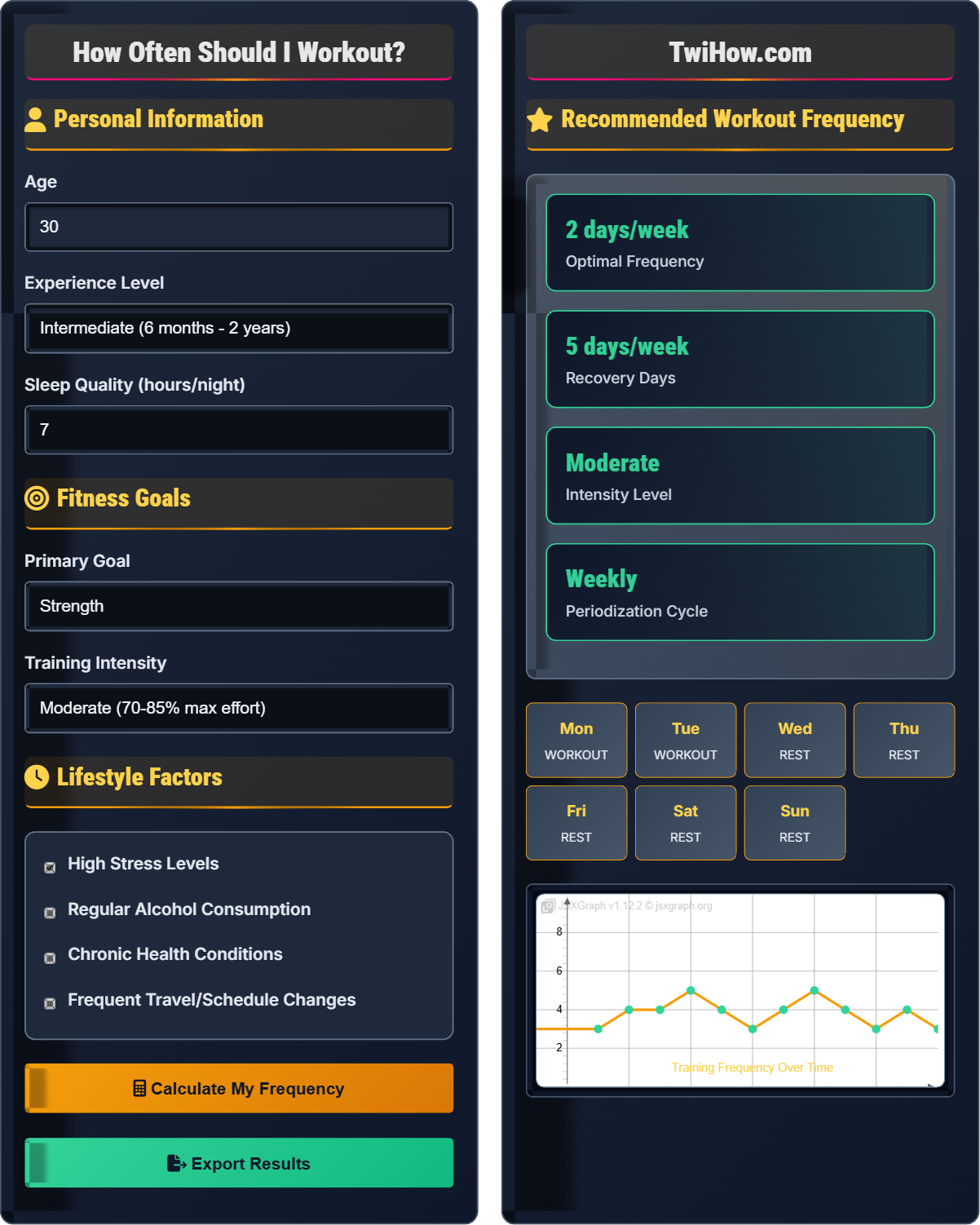
Recommended Workout Frequency
Select "Calculate My Frequency" to see your personalized recommendation.
Your personalized schedule will appear here after calculating frequency.
Recovery recommendations will appear here after calculating frequency.
Understanding Workout Frequency
Workout frequency refers to how often you engage in physical exercise within a given period. Research indicates that training frequency plays a crucial role in achieving fitness goals, but the relationship isn't linear. Here are the key principles:
- Minimum Effective Dose: Studies show that 2-3 sessions per week can maintain fitness levels
- Optimal Range: 3-5 sessions per week appears to maximize muscle protein synthesis
- Diminishing Returns: Beyond 5-6 sessions, benefits plateau or decrease due to inadequate recovery
- Individual Variance: Genetic factors, age, and experience level significantly affect optimal frequency
- Training Split: How you distribute training across the week impacts effectiveness
Scientific approaches to determining optimal workout frequency:
Where:
- Recovery Capacity: Influenced by sleep, nutrition, stress, and genetics
- Training Stress: Determined by volume, intensity, and exercise selection
- Base Frequency: Standard recommendation based on goals (typically 3-5)
Optimal frequency varies significantly based on your primary objective:
- Muscle Gain: 3-5 sessions per week targeting each muscle group 2-3 times
- Strength: 3-4 sessions per week focusing on compound movements
- Weight Loss: 4-6 sessions per week combining strength and cardio
- Endurance: 5-7 sessions per week with varied intensity
- Maintenance: 2-3 sessions per week to preserve current fitness
- Rehabilitation: 3-4 sessions per week with low intensity
- Age Factor: Recovery capacity decreases with age
- Stress Impact: Psychological stress reduces recovery capacity
- Sleep Requirement: 7-9 hours of quality sleep is essential
- Nutrition Needs: Adequate protein and calories support recovery
- Genetic Variation: Some people recover faster than others
Frequency Fundamentals
Workout frequency, recovery time, training stress, adaptation, periodization, volume, intensity.
Optimal Frequency = (Recovery Capacity ÷ Training Stress) × Base Recommendation
Where Recovery Capacity = Sleep + Nutrition + Stress Management, Training Stress = Volume × Intensity.
- Quality trumps quantity in workouts
- Allow 48-72 hours between training same muscle groups
- Listen to your body's recovery signals
Scheduling Strategies
Full body, upper/lower split, push/pull/legs, body part splits, circuit training.
- Identify your available training days
- Assign training splits to days
- Include recovery and active rest days
- Plan deload weeks every 4-6 weeks
- Adjust based on performance and recovery
- Match frequency to your recovery capacity
- Consider your lifestyle and schedule
- Account for travel and work commitments
- Maintain consistency over perfection
Workout Frequency Quiz
According to research, how much time should typically pass between training the same muscle group for optimal recovery?
Research consistently shows that 48-72 hours of recovery time is optimal for most individuals after training the same muscle group. This allows for muscle protein synthesis, glycogen replenishment, and cellular repair. While some people may recover faster or slower, this range represents the sweet spot for most people.
The answer is C) 48-72 hours.
Recovery is when adaptation actually occurs. During training, we create micro-tears in muscle fibers and deplete energy stores. Recovery is when the body repairs these tears and builds back stronger (supercompensation). Training too frequently prevents this process, while waiting too long may lead to detraining.
Recovery: Process of adapting to training stress
Supercompensation: Adaptation that exceeds baseline after recovery
Micro-tears: Small damage to muscle fibers during exercise
• Allow 48-72 hours between training same muscles
• Monitor recovery signs (fatigue, performance)
• Adjust timing based on individual response
• Track your performance to identify optimal timing
• Consider training opposing muscle groups on same day
• Training same muscles daily
• Not accounting for individual differences
• Ignoring signs of inadequate recovery
Explain how workout frequency should differ between a beginner and an advanced lifter, and why this difference exists.
Beginners: Typically benefit from 2-3 full-body workouts per week. Their recovery capacity is limited, and they can achieve significant adaptations with less frequent training.
Advanced Lifters: Often require 4-6 sessions per week, frequently using split routines to target muscle groups more frequently while managing total volume.
Why the Difference Exists: Advanced lifters have adapted to training stress, requiring higher volumes and frequencies to continue progressing. They also have superior recovery capacity developed over years of training.
The difference exists because of adaptation and recovery capacity. Beginners experience rapid improvements with minimal training due to their untrained state. As you advance, your body becomes more efficient at handling stress, requiring greater demands to continue adapting. Additionally, experienced lifters often have better recovery practices and genetic adaptations.
Adaptation: Body's response to training stress
Recovery Capacity: Body's ability to repair and adapt
Training Threshold: Minimum stress needed for adaptation
• Start conservatively and progress gradually
• Match frequency to your experience level
• Increase frequency only when ready
• Beginners: Focus on form and consistency
• Advanced: Use periodization strategies
• Always prioritize recovery quality
• Beginners training too frequently
• Advanced lifters not increasing frequency
• Not adjusting for changing needs
A 45-year-old office worker with 6 months of training experience wants to build muscle while managing a high-stress job and getting only 6 hours of sleep nightly. They have access to a gym 3 times per week. How should they structure their training frequency and why?
Recommended Approach: 3 times per week with full-body or upper/lower split routines.
Reasoning: Despite wanting to train more, their recovery capacity is limited by age (decreased recovery), stress levels (increased cortisol), and sleep deprivation (reduced growth hormone). Training 3x per week allows for adequate recovery while still providing sufficient stimulus.
Structure: Focus on compound movements, moderate volume, and emphasize recovery practices like stress management and improved sleep hygiene.
Priority: Quality of workouts and recovery over frequency.
This scenario demonstrates the importance of matching training to recovery capacity. Even though someone might want to train more frequently, external stressors (job stress, poor sleep) reduce the body's ability to recover and adapt. The limiting factor isn't their desire to train, but their physiological capacity to recover.
Recovery Capacity: Body's ability to handle and recover from stress
External Stressors: Factors outside training that impact recovery
Physiological Capacity: Body's inherent ability to adapt
• Recovery capacity limits training frequency
• External stressors affect adaptation
• Quality trumps quantity
• Address sleep and stress before increasing frequency
• Focus on compound movements for efficiency
• Monitor recovery markers closely
• Ignoring lifestyle factors in planning
• Prioritizing frequency over recovery
• Not adjusting for individual circumstances
Design a 4-week periodization cycle showing how workout frequency might vary within a month, explaining the rationale behind each phase.
Week 1 (Accumulation): 4-5 days/week - Higher frequency to accumulate training volume and establish routine.
Week 2 (Intensification): 4-5 days/week - Same frequency but increased intensity, reduced volume.
Week 3 (Peak): 3-4 days/week - Reduced frequency to allow for peak performance, maintain intensity.
Week 4 (Recovery): 2-3 days/week - Deload phase with reduced frequency and intensity to promote supercompensation.
Rationale: This pattern allows for progressive overload while preventing overtraining and promoting adaptation through strategic variations in frequency and intensity.
Periodization involves systematically varying training variables over time to maximize adaptation and minimize overtraining. The frequency changes throughout the cycle to accommodate different training phases. Higher frequency during accumulation phases allows for skill practice and volume accumulation, while lower frequency during peak and recovery phases allows for supercompensation and adaptation.
Periodization: Systematic variation of training variables
Accumulation Phase: Building volume and establishing routine
Supercompensation: Adaptation exceeding baseline after recovery
• Include planned recovery periods
• Vary frequency strategically
• Monitor performance and adjust
• Plan deloads every 4-6 weeks
• Track performance to adjust timing
• Adjust based on recovery markers
• Not including recovery phases
• Maintaining constant high frequency
• Not adjusting for individual response
Which factor has the greatest impact on how frequently someone can train while recovering adequately?
While all factors play a role, overall recovery capacity is the ultimate limiting factor. Someone with excellent recovery capacity (quality sleep, low stress, good nutrition, favorable genetics) can handle more frequent training than someone with poor recovery capacity, regardless of their age, experience, or goals.
The answer is C) Overall Recovery Capacity.
Recovery capacity acts as the "gatekeeper" for training frequency. Even if someone has the time and desire to train frequently, their body can only adapt if it has the resources to recover. This encompasses multiple factors like sleep, nutrition, stress, and genetic predisposition, making it the foundational element that determines sustainable training frequency.
Recovery Capacity: Body's ability to repair and adapt
Limiting Factor: Element that determines maximum sustainable rate
Adaptation: Physiological response to training stress
• Recovery capacity limits all other factors
• Improve recovery before increasing frequency
• Monitor recovery markers regularly
• Focus on sleep quality first
• Manage stress levels
• Optimize nutrition for recovery
• Prioritizing training over recovery
• Ignoring recovery capacity limitations
• Blaming frequency for poor results
FAQ
Q: I'm new to working out. Is it better to train every day or take rest days?
A: As a beginner, rest days are absolutely crucial for your progress. Your body needs time to adapt to the new stress of exercise. For beginners, 2-3 training days per week with rest days in between is optimal.
Key reasons beginners need rest:
1. Muscle Recovery: Micro-tears in muscle fibers need time to heal and grow stronger
2. Skill Development: Your nervous system needs time to learn movement patterns
3. Injury Prevention: Overtraining increases injury risk significantly
4. Motivation: Rest days prevent burnout and maintain enthusiasm
Start with 2-3 full-body workouts per week, and you'll see excellent results while building a sustainable habit.
Q: I've been working out 5 days a week for 2 years, but I'm not seeing progress anymore. Should I increase frequency or decrease it?
A: At your experience level, a plateau often indicates insufficient recovery rather than insufficient training. After 2 years of consistent training, your body has likely adapted to your current routine.
Consider these strategies:
First Option: Implement a deload week with reduced frequency (2-3 days) and volume to allow for supercompensation.
Second Option: Change your training split (e.g., from upper/lower to push/pull/legs) to vary muscle group frequency.
Third Option: Focus on improving recovery (sleep, nutrition, stress management) before increasing training stress.
Often, decreasing frequency temporarily while improving quality leads to breakthrough progress. Remember, adaptation occurs during recovery, not during training.