How to Build Muscle?
Complete muscle building guide • Step-by-step explanations
Muscle Building Fundamentals:
Calculate Your PlanMuscle building (hypertrophy) occurs when you consistently challenge your muscles with resistance training, provide adequate nutrition, and allow sufficient recovery time. The process involves creating microscopic tears in muscle fibers during exercise, which then repair and grow stronger during rest periods.
Successful muscle building requires a systematic approach combining progressive overload, proper nutrition, and adequate recovery. Consistency and patience are key, as muscle growth is a gradual process that typically occurs over months and years, not days or weeks.
Key muscle building factors:
- Progressive Overload: Gradually increasing training stimulus
- Protein Intake: Adequate amino acids for muscle repair
- Recovery: Sleep and rest for muscle growth
- Consistency: Regular training and nutrition habits
Realistic muscle building goals typically involve 1-2 pounds of muscle gain per month for beginners, with diminishing returns as experience increases.
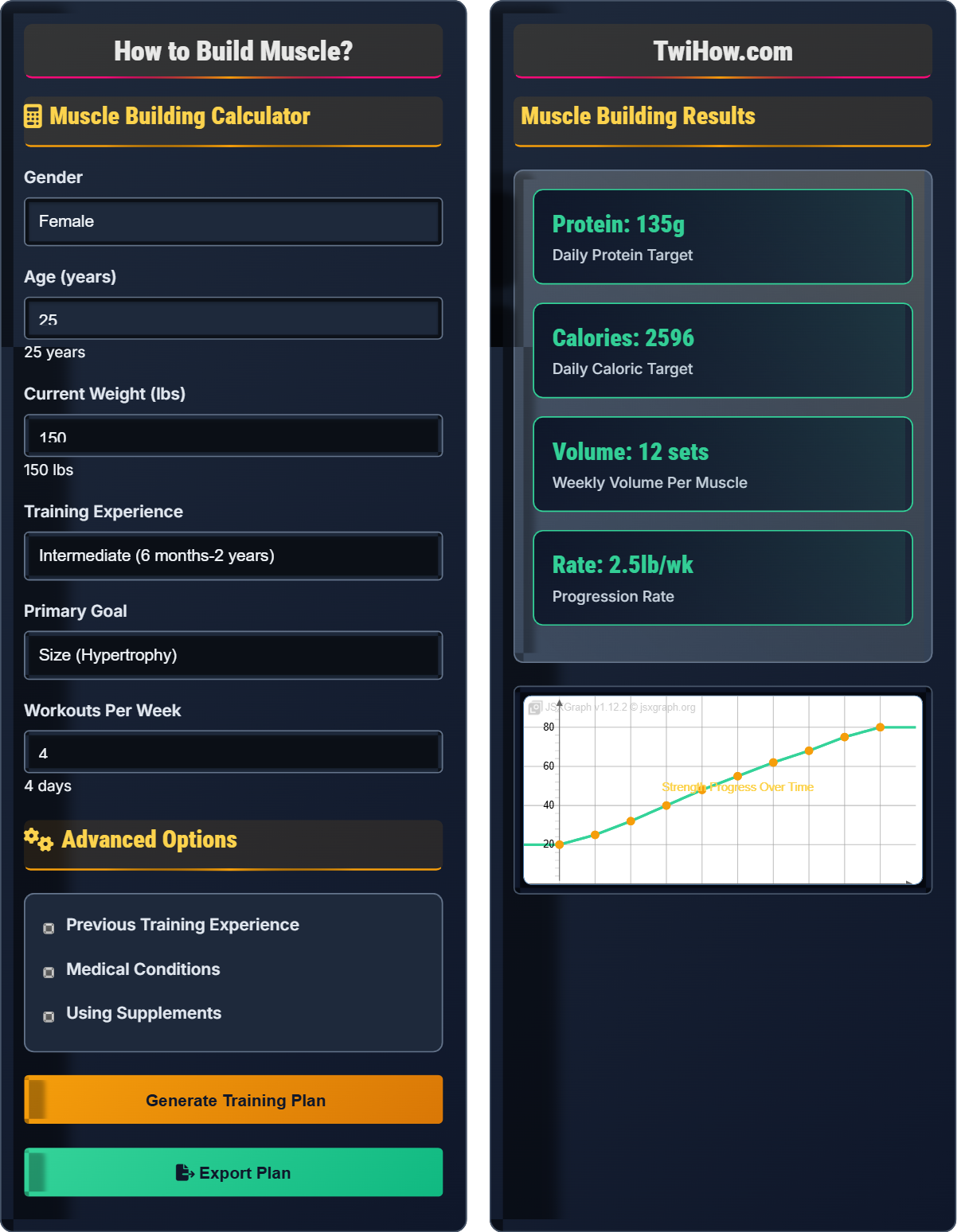
Muscle Building Calculator
Advanced Options
Muscle Building Results
| Day | Muscles | Exercises |
|---|---|---|
| Monday | Chest/Triceps | 5 exercises |
| Tuesday | Back/Biceps | 5 exercises |
| Wednesday | Legs | 6 exercises |
| Thursday | Shoulders | 4 exercises |
| Friday | Arms/Accessory | 6 exercises |
How Muscle Building Works Explained
Muscle building, or hypertrophy, is the process of increasing muscle fiber size through resistance training. This occurs when muscle fibers experience mechanical tension, metabolic stress, and muscle damage during exercise, triggering cellular processes that lead to muscle growth and strength gains.
The fundamental equation for muscle growth:
Where:
- Training Stimulus: Mechanical tension and metabolic stress
- Nutrition: Adequate protein and calories
- Recovery: Sleep and rest for muscle repair
- Stress: Negative factors (illness, overtraining)
Key factors that influence muscle growth:
- Volume: Number of sets and reps per muscle group (10-20 sets/week)
- Intensity: Load used relative to maximum capacity (65-85% 1RM)
- Frequency: How often muscles are trained (2-3x per week)
- Tempo: Speed of movement (controlled eccentric phase)
- Rest: Recovery time between sets (2-5 minutes)
- Progressive Overload: Gradually increase weight, reps, or sets
- Compound Movements: Squats, deadlifts, bench press for maximum stimulus
- Protein Timing: Distribute protein intake throughout the day
- Sleep Optimization: 7-9 hours for recovery and hormone production
- Consistency: Regular training and nutrition habits
Muscle Building Fundamentals
Hypertrophy, progressive overload, protein synthesis, recovery, training volume.
Volume: 10-20 sets per muscle group per week
Rep Range: 6-12 reps per set
- Progressive overload is essential for continued growth
- Adequate protein intake (0.8-1g per lb body weight)
- Sufficient recovery time between sessions
- Consistency over perfection
Training Principles
Volume, intensity, frequency, tempo, rest periods.
- Linear progression (increasing load over time)
- Undulating periodization (varying intensity/reps)
- Block periodization (focusing on specific goals)
- Autoregulation (adjusting based on daily readiness)
- Allow 48-72 hours between training same muscle groups
- Focus on compound movements for maximum stimulus
- Control the eccentric (lowering) phase of movements
- Track your progress to ensure overload
Muscle Building Learning Quiz
For muscle hypertrophy (growth), what rep range is most effective?
The 6-12 rep range is considered optimal for muscle hypertrophy (growth). This range provides sufficient mechanical tension and metabolic stress while allowing for enough volume to stimulate muscle protein synthesis. Reps in this range typically correspond to 65-85% of one-repetition maximum (1RM), which is ideal for promoting muscle growth.
The answer is C) 6-12 reps.
Different rep ranges target different adaptations: 1-5 reps emphasize strength, 6-12 reps focus on hypertrophy, and 15+ reps target muscular endurance. The 6-12 range strikes a balance between mechanical tension (which stimulates growth) and metabolic stress (which triggers cellular responses). This range also allows for sufficient volume to maximize the stimulus for muscle protein synthesis.
Hypertrophy: Increase in muscle fiber size
1RM: One repetition maximum (heaviest weight lifted once)
Mechanical Tension: Force applied to muscle fibers
• Rep ranges are guidelines, not absolute rules
• Volume is important in addition to rep range
• Individual responses may vary
• Use RPE (Rate of Perceived Exertion) to gauge effort
• Include some reps outside the optimal range
• Focus on controlled movement patterns
• Using too heavy weight for form breakdown
• Not progressing to heavier weights
• Ignoring the eccentric phase of movement
Calculate the daily protein requirements for a 160-pound individual aiming to build muscle. Explain the reasoning behind the recommendation and how protein should be distributed throughout the day.
Calculation: For muscle building, the recommended protein intake is 0.8-1 gram per pound of body weight.
Lower range: 160 lbs × 0.8g/lb = 128g protein per day
Upper range: 160 lbs × 1.0g/lb = 160g protein per day
Recommended daily intake: 140-160g protein
Reasoning: Protein provides the amino acids necessary for muscle protein synthesis, which is essential for muscle repair and growth. During muscle building, protein synthesis must exceed protein breakdown.
Distribution: Spread protein intake across 4-6 meals, aiming for 25-40g per meal. This optimizes muscle protein synthesis throughout the day. The body can only utilize a limited amount of protein for muscle building at one time, so spreading intake maximizes utilization.
Timing: Include protein in post-workout meals (within 2-3 hours) to support recovery and growth.
Protein requirements increase during muscle building because the body needs additional amino acids to support the increased muscle protein synthesis. The 0.8-1.0g per pound recommendation is based on research showing optimal muscle protein synthesis rates. Distributing protein throughout the day ensures a constant supply of amino acids for muscle repair and growth.
Muscle Protein Synthesis: Process of building muscle proteins
Essential Amino Acids: Amino acids the body cannot produce
Leucine: Amino acid that triggers muscle protein synthesis
• Higher protein needs during muscle building
• Distribute intake throughout the day
• Include leucine-rich foods
• Aim for 25-30g protein per meal
• Include complete protein sources
• Time protein around workouts
• Not eating enough protein
• Consuming all protein in one meal
• Focusing only on quantity, ignoring quality
A 25-year-old male beginner has been training consistently for 3 months and has hit a plateau. He's doing 3 workouts per week, eating adequate protein, and getting enough sleep, but hasn't gained strength or muscle in 4 weeks. Analyze his situation and recommend specific strategies to overcome the plateau while maintaining proper form and safety.
Situation Analysis: This is a common occurrence in the third month of training as initial "newbie gains" diminish. The beginner phase typically lasts 3-6 months, after which progress becomes more challenging.
Recommended Strategies:
1. Progressive Overload: Increase weight by 2.5-5 lbs on compound movements. If unable to increase weight, add 1-2 reps to each set.
2. Volume Adjustment: Consider adding 1-2 sets per muscle group if not already at upper volume ranges.
3. Program Change: Switch to a different training split or rep scheme to provide new stimuli.
4. Deload Period: Take 1-2 weeks of reduced intensity to allow for supercompensation.
5. Form Refinement: Focus on perfect technique to maximize muscle recruitment.
6. Accessory Work: Add isolation exercises to target lagging muscle groups.
Timeline: Expect to see renewed progress within 2-4 weeks of implementing changes.
Plateaus are a normal part of the muscle building process. As the body adapts to training stimuli, it becomes more efficient, requiring greater challenges to continue progress. This demonstrates the principle of adaptation and the need for continuous variation in training variables. The key is making systematic changes rather than random alterations.
Supercompensation: Recovery period when performance exceeds baseline
Plateau: Period of stalled progress despite consistent effort
Adaptation: Body's response to training stimuli
• Expect plateaus as part of the process
• Make systematic changes, not random ones
• Prioritize form over weight
• Track all training variables
• Implement planned deloads
• Focus on mind-muscle connection
• Increasing weight too rapidly
• Changing programs too frequently
• Neglecting recovery
You're designing a training program for a 30-year-old office worker who can only train 3 days per week due to work commitments. They want to maximize muscle growth while maintaining their job performance. Determine the optimal training frequency and split, and explain the trade-offs of training each muscle group once vs twice per week.
Optimal Program: Upper/Lower Split (3 days per week)
• Monday: Upper Body
• Wednesday: Lower Body
• Friday: Upper Body
Advantages of 2x/week frequency:
• Higher weekly volume per muscle group
• More opportunities for progressive overload
• Better skill acquisition and form refinement
Trade-offs of 1x vs 2x frequency:
• 1x/week: Higher volume per session, longer recovery time, less frequent stimulus
• 2x/week: Lower volume per session, more frequent stimulus, better skill development
Research shows 2x per week frequency is superior for muscle growth, which is why the Upper/Lower split is ideal for this schedule.
Training frequency is a crucial variable in muscle building. The optimal frequency balances stimulus, recovery, and practical constraints. With only 3 days available, maximizing the frequency of each muscle group becomes important. The Upper/Lower split allows each muscle group to be trained twice per week while fitting within the time constraint.
Training Frequency: How often a muscle group is trained per week
Upper/Lower Split: Alternating between upper and lower body workouts
Volume Distribution: How sets are spread across sessions
• More frequent training is generally better for growth
• Balance practical constraints with optimal programming
• Ensure adequate recovery time
• Use compound movements for efficiency
• Plan workouts around work schedule
• Prioritize sleep and recovery
• Training each muscle only once per week
• Not adjusting volume for frequency
• Ignoring practical scheduling constraints
Which of the following is a common myth about muscle building?
Option B is the myth. Training to failure (inability to complete another rep) on every set is not necessary for muscle growth and can actually hinder progress by increasing fatigue, reducing volume, and increasing injury risk. Research shows that training to near failure (1-3 reps in reserve) is sufficient for muscle growth while allowing for better recovery and more consistent training.
All other options are facts: protein is essential for muscle building, progressive overload is necessary for continued growth, and recovery is when muscles actually grow.
The answer is B) You need to train to failure on every set.
This myth stems from the belief that more intensity always equals more results. However, muscle growth occurs through consistent training over time, not through maximum effort on every set. Training to near failure allows for sufficient stimulus while maintaining the ability to perform adequate volume and recover properly. This approach is more sustainable and often more effective long-term.
Training to Failure: Inability to complete another rep with proper form
RIR (Reps in Reserve): Reps left in the tank at the end of a set
Volume: Total work performed (sets × reps × weight)
• Near failure is sufficient for growth
• Balance intensity with volume
• Consider long-term sustainability
• Use RPE (Rate of Perceived Exertion) to gauge effort
• Leave 1-3 reps in reserve
• Focus on progressive overload over time
• Training to failure on every set
• Sacrificing form for intensity
• Not considering recovery capacity
FAQ
Q: How important is the eccentric (lowering) phase of movements for muscle growth?
A: The eccentric phase is crucial for muscle growth and should not be neglected:
Benefits of Eccentric Training:
• Muscle Damage: Creates micro-tears that stimulate growth
• Force Production: Muscles can handle 20-40% more weight eccentrically
• Metabolic Stress: Increases time under tension
• Motor Unit Recruitment: Activates more muscle fibers
Optimal Tempo: 2-4 seconds for the eccentric phase, followed by 1-2 seconds concentric. For example, 3-second lowering, 1-second lifting.
Practical Application: Focus on controlling the weight during the lowering phase rather than letting it drop. This creates more muscle tension and damage, leading to greater growth adaptations.
While both phases contribute to muscle growth, the eccentric phase is particularly important for stimulating the cellular processes that lead to hypertrophy.
Q: What's the difference between myofibrillar and sarcoplasmic hypertrophy?
A: These are two distinct types of muscle growth:
Myofibrillar Hypertrophy:
• Definition: Increase in contractile proteins (actin/myosin)
• Result: Increased muscle fiber density and strength
• Training: Heavy loads (85%+ 1RM), lower reps (1-6)
• Appearance: Dense, hard-looking muscles
Sarcoplasmic Hypertrophy:
• Definition: Increase in non-contractile components (glycogen, fluid)
• Result: Increased muscle size without proportional strength gains
• Training: Moderate loads (65-85% 1RM), higher reps (8-12)
• Appearance: Larger, fuller-looking muscles
Reality: Most training programs stimulate both types, with the emphasis depending on rep ranges and training variables. The distinction is more theoretical than practical, as both contribute to overall muscle growth.