Best Vitamins?
Complete health guide • Step-by-step explanations
Essential Vitamins Guide:
Show Vitamin SelectorVitamins are essential organic compounds that our bodies need in small amounts to function properly. There are 13 essential vitamins divided into two groups: fat-soluble (A, D, E, K) and water-soluble (B-complex and C). Each vitamin plays a unique role in supporting various bodily functions including immune health, energy production, bone health, and cellular repair.
Key vitamin categories:
- Water-Soluble: B-complex and vitamin C (excess eliminated)
- Fat-Soluble: Vitamins A, D, E, K (stored in body)
- Essential Functions: Metabolism, immunity, vision, bone health
- Deficiency Prevention: Proper nutrition and supplementation
Understanding which vitamins you need and how much depends on age, gender, lifestyle, and health conditions. This guide will help you identify the most important vitamins for your health needs.
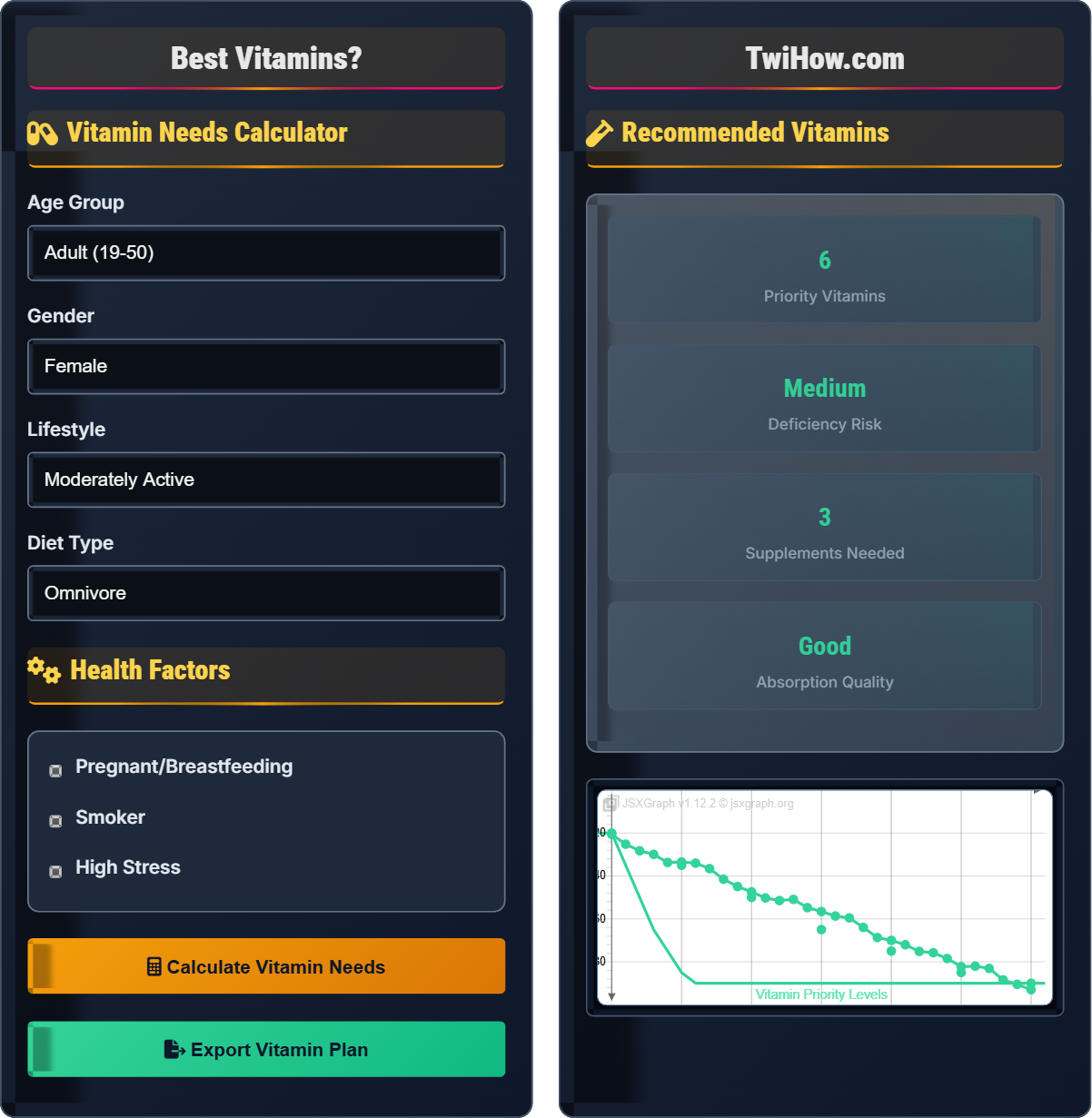
Vitamin Needs Calculator
Health Factors
Recommended Vitamins
Get vitamins from whole foods: citrus fruits (C), leafy greens (K), fish (D), eggs (B12), nuts (E).
Consider supplements for B12 (vegans), D (limited sun), and other deficiencies.
Take fat-soluble vitamins with meals; pair iron with vitamin C.
Essential Vitamins Explained
Essential vitamins are organic compounds that our bodies need in small amounts to function properly but cannot synthesize in sufficient quantities. There are 13 essential vitamins divided into two main categories: fat-soluble (A, D, E, K) and water-soluble (B-complex and C).
Each vitamin plays a unique role in supporting various bodily functions including metabolism, immune health, energy production, and cellular repair.
Where:
- Fat-Soluble: Stored in liver and fatty tissues (can accumulate to toxic levels)
- Water-Soluble: Excess amounts are excreted in urine (require regular replenishment)
Key functions of essential vitamins:
- Energy Production: B-complex vitamins (B1, B2, B3, B5, B6, B7, B9, B12)
- Immune Support: Vitamins A, C, D, E, B6, B12
- Bone Health: Vitamins D, K, C
- Antioxidant Protection: Vitamins C, E, A
- Cellular Repair: All B-complex vitamins
- Blood Clotting: Vitamin K
- Vitamin D: Affects 40% of population, especially in northern climates
- Vitamin B12: Common in vegetarians, elderly, and those with digestive issues
- Vitamin C: More common in smokers and those with poor diets
- Vitamin A: Often seen in developing countries and malabsorption disorders
- Vitamin B6: Can be deficient in alcoholics and elderly
- Vitamin K: Rare but can occur with antibiotic use or malabsorption
Essential Vitamins
Vitamin A, B-complex, C, D, E, K, folate, B12.
Fat-Soluble: A, D, E, K (stored in body)
Water-Soluble: B-complex + C (excreted in urine)
- Meet RDA requirements
- Don't exceed upper limits
- Consider bioavailability
- Account for interactions
Implementation Guide
Assessment, testing, planning, supplementation, monitoring.
- Assess dietary intake
- Identify deficiency risks
- Test vitamin levels
- Develop supplementation plan
- Get vitamins from food first
- Take with meals for absorption
- Consult healthcare providers
- Monitor for side effects
Vitamin Knowledge Learning Quiz
Which group contains only fat-soluble vitamins?
The four fat-soluble vitamins are A, D, E, and K. These vitamins dissolve in fat and are stored in the body's fatty tissues and liver. Unlike water-soluble vitamins, excess amounts of fat-soluble vitamins are not readily excreted, which means they can accumulate to toxic levels if taken in excessive amounts. This is why it's important to be cautious with supplementation of fat-soluble vitamins.
The answer is B) A, D, E, K.
Understanding the difference between fat-soluble and water-soluble vitamins is crucial for proper nutrition. Fat-soluble vitamins can be stored in the body, which means they don't need to be consumed daily but also means there's a risk of toxicity from excessive intake. Water-soluble vitamins are regularly excreted and need to be replenished more frequently, but have a lower risk of toxicity.
Fat-Soluble: Dissolves in fat, stored in body
Water-Soluble: Dissolves in water, excreted in urine
Storage: Ability to accumulate in tissues
• Fat-soluble can accumulate to toxic levels
• Water-soluble requires regular replenishment
• Both are essential for health
• Take fat-soluble vitamins with meals
• Water-soluble vitamins with or without food
• Monitor fat-soluble supplement doses
• Confusing fat and water-soluble vitamins
• Taking too much of fat-soluble vitamins
• Not understanding storage differences
Explain the importance of vitamin B12, its functions, sources, and populations at risk for deficiency. Include symptoms of deficiency and ways to address it.
Vitamin B12 Functions:
• Essential for red blood cell formation and DNA synthesis
• Critical for proper neurological function and nerve maintenance
• Plays a role in energy metabolism and homocysteine metabolism
Sources: Animal products (meat, fish, poultry, eggs, dairy), fortified foods, supplements
At-Risk Populations: Vegetarians/vegans, elderly, those with digestive issues, people taking certain medications
Deficiency Symptoms: Anemia, fatigue, weakness, neurological problems, memory issues, numbness/tingling
Addressing Deficiency: Dietary changes, oral supplements, injections for severe cases, fortified foods
Vitamin B12 is unique because it's found almost exclusively in animal products, making it a critical concern for vegetarians and vegans. It's also one of the few vitamins that requires intrinsic factor for absorption, which is why elderly people and those with digestive issues are at higher risk. B12 deficiency can cause irreversible neurological damage if not addressed promptly, making early detection crucial.
Intrinsic Factor: Protein needed for B12 absorption
Megaloblastic Anemia: Type of anemia from B12 deficiency
Methylmalonic Acid: Biomarker for B12 deficiency
• Vegans must supplement B12
• Elderly may need supplements
• Early detection prevents complications
• Test B12 levels regularly if at risk
• Consider methylcobalamin form
• Monitor homocysteine levels
• Not supplementing B12 on vegan diets
• Ignoring early deficiency symptoms
• Assuming all B12 tests are accurate
An adult living in a northern climate with limited sun exposure has a vitamin D level of 15 ng/mL (normal is 30-100 ng/mL). The doctor recommends 2,000 IU daily to raise levels. Calculate how many months it might take to reach the target level of 50 ng/mL, assuming 100 IU raises levels by 1 ng/mL. Also explain why vitamin D is critical for this person.
Calculate Required Increase:
Current level: 15 ng/mL
Target level: 50 ng/mL
Deficit: 50 - 15 = 35 ng/mL
Calculate Daily Supplement Effect:
2,000 IU daily ÷ 100 IU per ng/mL = 20 ng/mL per day
Wait, this doesn't seem right. Actually, the relationship is not linear daily.
More realistic: 1000-2000 IU daily raises levels by about 10-20 ng/mL over 6-8 weeks.
At 2,000 IU daily: approximately 5-10 ng/mL increase per month
Time needed: 35 ng/mL ÷ 7.5 ng/mL per month ≈ 4.7 months
Why Critical: Vitamin D is essential for calcium absorption, bone health, immune function, and mood regulation. In northern climates, sun exposure is limited, making supplementation crucial for maintaining adequate levels.
This problem demonstrates the importance of vitamin D in northern climates where UV exposure is limited. The calculation shows that correcting a deficiency requires consistent supplementation over several months. The non-linear relationship between dosage and serum levels reflects the complex metabolism of vitamin D in the body, which involves conversion in the liver and kidneys.
ng/mL: Nanograms per milliliter (measurement unit)
UV Exposure: Ultraviolet light needed for synthesis
Calcium Absorption: Primary function of vitamin D
• Northern climates need supplementation
• Consistency is key for correction
• Monitor levels regularly
• Take with fat for better absorption
• Test levels before and after
• Consider seasonal variations
• Assuming immediate results
• Not considering absorption factors
• Not monitoring actual levels
Explain how vitamin C enhances iron absorption and why this is particularly important for vegetarians. Include the mechanism of action and practical applications for meal planning.
Mechanism of Action: Vitamin C (ascorbic acid) converts ferric iron (Fe3+) to ferrous iron (Fe2+), which is more easily absorbed by the body. It also forms a complex with iron that protects it from forming insoluble compounds in the digestive tract.
Importance for Vegetarians: Plant-based iron (non-heme iron) is less bioavailable than iron from meat (heme iron). Vegetarians absorb only about 5-12% of dietary iron compared to 14-18% for meat eaters.
Practical Applications: Pair iron-rich foods (spinach, lentils, tofu) with vitamin C-rich foods (citrus, bell peppers, strawberries) in the same meal. For example, serve lentil soup with a side of orange slices or spinach salad with lemon dressing.
This interaction demonstrates how nutrients work synergistically in the body. The iron-vitamin C relationship is particularly important for vegetarians who rely on non-heme iron sources. Understanding these interactions helps optimize nutrient absorption and prevent deficiencies through strategic food combinations rather than just increasing individual nutrient intake.
Non-Heme Iron: Plant-based iron (less absorbable)
Heme Iron: Animal-based iron (more absorbable)
Bioavailability: Amount absorbed and utilized
• Combine complementary nutrients
• Consider absorption factors
• Plan meals strategically
• Eat iron-rich foods with vitamin C
• Avoid tea/coffee with iron meals
• Cook in cast iron for extra iron
• Not considering absorption enhancers
• Eating iron blockers with iron
• Assuming all iron is equal
Which vitamin is most likely to cause toxicity when taken in excess?
Vitamin A is most likely to cause toxicity when taken in excess because it's fat-soluble and stored in the liver. Chronic high doses can lead to hypervitaminosis A, causing symptoms like dizziness, nausea, headaches, and liver damage. Unlike water-soluble vitamins that are readily excreted, fat-soluble vitamins accumulate in the body over time. While vitamin D can also be toxic in high doses, vitamin A is generally considered the most concerning for toxicity.
The answer is C) Vitamin A.
This question highlights the critical difference between fat-soluble and water-soluble vitamins regarding toxicity risk. Fat-soluble vitamins (A, D, E, K) can accumulate to dangerous levels because they're stored in the body, while water-soluble vitamins are regularly excreted. This is why it's particularly important to follow recommended dosages for fat-soluble vitamin supplements and not exceed upper limits.
Toxicity: Harmful effects from excessive intake
Hypervitaminosis: Excessive vitamin levels
Upper Limit: Maximum safe intake level
• Fat-soluble vitamins have toxicity risk
• Follow RDA and upper limits
• Consult healthcare providers
• Don't exceed upper limits
• Take fat-soluble with meals
• Monitor for side effects
• Taking excessive fat-soluble vitamins
• Not understanding storage differences
• Assuming more is always better
FAQ
Q: What vitamins should vegetarians and vegans prioritize?
A: Vegetarians and vegans should prioritize:
• Vitamin B12: Found almost exclusively in animal products; supplement is essential
• Vitamin D: Especially important if limited sun exposure
• Vitamin B6: Important for protein metabolism
• Iron: Plant-based iron is less bioavailable; pair with vitamin C
• Zinc: Less bioavailable from plant sources
• Omega-3s: Consider algae-based DHA/EPA supplements
Regular blood tests are recommended to monitor levels and adjust supplementation accordingly.
Q: Which vitamins become more important with age?
A: As we age, the following vitamins become increasingly important:
• Vitamin B12: Absorption decreases with age due to reduced stomach acid
• Vitamin D: Skin synthesis decreases and dietary sources become more critical
• Vitamin B6: Important for cognitive function and immune health
• Vitamin K: Critical for bone health and blood clotting
• Folate: Important for DNA synthesis and cardiovascular health
• Vitamin C: Immune function and antioxidant protection
Older adults may need higher intakes due to decreased absorption and increased needs.
Q: What vitamins are essential for children's growth?
A: Essential vitamins for children's growth include:
• Vitamin D: Critical for bone development and calcium absorption
• Vitamin A: Important for vision, immune function, and growth
• Vitamin C: Collagen synthesis, wound healing, immune support
• B-Complex: Energy metabolism and nervous system development
• Vitamin K: Blood clotting and bone health
Most children can meet vitamin needs through a balanced diet, but supplements may be needed for picky eaters or specific deficiencies. Always consult with a pediatrician before supplementing children.