How Many Calories Per Day?
Complete health guide • Step-by-step explanations
Daily Calorie Needs:
Calculate Your CaloriesDaily calorie needs vary based on age, gender, weight, height, activity level, and metabolic rate. The average adult woman needs 1,600-2,400 calories per day, while the average adult man needs 2,000-3,000 calories per day. Understanding your specific calorie needs is essential for weight management, energy levels, and overall health.
Factors affecting daily calorie needs:
- Basal Metabolic Rate (BMR): Calories needed at rest
- Activity Level: Physical activity increases needs
- Age: Metabolism slows with age
- Gender: Men typically need more calories
- Body Composition: Muscle burns more calories than fat
Accurate calorie calculation supports healthy weight management and optimal energy levels.
Calorie Calculator
Additional Factors
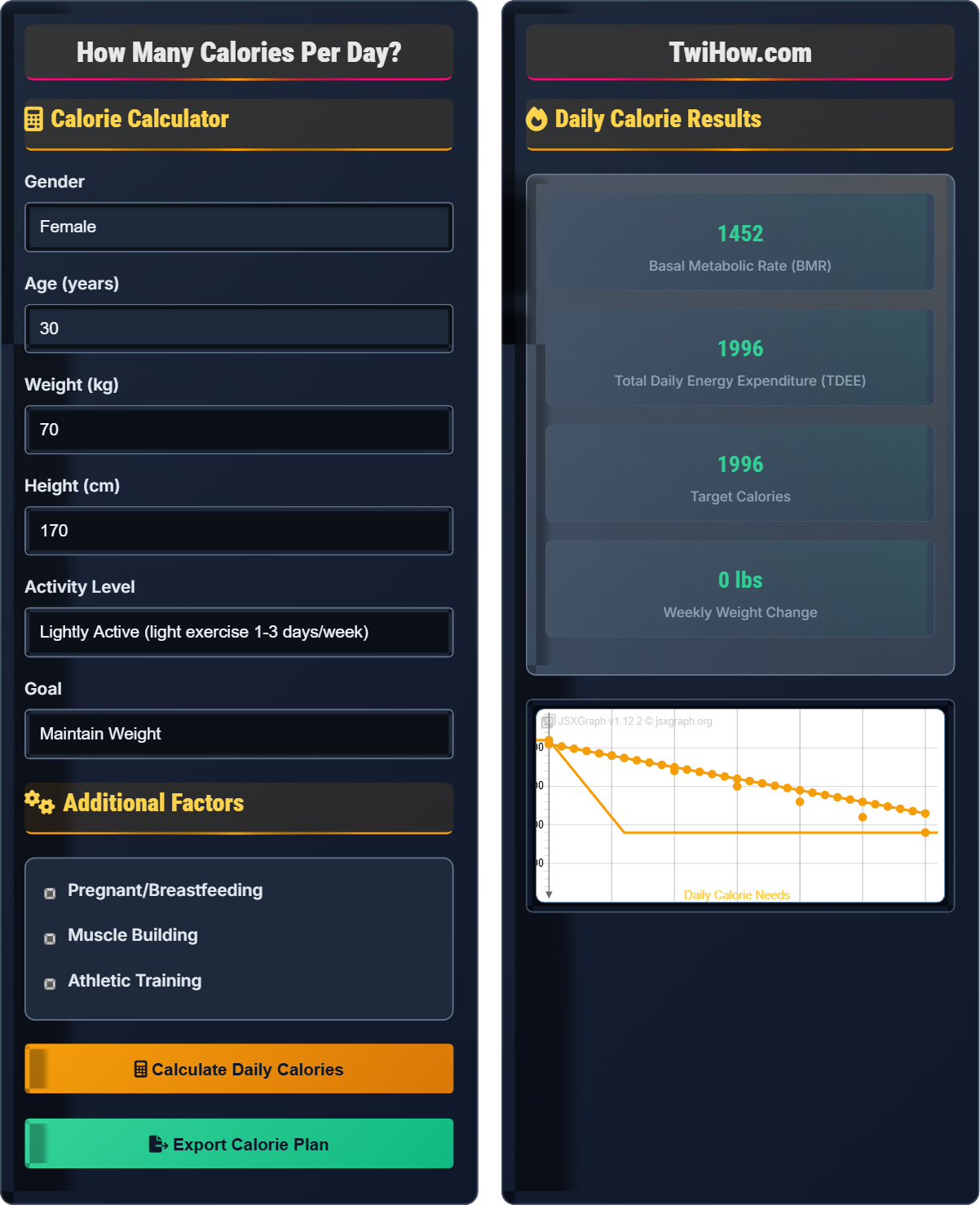
Daily Calorie Results
Consume calories equal to your TDEE to maintain current weight. This is your baseline for other goals.
Create a 500-1000 calorie daily deficit to lose 1-2 lbs per week. This is considered safe and sustainable.
Create a 300-500 calorie daily surplus to gain 0.5-1 lb per week. Focus on nutritious foods.
Daily Calorie Needs Explained
Daily calorie needs are determined by your Basal Metabolic Rate (BMR) multiplied by your Activity Factor. BMR represents the calories your body needs to maintain basic functions at rest, while the activity factor accounts for physical activity and exercise.
Understanding these calculations helps establish appropriate calorie intake for weight management and energy levels.
Where:
- Activity Factors: Sedentary (1.2), Lightly Active (1.375), Moderately Active (1.55), Very Active (1.725), Extra Active (1.9)
Calorie adjustments for different goals:
- Maintenance: Consume calories equal to TDEE
- Weight Loss: 500-1000 calorie daily deficit (1-2 lbs/week)
- Weight Gain: 300-500 calorie daily surplus (0.5-1 lb/week)
- Safe Range: Women shouldn't go below 1,200, men below 1,500
- Age: Metabolism decreases 2-3% per decade after 30
- Muscle Mass: More muscle = higher metabolism
- Genetics: Some people naturally burn more calories
- Hormones: Thyroid, insulin, leptin affect metabolism
- Environment: Temperature can slightly affect calorie burn
- Medications: Some drugs affect metabolic rate
Calorie Calculation Methods
BMR (Mifflin-St Jeor), TDEE, activity multipliers, weight goals.
Men: BMR = 10×weight + 6.25×height - 5×age + 5
Women: BMR = 10×weight + 6.25×height - 5×age - 161
TDEE = BMR × Activity Factor
- Women: minimum 1,200 calories
- Men: minimum 1,500 calories
- Safe weight loss: 1-2 lbs/week
- Track consistently
Goal Setting Guide
Weight loss, maintenance, gain, athletic performance.
- Calculate TDEE
- Set realistic goals
- Adjust calories accordingly
- Monitor progress
- Set gradual goals
- Combine with exercise
- Focus on nutrition quality
- Be patient
Calorie Needs Learning Quiz
According to the Mifflin-St Jeor equation, which factor is added for males but subtracted for females?
In the Mifflin-St Jeor equation, males have "+5" added to their calculation while females have "-161" subtracted. The complete equations are: Men: BMR = 10×weight + 6.25×height - 5×age + 5 Women: BMR = 10×weight + 6.25×height - 5×age - 161 The +5/-161 factor accounts for differences in body composition between genders.
The answer is B) 161.
The Mifflin-St Jeor equation accounts for gender differences in body composition, particularly muscle mass and fat distribution. On average, men have higher muscle mass and lower body fat percentage than women, which contributes to a higher baseline metabolic rate. The +5 for men and -161 for women reflects these physiological differences in calculating resting energy expenditure.
BMR: Basal Metabolic Rate - calories at rest
TDEE: Total Daily Energy Expenditure
Mifflin-St Jeor: Most accurate BMR equation
• Use gender-specific formulas
• Account for activity level
• Consider individual variations
• Use metric units for accuracy
• Adjust for muscle mass
• Monitor actual results
• Using wrong gender formula
• Not accounting for activity
• Underestimating actual needs
Explain the different activity factors used in TDEE calculations and describe what activities correspond to each level. Include examples of how activity level significantly impacts daily calorie needs.
Activity Factors:
• Sedentary (1.2): Desk job, little to no exercise
• Lightly Active (1.375): Light exercise 1-3 days/week
• Moderately Active (1.55): Moderate exercise 3-5 days/week
• Very Active (1.725): Hard exercise 6-7 days/week
• Extra Active (1.9): Very hard exercise & physical job
Impact Example: A person with BMR of 1,500 calories: Sedentary: 1,500 × 1.2 = 1,800 calories Very Active: 1,500 × 1.725 = 2,588 calories Difference: 788 calories per day!
Activity factors significantly amplify your baseline metabolic needs. The difference between sedentary and very active lifestyles can be nearly 800 calories per day for the same person. This demonstrates why accurately assessing activity level is crucial for calorie calculations. Overestimating activity can lead to under-eating and stalled progress, while underestimating can prevent weight loss goals.
TDEE: Total Daily Energy Expenditure
Activity Factor: Multiplier for BMR
Caloric Deficit: Consuming fewer calories than burned
• Be honest about activity level
• Adjust as activity changes
• Consider non-exercise activity
• Track daily steps
• Consider job activity
• Adjust seasonally
• Overestimating activity level
• Not considering job activity
• Forgetting to adjust
A woman calculates her TDEE as 2,200 calories per day. She wants to lose weight at a rate of 1.5 pounds per week. Calculate her target daily calorie intake. Also determine how long it would take to lose 15 pounds at this rate and verify that the weight loss rate is within safe limits.
Calculate Target Calories:
To lose 1.5 lbs/week, she needs a weekly deficit of: 1.5 × 3,500 = 5,250 calories
Daily deficit needed: 5,250 ÷ 7 = 750 calories per day
Target daily intake: 2,200 - 750 = 1,450 calories
Time to Lose 15 Pounds:
15 lbs ÷ 1.5 lbs/week = 10 weeks
Verification:
Safe weight loss is 1-2 lbs/week. At 1.5 lbs/week, this is within safe limits. The target intake of 1,450 calories is above the minimum recommended 1,200 calories for women.
Her target daily intake should be 1,450 calories to lose 1.5 lbs per week.
This calculation demonstrates the relationship between caloric deficit and weight loss. The 3,500-calorie rule (1 lb of fat ≈ 3,500 calories) is commonly used for planning. For sustainable weight loss, 1-2 lbs per week is recommended. Faster rates can lead to muscle loss, nutritional deficiencies, and metabolic adaptation that makes further weight loss difficult.
Caloric Deficit: Consuming fewer calories than burned
Safe Weight Loss: 1-2 lbs per week
Metabolic Adaptation: Body adjusts to lower intake• Safe loss: 1-2 lbs/week
• Minimum: 1,200 calories for women
• 1 lb fat ≈ 3,500 calories
• Combine diet with exercise
• Focus on nutrition quality
• Track progress consistently
• Setting too large deficits
• Going below minimum calories
• Not adjusting as weight changes
Calculate the BMR for a 25-year-old woman weighing 65kg and 165cm tall, then calculate her BMR at age 55 with the same weight and height. Assume she's moderately active. Discuss the implications of this change and how she should adjust her calorie intake to maintain her weight.
BMR at Age 25:
BMR = (10 × 65) + (6.25 × 165) - (5 × 25) - 161
BMR = 650 + 1,031.25 - 125 - 161 = 1,395.25 ≈ 1,395 calories
BMR at Age 55:
BMR = (10 × 65) + (6.25 × 165) - (5 × 55) - 161
BMR = 650 + 1,031.25 - 275 - 161 = 1,245.25 ≈ 1,245 calories
TDEE Calculations (Moderately Active):
Age 25: 1,395 × 1.55 = 2,162 calories
Age 55: 1,245 × 1.55 = 1,930 calories
Implications: At age 55, she needs 232 fewer calories daily to maintain the same weight. This decrease is due to natural metabolic slowdown with age, possible muscle mass loss, and hormonal changes.
This example illustrates how metabolism naturally decreases with age, typically by 2-3% per decade after age 30. This means that without adjusting calorie intake or increasing activity, weight gain is likely to occur. Regular strength training can help mitigate some of this metabolic decline by preserving muscle mass.
Metabolic Slowdown: Natural decrease with age
Muscle Preservation: Maintaining muscle mass
Hormonal Changes: Affect metabolism
• Adjust calories with age
• Maintain muscle mass
• Stay active
• Include strength training
• Adjust portions as needed
• Focus on nutrient density
• Not adjusting for age
• Continuing same intake
• Not staying active
What is the minimum recommended daily calorie intake for women and men to maintain health?
Health experts recommend that women should not consume fewer than 1,200 calories per day and men should not consume fewer than 1,500 calories per day for health reasons. These minimums ensure adequate nutrition and prevent metabolic slowdown. Going below these levels can lead to nutrient deficiencies, muscle loss, and other health complications.
The answer is B) Women: 1,200, Men: 1,500.
These minimum calorie recommendations are based on the amount needed to meet basic nutritional requirements and maintain essential body functions. Severely restricting calories below these thresholds can cause the body to enter starvation mode, slowing metabolism and potentially leading to muscle loss, hormonal imbalances, and nutrient deficiencies. Sustainable weight loss should stay above these minimums while creating a moderate deficit.
Starvation Mode: Metabolic slowdown from low intake
Nutrient Deficiency: Inadequate essential nutrients
Metabolic Adaptation: Body adjusts to lower intake
• Women: minimum 1,200 calories
• Men: minimum 1,500 calories
• Safe weight loss: 1-2 lbs/week
• Focus on nutrient-dense foods
• Combine with exercise
• Consult healthcare provider
• Going below minimum calories
• Not considering nutrient needs
• Extreme restriction
FAQ
Q: How accurate are these calorie calculations?
A: Calorie calculations provide estimates with a margin of error of ±100-200 calories. The Mifflin-St Jeor equation is considered the most accurate for most people. However, individual factors like genetics, hormones, gut bacteria, and muscle mass can affect actual needs. Use calculations as a starting point and adjust based on your results over 2-4 weeks of tracking. If you're not seeing expected weight changes, adjust your intake by 100-200 calories and reassess.
Q: Do athletes need special calorie calculations?
A: Athletes have higher caloric needs that standard equations may underestimate. Endurance athletes may need 2,500-4,500+ calories daily, while strength athletes may need 2,800-4,000+ calories. The activity factors may not fully capture the intensity and duration of training. Athletes should consider: • Training volume and intensity • Competition vs. off-season needs • Recovery requirements • Body composition goals • Sport-specific demands Working with a sports nutritionist is recommended for precise calculations.
Q: How do I calculate calories for children?
A: Children have different caloric needs based on age, growth stage, and activity level. General guidelines: • Ages 2-3: 1,000-1,400 calories • Ages 4-8: 1,200-1,800 calories • Ages 9-13: 1,400-2,200 calories (boys) / 1,400-2,000 calories (girls) • Ages 14-18: 1,800-3,200 calories (boys) / 1,800-2,400 calories (girls) These needs support growth, development, and activity. Consult pediatricians for personalized recommendations, especially for growing children with specific health conditions or athletic involvement.