How to Stay Hydrated?
Complete hydration guide • Step-by-step explanations
Hydration Fundamentals:
Calculate Your Water NeedsStaying hydrated is crucial for optimal health and bodily functions. Water makes up about 60% of your body weight and is essential for temperature regulation, joint lubrication, nutrient transport, and waste removal.
Proper hydration helps maintain energy levels, cognitive function, skin health, and supports kidney function. Dehydration can lead to fatigue, headaches, reduced physical performance, and serious health complications.
Key hydration factors:
- Body Weight: Higher weight requires more water
- Activity Level: Exercise increases water needs
- Climate: Hot weather increases fluid loss
- Diet: Foods contribute to daily fluid intake
General recommendations suggest drinking 8-10 glasses of water daily, but individual needs vary significantly based on multiple factors.
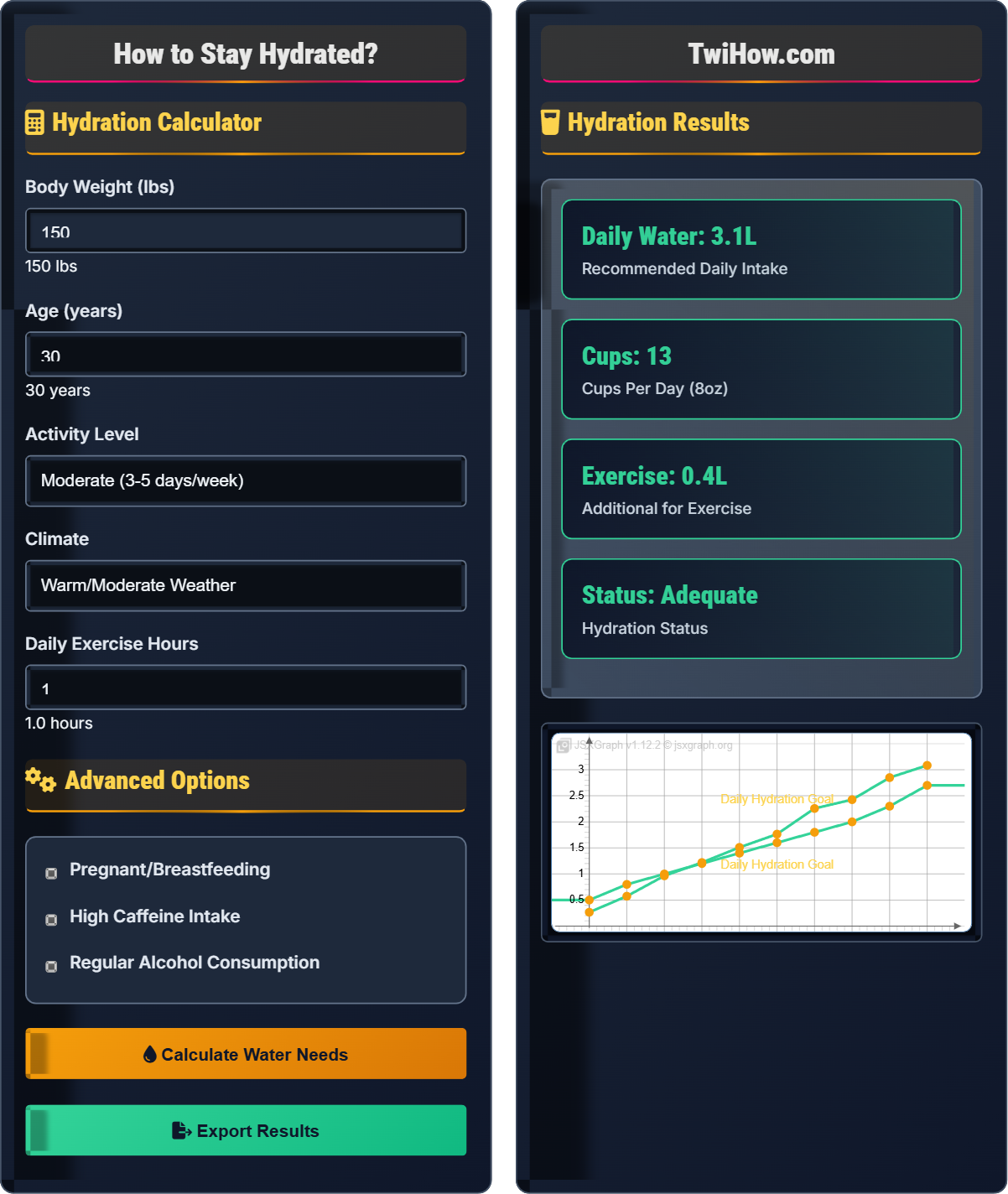
Hydration Calculator
Advanced Options
Hydration Results
| Time of Day | Amount (oz) | Recommendation |
|---|---|---|
| Upon Waking | 16 | Start your day hydrated |
| Mid-Morning | 8 | Continue steady intake |
| Lunch | 16 | With meal |
| Afternoon | 8 | Combat afternoon fatigue |
| Evening | 16 | Before dinner |
How Hydration Works Explained
Hydration refers to the process of providing adequate water to your body to maintain optimal physiological function. Water is essential for every cell, tissue, and organ in your body, making up approximately 60% of your total body weight.
The basic formula for calculating daily water needs:
Where:
- Base Requirement: Half your body weight in ounces
- Exercise Addition: 12 oz per hour of exercise
- Climate Adjustment: Additional 8 oz for hot weather
- Individual Factors: Age, activity, health conditions
Key benefits of maintaining optimal hydration:
- Energy: Improved cellular energy production
- Cognitive Function: Better focus and mental clarity
- Skin Health: Improved complexion and elasticity
- Kidney Function: Better toxin elimination
- Joint Lubrication: Reduced joint pain and stiffness
- Temperature Regulation: Effective sweating and cooling
- Pure Water: Best source of hydration
- Herbal Teas: Caffeine-free options
- Fruits & Vegetables: Natural water content
- Broths & Soups: Hydration with nutrients
- Electrolyte Drinks: For intense exercise
Hydration Fundamentals
Fluid balance, electrolytes, osmoregulation, water content, dehydration signs.
Daily Water (oz) = Body Weight (lbs) ÷ 2 + Exercise Hours × 12 + Climate Factor × 8
Where Climate Factor = 0 (mild), 4 (warm), 8 (hot), 12 (humid).
- Drink water before feeling thirsty
- Monitor urine color for hydration status
- Adjust intake based on activity and climate
- Consider food sources of water
Signs & Symptoms
Dark urine, fatigue, headaches, dry mouth, dizziness, reduced urination.
- Check urine color (pale yellow = hydrated)
- Monitor thirst levels
- Track physical symptoms
- Assess cognitive function
- Severe headaches
- Extreme fatigue
- Confusion or dizziness
- Very dark urine
Hydration Learning Quiz
According to general guidelines, what is the recommended daily water intake for an average adult?
The general recommendation is 8-10 glasses of water daily, which equals 64-80 ounces. This is often referred to as the "8x8 rule" (eight 8-ounce glasses), though individual needs vary based on factors like body weight, activity level, and climate.
The answer is C) 8-10 glasses (64-80 oz).
While the "8 glasses a day" rule is commonly cited, it's important to understand that hydration needs are highly individual. Factors such as body size, activity level, climate, and health conditions significantly influence how much water a person needs. The 8-10 glasses recommendation serves as a good baseline, but some people may need more or less depending on their circumstances.
Hydration: The process of providing adequate water to maintain optimal body function
Fluid Balance: The equilibrium between water intake and water loss in the body
Dehydration: Insufficient water in the body to maintain normal function
• Individual needs vary significantly
• Activity and climate affect requirements
• Monitor urine color as indicator
• Carry a water bottle for constant access
• Set reminders to drink water
• Eat water-rich foods
• Waiting until thirsty to drink
• Relying only on pure water
• Ignoring climate effects
Calculate the daily water requirement for a 160-pound individual who exercises 1.5 hours daily in warm weather. Explain your calculation and discuss factors that might increase this need.
Basic Calculation: 160 lbs ÷ 2 = 80 oz (base requirement)
Exercise Addition: 1.5 hours × 12 oz = 18 oz
Climate Adjustment: Warm weather adds 4-8 oz (let's use 6 oz)
Total: 80 + 18 + 6 = 104 oz = 13 cups daily
Factors that increase needs: Pregnancy, breastfeeding, illness, high altitude, caffeine/alcohol consumption, age (elderly may have reduced thirst sensation).
Calculating individual hydration needs involves considering multiple variables. The base formula provides a starting point, but adjustments must be made for activity level, climate, and personal factors. This demonstrates that hydration isn't one-size-fits-all and requires personalized attention based on individual circumstances.
Body Water Percentage: Typically 60% of body weight in adults
Fluid Replacement: Replenishing lost fluids during exercise
Climate Factor: Environmental conditions affecting water needs
• Drink water before feeling thirsty
• Adjust for activity and environment
• Consider all fluid sources
• Use body weight as baseline
• Add 12 oz per hour of exercise
• Increase in hot/humid conditions
• Using generic recommendations without personalization
• Ignoring environmental factors
• Not accounting for increased losses during exercise
A marathon runner weighing 140 pounds plans to run in 80°F weather. She typically runs 15 miles in 2.5 hours. Calculate her total hydration needs for the day, including pre-run, during-run, and post-run requirements. Include strategies for electrolyte replacement.
Daily Base Need: 140 ÷ 2 = 70 oz
Exercise Addition: 2.5 × 12 = 30 oz
Climate Adjustment: 80°F adds 8 oz
Pre-run: 16-20 oz 2-3 hours before
During-run: 6-8 oz every 15-20 minutes (total ~48-64 oz)
Post-run: 150% of fluid lost (weigh before/after)
Electrolyte Strategy: Sports drinks or electrolyte tablets every 30-45 minutes during run.
Total Estimated: ~180 oz (22.5 cups) for the day.
This scenario demonstrates the complexity of hydration planning for endurance athletes. It requires considering baseline needs, exercise duration/intensity, environmental conditions, and the timing of fluid intake. The 150% replacement rule for post-exercise emphasizes that athletes lose more than just water during intense activity.
Electrolytes: Minerals (sodium, potassium) that regulate fluid balance
Fluid Replacement Rate: 150% of weight lost during exercise
Hyponatremia: Dangerous condition from excessive water intake without electrolytes
• Replace 150% of fluid weight lost
• Include electrolytes during prolonged exercise
• Monitor urine color and frequency
• Weigh yourself before/after runs
• Practice hydration strategy during training
• Use sports drinks for runs >1 hour
• Drinking too much without electrolytes
• Not planning ahead for long runs
• Ignoring individual sweat rate variations
You're hiking with a friend on a hot day (95°F). After 2 hours, your friend complains of headache, fatigue, and dizziness. Their skin is dry and they haven't urinated in 4 hours. Assess the situation and recommend immediate actions to address potential dehydration.
Assessment: Friend shows clear signs of moderate dehydration: headache, fatigue, dizziness, dry skin, infrequent urination.
Immediate Actions:
1. Stop Activity: Rest in shade immediately
2. Rehydrate: Give small sips of water every 15 minutes
3. Electrolytes: Provide sports drink or oral rehydration solution
4. Cool Down: Remove excess clothing, apply cool water to skin
5. Monitor: Watch for improvement or worsening symptoms
6. Seek Help: If symptoms worsen, call emergency services
Never give large amounts of water rapidly as this can cause hyponatremia.
Recognizing dehydration symptoms early is crucial for preventing serious complications. The progression from mild (thirst) to severe (confusion, fainting) can happen quickly in hot conditions. Proper response involves gradual rehydration with both water and electrolytes, rest, and cooling measures.
Heat Exhaustion: Condition caused by dehydration and overheating
Hyponatremia: Low sodium levels from overhydration
Gradual Rehydration: Slow, controlled fluid replacement
• Stop activity immediately
• Rehydrate gradually, not rapidly
• Include electrolytes with water
• Prevent is better than cure
• Monitor urine color regularly
• Carry electrolyte supplements
• Giving too much water too quickly
• Ignoring early warning signs
• Not including electrolytes in rehydration
Which of the following is a common myth about hydration?
Option C is the myth. While pale yellow urine generally indicates good hydration, extremely clear urine can sometimes indicate overhydration, which can be dangerous. Other options are facts: coffee does count toward fluid intake (though caffeine has mild diuretic effects), thirst is not the first sign of dehydration (it comes after the body is already somewhat dehydrated), and water is indeed the best source of hydration.
The answer is C) Clear urine always indicates perfect hydration.
Many hydration beliefs are oversimplified or incorrect. Understanding the nuances helps people make better hydration decisions. For example, while we're taught that clear urine is ideal, it can actually indicate overhydration in some cases. Similarly, the relationship between thirst and dehydration is more complex than simply "drink when thirsty."
Overhydration: Excessive water intake leading to dilution of electrolytes
Thirst Mechanism: Body's signal for fluid needs (not always immediate)
Urine Color Scale: Indicator of hydration status (pale yellow = optimal)
• Balance is key in hydration
• Individual variation exists
• Multiple indicators matter
• Use multiple indicators (urine, thirst, energy)
• Listen to your body's signals
• Adjust for changing conditions
• Following rigid rules without personalization
• Believing hydration myths
• Ignoring individual differences
FAQ
Q: How much water should I drink during my workouts?
A: For optimal workout hydration:
Before: 16-20 oz of water 2-3 hours before exercise, plus 8-10 oz 10-15 minutes before starting.
During: 6-8 oz every 15-20 minutes during exercise. For workouts longer than 1 hour, consider a sports drink to replace electrolytes.
After: 150% of the weight lost during exercise (weigh yourself before and after to determine fluid loss).
For high-intensity or long-duration activities, electrolyte replacement becomes crucial to prevent hyponatremia (low blood sodium).
Q: Do caffeinated beverages count toward daily water intake?
A: Yes, caffeinated beverages do count toward daily fluid intake. Research shows that moderate caffeine consumption (up to 400mg/day) does not cause significant dehydration in regular consumers.
However, there are important considerations:
1. Moderation: Large amounts of caffeine (>400mg/day) may have mild diuretic effects
2. Tolerance: Regular caffeine consumers develop tolerance to diuretic effects
3. Timing: Avoid caffeine close to bedtime as it may affect sleep quality
4. Individual Response: Some people are more sensitive to caffeine's effects
For optimal hydration, water should still be the primary fluid source, but coffee, tea, and other caffeinated beverages contribute to your total intake.