What is Healthy Diet?
Complete health guide • Step-by-step explanations
Healthy Diet Fundamentals:
Show Meal PlannerA healthy diet is one that provides the body with essential nutrients for optimal functioning, disease prevention, and overall well-being. It consists of a balanced combination of macronutrients (carbohydrates, proteins, fats) and micronutrients (vitamins, minerals) in appropriate proportions. A healthy diet emphasizes whole foods, variety, moderation, and proper hydration.
Key components of a healthy diet:
- Macronutrients: Carbohydrates, proteins, and healthy fats
- Micronutrients: Vitamins and minerals
- Fiber: For digestive health
- Hydration: Adequate water intake
A healthy diet supports physical health, mental well-being, and longevity while reducing the risk of chronic diseases such as heart disease, diabetes, and obesity.
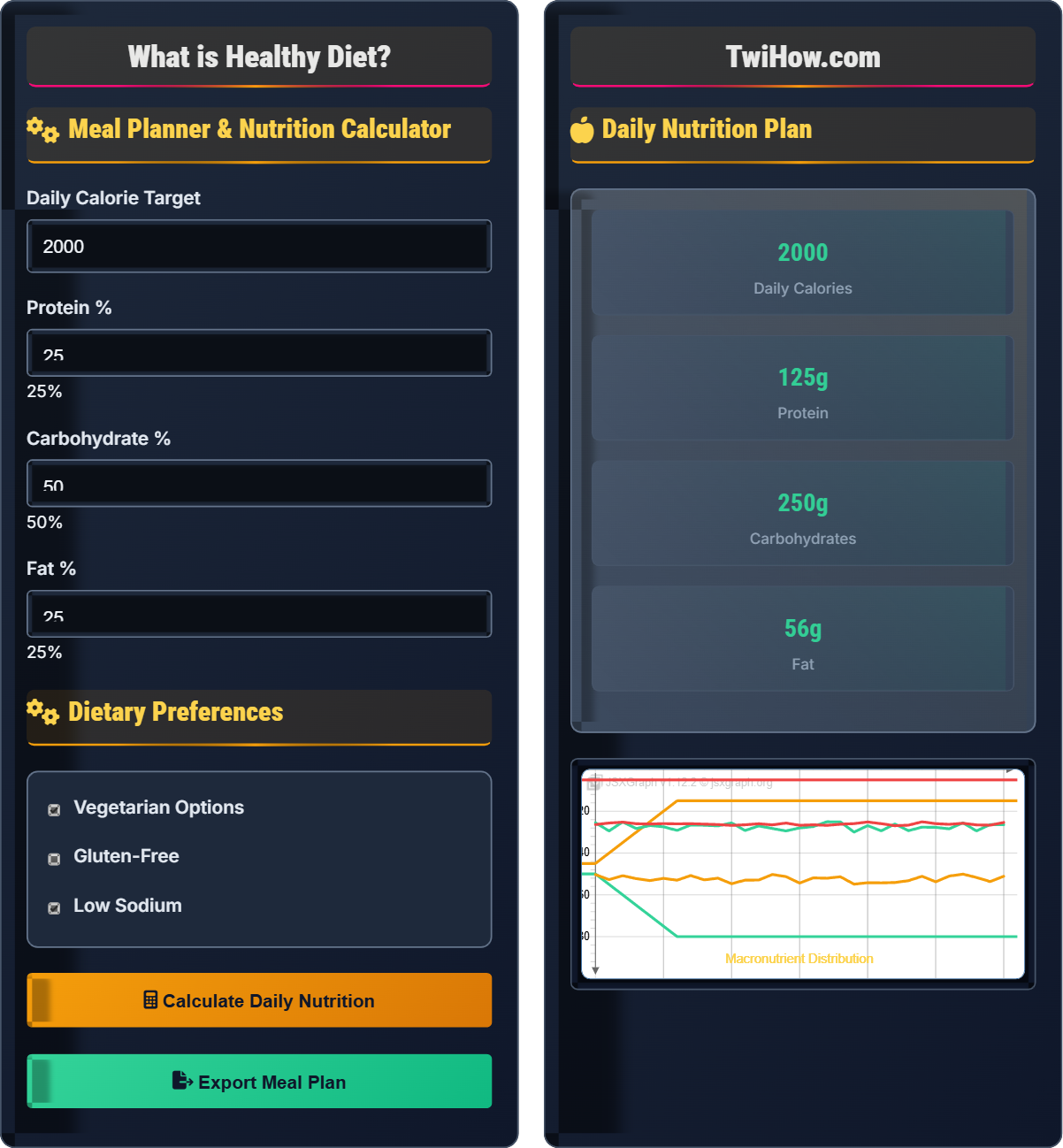
Meal Planner & Nutrition Calculator
Dietary Preferences
Daily Nutrition Plan
Healthy diet rich in fruits, vegetables, and whole grains supports cardiovascular health and reduces heart disease risk.
Proper nutrition supports cognitive function, memory, and mental clarity throughout life.
Balanced nutrition helps maintain healthy weight and prevents obesity-related diseases.
Healthy Diet Explained
A healthy diet is a nutritional plan that provides the body with essential nutrients in appropriate quantities to maintain optimal health, promote growth, and prevent disease. It emphasizes consuming a variety of whole foods including fruits, vegetables, whole grains, lean proteins, and healthy fats while limiting processed foods, added sugars, and excessive sodium.
A balanced diet supports physical health, mental well-being, and longevity while reducing the risk of chronic diseases.
Where:
- Protein: 4 calories per gram
- Carbohydrates: 4 calories per gram
- Fat: 9 calories per gram
Benefits of a healthy diet:
- Heart Health: Reduces risk of cardiovascular disease
- Brain Function: Supports cognitive health and memory
- Immune System: Strengthens defense against infections
- Energy Levels: Provides sustained energy throughout the day
- Weight Management: Helps maintain healthy body weight
- Longevity: Promotes healthy aging and longevity
- Fruits: Rich in vitamins, minerals, and antioxidants
- Vegetables: Provide fiber, vitamins, and phytonutrients
- Whole Grains: Source of fiber and sustained energy
- Lean Proteins: Support muscle health and repair
- Healthy Fats: Support hormone production and nutrient absorption
- Water: Essential for all bodily functions
Nutrition Essentials
Carbohydrates, proteins, fats, vitamins, minerals, water, fiber.
Protein Grams = (Daily Calories × Protein %) / 4
Carb Grams = (Daily Calories × Carb %) / 4
Fat Grams = (Daily Calories × Fat %) / 9
- Balance macronutrients appropriately
- Choose whole foods over processed
- Eat variety of colorful foods
- Stay hydrated
Implementation Guide
Assessment, planning, shopping, preparation, monitoring.
- Assess current eating habits
- Set nutritional goals
- Plan balanced meals
- Shop for healthy ingredients
- Read food labels
- Control portions
- Limit processed foods
- Plan ahead
Healthy Diet Learning Quiz
According to dietary guidelines, what percentage of daily calories should come from carbohydrates?
According to the Dietary Guidelines for Americans, carbohydrates should comprise 45-65% of total daily calories. Carbohydrates are the body's primary source of energy and should come primarily from complex carbohydrates like whole grains, fruits, and vegetables rather than refined sugars.
The answer is C) 45-65%.
Understanding macronutrient distribution is fundamental to healthy eating. Carbohydrates provide glucose, which is essential for brain function and energy. The 45-65% range allows flexibility based on individual needs, activity level, and health conditions. Complex carbohydrates provide sustained energy and essential nutrients, while simple sugars should be limited to prevent blood sugar spikes and weight gain.
Carbohydrates: Energy-providing nutrients (4 cal/g)
Complex Carbs: Fiber-rich, slowly digested carbs
Simple Sugars: Quickly absorbed, energy-spiking carbs
• 45-65% of calories from carbs
• Choose complex over simple carbs
• Include fiber-rich sources
• Include whole grains in every meal
• Eat fruits and vegetables daily
• Limit refined sugar intake
• Cutting carbs too low
• Eating too many refined carbs
• Not considering individual needs
Explain the concept of portion control and describe practical methods to implement it. Include specific examples and the role of visual cues in managing food portions.
Portion Control: The practice of managing food serving sizes to meet nutritional needs without overeating.
Practical Methods:
1. Plate Method: Fill half plate with vegetables, quarter with protein, quarter with grains
2. Hand Measurements: Palm-sized protein, fist-sized vegetables, cupped hand for carbs
3. Smaller Utensils: Use smaller plates, bowls, and cups
4. Pre-portioning: Divide snacks into individual servings
Visual Cues: Comparing portions to everyday objects (deck of cards for meat, tennis ball for fruit) helps estimate appropriate sizes without measuring tools.
Portion control is crucial for maintaining a healthy diet and preventing overeating. Visual cues make it easier to estimate appropriate portions without needing scales or measuring cups. The hand measurement method is particularly useful because it's portable and adjusts to individual body size. Understanding proper portions helps maintain energy balance and prevents weight gain.
Portion Control: Managing food serving sizes
Visual Cues: Using objects to estimate portions
Energy Balance: Calories consumed vs. burned
• Use smaller plates
• Measure portions initially
• Listen to hunger cues
• Pre-portion snacks
• Eat slowly and mindfully
• Wait 20 minutes before seconds
• Using oversized plates
• Eating directly from packages
• Not stopping when satisfied
An individual has a daily calorie target of 2,200 calories with 30% protein, 45% carbohydrates, and 25% fat. Calculate the grams of each macronutrient they should consume daily. Also determine how many calories come from each macronutrient.
Calculate Calories from Each Macronutrient:
Protein calories: 2,200 × 0.30 = 660 calories
Carb calories: 2,200 × 0.45 = 990 calories
Fat calories: 2,200 × 0.25 = 550 calories
Convert Calories to Grams:
Protein grams: 660 ÷ 4 = 165g
Carb grams: 990 ÷ 4 = 247.5g ≈ 248g
Fat grams: 550 ÷ 9 = 61.1g ≈ 61g
Verification:
Total calories: (165 × 4) + (248 × 4) + (61 × 9) = 660 + 992 + 549 = 2,201 calories (rounding error)
The individual should consume approximately 165g protein, 248g carbohydrates, and 61g fat daily.
This calculation demonstrates how to convert between calories and grams for different macronutrients. Remember that protein and carbohydrates each provide 4 calories per gram, while fat provides 9 calories per gram. This conversion is essential for meal planning and ensuring you meet your nutritional targets. The slight rounding error is normal in practical applications.
Macronutrients: Major nutrients (carbs, protein, fat)
Calories: Units of energy in food
Grams: Unit of mass measurement
• Protein = 4 cal/g
• Carbs = 4 cal/g
• Fat = 9 cal/g
• Use apps to track macros
• Plan meals in advance
• Read nutrition labels
• Confusing calories with grams
• Forgetting different caloric values
• Not accounting for rounding
Compare the nutrient density of 100 calories of broccoli versus 100 calories of ice cream. Analyze which food provides more vitamins, minerals, and fiber per calorie, and explain why nutrient-dense foods should form the foundation of a healthy diet.
Nutrient Density Comparison:
Broccoli (100 calories):
• High in vitamin C, vitamin K, folate, fiber
• Good source of potassium, iron, calcium
• Virtually no saturated fat or sodium
• High fiber content
Ice Cream (100 calories):
• Contains calcium and some protein
• High in saturated fat and sugar
• Low in vitamins and minerals
• Virtually no fiber
Analysis: Broccoli provides significantly more essential nutrients per calorie than ice cream. Nutrient-dense foods deliver more vitamins, minerals, and beneficial compounds with fewer calories, making them foundational to a healthy diet. They support optimal health while helping maintain energy balance.
Nutrient density refers to the ratio of nutrients to calories in food. Nutrient-dense foods provide high levels of vitamins, minerals, fiber, and other beneficial compounds relative to their calorie content. Prioritizing nutrient-dense foods helps meet nutritional needs without exceeding calorie limits. This approach supports long-term health and prevents nutrient deficiencies while promoting satiety.
Nutrient Density: Nutrients per calorie ratio
Empty Calories: Calories with little nutritionEssential Nutrients: Required for health
• Choose nutrient-dense foods
• Limit empty calories
• Prioritize whole foods
• Eat colorful fruits and vegetables
• Choose whole grains over refined
• Include lean proteins
• Focusing only on calories
• Ignoring nutrient quality
• Not eating enough vegetables
How much water should a healthy adult aim to drink daily?
Health experts generally recommend 8-10 glasses (64-80 ounces) of water daily for healthy adults. Water is essential for all bodily functions, temperature regulation, joint lubrication, and waste removal. Individual needs may vary based on activity level, climate, and health conditions.
The answer is C) 8-10 glasses (64-80 oz).
Water is the most important nutrient as it's required for virtually every bodily function. Adequate hydration supports kidney function, cognitive performance, physical performance, and overall health. While individual needs vary, the 8-10 glass recommendation provides a good baseline for most people. Other fluids contribute to hydration but plain water is the best choice.
Hydration: Adequate fluid balance in body
Dehydration: Fluid deficit condition
Electrolytes: Minerals that regulate fluid balance
• Drink 8-10 glasses daily
• More needed during exercise
• Monitor urine color
• Carry a water bottle
• Drink before feeling thirsty
• Add lemon for flavor
• Waiting until thirsty to drink
• Drinking too little
• Counting caffeinated drinks as water
FAQ
Q: How do I know if I'm eating enough protein?
A: General protein recommendations are:
• Adults: 0.8g per kg of body weight (or 0.36g per lb)
• Active individuals: 1.2-1.7g per kg
• Older adults: 1.0-1.2g per kg
Signs you may not be getting enough protein include constant hunger, slow wound healing, hair loss, and fatigue. Good protein sources include lean meats, fish, eggs, dairy, legumes, and plant-based proteins.
Aim to include protein at every meal to maintain steady amino acid levels in your body.
Q: What's the difference between healthy and unhealthy fats?
A: The key differences are:
Healthy Fats (Unsaturated): Monounsaturated and polyunsaturated fats found in olive oil, avocados, nuts, seeds, and fatty fish. These support heart health, reduce inflammation, and aid nutrient absorption.
Unhealthy Fats: Trans fats (found in processed foods) and excessive saturated fats (found in animal products and tropical oils). These can raise bad cholesterol and increase heart disease risk.
Focus on replacing unhealthy fats with healthy ones rather than eliminating all fats.
Q: Can I get all essential nutrients on a vegetarian diet?
A: Yes, a well-planned vegetarian diet can provide all essential nutrients. Focus on:
• Protein: Legumes, quinoa, nuts, seeds, soy products
• Vitamin B12: Fortified foods or supplements
• Iron: Legumes, dark leafy greens, fortified cereals (pair with vitamin C)
• Vitamin D: Sun exposure or supplements
• Omega-3s: Flaxseeds, chia seeds, walnuts, algae oil
Plan meals carefully and consider consulting a registered dietitian to ensure nutritional adequacy.