How Can I Support Someone with Depression?
Complete depression support guide • Step-by-step explanations
Depression Support:
Show Support PlannerSupporting someone with depression requires understanding, patience, and a compassionate approach. Depression is a serious mental health condition that affects millions of people worldwide, and the support of loved ones can play a crucial role in recovery and management. Effective support involves both emotional empathy and practical assistance while respecting the person's autonomy and dignity.
Supporting someone with depression means providing a safe, non-judgmental space where they feel heard and valued. It involves understanding that depression is not a choice or a sign of weakness, but a legitimate medical condition that requires care and attention.
Key support strategies include:
- Emotional Support: Active listening, empathy, validation, and unconditional acceptance
- Practical Assistance: Help with daily tasks, appointments, and responsibilities
- Encouragement: Motivation to seek professional help and maintain treatment
- Education: Learning about depression to better understand the condition
- Self-Care: Maintaining your own well-being while providing support
Remember that supporting someone with depression is a marathon, not a sprint. It requires consistency, patience, and an understanding that recovery takes time.
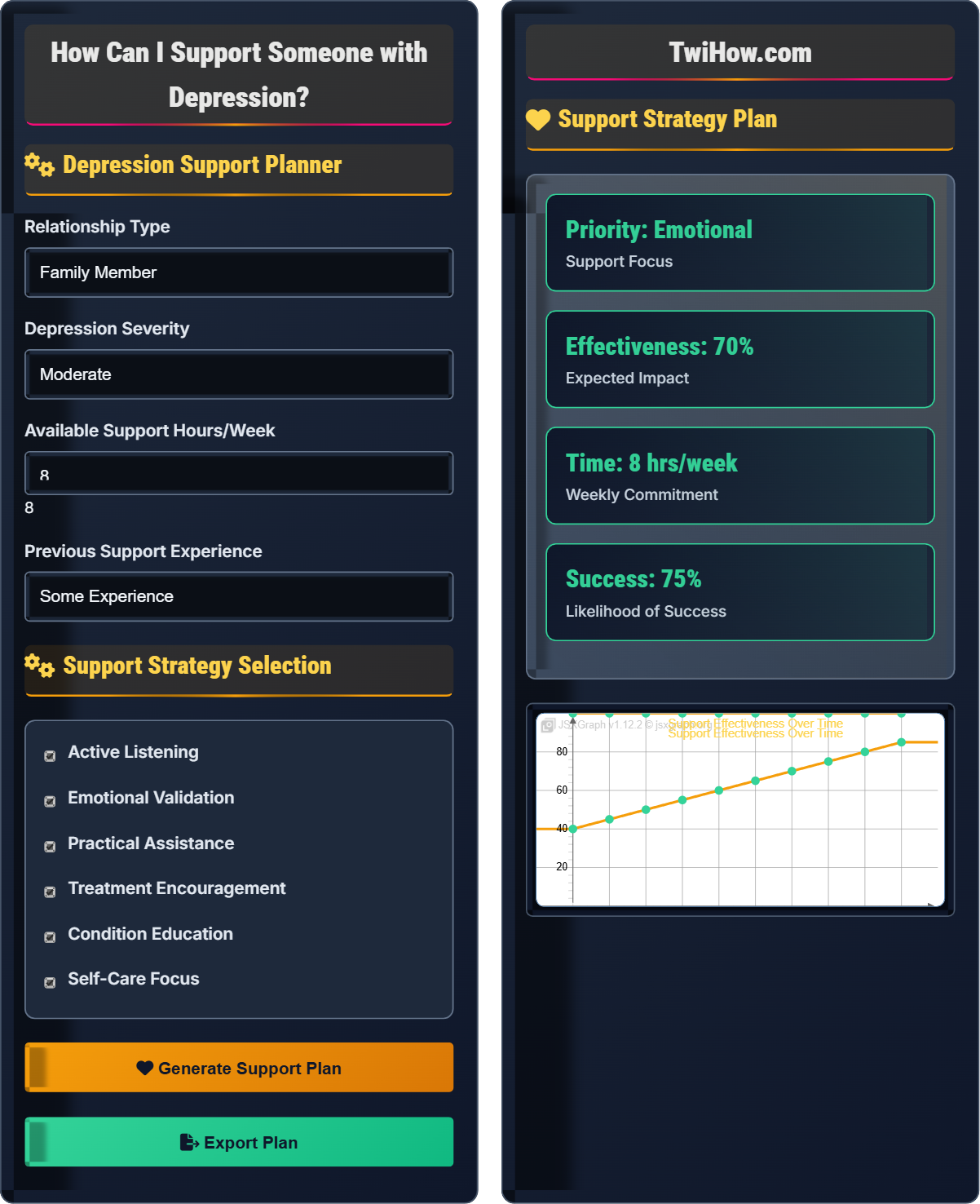
Depression Support Planner
Support Strategy Selection
Support Strategy Plan
| Support Area | Priority | Effectiveness | Implementation |
|---|---|---|---|
| Active Listening | High | 85% | Daily check-ins, no advice |
| Emotional Validation | High | 80% | Validate feelings, avoid minimization |
| Practical Assistance | Medium | 70% | Help with tasks as offered |
| Treatment Support | High | 75% | Encourage professional help |
| Self-Care | Medium | 65% | Maintain boundaries |
Depression Support Explained
Supporting someone with depression involves providing emotional, practical, and social assistance to help them manage their condition and maintain their well-being. Depression is a complex mental health condition that affects mood, thinking, and daily functioning. Effective support requires understanding that depression is not a choice or a sign of weakness, but a legitimate medical condition that requires care and attention.
Effective depression support follows a comprehensive framework:
Where:
- Empathy: Understanding and compassion for their experience
- Practical Help: Assistance with daily tasks and responsibilities
- Professional Encouragement: Support for seeking and maintaining treatment
- Personal Burnout: Risk of caregiver exhaustion and stress
Key areas where depression support provides significant benefits:
- Emotional Well-being: Reduced isolation and improved mood
- Treatment Adherence: Better compliance with therapy and medication
- Daily Functioning: Assistance with activities of daily living
- Recovery Process: Faster and more sustainable recovery
- Relationship Quality: Maintained social connections
- Prevention: Reduced risk of relapse and complications
- Active Listening: Providing undivided attention without judgment
- Validation: Acknowledging feelings as legitimate and real
- Patience: Understanding that recovery takes time
- Encouragement: Supporting treatment and positive activities
- Boundaries: Maintaining healthy limits while providing support
Support Fundamentals
Depression support, mental health advocacy, emotional validation, active listening, self-care, empathy.
Support Effectiveness = (Empathy + Practical Help + Professional Encouragement) / Personal Burnout
Where Empathy = understanding and compassion, Practical Help = daily assistance.
- Listen without trying to fix
- Validate feelings as real
- Encourage professional help
Application Strategies
Active listening, emotional validation, practical assistance, treatment encouragement, self-care planning.
- Learn about depression and its symptoms
- Establish a supportive relationship
- Provide consistent emotional support
- Maintain your own well-being
- Recovery takes time
- Professional help is essential
- Supporter self-care is important
- Respect individual autonomy
Depression Support Learning Quiz
What is the most important aspect of active listening when supporting someone with depression?
The most important aspect of active listening is providing undivided attention and validating their feelings. When someone with depression shares their experiences, they need to feel heard and understood rather than judged or immediately "fixed." Validation acknowledges that their feelings are real and important, which can be incredibly comforting and supportive.
The answer is B) Providing undivided attention and validating their feelings.
Active listening is a fundamental skill in supporting someone with depression. It involves giving your full attention, reflecting back what you've heard, and acknowledging the person's emotional experience. This approach helps build trust and creates a safe space for the person to express their feelings without fear of judgment.
Active Listening: Fully concentrating on and reflecting what someone says
Validation: Acknowledging the legitimacy of someone's feelings
Undivided Attention: Giving complete focus to the speaker
• Listen without trying to fix
• Validate feelings as real
• Focus on the person's experience
• Use "I hear that you're feeling..." statements
• Ask "How can I best support you?"
• Avoid giving unsolicited advice
• Trying to solve problems immediately
• Minimizing their feelings
• Offering advice without being asked
Explain how to effectively encourage someone with depression to seek professional help without being pushy or judgmental.
Approach with Compassion: Frame the suggestion in terms of care and concern rather than criticism. Say something like "I care about you and think professional support could be helpful."
Normalize Professional Help: Emphasize that seeking help is a sign of strength, not weakness. Compare it to seeing a doctor for physical health issues.
Provide Information: Research therapists, support groups, or treatment options together. Offer to help with logistics like scheduling appointments.
Respect Autonomy: Present options rather than demands. "Would you like me to help you research therapists in our area?" rather than "You need to see a therapist."
Be Patient: Understand that the decision to seek help may take time. Continue to offer support and gently revisit the topic periodically.
Offer Practical Support: Volunteer to accompany them to appointments, help with transportation, or assist with insurance paperwork.
The key is to maintain a supportive, non-pressure approach while emphasizing that professional help can be beneficial.
Encouraging professional help requires a delicate balance between being supportive and respecting the person's autonomy. Pushing too hard can create resistance, while being too passive may not provide adequate encouragement. The approach should emphasize care and concern while respecting their decision-making process.
Professional Help: Treatment from qualified mental health professionals
Autonomy: Individual's right to make their own decisionsNormalization: Presenting help-seeking as ordinary and acceptable
• Respect their decision-making process
• Normalize professional help
• Provide practical support
• Research options together
• Offer to accompany them
• Share success stories (if appropriate)
• Being pushy or demanding
• Criticizing their current approach
• Not respecting their pace
A close friend has been diagnosed with depression and is struggling with daily activities. They've withdrawn from social activities, have difficulty sleeping, and express feelings of hopelessness. They're reluctant to talk about their feelings but seem overwhelmed by basic tasks. Design a support plan that addresses their immediate needs while encouraging long-term recovery.
Immediate Support Actions:
1. Consistent Check-ins: Regular, gentle contact without pressure. Send texts asking "How are you today?" rather than "How are you feeling?"
2. Practical Assistance: Offer help with specific tasks like groceries, cleaning, or cooking. "I'm going to the store, can I pick up anything for you?"
3. Low-Pressure Activities: Invite them to quiet, non-demanding activities like watching a movie together or going for a walk.
Long-term Recovery Support:
4. Treatment Encouragement: Gently discuss professional help options and offer to help find resources or accompany them to appointments.
5. Structure and Routine: Help establish or maintain daily routines that promote well-being.
6. Positive Reinforcement: Acknowledge small improvements and efforts without minimizing their struggles.
Communication Approach:
7. Non-Judgmental Presence: Be available to listen when they're ready, without pushing for details.
8. Patience and Understanding: Recognize that recovery is not linear and may involve setbacks.
This approach provides immediate practical help while building toward long-term recovery.
This example demonstrates how to balance immediate practical support with long-term recovery goals. The key is providing consistent, non-intrusive support that respects the person's current capacity while gently encouraging positive steps forward. It's important to meet them where they are rather than where you wish they were.
Recovery Process: Journey toward improved mental health
Practical Support: Assistance with daily living tasks
Non-Intrusive: Respectful of boundaries and autonomy
• Meet them where they are
• Provide consistent support
• Respect their boundaries
• Start with small gestures
• Be consistently available
• Focus on small improvements
• Expecting immediate improvement
• Pushing for details they're not ready to share
• Not maintaining consistent contact
You're helping someone understand the importance of self-care while supporting a loved one with depression. Explain why supporter self-care is crucial and provide specific strategies for maintaining well-being while providing support.
Why Self-Care is Crucial:
1. Prevents Burnout: Supporting someone with depression can be emotionally and physically exhausting. Self-care helps maintain your energy and emotional reserves.
2. Ensures Sustained Support: You can only provide consistent support if you're taking care of yourself.
3. Models Healthy Behavior: Demonstrating self-care shows your loved one the importance of taking care of themselves.
4. Maintains Perspective: Self-care helps you maintain a balanced perspective on the situation.
Self-Care Strategies:
5. Set Boundaries: Establish clear limits on what you can and cannot do. It's okay to say "no" to requests that exceed your capacity.
6. Seek Support: Join support groups for family and friends of people with depression. Talk to trusted friends or consider counseling.
7. Maintain Your Own Life: Continue pursuing your own interests, hobbies, and relationships.
8. Physical Self-Care: Exercise regularly, eat well, and get adequate sleep to maintain your physical health.
9. Emotional Self-Care: Practice stress management techniques, mindfulness, or meditation.
Remember: Self-care is not selfish; it's essential for providing effective long-term support.
Self-care is often overlooked by supporters, who may feel guilty focusing on their own needs. However, maintaining your own well-being is crucial for providing effective long-term support. Think of it like the airplane safety instruction: you must secure your own oxygen mask first before helping others.
Burnout: Exhaustion from prolonged stress
Boundaries: Limits that protect your well-being
Support Groups: Groups for people in similar situations
• Self-care enables better support
• Boundaries protect both parties
• You can't pour from an empty cup
• Schedule regular self-care activities
• Seek support from others
• Maintain your own interests
• Neglecting personal needs
• Feeling guilty about self-care
• Not setting boundaries
Which of the following is the most important warning sign that requires immediate professional intervention when supporting someone with depression?
Expressions of hopelessness or suicidal thoughts are the most important warning signs that require immediate professional intervention. These indicate a potential risk to the person's safety and require urgent attention from mental health professionals. While all other symptoms are important indicators of depression, expressions of hopelessness or suicidal thoughts represent an immediate safety concern that should not be handled alone.
The answer is B) Expressions of hopelessness or suicidal thoughts.
Recognizing warning signs of suicide risk is crucial for anyone supporting someone with depression. While all symptoms of depression are important to address, safety concerns take priority. If someone expresses suicidal thoughts, it's important to take them seriously, stay calm, listen without judgment, and connect them with professional help immediately.
Warning Signs: Indicators of potential danger
Hopelessness: Feeling that things will never improve
Suicidal Thoughts: Thoughts about ending one's life
• Take all suicidal thoughts seriously
• Seek immediate professional help
• Don't leave them alone
• Contact National Suicide Prevention Lifeline
• Take them to emergency room if necessary
• Stay calm and listen without judgment
• Minimizing expressions of hopelessness
• Trying to handle alone
• Not taking threats seriously
FAQ
Q: How do I know if I'm being too helpful or not helpful enough?
A: Finding the right balance requires ongoing assessment and communication:
Signs You Might Be Too Helpful:
• Your loved one seems to have given up trying to do things independently
• They expect you to handle everything without effort on their part
• You're constantly anticipating their needs before they ask
• They seem to have lost confidence in their own abilities
Signs You Might Not Be Helpful Enough:
• They're struggling visibly with basic tasks and seem overwhelmed
• They're isolating themselves completely
• They seem to be deteriorating rather than maintaining
• They're expressing that they feel abandoned
Best Practice: Ask directly: "What would be most helpful right now?" or "Would you prefer to try this yourself or would help be welcome?" Respect their answer and check in periodically about the level of support they need.
Q: What if my friend with depression doesn't want my help?
A: Respect their autonomy while maintaining your support:
Respect Their Decision: If they decline help, accept it gracefully. They may need to maintain their independence or feel capable of managing.
Offer Specific Options: Instead of general "let me know if you need anything," offer specific help: "Would it help if I picked up groceries this week?" or "I could drive you to your next appointment if that would be useful."
Stay Connected: Continue to include them socially and check in on their well-being in other ways.
Be Available: Let them know you're available if they change their mind: "I understand you want to handle this yourself. I'm here if you decide you'd like help."
Don't Take It Personally: Their reluctance may stem from pride, independence, or not wanting to burden you, not from rejecting your friendship.
Remember, sometimes the greatest support is respecting their wishes while remaining available.