How to Balance Productivity with Mental Wellness
Complete wellness guide • Step-by-step explanations
Productivity-Wellness Balance:
Show Balance SimulatorBalancing productivity with mental wellness is a critical skill in today's fast-paced world. The key is finding sustainable ways to achieve goals while maintaining emotional, psychological, and physical well-being. This balance requires intentional strategies, boundary-setting, and self-awareness.
Successful balance involves recognizing that productivity and wellness are not mutually exclusive—they can support each other when properly aligned. Sustainable productivity emerges from good mental health, while meaningful accomplishments contribute to well-being.
Key balance concepts:
- Boundary Setting: Clear limits between work and personal time
- Energy Management: Matching tasks to energy levels throughout the day
- Values Alignment: Pursuing goals that support overall well-being
- Self-Compassion: Treating yourself with kindness during setbacks
The optimal balance varies by individual, role, and life circumstances, requiring regular assessment and adjustment to maintain harmony between achievement and well-being.
Balance Assessment
Balance Options
Balance Analysis
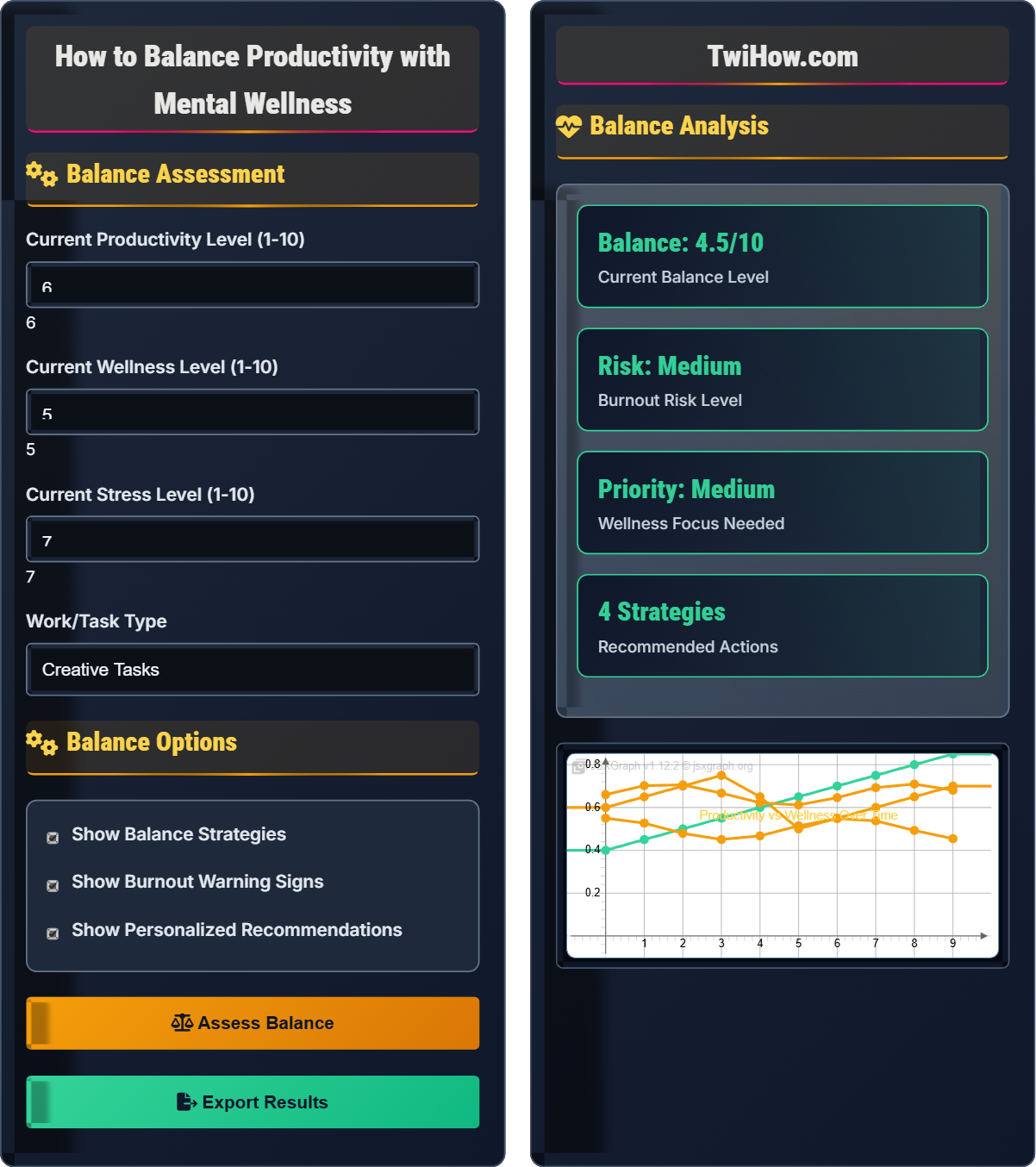
| Metric | Current | Target | Status |
|---|---|---|---|
| Productivity | 6/10 | 7/10 | Good |
| Wellness | 5/10 | 8/10 | Needs Improvement |
| Stress | 7/10 | 3/10 | High |
| Balance | 5.5/10 | 8/10 | Imbalanced |
Schedule specific time blocks for focused work and separate times for rest and wellness activities to prevent overlap.
Prioritize adequate sleep, breaks, and downtime to maintain energy and mental clarity for sustained productivity.
Understanding Productivity-Wellness Balance
Productivity-wellness balance is the practice of achieving meaningful outcomes while maintaining mental, emotional, and physical health. It recognizes that sustainable high performance requires periods of effort balanced with recovery, and that well-being supports rather than hinders long-term productivity.
- Productivity: Achieving meaningful goals and outcomes efficiently
- Wellness: Maintaining mental, emotional, and physical health
- Balance: Sustaining both over the long-term without burnout
- Alignment: Ensuring activities support both goals
The relationship between productivity and wellness is cyclical—good mental health enables better focus and performance, while meaningful accomplishments contribute to well-being.
The balance equation follows this model:
Where:
- Productivity: Achievement of meaningful goals
- Wellness: Mental, emotional, and physical health
- Sustainability: Ability to maintain over time
- Optimal Performance: Long-term success and fulfillment
Balance strategies apply across multiple life domains:
- Professional: Work tasks, career advancement, workplace relationships
- Personal: Family time, hobbies, self-care, social connections
- Health: Physical exercise, nutrition, sleep, mental health maintenance
- Learning: Skill development, education, personal growth
- Financial: Income generation, budgeting, financial security
- Community: Volunteering, civic engagement, social contribution
- Time Management: Scheduling, prioritization, boundary setting
- Energy Management: Matching tasks to energy levels, recovery periods
- Stress Management: Coping strategies, resilience building
- Goal Alignment: Ensuring objectives support overall well-being
- Self-Care Integration: Embedding wellness into daily routines
- Progressive Adjustment: Adapting approaches based on feedback
Balance Strategies
Time blocking, energy management, boundary setting, stress management, recovery periods.
Balance Index = (Wellness Score + Productivity Score) / (Stress Level × 2) × Sustainability Factor
Where Balance Index = overall balance effectiveness, Wellness Score = mental health rating.
- Wellness enables productivity
- Boundaries protect both dimensions
- Rest is productive
Warning Signs & Indicators
Chronic fatigue, decreased performance, emotional exhaustion, cynicism, detachment.
- Monitor energy levels throughout the day
- Track stress and recovery patterns
- Assess work-life integration
- Measure goal alignment with values
- Performance declines despite increased effort
- Feeling overwhelmed or exhausted
- Relationships suffering
- Losing sense of purpose
Equilibrium Model
Focused effort, goal achievement, results
Rest, recovery, self-care, balance
The optimal balance shifts based on life circumstances, energy levels, and personal values. The goal is sustainable performance that supports both achievement and well-being.
Balance Tactics Overview
Schedule specific time blocks for focused work and separate times for rest and wellness activities to prevent overlap.
Prioritize adequate sleep, breaks, and downtime to maintain energy and mental clarity for sustained productivity.
Choose tasks and goals that align with personal values and support both productivity and well-being simultaneously.
Productivity-Wellness Balance Learning Quiz
What is the most important aspect of balancing productivity with mental wellness?
The most important aspect is ensuring long-term sustainability. Sustainable productivity requires maintaining mental wellness over time. While short-term gains might come from pushing too hard, true balance focuses on creating systems that can be maintained indefinitely without leading to burnout or compromising health.
The answer is B) Ensuring long-term sustainability.
The sustainability principle is fundamental to effective balance. The human body and mind require recovery and restoration. Without sustainable practices, productivity eventually decreases due to fatigue, stress, and burnout. The goal is not to maximize output at any cost, but to find a rhythm that supports both achievement and well-being over the long term.
Sustainability: Practices that can be maintained over time
Burnout: Chronic stress leading to exhaustion and cynicism
Recovery: Restoration of physical and mental resources
• Recovery is as important as effort
• Short-term gains may compromise long-term health
• Balance is dynamic, not static
• Schedule recovery time like important tasks
• Monitor energy levels throughout the day
• Adjust intensity based on capacity
• Sacrificing sleep for productivity
• Ignoring physical and emotional signals
• Equating busyness with success
Explain the concept of energy management and how it differs from time management in balancing productivity and wellness.
Time management: Focuses on organizing and scheduling activities within fixed time periods, treating all tasks equally regardless of their demands.
Energy management: Focuses on matching activities to energy levels throughout the day, recognizing that our capacity for different types of work varies based on circadian rhythms, stress levels, and recovery.
Key differences: Time management allocates time; energy management allocates mental and physical resources. Time is fixed (24 hours/day); energy fluctuates. Effective balance requires managing both time and energy to optimize performance while preserving wellness.
Energy management is often overlooked in favor of time management, but it's crucial for sustainable productivity. Our cognitive and physical energy fluctuates throughout the day due to circadian rhythms, meal timing, stress levels, and other factors. By aligning demanding tasks with peak energy periods and reserving lower-energy periods for routine tasks, we can accomplish more while preserving mental wellness.
Energy management: Matching tasks to energy levels
Circadian rhythms: Natural daily biological cycles
Cognitive energy: Mental capacity for focused work• Schedule high-demand tasks during peak energy
• Protect recovery time
• Adjust expectations based on energy
• Track your energy patterns for a week
• Schedule demanding work during peak hours
• Plan restorative activities for low-energy times
• Treating all hours as equal
• Ignoring natural energy rhythms
• Pushing through low-energy periods
Sarah is a marketing manager who has been working 12-hour days to meet quarterly goals. She's experiencing chronic stress, poor sleep, and decreased creativity. Her team's morale is declining, and she's considering leaving her job. Develop a comprehensive plan to help Sarah balance productivity with mental wellness while meeting her professional obligations.
Immediate actions: 1) Reduce workday to 8-9 hours, 2) Schedule 30-minute lunch breaks, 3) Establish no-work evenings/weekends, 4) Begin with 7-8 hours of sleep nightly.
Productivity improvements: 1) Delegate tasks to team members, 2) Use time-blocking for focused work, 3) Batch similar activities, 4) Set clear boundaries with colleagues.
Wellness integration: 1) Morning meditation or exercise, 2) Mid-day walk or break, 3) Evening wind-down routine, 4) Weekly personal time.
Long-term strategy: Gradually implement changes while communicating with leadership about realistic expectations and workload distribution.
This scenario illustrates the classic productivity-wellness imbalance. The solution requires addressing both productivity (through better time management and delegation) and wellness (through boundaries and self-care). The key is making changes gradually to avoid overwhelming herself while demonstrating that balance can improve rather than decrease performance.
Delegation: Assigning tasks to others
Time-blocking: Scheduling specific time periods for tasks
Boundaries: Limits set to protect time and energy
• Recovery improves performance
• Boundaries protect both productivity and wellness
• Gradual changes are more sustainable
• Start with small boundary changes
• Communicate benefits to leadership
• Track performance metrics to show results
• Trying to fix everything at once
• Not communicating with stakeholders
• Sacrificing wellness for short-term gains
Your boss expects you to respond to emails and messages within 2 hours during non-work hours. You're experiencing anxiety and can't fully disconnect from work. Analyze this situation and propose strategies for setting appropriate boundaries while maintaining your job security.
Assessment: This expectation violates healthy work-life boundaries and contributes to chronic stress. While some flexibility is reasonable, constant availability is unsustainable.
Strategies: 1) Negotiate specific after-hours response times (e.g., next business day), 2) Set auto-responder indicating response times, 3) Use "Do Not Disturb" modes during personal time, 4) Discuss with HR if necessary.
Implementation: Start with small changes, communicate proactively about work status, and document successful outcomes of boundary-setting.
Boundary-setting is crucial for balance but can feel risky in competitive workplaces. The key is approaching it professionally and demonstrating that boundaries actually improve performance during work hours. Good boundaries benefit both employee and employer by ensuring focused, high-quality work during designated times.
Work-life boundaries: Separation between professional and personal time
Response expectations: Agreed-upon communication timeframes
Professional negotiation: Discussing boundaries respectfully
• Boundaries protect long-term performance
• Communication about boundaries should be professional
• Document successes to support future negotiations
• Start with reasonable boundaries
• Show improved focus during work hours
• Have backup plans for urgent situations
• Accepting unreasonable expectations without pushback
• Setting boundaries too rigidly
• Not communicating boundary changes
Which of the following represents the most sustainable approach to balancing productivity and wellness?
Maintaining moderate effort with regular breaks and self-care represents the most sustainable approach. This creates a consistent rhythm that preserves both productivity and wellness over time, preventing the peaks and valleys that lead to burnout. Consistency is more effective than extremes.
The answer is B) Maintaining moderate effort with regular breaks and self-care.
Sustainable practices follow the "Goldilocks principle"—not too much, not too little, but just right. This approach recognizes that both productivity and wellness require consistent attention. Extreme approaches (intense work followed by complete rest) create unsustainable cycles that ultimately harm both dimensions. The goal is steady, manageable effort combined with regular recovery.
Sustainability: Practices that can be maintained long-term
Consistency: Regular, steady application of practices
Recovery: Regular restoration of resources
• Consistency beats intensity
• Recovery is productive
• Balance requires regular attention
• Build wellness practices into daily routines
• Maintain consistent effort levels
• Plan recovery time regularly
• Alternating between extremes
• Viewing rest as laziness
• Believing productivity requires sacrifice
FAQ
Q: How do I balance productivity expectations with mental wellness when my workplace culture rewards overworking?
A: Navigating a culture that rewards overworking requires strategic boundary-setting:
1. Lead by example: Demonstrate that quality work can be accomplished within reasonable hours
2. Communicate results: Focus conversations on outcomes rather than hours worked
3. Find allies: Connect with others who share your values about work-life balance
4. Propose solutions: Suggest productivity improvements that don't require longer hours
5. Document success: Track your performance metrics to prove that balance doesn't mean lower output
Remember that sustainable performance ultimately benefits the organization more than short-term heroics.
Q: How do I maintain academic productivity while managing anxiety and stress?
A: Academic productivity and mental wellness can coexist through structured approaches:
Study techniques: Use the Pomodoro Technique (25-minute focused sessions with 5-minute breaks) to maintain concentration while preventing mental fatigue. Break large projects into smaller, manageable tasks.
Stress management: Incorporate brief mindfulness exercises between study sessions, maintain regular sleep schedules, and engage in physical activity. Anxiety often decreases when you have clear, achievable goals.
Support systems: Connect with classmates, professors, or campus counseling services. Academic environments can be isolating, but you don't have to navigate challenges alone.
Realistic expectations: Perfectionism often increases anxiety while decreasing productivity. Aim for excellence, not perfection.