How Do I Create a Mental Health Self-Care Routine?
Complete self-care guide • Step-by-step explanations
Mental Health Self-Care Fundamentals:
Show Self-Care PlannerA mental health self-care routine is a personalized set of practices designed to maintain and improve your emotional, psychological, and social well-being. It involves intentional activities that help manage stress, maintain emotional balance, and support overall mental health. Self-care is not selfish—it's essential for maintaining your ability to function effectively and support others.
Mental health self-care works by providing regular opportunities to recharge, process emotions, and maintain psychological resilience. It involves recognizing your needs and creating sustainable practices that address them. The key is consistency and personalization to your specific circumstances and preferences.
Key self-care components include:
- Physical Care: Exercise, nutrition, sleep, and body care
- Emotional Care: Processing feelings, practicing self-compassion
- Social Care: Maintaining relationships and social connections
- Spiritual Care: Finding meaning, purpose, and connection
- Mental Care: Intellectual stimulation and cognitive health
With consistent practice and personalization, mental health self-care becomes an integral part of maintaining psychological wellness and resilience.
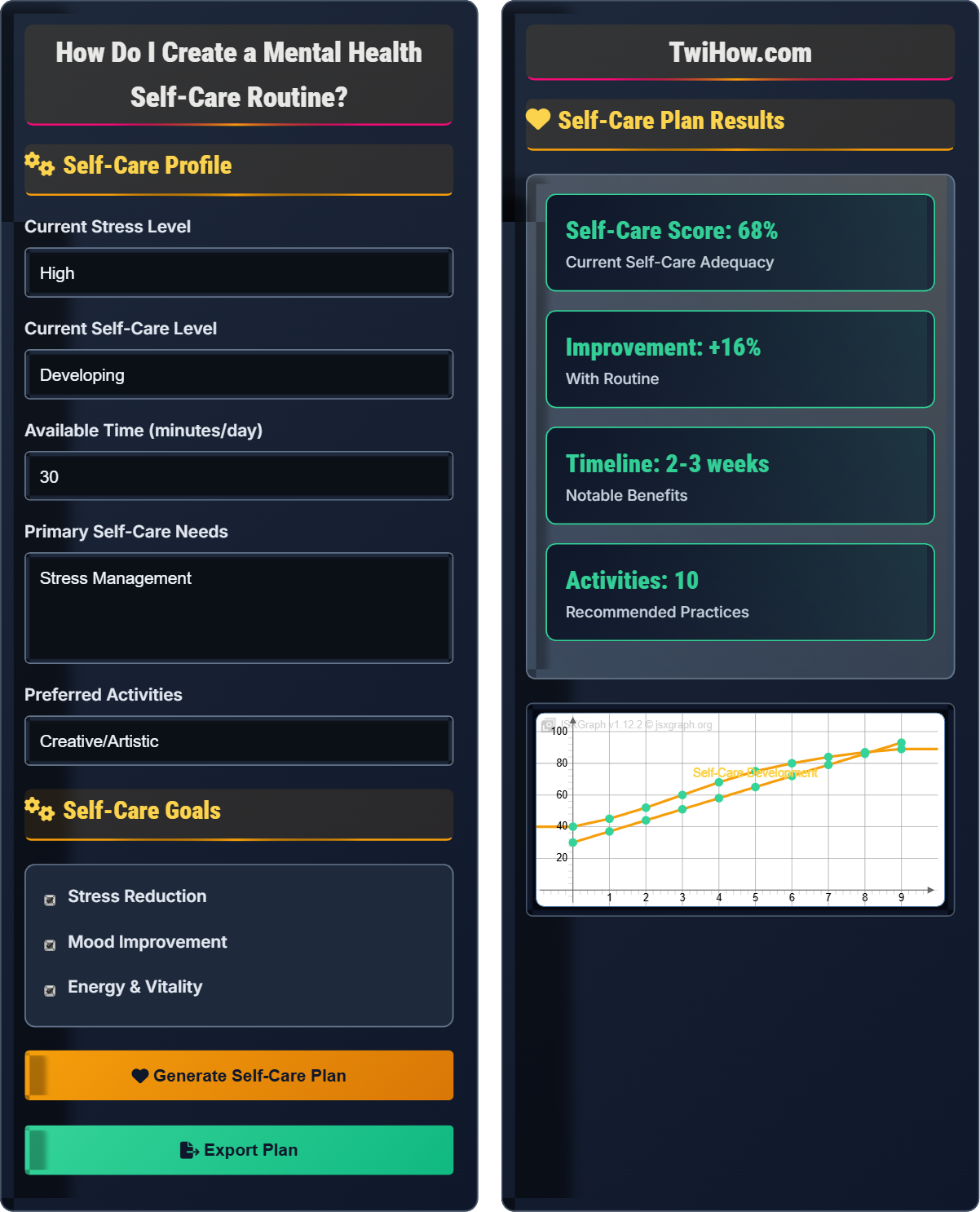
Self-Care Profile
Self-Care Goals
Self-Care Plan Results
| Activity | Duration | Frequency | Benefit |
|---|---|---|---|
| Mindful Breathing | 5 min | Daily | Stress Reduction |
| Gratitude Journal | 10 min | Daily | Mood Enhancement |
| Physical Exercise | 20 min | 3x/week | Energy Boost |
| Quality Sleep | 8 hours | Nightly | Restoration |
Mental Health Self-Care Development Explained
Mental health self-care is the practice of taking action to preserve or improve your mental health and well-being. It involves conscious, intentional activities that help maintain emotional balance, reduce stress, and promote psychological resilience. Self-care is not a luxury—it's a necessity for maintaining mental health and preventing burnout.
Effective mental health self-care involves recognizing your needs and creating sustainable practices that address them. It's about finding activities that restore your emotional resources and help you cope with life's challenges. The key is personalization and consistency.
Wellness Impact = (Consistency × Personalization × Appropriateness) ÷ (Barriers + Stress Level)
Where:
- Consistency: Regularity of self-care practice
- Personalization: How well activities match your needs
- Appropriateness: Suitability for your current situation
- Barriers: Obstacles to implementing self-care
- Stress Level: Current demands on your resources
Effective mental health self-care includes activities from multiple categories:
- Physical Self-Care: Exercise, nutrition, sleep, medical care
- Emotional Self-Care: Journaling, therapy, emotional expression
- Social Self-Care: Relationships, community, social support
- Spiritual Self-Care: Meditation, nature, meaning-making
- Professional Self-Care: Work-life balance, boundary setting
- Creative Self-Care: Art, music, hobbies, creative expression
- Start Small: Begin with short, simple activities
- Be Consistent: Regular practice is more important than perfection
- Stay Flexible: Adjust your routine based on changing needs
- Track Progress: Monitor how activities affect your mental health
- Seek Support: Involve others in your self-care journey
- Practice Self-Compassion: Be kind to yourself when you miss activities
Self-Care Fundamentals
Mental health self-care, wellness, emotional regulation, stress management, self-compassion, resilience.
Self-Care Impact = (Personalization + Consistency + Appropriateness) ÷ (Barriers + Stress)
Where Self-Care Impact indicates wellness improvement, components are weighted by research evidence.
- Self-care is not selfish
- Consistency beats perfection
- Personalization is key
Applications
Stress management, burnout prevention, mood regulation, relationship maintenance, work-life balance.
- Assess current needs and stress levels
- Identify suitable activities
- Integrate into daily routine
- Monitor and adjust regularly
- Change takes time and practice
- Progress is not linear
- Professional help available
- Self-compassion is crucial
Self-Care Learning Quiz
Which of the following is a common myth about mental health self-care?
The myth is that self-care is selfish and takes time away from others. In reality, self-care is essential for maintaining your ability to care for others effectively. When you're well-rested and emotionally balanced, you can provide better support to those around you. Self-care is not about neglecting others but about maintaining your capacity to help them.
The answer is B) Self-care is selfish and takes time away from others.
This myth is particularly harmful because it prevents people from engaging in self-care. The airplane oxygen mask analogy is apt: you must put on your own mask first before helping others. Self-care is not a luxury but a necessity for maintaining your ability to function effectively and support others.
Self-Care: Actions to maintain mental health
Myth: False belief about self-care
Essential: Necessary for well-being
• Self-care enables helping others
• Not selfish, but necessary
• Improves capacity to serve
• Reframe self-care as self-responsibility
• Remember the oxygen mask principle
• Explain benefits to others
• Believing self-care is selfish
• Not prioritizing personal needs
• Feeling guilty about self-care
Explain the different categories of mental health self-care and provide examples of activities for each category.
Different Categories of Mental Health Self-Care:
1. Physical Self-Care: Activities that maintain and improve physical health, which directly impacts mental health.
Examples: Regular exercise, adequate sleep, nutritious eating, medical check-ups, stretching, yoga, walking in nature.
2. Emotional Self-Care: Practices that help you process, express, and regulate emotions.
Examples: Journaling, therapy, meditation, deep breathing, crying when needed, creative expression, talking to trusted friends.
3. Social Self-Care: Activities that maintain and strengthen social connections.
Examples: Spending time with loved ones, joining clubs or groups, volunteering, setting healthy boundaries, practicing communication skills.
4. Spiritual Self-Care: Practices that provide meaning, purpose, and connection to something greater.
Examples: Meditation, prayer, spending time in nature, reading inspirational literature, practicing gratitude, mindfulness.
5. Professional Self-Care: Activities that maintain work-life balance and prevent burnout.
Examples: Setting work boundaries, taking breaks, delegating tasks, pursuing professional development, saying no to extra responsibilities.
6. Creative Self-Care: Activities that engage your creative spirit and provide joy.
Examples: Art, music, writing, crafting, cooking, photography, gardening, dancing.
7. Mental Self-Care: Activities that stimulate your mind and maintain cognitive health.
Examples: Reading, puzzles, learning new skills, intellectual discussions, challenging yourself mentally.
Effective Self-Care: A comprehensive self-care routine includes activities from multiple categories, though the specific activities should be personalized to your individual needs, preferences, and lifestyle.
Thinking about self-care in categories helps ensure you're addressing all aspects of your well-being. Different people may need more focus on certain categories based on their current life circumstances and stressors. The key is finding a balance that works for your individual situation and maintaining it consistently.
Physical Self-Care: Activities for physical health
Emotional Self-Care: Activities for emotional regulation
Social Self-Care: Activities for relationship maintenance
• Address multiple categories
• Personalize to your needs
• Maintain balance
• Assess which areas need attention
• Start with one category
• Gradually expand
• Focusing only on physical self-care
• Not addressing emotional needs
• Ignoring social connections
You work long hours, have family responsibilities, and feel like you don't have time for self-care. How can you incorporate mental health self-care into a busy schedule?
Strategies for Self-Care in a Busy Schedule:
1. Micro-Self-Care: Incorporate short self-care activities throughout your day:
• Take 2-3 deep breaths before starting work
• Practice a 5-minute meditation
• Take a 1-minute break to stretch
• Listen to calming music during commutes
• Practice gratitude for 30 seconds before bed
2. Integrated Self-Care: Combine self-care with existing activities:
• Listen to podcasts while commuting
• Practice mindfulness while doing household chores
• Take walking meetings
• Include family in self-care activities (nature walks, cooking together)
3. Time-Block Self-Care: Schedule self-care like important appointments:
• Block 10 minutes for morning meditation
• Schedule a weekly "me time" appointment
• Protect your sleep schedule
4. Quality Over Quantity: Focus on activities that provide maximum benefit in minimum time:
• Identify your most effective self-care activities
• Prioritize high-impact, short-duration activities
• Be consistent with what you do have time for
5. Delegate and Boundaries: Create more time for self-care:
• Ask family members to help with responsibilities
• Say no to non-essential commitments
• Outsource tasks when possible
6. Family Integration: Involve family in your self-care:
• Exercise with family members
• Practice mindfulness together
• Create family self-care traditions
7. Morning or Evening Routines: Build self-care into your daily routine:
• Start with 5 minutes of intention-setting
• End with 5 minutes of reflection
• Create a consistent bedtime routine
Remember: Self-care is not optional—it's essential for maintaining your ability to function effectively and care for others. Even small, consistent activities can make a significant difference in your mental health and well-being.
This approach shows that self-care doesn't require large time blocks. The key is finding small, consistent moments that can be integrated into existing routines. The goal is to make self-care sustainable rather than perfect. Even 5-10 minutes of intentional self-care can have significant benefits when practiced consistently.
Micro-Self-Care: Short self-care activities
Integrated Self-Care: Self-care combined with other activities
Time-Blocking: Scheduling self-care
• Consistency over duration
• Quality over quantity
• Integrate into existing routines
• Start with 5-minute activities
• Use commute time
• Make it routine
• Waiting for perfect time
• Thinking self-care needs to be long
• Not scheduling it
You're experiencing high levels of stress at work and home, and your usual coping mechanisms aren't working as well. How should you adapt your self-care routine to better manage stress?
Adapting Self-Care for High Stress:
1. Increase Frequency of Stress-Relief Activities:
• Practice deep breathing exercises every 2-3 hours
• Take brief walking breaks throughout the day
• Use progressive muscle relaxation techniques
• Practice mindfulness for 2-3 minutes multiple times daily
2. Add Physical Stress-Release Activities:
• Engage in physical exercise to release tension
• Practice yoga or stretching
• Use physical activities like cleaning or gardening as stress relief
3. Prioritize Sleep Hygiene:
• Maintain consistent sleep schedule
• Create relaxing bedtime routine
• Avoid screens and stimulants before bed
• Ensure comfortable sleep environment
4. Increase Social Support:
• Reach out to trusted friends or family more frequently
• Consider joining support groups
• Don't isolate when stressed
5. Practice Self-Compassion:
• Be kind to yourself during difficult times
• Acknowledge that stress is normal and temporary
• Avoid harsh self-judgment
6. Simplify Other Areas:
• Reduce non-essential commitments
• Lower personal standards temporarily
• Focus on basic self-care needs
7. Add Immediate Stress-Relief Techniques:
• Use the 5-4-3-2-1 grounding technique
• Practice box breathing (4-4-4-4 pattern)
• Listen to calming music or nature sounds
• Hold ice cubes or splash cold water on face
8. Monitor and Adjust:
• Track what self-care activities provide the most relief
• Be flexible and adjust based on effectiveness
• Consider professional support if stress remains unmanageable
Important Considerations:
Duration: High stress may require temporary intensification of self-care
Professional Help: If stress becomes overwhelming, consider therapy or counseling
Root Causes: Address underlying stressors when possible
Patience: Stress management techniques take time to show full effects
Remember that during high-stress periods, you may need more intensive self-care than usual. The goal is to maintain your emotional equilibrium and prevent burnout.
This approach demonstrates that self-care needs to be dynamic and responsive to changing circumstances. Just as you might need more sleep when sick, you may need more intensive self-care during high-stress periods. The key is recognizing when your current routine isn't sufficient and being willing to adapt and increase support.
Stress Management: Techniques to reduce stress
Grounding Techniques: Methods to stay present
Self-Compassion: Kindness during difficult times
• Adapt self-care to current stress levels
• Increase intensity during high stress
• Monitor effectiveness
• Keep a stress log
• Have backup self-care strategies
• Seek support proactively
• Maintaining same routine during high stress
• Not increasing support during stress
• Isolating when stressed
What is the most important factor for maintaining a successful mental health self-care routine?
Consistency is the most important factor for maintaining a successful self-care routine. Regular practice, even if imperfect, creates lasting habits and provides cumulative benefits. It's better to do a simple self-care activity consistently than to have an elaborate routine that you can't maintain. Consistency builds momentum and makes self-care a natural part of your routine.
The answer is B) Consistency - Regular practice even if imperfect.
This principle is based on habit formation research, which shows that regular practice is more important than perfection. The goal is to create sustainable practices that can be maintained long-term. Self-compassion is important here—missing a day or not executing perfectly shouldn't derail your entire routine. The key is getting back on track as soon as possible.
Consistency: Regular practice over time
Habit Formation: Creating automatic behaviors
Sustainability: Ability to maintain long-term
• Consistency beats perfection
• Small, regular actions are effective
• Self-compassion during setbacks
• Start with tiny, achievable steps
• Track your consistency
• Be flexible with timing
• Aiming for perfection
• Not starting small enough
• Giving up after missing a day
FAQ
Q: How can I practice self-care when I barely have time for myself?
A: Self-care doesn't have to be time-intensive. Here are practical strategies for busy parents:
Micro-Self-Care: Take advantage of small moments throughout the day:
• Breathe deeply while waiting for the coffee to brew
• Practice gratitude while driving
• Stretch for 30 seconds before getting out of bed
• Take a few minutes to savor your morning coffee
Integrated Self-Care: Combine self-care with existing activities:
• Listen to podcasts while doing household tasks
• Practice mindfulness while washing dishes
• Take walking breaks while children play
Steal Time: Find unexpected moments:
• Stay in the car for 5 minutes after dropping kids off
• Take a shower or bath before bed (not just for cleaning)
• Wake up 10 minutes earlier for quiet time
Family Integration: Include children in self-care:
• Exercise together as a family
• Practice mindfulness during bedtime stories
• Cook together as a bonding activity
Weekend Planning: Schedule self-care:
• Trade childcare with another parent
• Ask your partner for dedicated time
• Plan self-care activities that also benefit the family
Remember: Even 5 minutes of intentional self-care is better than none. The goal is to maintain your emotional resources so you can be present for your family.
Q: What's the difference between self-care and just relaxing or having fun?
A: While there's overlap, self-care and relaxation/fun serve different purposes:
Self-Care: Intentional activities aimed at maintaining or improving mental health and well-being. It's about meeting specific needs (emotional, physical, social, etc.) and often involves activities that might not feel immediately fun but are beneficial long-term.
Relaxation/Fun: Activities primarily intended to provide immediate pleasure, enjoyment, or entertainment.
Key Differences:
Purpose: Self-care is about maintaining health and preventing problems; relaxation is about immediate enjoyment.
Selection: Self-care is chosen based on your current needs; fun is chosen based on preference.
Timing: Self-care should be consistent; relaxation is more spontaneous.
Examples:
Self-Care: Going to bed early when tired (even if you'd rather stay up), talking to a friend when you're lonely, meditating to manage anxiety, exercising when you're stressed.
Relaxation/Fun: Watching TV, playing games, going out with friends for entertainment, reading fiction for pleasure.
Integration: The best approach combines both. You need activities that are fun and relaxing, but you also need intentional self-care to maintain your mental health. Self-care can become enjoyable over time as you see its benefits.
Balance: Both are important. Self-care maintains your emotional health; relaxation and fun provide joy and break from stress.