How Do I Find an Affordable Therapist or Counselor?
Complete therapy access guide • Step-by-step explanations
Affordable Therapy Access:
Show Therapy FinderFinding affordable therapy requires exploring multiple options including sliding-scale fees, insurance coverage, community mental health centers, and teletherapy platforms. The average cost of therapy ranges from $65-250 per session, but there are many ways to access quality care within your budget.
Accessing affordable therapy involves researching various funding sources, understanding insurance benefits, and utilizing community resources. Many therapists offer reduced rates based on income, and community health centers provide services regardless of ability to pay.
Key affordable options include:
- Sliding Scale Therapy: Fees based on income and household size
- Community Mental Health Centers: Federally funded facilities offering low-cost services
- University Clinics: Supervised services by graduate students at reduced rates
- Teletherapy Platforms: Online therapy often at lower costs
With proper research and planning, quality mental health care is accessible to people at various income levels.
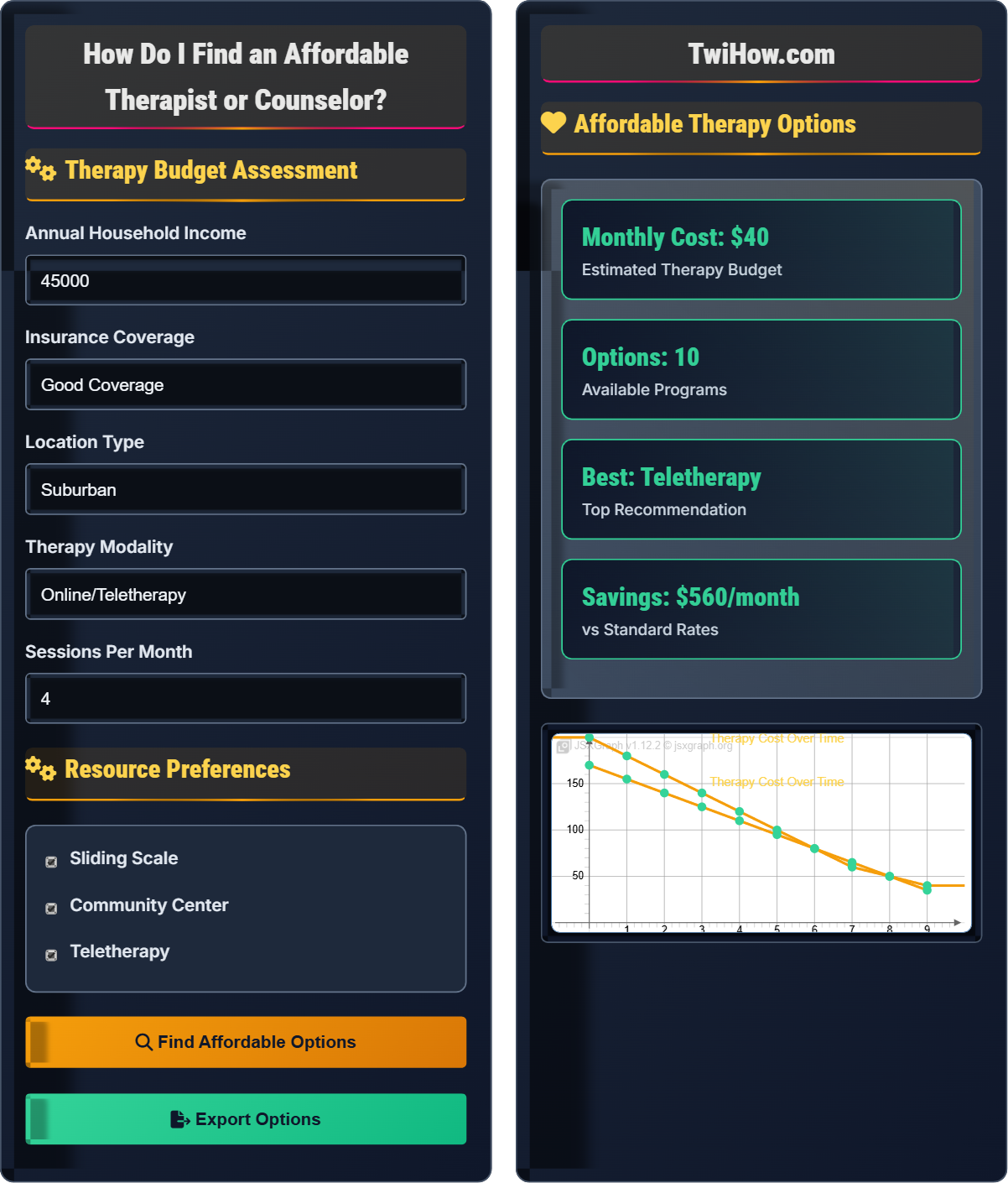
Therapy Budget Assessment
Resource Preferences
Affordable Therapy Options
| Option | Cost | Availability | Features |
|---|---|---|---|
| Sliding Scale Private | $40-80/session | High | Flexible, licensed |
| Community Center | $10-30/session | High | Income-based |
| University Clinic | $15-50/session | Medium | Supervised care |
| Teletherapy | $30-70/session | Very High | Online convenience |
Finding Affordable Therapy Explained
Affordable therapy refers to mental health services offered at reduced costs through various funding mechanisms. This includes sliding-scale fees based on income, insurance-covered services, community health centers, and training clinics. The goal is to make quality mental health care accessible regardless of financial situation.
Therapy costs can vary significantly, from $10-20 per session at community centers to $200+ per session with private practitioners. Understanding the different funding sources and service delivery models helps individuals find appropriate care within their budget.
Affordable Therapy Cost = Base Rate - (Insurance Coverage + Sliding Scale Adjustment + Community Discount)
Where:
- Base Rate: Standard therapy fee ($100-200/session)
- Insurance Coverage: Amount covered by insurance plan
- Sliding Scale Adjustment: Income-based fee reduction
- Community Discount: Reduction for community/federally funded services
Various options make therapy more accessible:
- Sliding Scale: Fees adjusted based on income and household size
- Community Mental Health Centers: Federally funded centers with income-based pricing
- University Training Clinics: Supervised services by graduate students
- Insurance Coverage: In-network providers with copayments
- Teletherapy Platforms: Online services often at reduced rates
- Group Therapy: Multiple clients, shared costs
- Employee Assistance Programs: Employer-sponsored counseling
- Religious Organizations: Faith-based counseling services
- Licensed Professionals: Ensure providers are properly licensed and credentialed
- Specialization: Match therapist expertise to your specific needs
- Accessibility: Convenient location and scheduling options
- Continuity: Ability to maintain consistent care over time
- Effectiveness: Evidence-based approaches and good therapeutic relationship
- Confidentiality: Proper privacy protections and HIPAA compliance
Therapy Access Fundamentals
Sliding scale, insurance coverage, community mental health, teletherapy, therapy costs, accessibility.
Affordable Cost = Standard Fee - (Insurance × 0.8) - (Income Adjustment × 0.6) - (Community Discount × 0.7)
Where Affordable Cost indicates accessible therapy price, components are weighted by effectiveness.
- Shop around for best rates
- Check insurance benefits first
- Don't sacrifice quality for cost
Applications
Insurance verification, sliding scale applications, community center registration, teletherapy platform selection.
- Assess financial capacity
- Research available options
- Verify credentials and quality
- Initiate contact and scheduling
- Quality should not be compromised
- Accessibility varies by location
- Wait times may be longer
- Continuity of care is important
Therapy Access Learning Quiz
What is a sliding scale fee structure in therapy?
A sliding scale fee structure bases therapy costs on the client's income and household size. This allows therapists to serve clients who couldn't otherwise afford their standard rates. The fee decreases as income decreases, making therapy accessible across different economic situations.
The answer is B) Fees based on the client's income and household size.
Sliding scale fees represent one of the most important mechanisms for making therapy accessible. Rather than charging a flat rate, therapists adjust their fees based on the client's ability to pay. This system allows middle and lower-income individuals to access quality mental health care while still enabling therapists to maintain their practice.
Sliding Scale: Income-based fee adjustment system
Fee Structure: Pricing model for services
Accessibility: Ability to obtain services
• Based on income verification
• Varies by provider
• Maintains quality of care
• Ask about sliding scale upfront
• Provide documentation if requested
• Compare multiple providers
• Not asking about sliding scale
• Assuming all therapists offer it
• Not comparing options
Explain how to maximize insurance benefits for mental health coverage and what key terms to understand when reviewing your policy.
Maximizing Insurance Benefits:
1. Review Your Policy: Carefully read your mental health benefits section. Look for specific coverage details, limits, and requirements.
2. Understand Key Terms:
Out-of-Pocket Maximum: The most you'll pay annually before insurance covers 100% of covered services.
Deductible: The amount you pay before insurance begins covering services.
Copayment (Copay): Fixed amount you pay per visit (e.g., $25/session).
Coincidence: Percentage of costs you pay after meeting deductible (e.g., you pay 20%).
Authorization: Pre-approval required for certain services or extended treatment.
3. Find In-Network Providers: Search your insurance directory for mental health professionals. These providers have contracted rates with your insurer.
4. Prior Authorization: Some insurers require pre-approval for therapy sessions. Contact your insurer to understand the process.
5. Out-of-Network Benefits: Some policies cover out-of-network providers at a reduced rate. Calculate if this is more cost-effective than paying cash.
6. Employee Assistance Programs (EAP): Many employers offer free or low-cost counseling sessions separate from insurance.
7. Mental Health Parity: Federal law requires equal coverage for mental and physical health, though implementation varies.
Always contact your insurance company directly to verify benefits before starting therapy.
Understanding insurance terminology is crucial for maximizing mental health benefits. Many people avoid therapy because they don't understand their coverage. Insurance companies often have complex benefit structures, and small differences in policies can significantly impact out-of-pocket costs. Taking time to understand your specific benefits can save hundreds of dollars.
Copayment: Fixed amount paid per service
Deductible: Amount paid before insurance coverage begins
Out-of-Network: Providers not contracted with insurance
• Verify benefits before starting therapy
• Check in-network provider lists
• Understand authorization requirements
• Call insurance directly
• Keep benefit documentation
• Ask about prior authorization
• Not verifying benefits
• Assuming all therapy is covered
• Not understanding prior auth
Emma earns $3,500 per month after taxes and wants to spend no more than 5% of her income on therapy. She needs weekly sessions. What is the maximum she can afford per session, and what options should she explore to stay within budget?
Calculation:
Monthly Income: $3,500
Budget for Therapy (5%): $3,500 × 0.05 = $175/month
Weekly Sessions: 4 sessions per month
Maximum per Session: $175 ÷ 4 = $43.75/session
Recommended Options:
1. Sliding Scale Private Practice: Look for therapists offering sliding scale fees of $40-60/session based on income.
2. Community Mental Health Center: Federally qualified health centers often charge $10-30/session based on income.
3. University Training Clinic: Graduate student therapists supervised by licensed professionals, typically $15-40/session.
4. Teletherapy Platform: Online therapy services often offer subscription models or sliding scale options.
5. Insurance Verification: Check if insurance covers mental health with low copays ($10-30/session).
6. Employee Assistance Program: Many employers offer free sessions separate from insurance.
Emma should contact multiple providers to discuss sliding scale options and compare services. She may also consider group therapy as a supplement to individual sessions to stretch her budget further.
This example demonstrates the importance of budget planning for therapy. Many people underestimate the cost of regular therapy sessions and become discouraged. By calculating a realistic budget and exploring multiple options, individuals can find affordable care that meets their needs. The key is to research multiple pathways rather than limiting oneself to one option.
Sliding Scale: Income-based fee adjustment
Training Clinic: Supervised student servicesCommunity Center: Federally funded health facility
• Budget 5-10% of income for therapy
• Research multiple options
• Don't sacrifice quality for cost
• Calculate per-session budget
• Explore multiple pathways
• Consider group therapy
• Not budgeting for therapy
• Assuming only expensive options
• Not researching alternatives
David is choosing between a $200/session private therapist with excellent reviews and a $40/session sliding scale therapist with average reviews. Both are licensed and specialize in his needs. How should he evaluate these options?
Evaluation Criteria:
1. Financial Sustainability: Calculate long-term affordability. The private therapist costs $800/month for weekly sessions, while the sliding scale option costs $160/month.
2. Therapeutic Relationship: The most important factor in therapy effectiveness is the rapport between client and therapist. Sometimes a lower-cost therapist can provide excellent care.
3. Credentials and Specialization: Both are licensed and specialize in his needs, so this factor is equal.
4. Accessibility and Availability: Lower-cost options may have longer wait times or less flexible scheduling.
5. Insurance Coverage: Check if either option is covered by insurance.
6. Trial Period: Many therapists offer initial consultations to assess compatibility.
Recommendation:
Start with the sliding scale therapist if budget is a concern. The quality of the therapeutic relationship often matters more than the therapist's reputation. David can always transition to a different provider later if needed.
Alternative Approach: Consider the private therapist for 3-4 sessions to establish direction, then transition to sliding scale for ongoing care, or alternate between both based on budget.
Research shows that therapy effectiveness correlates more with the therapeutic alliance than with the therapist's reputation or cost.
This scenario highlights the balance between cost and quality in therapy selection. The therapeutic relationship is often more important than the therapist's reputation or cost. A good fit between client and therapist can be found at various price points. The key is to start somewhere and adjust as needed rather than avoiding therapy due to cost concerns.
Therapeutic Alliance: Relationship between client and therapist
Therapeutic Relationship: Collaborative bond in therapy
Effectiveness: Achieving therapy goals
• Therapeutic relationship is key
• Quality exists at all price points
• Budget sustainability matters
• Start with affordable option
• Assess therapeutic fit
• Transition if needed
• Equating cost with quality
• Not considering therapeutic fit
• Ignoring budget sustainability
Which of the following is NOT typically a benefit of teletherapy compared to in-person therapy?
Teletherapy does not typically provide more personal attention from the therapist compared to in-person therapy. The level of personal attention depends on the therapist's approach and the therapeutic relationship, not the modality. Teletherapy offers benefits like lower costs, greater convenience, and proven effectiveness for many conditions, but the quality of attention remains similar to in-person sessions.
The answer is D) More personal attention from therapist.
Teletherapy has become increasingly popular and effective, especially since the COVID-19 pandemic. It offers significant cost and convenience advantages while maintaining therapeutic effectiveness for most conditions. However, the personal connection and attention in therapy depend on the therapist's skills and the client's engagement, not the delivery method. Both modalities can provide equally meaningful therapeutic experiences.
Teletherapy: Online therapy sessions
Effectiveness: Achievement of therapy goals
Modality: Method of service delivery
• Teletherapy is equally effective
• Cost is typically lower
• Convenience is greater
• Try teletherapy for convenience
• Ensure good internet connection
• Choose quiet private space
• Assuming teletherapy is less effective
• Not preparing proper environment
• Underestimating convenience benefits
FAQ
Q: Is therapy really worth the money if I can't afford the standard rates?
A: Absolutely, therapy can be incredibly valuable even if you need to seek affordable options:
Return on Investment: The skills, insights, and coping strategies gained in therapy can improve your life for years. Many people find that addressing mental health concerns helps them be more productive, maintain better relationships, and make better decisions.
Cost of Not Getting Help: Untreated mental health issues can lead to lost productivity, relationship problems, physical health issues, and other costs that far exceed therapy expenses.
Accessible Options Exist: As mentioned in this guide, there are many affordable therapy options that maintain quality care:
• Community mental health centers often charge based on income
• University training clinics offer supervised services at low cost
• Sliding scale private practices adjust fees based on ability to pay
• Teletherapy platforms often cost less than in-person sessions
Quality Over Cost: A competent therapist at a lower cost can be more beneficial than an expensive one with whom you don't connect well. The therapeutic relationship is more important than the price tag.
The key is finding an approach that's financially sustainable for you while meeting your therapeutic needs.
Q: How do I know if a low-cost therapist is still qualified and effective?
A: You can verify the qualifications of low-cost therapists through several methods:
1. License Verification: Check your state's licensing board website to confirm their credentials are active and in good standing.
2. Educational Background: Look up their educational institutions and training programs to ensure they're accredited.
3. Professional Associations: Check if they belong to professional organizations like APA, NASW, or ACA.
4. Training Clinics: University clinics have licensed supervisors overseeing student therapists.
5. Community Centers: Federally qualified health centers employ licensed professionals.
Quality Indicators:
• Proper credentials and licenses displayed on their website or provided upon request
• Professional memberships in relevant associations
• Clear therapeutic approach and treatment philosophy
• Appropriate supervision if they're in training
Effectiveness vs. Cost: Research shows that therapy effectiveness is more related to the therapeutic relationship and the therapist's competence than their fee structure. Many excellent therapists offer sliding scale fees because they believe in accessible mental health care.
Initial Consultation: Most therapists offer brief consultations to assess compatibility and answer questions about their qualifications.