How Do I Manage Perfectionism and Self-Criticism?
Complete self-compassion guide • Step-by-step explanations
Managing Perfectionism & Self-Criticism:
Show Self-Compassion BuilderManaging perfectionism and self-criticism involves developing self-compassion, challenging unrealistic standards, and learning to accept imperfection as part of the human experience. This process includes recognizing perfectionist thinking patterns, practicing self-kindness, and cultivating a growth mindset.
Healthy perfectionism management works by replacing self-criticism with self-compassion, setting realistic goals, and embracing mistakes as learning opportunities. The goal is not to eliminate ambition but to pursue excellence without the harsh self-judgment that undermines well-being and performance.
Key strategies include:
- Self-Compassion: Treating yourself with the same kindness you'd offer a friend
- Cognitive Restructuring: Challenging perfectionist thought patterns
- Realistic Goal Setting: Establishing achievable, flexible standards
- Embracing Imperfection: Viewing mistakes as natural and valuable
- Mindfulness: Observing thoughts and feelings without judgment
With consistent practice and self-compassion, perfectionism and self-criticism can be transformed into healthy motivation and self-acceptance.
Perfectionism Profile
Management Goals
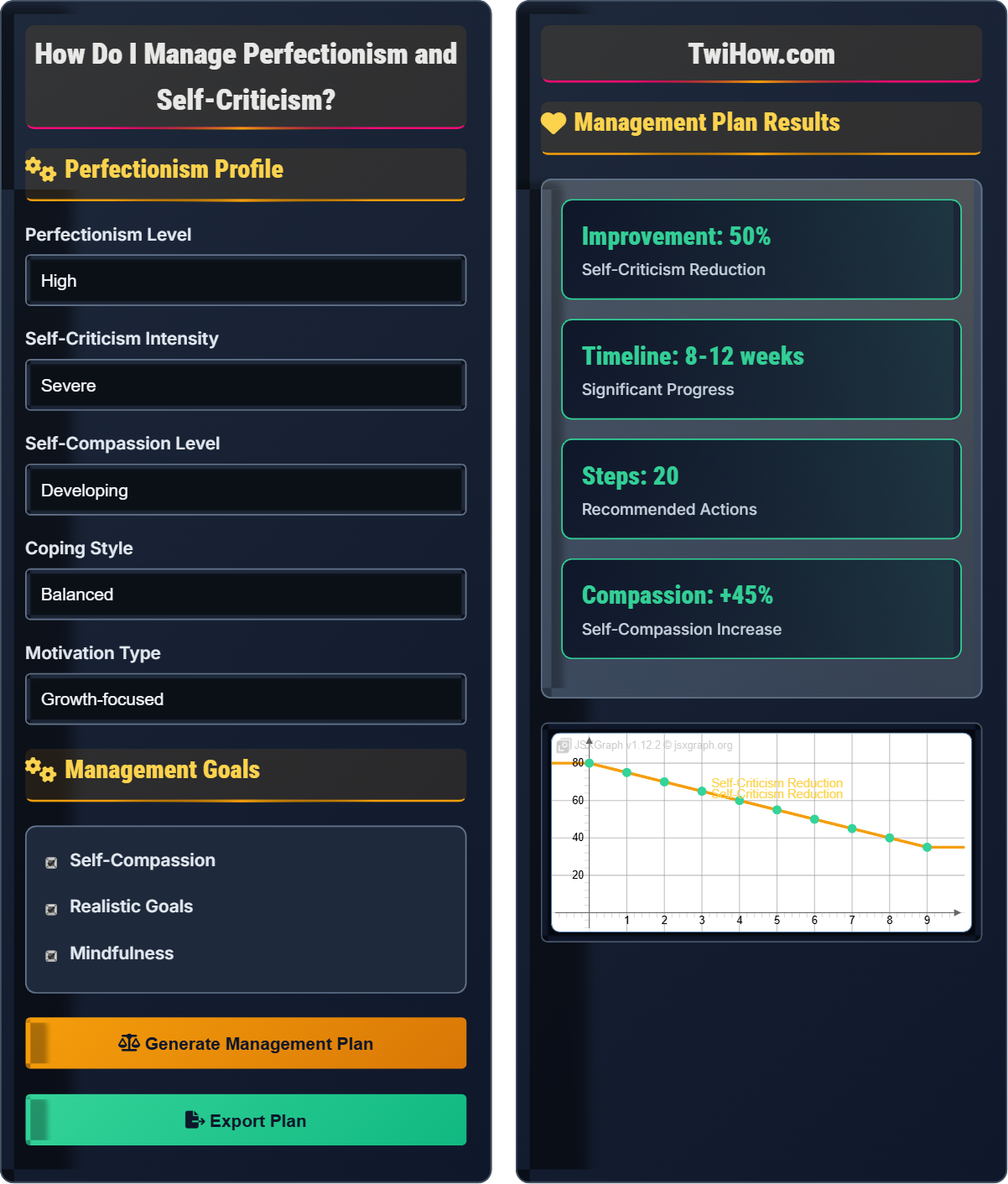
Management Plan Results
| Strategy | Method | Frequency | Difficulty |
|---|---|---|---|
| Self-Compassion | Self-kindness phrases | Daily | Easy |
| Cognitive | Challenge negative thoughts | As needed | Medium |
| Goal Setting | SMART goals | Weekly | Easy |
| Mindfulness | Meditation practice | Daily | Medium |
Managing Perfectionism and Self-Criticism Explained
Perfectionism is the pursuit of flawlessness and setting excessively high performance standards, accompanied by overly critical self-evaluations and concerns regarding others' evaluations. It's important to distinguish between adaptive perfectionism (healthy striving) and maladaptive perfectionism (self-defeating pursuit of perfection).
Self-criticism is the internal dialogue of harsh judgment, blame, and negative self-evaluation. It often manifests as an inner critic that magnifies mistakes, minimizes achievements, and creates unrealistic expectations.
Healthy Performance = (Realistic Standards × Self-Compassion × Growth Mindset) ÷ (Perfectionist Demands + Self-Criticism)
Where:
- Realistic Standards: Achievable, flexible goals
- Self-Compassion: Kindness toward oneself
- Growth Mindset: Belief in learning and development
- Perfectionist Demands: Unrealistic expectations
- Self-Criticism: Harsh internal dialogue
Proven strategies for managing perfectionism and self-criticism include:
- Self-Compassion: Treating yourself with kindness and understanding
- Cognitive Restructuring: Challenging and reframing negative thoughts
- Realistic Goal Setting: Establishing achievable, flexible objectives
- Mindfulness: Observing thoughts and feelings without judgment
- Values-Based Living: Aligning actions with personal values
- Acceptance: Embracing imperfection as part of life
- Embracing Failure: Viewing mistakes as learning opportunities
- Self-Kindness: Speaking to yourself as you would a friend
- All-or-Nothing Thinking: Recognizing extreme thought patterns
- Should Statements: Identifying unrealistic expectations
- Catastrophizing: Challenging worst-case scenarios
- Mind Reading: Avoiding assumptions about others' thoughts
- Discounting Positives: Acknowledging achievements
- Overgeneralization: Not seeing one mistake as a pattern
Perfectionism Management Fundamentals
Perfectionism, self-criticism, self-compassion, cognitive restructuring, growth mindset, acceptance.
Healthy Performance = (Self-Compassion + Realistic Standards) ÷ (Self-Criticism × Perfectionist Demands)
Where Healthy Performance indicates well-being and effectiveness, components are weighted by psychological research.
- Strive for excellence, not perfection
- Embrace mistakes as learning opportunities
- Treat yourself with kindness
Applications
Work performance, academic achievement, relationships, parenting, creative pursuits, personal development.
- Identify perfectionist patterns
- Challenge unrealistic standards
- Practice self-compassion
- Develop growth mindset
- Change takes time and practice
- Progress is not linear
- Professional help available
- Self-compassion is a skill
Perfectionism Management Learning Quiz
What is the key difference between adaptive and maladaptive perfectionism?
The key difference lies in the approach to standards and self-evaluation. Adaptive perfectionism involves setting high standards while maintaining flexibility and self-compassion. Maladaptive perfectionism involves setting unrealistically high standards combined with harsh self-criticism and fear of failure. The former can lead to achievement and satisfaction, while the latter often results in anxiety, depression, and burnout.
The answer is B) Adaptive perfectionism focuses on high standards without self-criticism; maladaptive involves harsh self-judgment.
Understanding this distinction is crucial because it shows that the pursuit of excellence isn't inherently problematic. The issue lies in the relationship with standards and the response to mistakes. Healthy ambition with self-compassion can be motivating, while perfectionism with self-criticism is often paralyzing.
Adaptive Perfectionism: Healthy pursuit of excellence with flexibility
Maladaptive Perfectionism: Self-defeating pursuit of perfection
Self-Criticism: Harsh internal judgment
• High standards aren't the problem
• Self-criticism is the issue
• Flexibility is key
• Focus on process, not just outcomes
• Practice self-kindness
• Embrace learning mindset
• Confusing ambition with perfectionism
• Not distinguishing between types
• Thinking all high standards are harmful
Explain the difference between self-compassion and self-esteem, and why self-compassion may be more beneficial for managing perfectionism.
Difference Between Self-Compassion and Self-Esteem:
Self-Esteem: Involves evaluating yourself positively and feeling better than others. It fluctuates based on success, appearance, or social comparison. Requires feeling superior to others to maintain high self-esteem.
Self-Compassion: Involves treating yourself with kindness and understanding during difficult times, regardless of your circumstances. It remains stable during both successes and failures.
Why Self-Compassion is Better for Managing Perfectionism:
1. Stability: Self-compassion provides consistent emotional support during both successes and failures, while self-esteem fluctuates dramatically with performance.
2. Authenticity: Self-compassion allows acknowledging weaknesses without harsh judgment, promoting genuine self-improvement. Self-esteem often requires denying weaknesses.
3. Less Comparison: Self-compassion doesn't require feeling better than others, reducing competitive and defensive behaviors that fuel perfectionism.
4. Emotional Safety: Creates a secure base for taking risks and learning from mistakes without fear of self-condemnation.
5. Resilience: Provides emotional resources during difficult times when self-esteem typically plummets.
6. Motivation: Self-compassion promotes intrinsic motivation and learning orientation, while self-esteem often creates fear of failure that inhibits learning.
Research shows that self-compassion is associated with greater emotional stability, reduced anxiety and depression, and improved motivation compared to self-esteem, making it particularly effective for managing perfectionism.
This distinction is crucial for understanding why self-compassion is more effective than trying to build self-esteem to combat perfectionism. Self-esteem can actually reinforce perfectionist tendencies by creating a need to maintain a positive self-image, while self-compassion provides unconditional self-acceptance that allows for growth and learning.
Self-Esteem: Evaluation of self-worth
Self-Compassion: Kindness toward self during suffering
Learning Orientation: Focus on growth rather than performance
• Self-compassion is unconditional
• Self-esteem requires comparison
• Self-compassion supports growth
• Focus on kindness over evaluation
• Accept imperfections
• Avoid comparison traps
• Equating compassion with weakness
• Thinking it's self-indulgent
• Confusing with self-pity
Sarah made a mistake on an important project and immediately thought, "I'm so stupid, I'll never succeed at anything, and everyone will think I'm incompetent." How should she apply cognitive restructuring to challenge this perfectionist self-criticism?
Applying Cognitive Restructuring to Sarah's Thoughts:
Step 1: Identify the Thought Pattern: Sarah's thoughts demonstrate several cognitive distortions:
• All-or-nothing thinking: "I'm so stupid" (absolute negative evaluation)
• Catastrophizing: "I'll never succeed at anything" (worst-case scenario)
• Fortune telling: "Everyone will think I'm incompetent" (predicting others' reactions)
• Mind reading: Assuming others' thoughts without evidence
Step 2: Challenge the Thoughts:
Reality Check: "Is making one mistake equivalent to being stupid? Have I succeeded at other things?"
Probability: "What evidence do I have that everyone will think I'm incompetent? What's the actual likelihood?"
Alternative Perspective: "What would I say to a friend who made this mistake?"
Contextualization: "Making mistakes is part of learning. What can I learn from this?"
Step 3: Replace with Balanced Thoughts:
Instead of: "I'm so stupid, I'll never succeed at anything"
Try: "I made a mistake on this project. I'm competent at many things, and this one error doesn't define my abilities."
Instead of: "Everyone will think I'm incompetent"
Try: "Some people might notice this mistake, but most people understand that everyone makes errors. I can learn from this and improve."
Step 4: Practice Self-Compassion: Acknowledge the difficulty of making mistakes while treating herself with kindness: "This is disappointing, but it's part of being human. I can handle this and grow from it."
Benefits: This approach reduces self-criticism, provides more realistic perspective, and creates space for learning from the mistake rather than being paralyzed by shame.
This example demonstrates how cognitive restructuring transforms destructive self-criticism into constructive self-reflection. The key is identifying distorted thinking patterns and replacing them with more balanced, realistic thoughts. This process takes practice but becomes more natural over time, helping to break the cycle of perfectionism and self-criticism.
Cognitive Restructuring: Challenging and changing thought patterns
Cognitive Distortion: Irrational thought pattern
Self-Compassion: Kindness during difficulty
• Identify distorted thinking patterns
• Challenge thoughts with evidence
• Replace with balanced perspectives
• Keep thought records
• Practice regularly
• Be patient with the process
• Trying to eliminate all negative thoughts
• Not practicing consistently
• Expecting immediate results
Michael is a perfectionist who avoids taking on new challenges because he fears failing and looking incompetent. How can he develop a growth mindset to overcome this fear and embrace learning opportunities?
Developing Growth Mindset for Michael:
1. Reframe Failure: Instead of viewing failure as evidence of incompetence, see it as valuable feedback and learning opportunity. "Failure is information that helps me improve."
2. Focus on Process Over Outcome: Emphasize effort, strategy, and learning rather than just results. "What did I learn from this attempt?" rather than "Did I succeed?"
3. Embrace Challenges: View challenges as opportunities to grow rather than threats to competence. "This challenge will help me develop new skills."
4. Learn from Others: See others' success as inspiration rather than competition. "I can learn from their strategies and approaches."
5. Practice Self-Compassion: Treat mistakes with kindness rather than harsh judgment. "Making mistakes is part of learning. I can handle this and grow from it."
6. Set Learning Goals: Focus on developing competence rather than proving it. "I want to learn X" rather than "I want to show I'm good at X."
Implementation Strategies:
Start Small: Begin with low-stakes challenges to build confidence in handling mistakes.
Track Learning: Keep a learning journal documenting what you've gained from attempts, regardless of outcome.
Reframe Language: Change "I failed" to "I learned" or "I discovered what doesn't work."
Seek Feedback: Actively ask for constructive feedback to improve rather than avoiding it.
Study Growth Examples: Learn about successful people who failed repeatedly before succeeding.
Practice Self-Compassion: When mistakes happen, use self-kindness phrases like "Everyone makes mistakes" or "This is part of learning."
Gradual Exposure: Systematically increase the difficulty of challenges as confidence grows.
Important Note: Developing a growth mindset takes time and consistent practice. The goal is not to eliminate all fear of failure but to reduce its power to prevent growth and learning.
This approach addresses the core fear driving perfectionism: the belief that mistakes indicate fundamental flaws. A growth mindset reframes mistakes as natural and valuable parts of learning, reducing the fear that drives perfectionist behaviors. The key is gradual practice and consistent application of new thought patterns.
Growth Mindset: Belief that abilities can be developed
Fixed Mindset: Belief that abilities are static
Learning Orientation: Focus on skill development
• Mistakes are learning opportunities
• Abilities can be developed
• Focus on process, not just outcomes
• Start with small challenges
• Track learning progress
• Reframe failure as feedback
• Expecting immediate mindset change
• Not practicing consistently
• Still avoiding challenges
Research has consistently shown that self-compassion is associated with which of the following outcomes compared to self-criticism?
Extensive research by Dr. Kristin Neff and others has consistently shown that self-compassion is associated with greater emotional resilience, reduced anxiety and depression, improved motivation, and better performance outcomes. Rather than reducing motivation, self-compassion actually enhances it by creating a safe emotional base for growth and learning from mistakes.
The answer is B) Greater resilience and motivation.
One common misconception is that self-compassion will reduce motivation or make people lazy. However, research shows the opposite is true. When people aren't paralyzed by fear of failure or self-criticism, they're more willing to take risks, learn from mistakes, and persist toward goals. Self-compassion creates a growth-oriented mindset that enhances performance rather than diminishing it.
Emotional Resilience: Ability to recover from setbacks
Growth Mindset: Belief in ability to develop
Emotional Safety: Secure base for risk-taking
• Self-compassion increases motivation
• Enhances emotional resilience
• Improves performance outcomes
• Self-compassion isn't self-indulgent
• It supports growth and learning
• Creates emotional safety
• Thinking it reduces motivation
• Confusing with self-pity
• Believing it's selfish
FAQ
Q: Won't being self-compassionate make me lazy and reduce my motivation to achieve?
A: Actually, research consistently shows the opposite:
Self-Compassion Increases Motivation: When you're not paralyzed by fear of failure or self-criticism, you're more willing to take risks, try new things, and persist through challenges.
Safe Learning Environment: Self-compassion creates emotional safety that allows you to acknowledge mistakes and learn from them without harsh self-judgment.
Growth Mindset: Rather than avoiding challenges to protect self-esteem, self-compassion supports a growth mindset that embraces learning opportunities.
Resilience: Self-compassionate people bounce back from setbacks more quickly and are more likely to try again.
Healthy Standards: Self-compassion doesn't mean lowering standards—it means pursuing them from a place of self-care rather than self-criticism.
Studies show that self-compassionate people actually have higher personal standards and are more likely to take responsibility for their actions while maintaining emotional well-being.
Consider this: athletes perform better when coaches provide constructive feedback with encouragement rather than harsh criticism. The same applies to our inner dialogue.
Q: How is self-compassion different from self-pity or self-indulgence?
A: These are important distinctions:
Self-Pity: Focuses on feeling sorry for yourself, often with a sense of "poor me" and victim mentality. It involves exaggerating problems and isolating yourself from others.
Self-Indulgence: Giving in to every desire or avoiding necessary responsibilities to feel better temporarily. It's about immediate gratification without considering long-term consequences.
Self-Compassion: Offers balanced awareness and kindness. It acknowledges suffering without exaggerating it, recognizes that suffering is part of the human experience, and motivates positive change from a place of care rather than criticism.
Key Differences:
Isolation vs. Connection: Self-pity isolates; self-compassion connects you to common humanity.
Present-Moment Awareness: Self-compassion involves mindful acknowledgment of current experience without getting lost in negative stories.
Responsibility: Self-compassion includes taking appropriate responsibility while being kind to yourself about mistakes.
Motivation: Self-pity and self-indulgence often lead to inaction; self-compassion motivates healthy change.
Self-compassion is about emotional balance and wise self-care, not avoidance or excessive self-focus.