How Do I Practice Self-Compassion When I'm Struggling?
Complete self-compassion guide • Step-by-step explanations
Self-Compassion Fundamentals:
Show Self-Compassion CoachSelf-compassion is the practice of treating yourself with the same kindness and understanding you would offer to a good friend during difficult times. It involves three core components: mindfulness (awareness of your current experience), self-kindness (being warm and supportive toward yourself), and common humanity (recognizing that suffering is part of the shared human experience).
Self-compassion works by creating emotional resilience and reducing self-criticism, which helps regulate emotions and promotes psychological well-being. Rather than harsh self-judgment, self-compassion offers a gentler approach to handling failure, imperfection, and life challenges.
Key self-compassion components:
- Mindfulness: Acknowledging and accepting your current emotional state
- Self-Kindness: Offering warmth and support to yourself
- Common Humanity: Recognizing that suffering is universal
- Emotional Regulation: Balancing emotional responses
Modern self-compassion practice combines ancient wisdom traditions with evidence-based psychological techniques, offering a sustainable approach to emotional well-being.
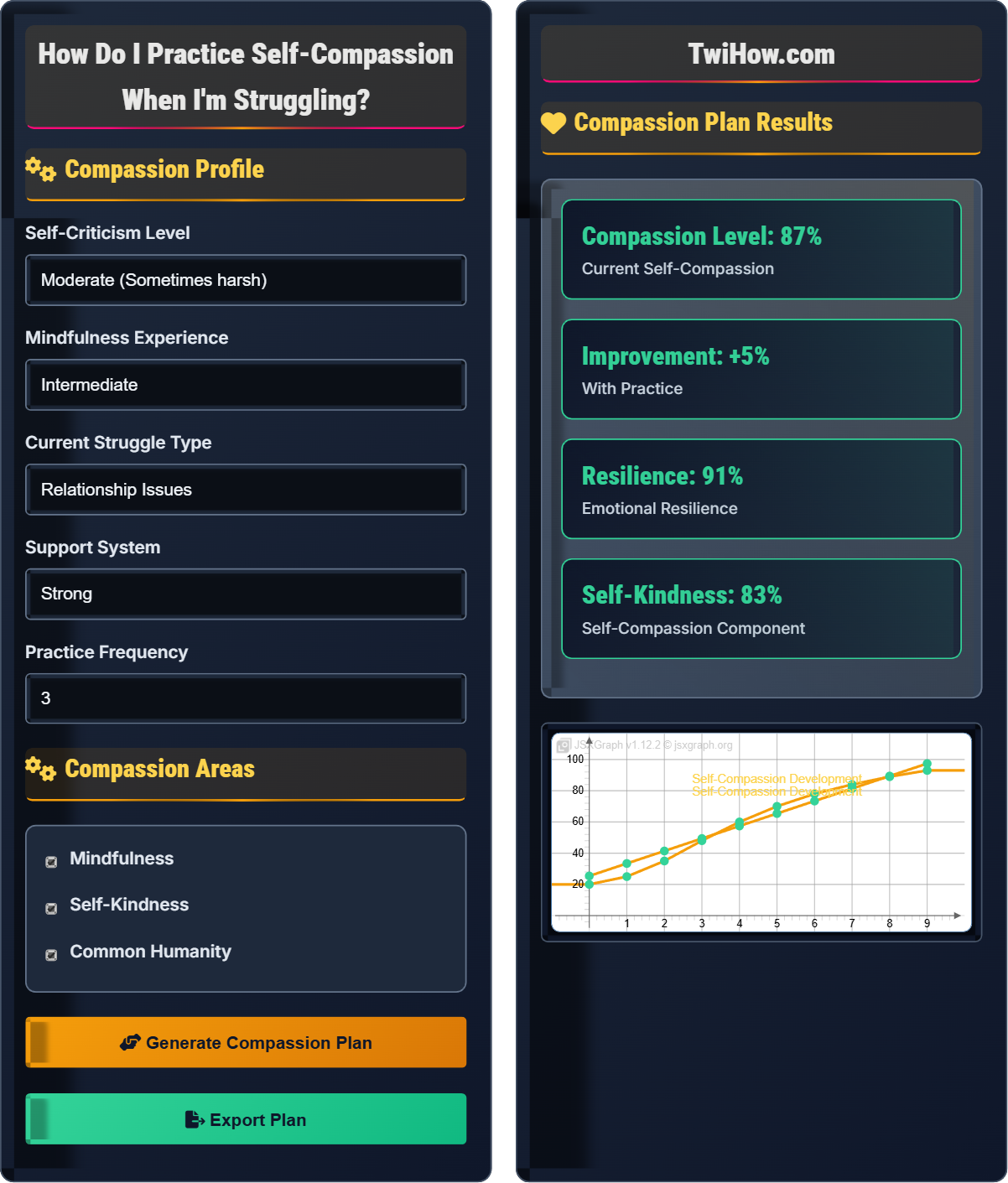
Compassion Profile
Compassion Areas
Compassion Plan Results
| Practice | Technique | Frequency | Benefit |
|---|---|---|---|
| Mindful Breathing | Focus on breath during distress | Daily | Calms nervous system |
| Self-Kindness Phrases | "May I be kind to myself" | As needed | Reduces self-criticism |
| Common Humanity Reminder | As needed | Reduces isolation | |
| Body Scan | Notice physical sensations | 3x/week | Increases awareness |
Self-Compassion Practice Explained
Self-compassion is the practice of extending compassion to oneself in instances of perceived inadequacy, failure, or general suffering. Developed by Dr. Kristin Neff, it involves treating yourself with the same kindness and understanding you would offer to a good friend during difficult times.
Self-compassion differs from self-esteem, which involves evaluating yourself positively. Instead, self-compassion involves relating to your experience in a caring way regardless of whether you're successful or struggling.
Self-Compassion = (Mindfulness × Self-Kindness × Common Humanity) ÷ (Self-Judgment + Isolation + Over-Identification)
Where:
- Mindfulness: Awareness of present moment experience
- Self-Kindness: Warmth and understanding toward self
- Common Humanity: Recognition of shared human experience
- Self-Judgment: Critical self-evaluation
- Isolation: Feeling alone in struggles
- Over-Identification: Becoming overwhelmed by emotions
Self-compassion consists of three interrelated components:
- Self-Kindness vs. Self-Judgment: Being warm and understanding rather than harshly critical
- Common Humanity vs. Isolation: Recognizing that suffering is part of shared human experience
- Mindfulness vs. Over-Identification: Holding painful thoughts and feelings in balanced awareness
- Emotional Regulation: Better management of difficult emotions
- Resilience: Faster recovery from setbacks
- Reduced Anxiety: Less fear of failure and judgment
- Increased Motivation: Growth mindset and persistence
- Enhanced Well-being: Greater life satisfaction and happiness
- Improved Relationships: Better empathy and connection
Self-Compassion Fundamentals
Self-compassion, mindfulness, self-kindness, common humanity, self-judgment, emotional regulation.
Compassion Level = (Awareness + Kindness + Connection) ÷ (Judgment + Isolation + Over-identification)
Where Compassion Level indicates self-compassion strength, components are weighted by psychological research.
- Be as kind to yourself as to others
- Struggle is part of human experience
- Balance awareness with acceptance
Applications
Emotional distress, failure recovery, relationship conflicts, stress management, anxiety reduction.
- Recognize moments of suffering
- Apply self-compassion techniques
- Practice regularly
- Develop natural responses
- Practice requires patience
- Progress is gradual
- Consistency is crucial
- Professional support may help
Self-Compassion Learning Quiz
According to Dr. Kristin Neff's research, which of the following represents the three core components of self-compassion?
According to Dr. Kristin Neff's research, the three core components of self-compassion are mindfulness (awareness of present moment experience), self-kindness (warmth and understanding toward oneself), and common humanity (recognition that suffering is part of the shared human experience).
The answer is B) Mindfulness, self-kindness, common humanity.
These three components work together synergistically. Mindfulness provides awareness without judgment, self-kindness offers warmth and support, and common humanity reduces feelings of isolation. Together, they create a balanced approach to handling difficult experiences that differs from both self-esteem and self-indulgence.
Self-Compassion: Treating oneself with kindness during suffering
Common Humanity: Recognizing shared human experience
Mindfulness: Present-moment awareness
• All three components are essential
• Components work together
• Different from self-esteem
• Practice all three components
• Balance awareness with kindness
• Remember you're not alone
• Confusing self-compassion with self-pity
• Thinking it's self-indulgence
• Neglecting mindfulness aspect
Explain the difference between self-compassion and self-esteem, and why self-compassion may be more beneficial for emotional well-being.
Difference Between Self-Compassion and Self-Esteem:
Self-Esteem: Involves evaluating yourself positively and feeling better than others. It fluctuates based on success, appearance, or social comparison. Requires feeling superior to maintain high self-esteem.
Self-Compassion: Involves treating yourself with kindness regardless of your circumstances. It remains stable during difficult times and doesn't require feeling better than others.
Why Self-Compassion is More Beneficial:
1. Stability: Self-compassion provides consistent support during both successes and failures, while self-esteem fluctuates dramatically.
2. Authenticity: Self-compassion allows acknowledging weaknesses without harsh judgment, promoting genuine self-improvement.
3. Less Comparison: Doesn't require feeling superior to others, reducing competitive and defensive behaviors.
4. Emotional Safety: Creates a secure base for taking risks and learning from mistakes without fear of self-condemnation.
5. Resilience: Provides emotional resources during difficult times when self-esteem typically plummets.
Research shows that self-compassion is associated with greater emotional stability, reduced anxiety and depression, and improved motivation compared to self-esteem.
This distinction is crucial for understanding self-compassion's unique benefits. While self-esteem depends on external validation and comparison, self-compassion provides internal emotional support that's available regardless of circumstances. This makes self-compassion a more reliable source of emotional stability and motivation for growth.
Self-Esteem: Evaluation of self-worth
Self-Compassion: Kindness toward self during suffering
Emotional Stability: Consistent emotional regulation
• Self-compassion doesn't require feeling superior
• Stable during success and failure
• Promotes genuine growth
• Focus on kindness over evaluation
• Accept imperfections
• Avoid comparison traps
• Equating compassion with weakness
• Thinking it's self-indulgent
• Confusing with self-pity
Sarah failed an important exam she studied hard for and is now beating herself up with thoughts like "I'm so stupid" and "I'll never succeed." She feels isolated and ashamed. How should she apply self-compassion to this situation?
Applying Self-Compassion to Sarah's Situation:
1. Mindfulness: Sarah should acknowledge her disappointment without getting lost in self-critical thoughts. "I notice I'm feeling disappointed and frustrated right now."
2. Self-Kindness: Instead of harsh criticism, she should offer herself warmth and understanding. "This is really hard right now. It's okay to feel disappointed. I did study hard and tried my best."
3. Common Humanity: Sarah should remember that everyone experiences failure and setbacks. "Many people have failed important exams and gone on to succeed. This doesn't define me or mean I'm inadequate."
Self-Compassion Response: "I'm feeling really disappointed about this exam failure. This is a difficult moment for me. Everyone struggles with setbacks sometimes. I've been very hard on myself, but I deserve the same kindness I'd offer a friend in this situation. What do I need right now? Perhaps some rest, and then I can figure out how to learn from this experience."
Benefits: This approach reduces shame, provides emotional support, and creates space for learning from the experience rather than being paralyzed by self-criticism.
This example demonstrates how self-compassion transforms a destructive self-critical spiral into a constructive and supportive response. Instead of amplifying negative emotions through self-judgment, self-compassion provides emotional regulation that enables clearer thinking and better problem-solving.
Self-Critical Spiral: Escalating negative self-talk
Emotional Regulation: Managing emotional responses
Constructive Response: Productive handling of situation
• Acknowledge pain without judgment
• Offer kindness to yourself
• Remember shared human experience
• Use "I notice..." statements
• Speak to yourself as friend
• Remember others struggle too
• Continuing self-critical thoughts
• Not recognizing common humanity
• Suppressing emotions
Mark tends to get overwhelmed by negative emotions and often tries to suppress or avoid them. He struggles with the mindfulness component of self-compassion. How can he develop mindful awareness of his emotions without becoming overwhelmed?
Developing Mindful Awareness Without Overwhelm:
1. Start Small: Begin with noticing physical sensations rather than diving into intense emotions. Notice tension, temperature, or breathing.
2. Use the "Observer" Perspective: Imagine watching your emotions from a distance, like clouds passing in the sky. "I notice anger arising" rather than "I am angry."
3. Grounding Techniques: Use the 5-4-3-2-1 method (notice 5 things you see, 4 you hear, 3 you touch, 2 you smell, 1 you taste) to anchor awareness in the present moment.
4. Name the Emotion: Simply labeling emotions (e.g., "sadness," "anxiety") activates the prefrontal cortex and calms the emotional brain.
5. Breath Awareness: Focus on breathing as an anchor. When overwhelmed, return attention to the breath without trying to change it.
6. Self-Compassion Break: When emotions become too intense, take a self-compassion break: "This is a moment of suffering, suffering is part of life, may I be kind to myself."
7. Practice Regularly: Start with just 2-3 minutes daily, gradually increasing as tolerance for emotions grows.
Remember, mindfulness is about balanced awareness—not suppressing emotions but not getting swept away by them either.
Many people struggle with the mindfulness component because they fear their emotions will overwhelm them. The key is developing the capacity to observe emotions without being consumed by them. This requires gradual practice and the understanding that emotions are temporary experiences that can be observed safely.
Mindful Awareness: Observing experience without judgment
Emotional Regulation: Managing emotional responses
Observer Perspective: Watching thoughts/feelings objectively
• Start with physical sensations
• Observe without judgment
• Emotions are temporary
• Use breath as anchor
• Label emotions gently
• Practice regularly
• Jumping into intense emotions too quickly
• Trying to suppress emotions
• Not seeking support when needed
Research has consistently shown that self-compassion is associated with which of the following outcomes?
Extensive research by Dr. Kristin Neff and others has consistently shown that self-compassion is associated with greater emotional resilience, reduced anxiety and depression, increased well-being, and improved motivation. Rather than reducing motivation, self-compassion actually enhances it by creating a safe emotional base for growth and learning from mistakes.
The answer is B) Greater emotional resilience and well-being.
One common misconception is that self-compassion will reduce motivation or make people lazy. However, research shows the opposite is true. When people aren't paralyzed by fear of failure or self-criticism, they're more willing to take risks, learn from mistakes, and persist toward goals. Self-compassion creates a growth-oriented mindset.
Emotional Resilience: Ability to recover from setbacks
Growth Mindset: Belief in ability to develop
Emotional Safety: Secure base for risk-taking
• Self-compassion increases motivation
• Enhances emotional resilience
• Improves well-being
• Self-compassion isn't self-indulgent
• It supports growth and learning
• Creates emotional safety
• Thinking it reduces motivation
• Confusing with self-pity
• Believing it's selfish
FAQ
Q: Won't being self-compassionate make me lazy or reduce my motivation to improve?
A: Actually, research consistently shows the opposite:
Self-Compassion Increases Motivation: When you're not paralyzed by fear of failure or self-criticism, you're more willing to take risks, try new things, and persist through challenges.
Safe Learning Environment: Self-compassion creates emotional safety that allows you to acknowledge mistakes and learn from them without harsh self-judgment.
Growth Mindset: Rather than avoiding challenges to protect self-esteem, self-compassion supports a growth mindset that embraces learning opportunities.
Resilience: Self-compassionate people bounce back from setbacks more quickly and are more likely to try again.
Healthy Standards: Self-compassion doesn't mean lowering standards—it means pursuing them from a place of self-care rather than self-criticism.
Studies show that self-compassionate people actually have higher personal standards and are more likely to take responsibility for their actions while maintaining emotional well-being.
Q: How is self-compassion different from self-pity or self-indulgence?
A: These are important distinctions:
Self-Pity: Focuses on feeling sorry for yourself, often with a sense of "poor me" and victim mentality. It involves exaggerating problems and isolating yourself from others.
Self-Indulgence: Giving in to every desire or avoiding necessary responsibilities to feel better temporarily. It's about immediate gratification without considering long-term consequences.
Self-Compassion: Offers balanced awareness and kindness. It acknowledges suffering without exaggerating it, recognizes that suffering is part of the human experience, and motivates positive change from a place of care rather than criticism.
Key Differences:
Isolation vs. Connection: Self-pity isolates; self-compassion connects you to common humanity.
Present-Moment Awareness: Self-compassion involves mindful acknowledgment of current experience without getting lost in negative stories.
Responsibility: Self-compassion includes taking appropriate responsibility while being kind to yourself about mistakes.
Self-compassion is about emotional balance and wise self-care, not avoidance or excessive self-focus.