How to Recognize and Challenge Negative Thought Patterns
Complete guide • Step-by-step explanations
Negative Thought Patterns:
Show Thought Challenging ToolRecognizing and challenging negative thought patterns is a core component of Cognitive Behavioral Therapy (CBT) that helps individuals identify distorted thinking and replace it with more balanced perspectives. Negative thought patterns, also known as cognitive distortions, can significantly impact mood, behavior, and overall mental wellness.
Common cognitive distortions include:
- All-or-Nothing Thinking: Seeing things in black and white categories
- Catastrophizing: Expecting disaster in everyday situations
- Mind Reading: Assuming others think negatively about you
- Overgeneralization: Drawing broad conclusions from single events
- Personalization: Blaming yourself for events outside your control
Learning to identify and challenge these patterns is crucial for improving mental health and emotional well-being.
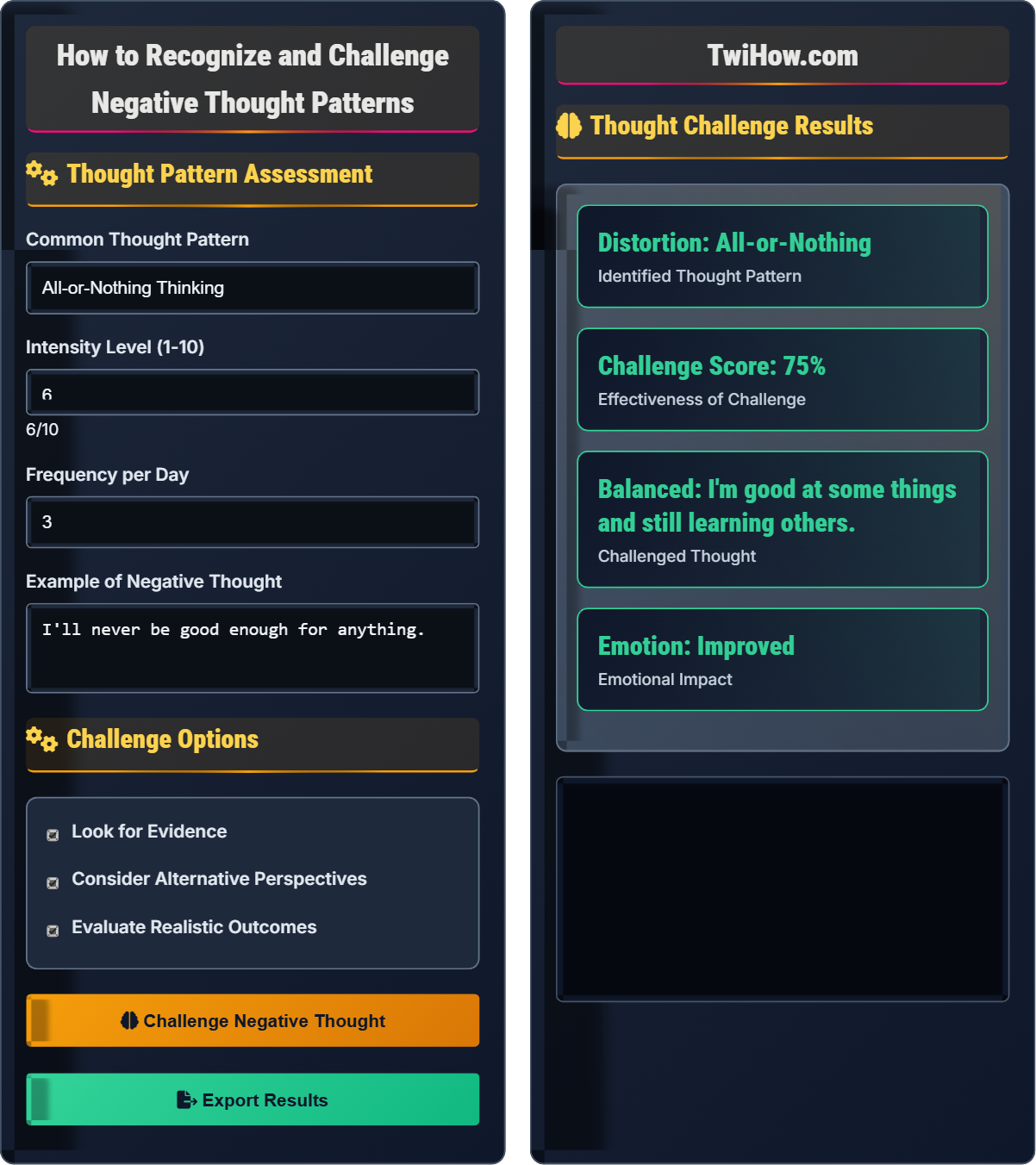
Thought Pattern Assessment
Challenge Options
Thought Challenge Results
| Step | Action | Result | Effectiveness |
|---|---|---|---|
| 1 | Identify Thought | I'll never be good enough | 100% |
| 2 | Find Evidence | Some successes noted | 80% |
| 3 | Alternative View | Gradual improvement possible | 75% |
| 4 | Realistic Outcome | Can improve with effort | 85% |
| 5 | Final Balance | Accepting imperfection | 90% |
CBT Challenge Techniques
- Question the evidence for and against the thought
- Consider alternative explanations
- Examine the consequences of believing the thought
- Test the thought against reality
- Develop a balanced perspective
Recognizing and Challenging Negative Thought Patterns
Cognitive distortions are systematic patterns of thinking that are inaccurate and unhelpful. They are thoughts that cause us to view reality incorrectly, often in a negative way. These distorted thoughts can contribute to feelings of anxiety, depression, and other mental health challenges. The goal of cognitive restructuring is to identify these patterns and develop more balanced, realistic ways of thinking.
The cognitive-behavioral model shows how thoughts, feelings, and behaviors are interconnected:
By changing the thoughts in this cycle, we can alter the resulting feelings and behaviors. For example:
- Situation: Receiving critical feedback at work
- Distorted Thought: "I'm terrible at my job"
- Feeling: Sadness, shame, anxiety
- Behavior: Avoiding work, isolating from colleagues
- Consequence: Poor performance, damaged relationships
Here are the most prevalent negative thought patterns:
- All-or-Nothing Thinking: Viewing situations in absolute extremes
- Overgeneralization: Making broad conclusions from single events
- Mental Filter: Focusing exclusively on negative details
- Disqualifying the Positive: Rejecting positive experiences
- Jumping to Conclusions: Mind reading or fortune telling
- Magnification/Minimization: Exaggerating or downplaying significance
- Emotional Reasoning: Believing feelings reflect reality
- Should Statements: Rigid rules about how things must be
- Labeling: Assigning global negative traits
- Personalization: Blaming yourself for external events
- CBT Effectiveness: Studies show 50-75% reduction in symptoms
- Long-term Benefits: Skills continue to help after therapy ends
- Neuroplasticity: Challenging thoughts changes brain structure
- Accessibility: Self-help techniques can be effective
- Combination Approach: Works well with other treatments
- Prevention: Skills help prevent future episodes
Fundamentals
Cognitive distortions, thought challenging, CBT, cognitive restructuring, automatic thoughts, balanced thinking, emotional regulation, metacognition.
Challenge Effectiveness = (Evidence for × Weight) - (Evidence against × Weight) + Balanced Perspective
Where evidence is evaluated based on reliability, relevance, and objectivity.
- Thoughts are not facts
- Balance is more realistic than extremes
- Practice makes permanent neural pathways
Techniques
Thought records, evidence examination, alternative perspectives, reality testing, behavioral experiments, mindfulness techniques.
- Keep a thought diary to identify patterns
- Pause when negative thoughts arise
- Ask "Is this thought helpful?"
- Look for evidence that supports and contradicts
- Consider what you'd tell a friend
- Practice daily thought challenging
- Be patient with yourself
- Start with less intense thoughts
- Seek professional help for severe cases
- Combine with other wellness practices
Thought Challenging Quiz
Which cognitive distortion involves seeing things in absolute extremes with no middle ground?
All-or-Nothing Thinking (also called Black-and-White Thinking) involves seeing situations in absolute extremes without acknowledging any middle ground. This distortion leads to thoughts like "I'm either perfect or a complete failure" or "If I make one mistake, I'm totally incompetent." This type of thinking prevents nuanced evaluation and often leads to harsh self-judgment and unrealistic expectations.
The answer is B) All-or-Nothing Thinking.
All-or-Nothing Thinking creates a binary worldview that doesn't reflect the complexity of real-life situations. This distortion is particularly harmful because it eliminates the possibility of growth, learning from mistakes, or accepting partial success. When people engage in this type of thinking, they often set themselves up for failure by expecting perfection or viewing minor setbacks as total defeats.
Cognitive Distortion: Irrational thought pattern that distorts reality
All-or-Nothing Thinking: Viewing situations in absolute extremes
Binary Thinking: Black-and-white categorization without nuance
• Reality exists on spectrums, not extremes
• Most situations have multiple valid perspectives
• Partial success is still success
• Look for shades of gray between extremes
• Accepting extreme thoughts without questioning
• Not recognizing the all-or-nothing pattern
• Failing to consider alternative perspectives
Explain the process of examining evidence for and against a negative thought. Provide specific steps and examples of how to conduct this examination effectively.
Evidence Examination Process: This technique involves objectively evaluating the factual basis of a negative thought by looking for supporting and contradicting evidence.
Steps for Effective Evidence Examination:
1. Write Down the Thought: Clearly articulate the negative thought (e.g., "I'm terrible at my job")
2. Look for Supporting Evidence: What facts support this thought? Be specific and objective
3. Look for Contradicting Evidence: What facts contradict this thought? Include past successes
4. Evaluate Evidence Quality: Assess reliability, relevance, and completeness of evidence
5. Consider Alternative Explanations: Are there other ways to interpret the situation?
Example: Negative thought: "I'm terrible at my job"
Supporting evidence: Made a mistake on one project
Contradicting evidence: Received positive feedback on three projects, promoted last year, colleagues seek advice
Balanced thought: "I made a mistake, but I also have many strengths and successes"
Evidence examination works by shifting from emotional to rational processing. It forces us to move beyond subjective feelings to objective facts. This technique is effective because our brains naturally notice information that confirms our beliefs (confirmation bias), so actively seeking contradictory evidence helps create balance. The process also slows down automatic thinking, allowing for more considered responses.
Evidence Examination: Objective evaluation of thoughts against factual evidence
Confirmation Bias: Tendency to notice information confirming existing beliefs
Objective Evidence: Verifiable facts rather than subjective interpretations
• Distinguish between facts and interpretations
• Only looking for evidence that confirms the negative thought
• Dismissing contradictory evidence as exceptions
• Treating feelings as evidence
John received critical feedback from his manager and immediately thought, "I'm going to get fired. My career is over. I'm a complete failure." He felt anxious and wanted to call in sick the next day. Using the thought challenging process, identify John's cognitive distortion, provide evidence examination, and suggest a balanced thought replacement.
Identified Distortions: Catastrophizing (expecting the worst outcome), All-or-Nothing Thinking (viewing feedback as total failure)
Evidence Examination:
Supporting evidence: Received critical feedback, manager was direct
Contradicting evidence: Has worked at company for 3 years, received positive reviews previously, manager gave specific improvement suggestions rather than threats
Alternative Perspectives: Manager may be helping John improve, feedback is common in professional settings, one criticism doesn't define entire career
Realistic Outcomes: More likely to receive guidance for improvement than immediate termination
Balanced Thought: "My manager gave me feedback to help me improve. I can use this information to grow professionally."
Behavioral Change: Instead of avoiding work, John can prepare to discuss improvement strategies with his manager.
John's case demonstrates how a single event can trigger multiple cognitive distortions simultaneously. The critical feedback became the catalyst for catastrophic thinking that spiraled into thoughts about his entire career. This scenario shows the importance of catching thoughts early in the chain before they escalate. The thought challenging process helps break the cycle by introducing objective evaluation and realistic alternatives.
Catastrophizing: Expecting disaster from ordinary events
Thought Challenging: Systematic process of questioning negative thoughts
Behavioral Consequences: Actions taken based on thoughts and emotions
• One event doesn't determine entire trajectory
• Treating temporary setbacks as permanent failures
• Assuming worst-case scenarios are inevitable
• Acting on emotion rather than reason
Your friend consistently says things like "I should always be perfect" and "Everyone must approve of me." They seem stressed and disappointed when these expectations aren't met. Explain which cognitive distortion this represents and provide three evidence-based CBT techniques to help them challenge these thoughts.
Identified Distortion: "Should Statements" - rigid rules about how things must be, often leading to guilt, frustration, and disappointment when expectations aren't met.
Three Evidence-Based CBT Techniques:
1. Flexible Language Replacement: Replace "should" with "would prefer" or "it would be nice if." For example, change "I should always be perfect" to "I would prefer to do my best, but it's okay to make mistakes."
2. Cost-Benefit Analysis: Examine the advantages and disadvantages of holding rigid "should" statements. Benefits might include motivation, but costs include stress, disappointment, and self-criticism.
3. Experimentation: Test what happens when they don't meet their "should" expectations. This helps them realize that consequences are often less severe than feared and builds tolerance for imperfection.
These techniques help create more flexible, realistic expectations that reduce stress while maintaining motivation.
Should statements create unrealistic expectations that are virtually impossible to meet consistently. These thoughts often stem from internalized messages from childhood or cultural pressures. The rigid nature of "should" thinking leaves no room for human imperfection or situational factors. CBT techniques work by introducing flexibility and realism, helping individuals develop more compassionate and achievable standards.
Should Statements: Rigid rules about how things must be
Cognitive Behavioral Therapy (CBT): Evidence-based psychotherapy approach
Flexibility: Ability to adapt standards to realistic circumstances
• Perfection is impossible and unhealthy
• Treating personal preferences as universal rules
• Not questioning the origin of "should" statements
• Believing that lowering standards means giving up
Which of the following is the most effective way to challenge negative thoughts?
Developing balanced, realistic thoughts based on evidence is the most effective approach because it addresses the root of the problem rather than avoiding it or creating new distortions. This method acknowledges both positive and negative aspects of a situation while basing conclusions on objective evidence. Ignoring thoughts doesn't resolve them, overly positive affirmations can feel fake and backfire, and focusing only on past successes ignores current realities that need addressing.
The answer is C) Develop balanced, realistic thoughts based on evidence.
Effective thought challenging requires balance between acknowledging legitimate concerns and avoiding catastrophic thinking. The evidence-based approach creates credibility for the new thought, making it more likely to be accepted by the subconscious mind. Balanced thoughts are more sustainable because they align with reality while promoting healthier emotional responses. This approach builds genuine confidence rather than artificial optimism.
Thought Challenging: Systematic process of questioning negative thoughts
Balance: Acknowledging both positive and negative aspects
Realistic Thinking: Aligning thoughts with objective reality
• Truth is more powerful than positive thinking alone
• Creating thoughts that feel fake or unbelievable
• Ignoring legitimate concerns
• Not practicing new thoughts enough to make them automatic
FAQ
Q: How long does it take to see results from challenging negative thoughts?
A: The timeline for seeing results from thought challenging varies by individual, but most people begin to notice changes within 2-4 weeks of consistent practice. Initial improvements often include increased awareness of negative thoughts and reduced emotional intensity when these thoughts arise.
Significant changes in automatic thought patterns typically occur after 6-8 weeks of daily practice. This timeframe corresponds to neuroplasticity research showing that new neural pathways strengthen with repetition.
Factors affecting the timeline include:
- Severity and duration of established thought patterns
- Consistency of practice
- Additional stressors in life
- Previous experience with introspection
Q: How can I help a loved one who struggles with negative thinking patterns?
A: Supporting someone with negative thinking patterns requires patience and understanding:
Listen Without Judgment: Avoid dismissing their concerns or trying to talk them out of their feelings immediately
Encourage Professional Help: Recommend therapy or counseling when appropriate, emphasizing that seeking help is a sign of strength
Model Healthy Thinking: Demonstrate balanced perspectives in your own responses to challenges
Practice Patience: Remember that changing thought patterns takes time and effort
Offer Specific Support: Help them practice techniques or accompany them to appointments if desired
Set Boundaries: Take care of your own mental health while providing support
Remember that your role is to support, not to fix. Professional intervention may be necessary for severe or persistent patterns.