How to Support a Child's Mental Health Development
Complete child mental health guide • Step-by-step explanations
Child Mental Health Fundamentals:
Show Child Support SimulatorSupporting a child's mental health development involves understanding their unique needs at different developmental stages, providing consistent emotional support, and creating safe environments for growth. Children's mental health encompasses emotional, psychological, and social well-being.
Effective child mental health support requires recognizing early warning signs, fostering secure attachments, and implementing age-appropriate communication strategies. The foundation for lifelong mental wellness is established in childhood through supportive relationships and healthy coping mechanisms.
Key support concepts:
- Secure Attachment: Building trust and emotional safety
- Emotional Regulation: Teaching children to manage feelings
- Communication: Open dialogue and active listening
- Consistency: Predictable routines and boundaries
Successful child mental health support adapts to developmental stages, individual temperament, and environmental factors while promoting resilience and emotional intelligence.
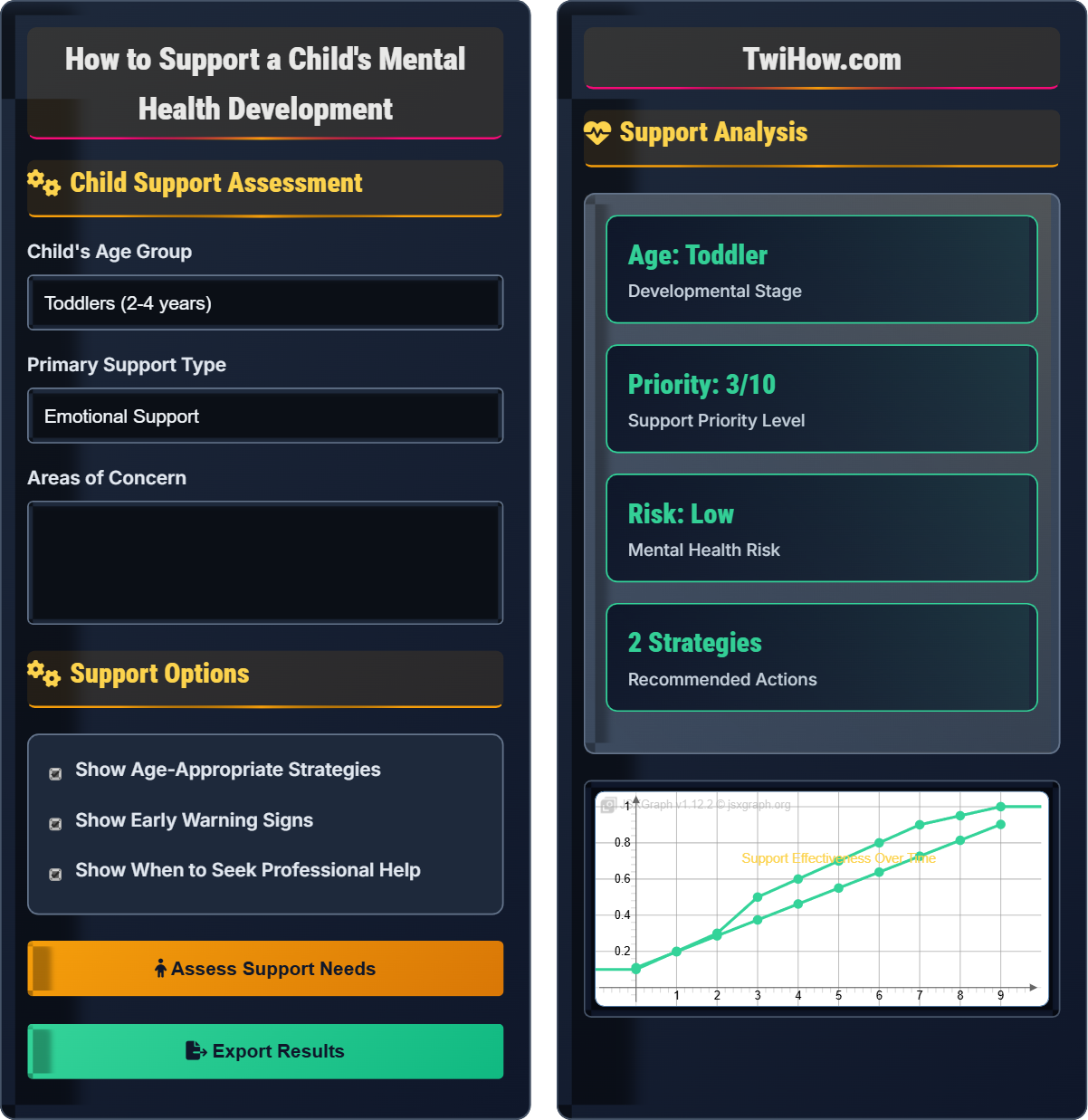
Child Support Assessment
Support Options
Support Analysis
| Area | Concern Level | Support Needed | Action Required |
|---|---|---|---|
| Emotional Regulation | Medium | High | Immediate |
| Social Skills | Low | Medium | Planned |
| Academic Support | High | High | Immediate |
| Family Dynamics | Low | Low | Monitor |
Give your full attention when your child speaks, validate their feelings, and reflect back what you hear to show understanding.
Establish predictable daily routines that provide security and help children anticipate what comes next.
Understanding Child Mental Health Development
Child mental health encompasses emotional, psychological, and social well-being during development. It affects how children think, feel, and act, influencing their ability to handle stress, relate to others, and make healthy choices. Mental health is not just the absence of mental illness but includes the presence of positive psychological traits.
- Emotional Development: Learning to identify, express, and manage emotions
- Social Development: Building relationships and social skills
- Cognitive Development: Developing thinking, learning, and problem-solving skills
- Biological Factors: Genetic predispositions and brain development
Healthy mental development in childhood lays the foundation for lifelong emotional resilience and psychological well-being.
Child mental health development follows a structured progression:
Where:
- Foundation: Secure attachment and basic trust
- Safety: Physical and emotional security
- Connection: Healthy relationships and social bonds
- Growth: Skill development and independence
- Resilience: Ability to bounce back from challenges
Effective child mental health support is applied in various contexts:
- Home Environment: Consistent routines, emotional safety, nurturing
- School Setting: Academic support, peer relationships, teacher collaboration
- Community: Social activities, extracurricular engagement
- Healthcare: Preventive care, early intervention, ongoing support
- Crisis Situations: Trauma response, grief support, emergency interventions
- Special Needs: Individualized accommodations and support
- Preventive: Proactive measures to promote mental wellness
- Interventional: Targeted support for emerging concerns
- Therapeutic: Professional treatment for mental health conditions
- Educational: Teaching skills and coping strategies
- Environmental: Creating supportive physical and social environments
Developmental Stages
Early childhood, middle childhood, adolescence, with unique needs at each stage.
Effective Support = (Age-Appropriate Strategy × Consistency) + (Individual Needs × Environmental Factors)
Where Effective Support = positive outcomes, Age-Appropriate = developmental stage consideration.
- Match support to developmental stage
- Consider individual temperament
- Maintain consistent expectations
Warning Signs & Red Flags
Changes in behavior, sleep, appetite, social withdrawal, regression, extreme emotions.
- Duration of symptoms
- Severity of impact
- Frequency of occurrence
- Functional impairment
- Symptoms persist for weeks
- Impairs daily functioning
- Self-harm or suicidal thoughts
- Extreme behavioral changes
Developmental Stages Overview
Focus on establishing secure attachment, emotional regulation, and basic social skills. Toddlers need consistent routines and clear boundaries.
Emphasis on academic success, peer relationships, and developing coping strategies. Children need guidance in managing increased responsibilities.
Focus on identity development, independence, and preparing for adulthood. Teens need balanced support with respect for growing autonomy.
Child Mental Health Learning Quiz
Which approach would be most appropriate for supporting a 4-year-old experiencing separation anxiety?
For a 4-year-old with separation anxiety, establishing consistent goodbye rituals and using simple, reassuring language is most appropriate. At this age, children need predictable routines and concrete reassurance that their caregiver will return. Complex explanations are beyond their developmental capacity.
The answer is B) Establish consistent goodbye rituals and reassure with simple language.
Developmental appropriateness is crucial in child mental health support. Four-year-olds are in the preoperational stage of cognitive development, characterized by concrete thinking and limited abstract reasoning. They understand the world through sensory experiences and direct interactions. Consistent routines provide security, while simple, concrete language matches their cognitive abilities. Rituals help children predict what will happen next, reducing anxiety.
Separation anxiety: Normal fear when separated from caregivers
Developmental appropriateness: Matching support to cognitive abilitiesRitual: Consistent routine that provides predictability
• Match communication to developmental level
• Maintain consistent routines
• Provide concrete reassurance
• Use simple, clear language
• Establish predictable goodbye routines
• Offer comfort objects during transitions
• Providing overly complex explanations
• Inconsistent routines
• Punishing anxiety behaviors
Explain how to teach emotional regulation skills to children and describe age-appropriate strategies for different developmental stages.
Emotional regulation: The ability to manage and respond to emotional experiences in a socially appropriate way.
Strategies by age:
Toddlers (2-4): Simple breathing exercises ("breathe like a bear"), counting to calm down, identifying emotions with basic words, redirecting attention.
School Age (5-12): More complex coping strategies, problem-solving skills, journaling, physical activities, recognizing emotional triggers.
Teens (13-17): Advanced cognitive strategies, mindfulness, stress management, healthy outlets for emotions, independent coping skills.
Consistent modeling, practice, and patience are essential at all stages.
Emotional regulation develops gradually over time and requires explicit teaching. Young children need concrete, simple strategies that they can practice repeatedly. As children mature, they can handle more complex cognitive approaches. Modeling is crucial—children learn emotional regulation by observing how adults manage their own emotions. Consistent practice in safe environments allows children to internalize these skills.
Emotional regulation: Managing emotional responses appropriately
Modeling: Demonstrating desired behaviors for children
Internalization: Making skills automatic through practice
• Teach when child is calm
• Practice regularly
• Model desired behaviors
• Start with simple strategies
• Practice during calm moments
• Use visual aids and props
• Expecting adult-level regulation from children
• Teaching during emotional states
• Inconsistent modeling
Emma is a 10-year-old girl who has recently become withdrawn, complains of stomachaches before school, and has been struggling with her grades. Her parents noticed she's been sleeping poorly and seems anxious about going to school. Identify potential causes and create a comprehensive support plan that addresses Emma's needs.
Potential causes: Bullying, academic pressure, social difficulties, family stress, or adjustment to changes.
Comprehensive support plan: 1) Create safe space for communication, 2) Collaborate with teachers to investigate school issues, 3) Establish consistent bedtime routine, 4) Provide emotional validation, 5) Consider counseling if needed, 6) Address academic concerns with appropriate support.
Implementation: Start with open communication, involve school personnel, maintain consistent support, and monitor progress. If symptoms persist or worsen, seek professional evaluation.
This scenario demonstrates the interconnected nature of child mental health concerns. Physical symptoms (stomachaches, sleep problems) often accompany emotional distress in children. The key is taking a holistic approach that addresses multiple domains simultaneously. School-home collaboration is essential, as is creating safe spaces for children to express their concerns. Early intervention prevents minor issues from becoming major problems.
Holistic approach: Addressing multiple aspects of well-being
Early intervention: Addressing concerns before they escalate
Safe space: Environment where child feels comfortable sharing
• Take physical symptoms seriously
• Collaborate with school personnel
• Maintain consistent support
• Look for patterns in symptoms
• Involve child in solution planning
• Monitor and adjust support as needed
• Dismissing physical symptoms
• Working in isolation from school
• Waiting for problems to resolve themselves
Your 14-year-old child has been exhibiting persistent sadness, withdrawal from activities they previously enjoyed, changes in appetite and sleep, and has made comments about not wanting to live anymore. Analyze this situation and explain when and how to seek professional help.
Severity assessment: These symptoms indicate serious depression and potential suicidal ideation, requiring immediate professional attention. The combination of persistent mood changes, behavioral changes, and suicidal comments constitutes a mental health emergency.
Professional help steps: 1) Contact pediatrician immediately, 2) Call crisis hotline (988) if immediate danger, 3) Seek emergency psychiatric evaluation, 4) Engage school counselor if appropriate, 5) Follow up with mental health specialist.
Key principle: When children express suicidal thoughts, take all statements seriously and seek immediate professional help.
This represents a mental health crisis that requires immediate professional intervention. Suicidal ideation in children and adolescents is always serious and requires prompt professional evaluation. The key is not to try to handle this alone—professional assessment and treatment are essential. Parents should contact emergency services (911) if there's immediate danger, or contact crisis hotlines (988) for immediate support and guidance.
Suicidal ideation: Thoughts about ending one's life
Mental health emergency: Situation requiring immediate intervention
Crisis hotline: 24/7 support for mental health emergencies
• Take all suicidal statements seriously
• Seek immediate professional help
• Don't try to handle alone
• Keep crisis hotline numbers accessible
• Remove access to means of harm
• Stay with child at all times
• Minimizing severity of symptoms
• Waiting to see if symptoms improve
• Discussing with child alone
Which of the following is the most effective preventive strategy for supporting child mental health?
Consistent emotional support and open communication create the foundation for healthy mental development. When children feel secure and know they can communicate openly with trusted adults, they're better equipped to handle challenges and seek help when needed. This approach builds resilience and emotional intelligence.
The answer is B) Consistent emotional support and open communication.
Prevention in child mental health is built on secure attachment relationships and emotional safety. Rather than preventing all stress (which would be counterproductive), effective prevention teaches children to navigate challenges with appropriate support. Secure attachment theory shows that children who feel emotionally safe are more likely to explore, learn, and develop healthy coping mechanisms. Open communication allows for early identification of concerns.
Prevention: Building protective factors before problems arise
Secure attachment: Trusting relationship with caregiver
Resilience: Ability to bounce back from challenges
• Build emotional safety first
• Foster open communication
• Balance protection with growth opportunities
• Create regular check-in times
• Validate all emotions
• Model healthy coping strategies
• Overprotecting children
• Dismissing child's emotions
• Focusing only on outcomes
FAQ
Q: How do I know if my child's behavior is just a phase or a sign of a mental health concern?
A: Consider these key factors:
1. Duration: Phases typically last days to weeks; concerns persist for months
2. Intensity: Normal variations vs. extreme or disruptive behaviors
3. Functioning: Ability to participate in school, friendships, family activities
4. Pattern: Gradual changes vs. sudden onset of problems
When in doubt, consult with pediatricians, teachers, or mental health professionals. It's always better to address concerns early rather than wait for problems to worsen. Trust your instincts as a parent—you know your child best.
Q: What's the difference between normal childhood development and mental health issues?
A: The key difference lies in degree, duration, and functional impact:
Normal development: Temporary regressions during stress, age-appropriate fears (separation anxiety in toddlers), testing boundaries, mood fluctuations related to specific events.
Mental health concerns: Persistent symptoms that interfere with daily functioning, developmental regression lasting weeks/months, symptoms occurring without obvious triggers, significant decline in academic or social functioning.
Children's mental health exists on a spectrum, and many behaviors fall somewhere between "normal" and "concerning." The critical factor is whether the behavior interferes with the child's ability to function in key areas of life.