How to Support Mental Health While Working Remotely
Complete guide • Step-by-step explanations
Mental Health Fundamentals:
Show Mental Health SimulatorSupporting mental health while working remotely involves creating healthy boundaries, establishing routines, maintaining social connections, and implementing stress management techniques. Remote work presents unique challenges including isolation, blurred work-life boundaries, and potential increases in anxiety or depression.
Key strategies for remote mental wellness:
- Social Connection: Regular communication with colleagues and loved ones
- Physical Environment: Creating a dedicated, comfortable workspace
- Work-Life Balance: Setting clear boundaries between work and personal time
- Self-Care: Maintaining physical health through exercise, nutrition, and rest
Modern approaches to remote mental health focus on proactive prevention, mindfulness practices, and utilizing digital tools to maintain psychological wellbeing during extended periods of remote work.
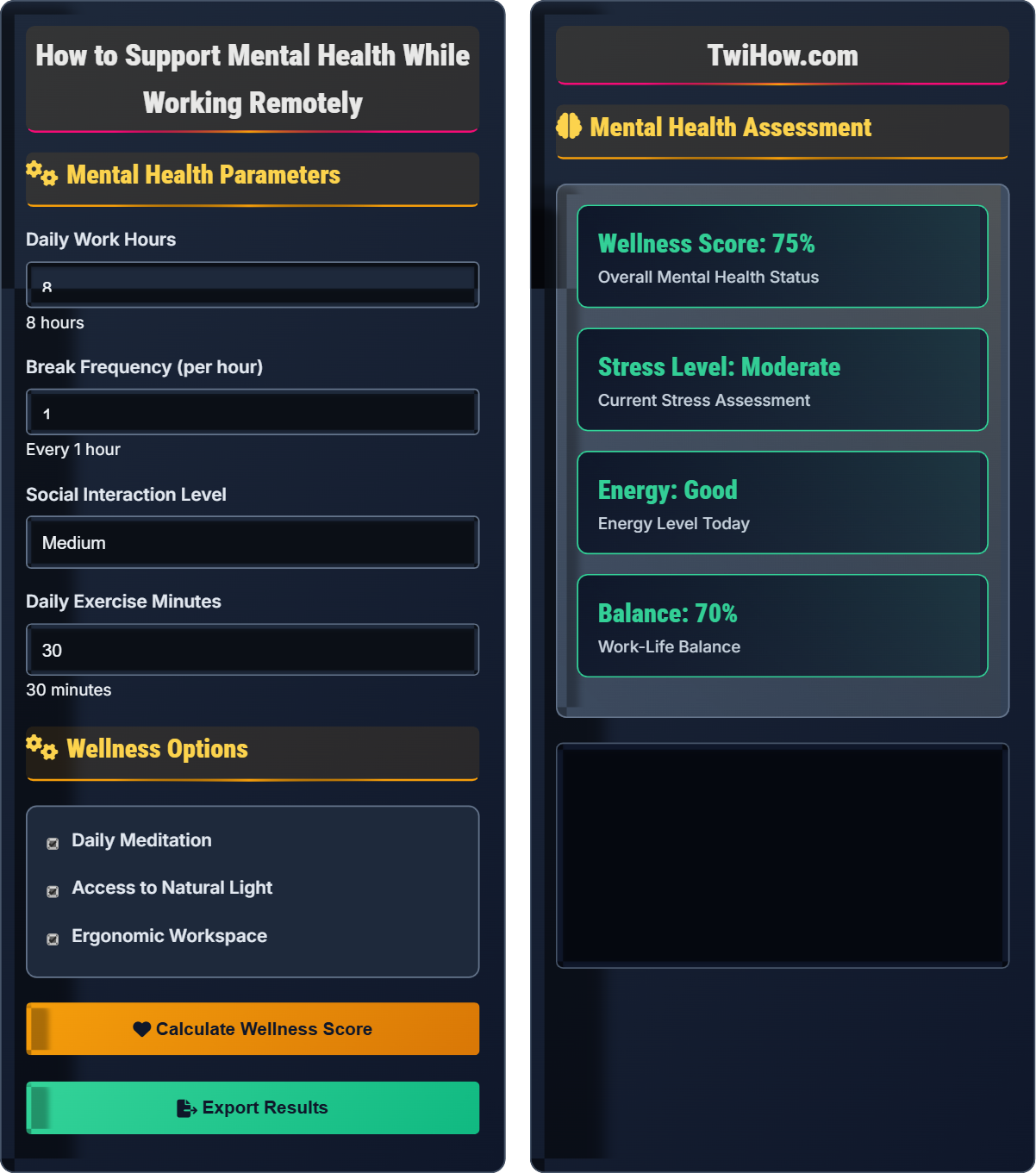
Mental Health Parameters
Wellness Options
Mental Health Assessment
| Area | Score | Status | Recommendation |
|---|---|---|---|
| Sleep Quality | 80% | Good | Maintain consistent schedule |
| Physical Activity | 75% | Good | Add stretching breaks |
| Social Connection | 70% | Fair | Schedule regular calls |
| Work-Life Balance | 70% | Fair | Set clear boundaries |
| Stress Management | 80% | Good | Continue meditation |
Recommended Strategies
- Create a morning routine to establish structure
- Take breaks every 60-90 minutes
- Engage in virtual team activities
- Practice mindfulness exercises
- Maintain a dedicated workspace
Mental Health in Remote Work Explained
Working remotely can significantly impact mental health in both positive and negative ways. On one hand, it offers flexibility, reduced commute stress, and personalized environments. On the other hand, it can lead to isolation, blurred boundaries between work and personal life, and increased anxiety about productivity and career advancement.
Mental wellness during remote work can be represented as:
Where:
- Social Connection: Regular interaction with colleagues and friends
- Physical Activity: Exercise and movement throughout the day
- Work-Life Balance: Clear boundaries between professional and personal time
- Self-Care: Adequate sleep, nutrition, and relaxation
- Stress Factors: Overwork, isolation, uncertainty
Key areas where remote workers face mental health challenges:
- Isolation: Reduced face-to-face interactions leading to loneliness
- Overworking: Difficulty disconnecting from work tasks
- Distractions: Home environment interruptions affecting focus
- Communication Gaps: Misunderstandings in virtual interactions
- Career Concerns: Fear of missing opportunities or advancement
- Physical Health: Sedentary lifestyle and poor ergonomics
- Virtual Coffee Chats: Informal video calls with colleagues
- Digital Detox: Scheduled breaks from screens and notifications
- Co-working Sessions: Virtual shared workspaces
- Professional Development: Online courses and skill-building
- Accountability Partners: Colleagues to check in with regularly
- Flexible Scheduling: Adapting work hours to personal rhythms
Fundamentals
Social connection, work-life balance, stress management, physical activity, mental resilience, boundary setting.
Wellness = (Social Connection + Physical Activity + Work-Life Balance + Self-Care) ÷ Stress Factors
Where each component is rated from 0-100% based on implementation frequency.
- Consistency is more important than perfection
- Mental health needs vary by individual
- Small changes can have significant impacts
Strategies
Creating structure, building connections, managing boundaries, practicing self-care, seeking support.
- Establish morning and evening routines
- Set up a dedicated workspace
- Schedule regular check-ins with colleagues
- Take intentional breaks throughout the day
- Practice mindfulness or meditation
- Personalize strategies to your needs
- Start with small, manageable changes
- Seek professional help when needed
- Maintain flexibility during difficult times
Mental Health Learning Quiz
Which of the following is the most commonly reported mental health challenge faced by remote workers?
Research consistently shows that social isolation and loneliness are the most frequently cited mental health challenges among remote workers. The lack of casual workplace interactions, water cooler conversations, and in-person collaboration can lead to feelings of disconnection and isolation. While other factors like workload and distractions are also significant, the absence of social connection has been identified as the primary psychological challenge in remote work environments.
The answer is B) Social isolation and loneliness.
Understanding the primary challenges of remote work helps prioritize mental health strategies. Social isolation affects cognitive function, emotional regulation, and overall psychological wellbeing. Humans are inherently social beings, and the absence of regular interpersonal interactions can trigger stress responses and contribute to depression and anxiety. Recognizing this as the primary challenge allows individuals to proactively address it through virtual connections, community engagement, and structured social activities.
Social Isolation: Lack of social contact or meaningful relationships
Loneliness: Subjective feeling of being alone regardless of social contacts
Psychological Wellbeing: Overall mental health and emotional stability
• Prioritize social connections in remote work
• Schedule regular virtual interactions
• Maintain meaningful relationships outside work
• Use video calls to maintain visual connection
• Join virtual coworking sessions
• Participate in online communities related to interests
• Underestimating the importance of social connection
• Relying only on work-related interactions
• Ignoring early signs of isolation
Explain the importance of setting work-life boundaries when working remotely and provide specific strategies for maintaining these boundaries.
Importance of Boundaries: Without physical separation between work and home, remote workers often struggle with "always-on" mentality, leading to burnout, decreased productivity, and stress. Clear boundaries help maintain psychological separation, ensuring adequate rest and personal time.
Specific Strategies:
1. Physical Boundaries: Designate a specific workspace that can be "closed" at the end of the day
2. Temporal Boundaries: Set specific work hours and stick to them, including start/end rituals
3. Digital Boundaries: Turn off work notifications after hours and avoid checking emails
4. Communication Boundaries: Communicate availability windows to colleagues and family members
These boundaries prevent work from consuming personal time and maintain psychological health.
Boundary setting is crucial because the home environment becomes both the workplace and the place of rest. Without clear demarcation, the brain struggles to transition between work mode and personal mode. This leads to chronic stress as the nervous system remains in a constant state of alertness. Effective boundaries create psychological safety and allow for proper recovery, which is essential for sustained performance and mental health.
Work-Life Balance: Equitable distribution of time and energy between professional and personal activities
Burnout: State of emotional, physical, and mental exhaustion caused by excessive stress
Boundary Setting: Establishing limits to protect personal time and space
• Consistency is key to effective boundaries
• Boundaries need to be communicated to others
• Flexibility should not compromise core boundaries
• Use different devices or profiles for work/personal
• Create a shutdown ritual to end workday
• Share your boundaries with family members
• Starting work immediately upon waking
• Checking work emails during family time
• Not having a designated workspace
Sarah has been working from home for 8 months and recently started experiencing symptoms of anxiety, including difficulty concentrating, irritability, and trouble sleeping. She works 10+ hours daily, rarely takes breaks, and feels constantly "on-call." Describe Sarah's situation, identify the contributing factors to her anxiety, and recommend a comprehensive plan to address her mental health concerns.
Sarah's Situation: Sarah is experiencing burnout symptoms due to poor work-life balance and inadequate self-care while working remotely.
Contributing Factors:
• Excessive work hours (10+ hours daily) without adequate rest
• Lack of scheduled breaks during the workday
• Perpetual "on-call" mentality preventing psychological recovery
• Absence of boundaries between work and personal time
Comprehensive Plan:
1. Immediate Actions: Set maximum 8-hour workdays, schedule mandatory 15-minute breaks every 2 hours
2. Boundary Establishment: Define specific work hours, turn off notifications after hours
3. Self-Care Integration: Incorporate 30 minutes of physical activity daily
4. Social Connection: Schedule virtual coffee chats with colleagues twice weekly
5. Professional Support: Consider counseling if symptoms persist
This scenario illustrates how the absence of natural workplace boundaries can lead to overwork and subsequent mental health deterioration. Remote work removes the physical and temporal cues that traditionally signal the end of the workday, making it easier to fall into patterns of overwork. Sarah's case demonstrates the importance of proactively establishing boundaries and self-care practices, as the remote environment doesn't provide these structures automatically.
Burnout: Syndrome of emotional exhaustion, depersonalization, and reduced personal accomplishment
Work-Life Balance: Equitable distribution of time and energy between professional and personal activities
Self-Care: Activities and practices that maintain mental, physical, and emotional health
• Early intervention prevents severe burnout
• Self-care is essential for productivity
• Professional help may be necessary for persistent symptoms
• Use time-tracking apps to monitor work hours
• Implement the "20-20-20" rule for eye breaks
• Create a physical shutdown ritual at the end of the day
• Equating long hours with productivity
• Neglecting to take breaks during the day
• Failing to communicate boundaries to colleagues
Your colleague has mentioned struggling with stress while working remotely, particularly due to constant video calls, difficulty focusing, and feeling disconnected from the team. Propose three evidence-based stress management techniques specifically adapted for remote work environments.
Evidence-Based Techniques:
1. Micro-Breaks Strategy: Implement the Pomodoro Technique (25 minutes work, 5 minutes break) with physical movement during breaks to combat fatigue and improve focus.
2. Virtual Connection Rituals: Schedule brief, non-work-related video chats (virtual coffee breaks) to maintain social bonds and reduce isolation.
3. Mindful Transitions: Create physical and mental rituals between tasks (e.g., walking to another room, 3 deep breaths) to reset attention and reduce stress.
These techniques address the specific stressors of remote work: screen fatigue, isolation, and concentration difficulties.
Remote work stress management requires approaches tailored to the unique challenges of distributed work. Traditional stress management techniques need adaptation for the home environment. Micro-breaks address the cognitive fatigue associated with prolonged screen time and video conferencing. Virtual connection rituals counteract the isolation that comes from reduced spontaneous interactions. Mindful transitions help recreate the psychological shifts that normally occur when moving between physical spaces in an office environment.
Micro-Breaks: Short pauses during work to rest the mind and body
Video Conferencing Fatigue: Tiredness resulting from excessive virtual meetings
Mindful Transitions: Conscious shifts between different activities or contexts
• Stress management must fit the remote work context
• Techniques should be practical and sustainable
• Consistency is more important than intensity
• Use apps to remind you to take breaks
• Try the 20-20-20 rule during video calls
• Keep a stress journal to track patterns
• Applying traditional office stress management to remote work
• Neglecting the unique aspects of remote work stress
• Failing to customize techniques to personal preferences
Which of the following is the most effective way to build a support system while working remotely?
Proactively scheduling regular check-ins with colleagues is the most effective approach because it creates structured, reliable connections with people who understand the remote work experience. This strategy provides both professional support and social interaction, addresses isolation proactively, and builds accountability relationships. Waiting passively for others to reach out often results in insufficient connection, while relying only on family may not address work-specific challenges. Occasional forum participation is beneficial but less consistent than scheduled connections.
The answer is B) Proactively schedule regular check-ins with colleagues.
Building a support system requires intentional action, especially in remote environments where organic interactions are limited. Proactive outreach creates predictability and reliability in social connections, which is crucial for mental health. Regular check-ins provide ongoing support rather than crisis-only communication, normalize discussions about challenges, and create accountability partners. This approach recognizes that remote work requires deliberate effort to maintain the social connections that naturally occur in physical offices.
Support System: Network of people providing emotional, social, and practical assistance
Proactive Approach: Taking initiative to address needs before problems arise
Accountability Partner: Someone who helps maintain goals and commitments
• Take initiative in building connections
• Maintain regular, not just occasional, contact
• Diversify support across different relationship types
• Schedule recurring virtual coffee chats
• Join or create virtual co-working sessions
• Participate in team-building activities
• Expecting others to initiate contact
• Limiting connections to work topics only
• Neglecting to maintain existing relationships
FAQ
Q: How can I maintain motivation and productivity while working from home?
A: Maintaining motivation while working remotely requires creating structure and purpose:
1. Visualize Progress: Use task management tools to see completed items and upcoming priorities
2. Set Micro-Goals: Break large projects into smaller, achievable tasks to maintain momentum
3. Create Accountability: Share goals with colleagues or supervisors to maintain commitment
4. Design Your Space: Organize your workspace to promote focus and minimize distractions
5. Celebrate Wins: Acknowledge accomplishments to reinforce positive behaviors
Remember that motivation often follows action rather than preceding it, so starting with small tasks can build momentum for larger projects.
Q: How can I support my team's mental health while managing remote work?
A: Supporting remote team mental health requires intentional leadership practices:
Regular Check-ins: Conduct frequent one-on-one meetings focusing on wellbeing, not just tasks
Normalize Conversations: Encourage open dialogue about mental health challenges without stigma
Provide Resources: Offer access to Employee Assistance Programs, mental health apps, or counseling services
Model Balance: Demonstrate healthy work-life boundaries by respecting off-hours and taking breaks
Flexibility: Accommodate different working styles and life circumstances when possible
Recognition: Acknowledge efforts and celebrate achievements to boost morale
Remember that supporting mental health is an investment in team performance and retention.