Culturally Sensitive Approaches to Mental Health Care
Complete cultural competency guide • Step-by-step explanations
Cultural Competency in Mental Health:
Show Cultural Competency SimulatorCulturally sensitive mental health care recognizes that culture profoundly influences how individuals experience, express, and cope with mental health challenges. It requires practitioners to understand and respect diverse worldviews, values, communication styles, and healing traditions while adapting evidence-based treatments accordingly.
Effective cultural sensitivity goes beyond surface-level awareness to include deep understanding of how cultural factors shape symptom presentation, help-seeking behaviors, and treatment preferences. This approach acknowledges that universal treatment models may not adequately serve diverse populations.
Key cultural competency concepts:
- Cultural Awareness: Understanding one's own cultural background and biases
- Cultural Knowledge: Learning about clients' cultural backgrounds
- Cultural Skills: Developing competencies to work effectively across cultures
- Cultural Encounters: Engaging with diverse populations to build understanding
Culturally sensitive care aims to reduce disparities in mental health outcomes and ensure that all individuals receive respectful, effective treatment regardless of their cultural background.
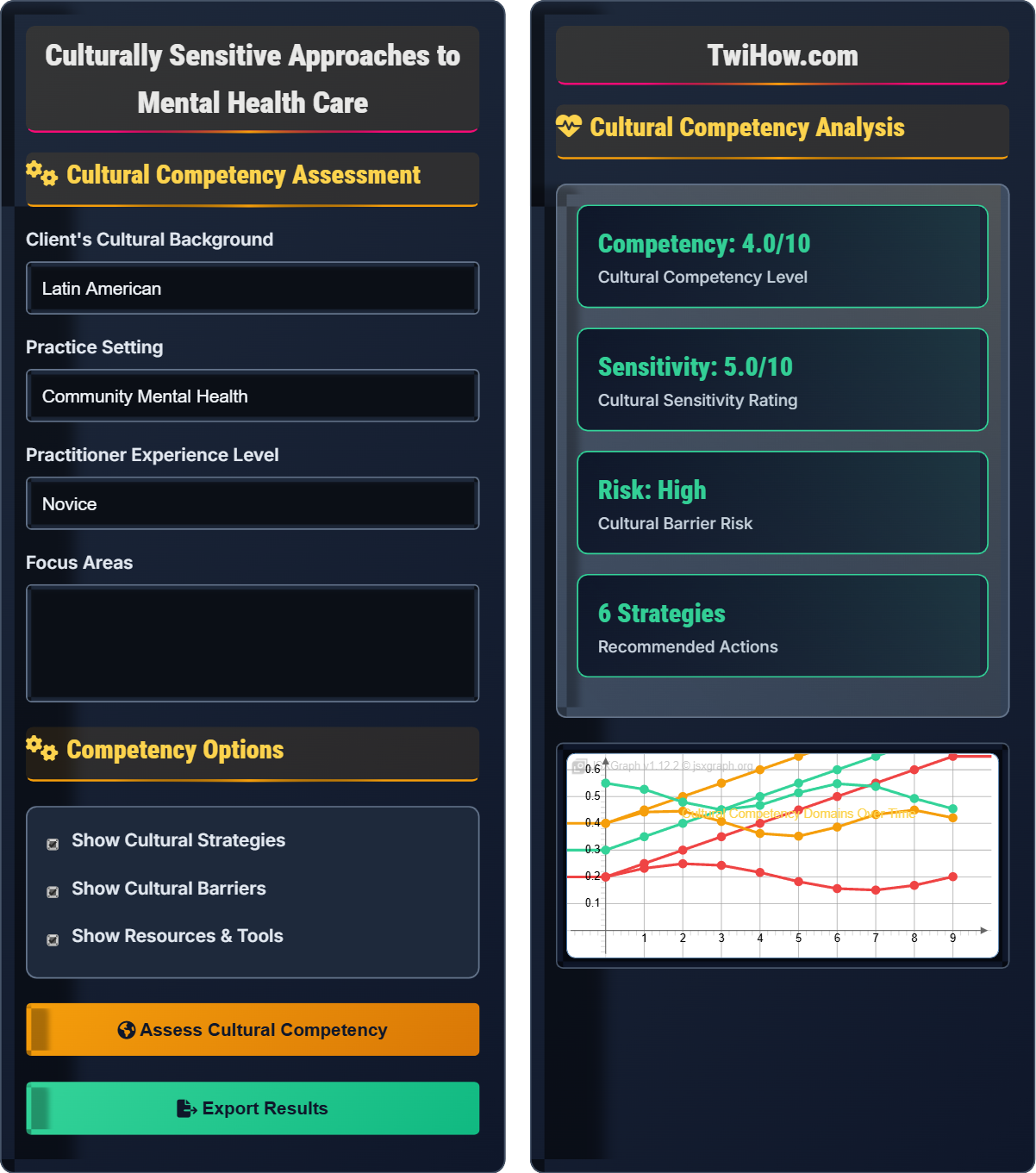
Cultural Competency Assessment
Competency Options
Cultural Competency Analysis
| Domain | Current | Target | Gap |
|---|---|---|---|
| Knowledge | 6/10 | 8/10 | 2 points |
| Skills | 5/10 | 8/10 | 3 points |
| Attitudes | 8/10 | 9/10 | 1 point |
| Encounters | 4/10 | 7/10 | 3 points |
Provide services in the client's preferred language using qualified interpreters or bilingual practitioners when possible.
Understand the role of family in the client's culture and incorporate family perspectives when appropriate.
Understanding Culturally Sensitive Mental Health Care
Cultural competency in mental health refers to the ability of practitioners to understand, appreciate, and work effectively with individuals from diverse cultural backgrounds. It encompasses awareness of cultural differences, knowledge of specific cultural factors, and skills to adapt treatment approaches accordingly.
- Cultural Awareness: Understanding one's own cultural background and biases
- Cultural Knowledge: Learning about clients' cultural backgrounds, beliefs, and practices
- Cultural Skills: Developing competencies to work effectively across cultures
- Cultural Encounters: Engaging with diverse populations to build understanding
Culturally sensitive care recognizes that culture influences symptom expression, help-seeking behaviors, and treatment preferences, requiring adaptive approaches for effective outcomes.
The cultural competency model follows this progression:
Where:
- Awareness: Self-reflection on cultural biases and assumptions
- Knowledge: Understanding of cultural differences and similarities
- Skills: Practical abilities to work with diverse populations
- Encounters: Direct experience with diverse cultural groups
- Desire: Motivation to continue learning and growing
Cultural sensitivity applies across multiple domains of mental health care:
- Assessment: Adapting diagnostic tools and approaches for cultural relevance
- Treatment: Modifying interventions to align with cultural values
- Communication: Understanding cultural communication styles and preferences
- Family Dynamics: Incorporating cultural family structures and roles
- Spirituality: Respecting religious and spiritual beliefs
- Traditional Healing: Acknowledging indigenous and traditional practices
- Language: Providing services in preferred language
- Stigma: Understanding cultural attitudes toward mental health
- Acculturation: Addressing generational and cultural conflicts
- Collectivism vs. Individualism: Adapting approaches accordingly
- Power Distance: Understanding hierarchical relationships
- Time Orientation: Present vs. future-focused perspectives
Cultural Competency Framework
Self-reflection on cultural biases
Learning about cultural groups
Developing cross-cultural abilities
Direct cultural experiences
Cultural Considerations
Language, stigma, acculturation, family dynamics, spirituality, traditional healing.
Effective Care = (Cultural Knowledge + Cultural Skills) × Client Engagement × Cultural Safety
Where Effective Care = positive therapeutic outcomes, Cultural Knowledge = understanding of background.
- Never assume cultural homogeneity
- Ask clients about their specific needs
- Respect traditional healing practices
Common Cultural Barriers
Language differences, cultural stigma, mistrust of institutions, stereotyping, communication mismatches.
- Provide language services
- Build community partnerships
- Engage cultural brokers
- Adapt communication styles
- Cultural stereotyping
- Minimizing cultural differences
- Imposing Western values
- Ignoring systemic inequalities
Cultural Approaches Overview
Provide services in the client's preferred language using qualified interpreters or bilingual practitioners when possible.
Understand the role of family in the client's culture and incorporate family perspectives when appropriate.
Respect and incorporate clients' spiritual and religious beliefs into the therapeutic process.
Cultural Competency in Mental Health Learning Quiz
What is the most important first step in developing cultural competency?
The most important first step is examining one's own cultural biases and assumptions. Cultural self-awareness forms the foundation of cultural competency. Before we can effectively work with others, we must understand how our own cultural background, values, and biases influence our perceptions and interactions.
The answer is B) Examining one's own cultural biases and assumptions.
Cultural competency begins with introspection. The cultural competency model emphasizes that awareness of one's own cultural lens is prerequisite to understanding others. Without this self-awareness, practitioners may unconsciously impose their own cultural values and interpretations on clients, leading to misdiagnosis or ineffective treatment. This foundational step prevents cultural projection and promotes genuine cultural curiosity.
Cultural awareness: Understanding one's own cultural background
Cultural bias: Prejudgments based on cultural background
Cultural projection: Imposing one's cultural views on others
• Self-awareness precedes other competency domains
• Cultural humility is essential
• Ongoing reflection is required
• Regular self-reflection exercises
• Seek feedback from diverse colleagues
• Examine reactions to different cultural groups
• Assuming cultural neutrality
• Focusing only on others' cultures
• Resistance to self-examination
Explain the importance of language accommodation in mental health care and describe best practices for working with interpreters.
Importance: Language is deeply tied to cultural identity and thought processes. Clients may express emotions and experiences more accurately in their native language. Effective communication is essential for accurate assessment, building rapport, and ensuring informed consent.
Best practices: 1) Use qualified mental health interpreters, 2) Position interpreter appropriately to maintain eye contact with client, 3) Speak directly to client, not interpreter, 4) Allow for cultural interpretation of expressions, 5) Maintain confidentiality protocols.
Considerations: Some concepts may not translate directly, cultural nuances in expression, potential for misinterpretation of emotional content.
Language accommodation is more than just translation—it's about preserving the emotional and cultural meaning of communication. Mental health concepts often have no direct translation, and emotional expression varies significantly across cultures. Qualified interpreters understand both linguistic and cultural nuances, unlike family members who may filter or alter information based on cultural expectations or shame.
Qualified interpreter: Trained professional with mental health knowledge
Cultural interpretation: Understanding meaning beyond literal translationLanguage concordance: Matching provider and client language
• Never use family members as interpreters for mental health
• Ensure interpreter confidentiality
• Maintain therapeutic alliance with client
• Brief interpreter on session goals
• Pause frequently for processing
• Verify understanding regularly
• Using unqualified interpreters
• Speaking to interpreter instead of client
• Assuming direct translation captures meaning
You're working with a Latino immigrant family whose teenage daughter has been diagnosed with depression. The parents believe her symptoms are caused by "mal de ojo" (evil eye) and are resistant to medication. They want to involve a traditional healer alongside therapy. Develop a culturally sensitive approach that respects their beliefs while ensuring effective treatment.
Assessment approach: Explore the family's understanding of "mal de ojo," acknowledge their belief system, and look for common ground between traditional and clinical perspectives.
Collaborative strategy: Consider integrating traditional healing with evidence-based treatment, involve cultural broker or traditional healer when appropriate, educate about depression while respecting cultural framework.
Treatment plan: Psychoeducation that incorporates cultural understanding, family therapy to address cultural conflicts, gradual introduction of Western treatment approaches alongside traditional practices.
Outcome: Build trust by validating cultural beliefs while introducing evidence-based interventions in a culturally acceptable manner.
This scenario exemplifies the need for cultural brokerage and collaborative care. Rather than dismissing traditional beliefs, effective cultural competency involves understanding the meaning behind them and finding ways to integrate different healing paradigms. The goal is not to replace cultural beliefs but to expand the family's toolkit for addressing mental health concerns.
Cultural brokerage: Facilitating between different cultural systems
Collaborative care: Integrating multiple healing approaches
Cultural humility: Ongoing self-reflection and learning
• Respect traditional healing practices
• Seek to understand cultural meanings
• Integrate rather than replace beliefs
• Ask about traditional healing experiences
• Find common goals across paradigms
• Involve respected community members
• Dismissing traditional beliefs
• Forcing Western approaches
• Not involving family in treatment planning
You're working in a community where mental health stigma is prevalent and seeking help is seen as shameful. Many potential clients avoid treatment due to cultural attitudes. Analyze this challenge and propose strategies for reducing barriers to care.
Analysis: Stigma operates at individual, family, and community levels, often rooted in cultural beliefs about mental illness, shame, and family honor. It can manifest as denial of problems, preference for informal support, or fear of discrimination.
Strategies: 1) Partner with trusted community leaders and organizations, 2) Use culturally appropriate messaging emphasizing wellness rather than illness, 3) Provide services in familiar community settings, 4) Train peer advocates from the community.
Implementation: Engage in community education, collaborate with religious institutions, emphasize strength-based approaches, normalize help-seeking through storytelling and testimonials.
Cultural stigma requires community-level interventions that respect cultural values while promoting mental health. Effective approaches often reframe mental health in culturally acceptable terms, such as spiritual wellness, family harmony, or physical health. Success depends on authentic community partnership rather than top-down approaches.
Cultural stigma: Shame associated with mental illness in cultural context
Community partnership: Collaboration with local organizations
Strength-based approach: Focusing on assets rather than deficits
• Address stigma at multiple levels
• Respect cultural values in messaging
• Engage authentic community voices
• Use trusted messengers
• Frame mental health as wellness
• Normalize help-seeking behaviors
• Ignoring cultural context of stigma
• Using generic anti-stigma campaigns
• Not involving community in planning
What is the most significant mental health challenge faced by immigrants and refugees?
Acculturation stress and cultural identity conflicts represent the most significant mental health challenge. This involves navigating between heritage culture and receiving society, often creating internal conflict, family tensions, and identity confusion. While practical stressors are important, the psychological impact of cultural adaptation is fundamental to mental health outcomes.
The answer is B) Acculturation stress and cultural identity conflicts.
Acculturation stress refers to the psychological impact of adapting to a new culture while potentially maintaining ties to one's heritage culture. This can create internal conflict, especially when values differ significantly. The stress is often compounded by generational differences, where family members may acculturate at different rates, leading to intergenerational tension and family disruption.
Acculturation: Process of cultural adaptation
Acculturative stress: Psychological strain of cultural adaptation
Identity conflict: Tension between cultural identities
• Address acculturation stress directly
• Consider generational differences
• Validate cultural identity struggles
• Explore cultural identity development
• Address family dynamics around acculturation
• Support bicultural competence
• Overlooking cultural identity issues
• Assuming quick adaptation
• Minimizing cultural loss
FAQ
Q: How do I develop cultural competency without falling into stereotypes or making assumptions?
A: Developing cultural competency requires a nuanced approach that balances cultural awareness with individualization:
1. Learn cultural patterns, not stereotypes: Understand general tendencies while recognizing individual variation
2. Ask curious questions: Inquire about the client's specific cultural experiences and preferences
3. Practice cultural humility: Acknowledge your limitations and remain open to learning
4. Focus on intersectionality: Recognize that individuals have multiple, intersecting identities
5. Seek supervision: Consult with colleagues experienced in cross-cultural work
Remember that cultural competency is an ongoing journey, not a destination.
Q: What resources are available for learning about specific cultural groups?
A: Effective resources for cultural competency include:
Academic sources: Cultural competency textbooks, peer-reviewed journals, ethnic psychology research
Community resources: Cultural centers, religious institutions, community organizations, and elders
Professional development: Continuing education courses, workshops, conferences focused on multicultural issues
Direct engagement: Cultural immersion experiences, volunteering in diverse communities, consultation with cultural experts
Supervision and consultation: Working with supervisors experienced in multicultural counseling
The most effective approach combines formal education with authentic community engagement and ongoing self-reflection.