What Are Effective Coping Strategies for Anxiety?
Complete anxiety coping strategies guide • Step-by-step explanations
Anxiety Coping Strategies:
Show Coping PlannerAnxiety coping strategies are techniques and approaches that help manage anxiety symptoms and reduce their impact on daily life. These strategies work by addressing the physical, cognitive, and behavioral aspects of anxiety. Effective coping involves both immediate relief techniques for acute anxiety and long-term management approaches for overall anxiety reduction.
Learning and practicing these strategies can significantly improve quality of life and help individuals regain control over their anxiety. The most effective approach often combines multiple strategies tailored to individual needs and situations.
Key anxiety coping strategies include:
- Immediate Relief: Breathing techniques, grounding exercises, progressive muscle relaxation
- Cognitive Strategies: Challenging anxious thoughts, reframing, mindfulness
- Behavioral Approaches: Exposure therapy, gradual desensitization, activity scheduling
- Lifestyle Modifications: Exercise, sleep hygiene, nutrition, stress management
- Social Support: Seeking help from others, joining support groups, communication skills
With consistent practice, these strategies can become automatic responses that help manage anxiety effectively in various situations.
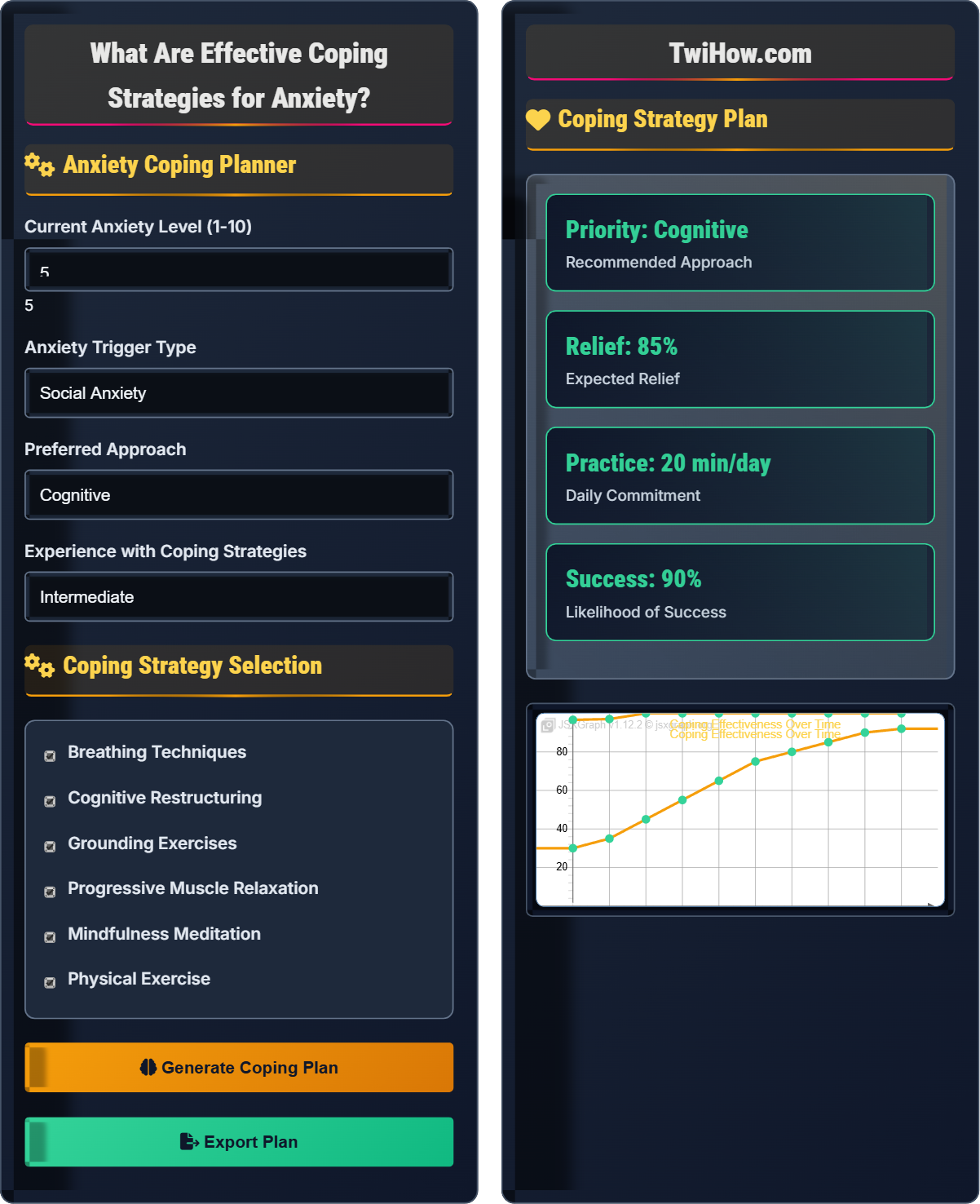
Anxiety Coping Planner
Coping Strategy Selection
Coping Strategy Plan
| Strategy | Priority | Effectiveness | Implementation |
|---|---|---|---|
| Deep Breathing | High | 80% | Practice 5 min, 3x/day |
| Cognitive Reframing | High | 75% | Daily thought tracking |
| Grounding Exercises | Medium | 70% | As needed basis |
| Muscle Relaxation | Medium | 65% | 10 min, daily |
| Mindfulness Practice | High | 75% | 15 min, daily |
Anxiety Coping Strategies Explained
Anxiety coping strategies are specific techniques and approaches used to manage and reduce anxiety symptoms. These strategies work by addressing the physical, cognitive, and behavioral aspects of anxiety, helping individuals regain control and reduce the impact of anxiety on their daily lives. Effective coping involves both immediate relief techniques for acute anxiety episodes and long-term management approaches.
Effective anxiety coping follows a comprehensive framework:
Where:
- Strategy Match: How well the technique matches the anxiety type
- Consistency: Regular practice and application of techniques
- Practice: Amount of time invested in developing skills
- Anxiety Triggers: Number and intensity of anxiety-inducing situations
Key areas where anxiety coping strategies provide significant benefits:
- Social Situations: Managing social anxiety and public speaking
- Performance Situations: Reducing performance anxiety and test anxiety
- Everyday Stress: Handling daily stress and worry
- Panic Episodes: Managing acute panic attacks
- Generalized Worry: Addressing chronic anxiety and overthinking
- Sleep Issues: Improving sleep quality affected by anxiety
- Immediate Relief: Techniques for acute anxiety episodes
- Cognitive Strategies: Changing thought patterns and beliefs
- Behavioral Approaches: Modifying behaviors and responses
- Physical Techniques: Using body-based methods
- Lifestyle Modifications: Long-term habit changes
Coping Strategies Fundamentals
Anxiety coping, stress management, relaxation techniques, cognitive behavioral therapy, mindfulness, anxiety relief.
Coping Effectiveness = (Strategy Match + Consistency + Practice) / Anxiety Triggers
Where Strategy Match = technique-appropriateness, Consistency = regular application.
- Practice makes progress
- Consistency is more important than perfection
- Match strategies to specific situations
Application Strategies
Breathing exercises, cognitive restructuring, mindfulness meditation, progressive muscle relaxation, grounding techniques.
- Start with one technique
- Practice daily for consistency
- Gradually add more strategies
- Track progress and effectiveness
- Individual responses vary
- Some techniques take time to master
- Combine multiple approaches
- Seek professional help when needed
Anxiety Coping Strategies Learning Quiz
Which breathing technique is most effective for immediate anxiety relief?
Slow, deep diaphragmatic breathing is the most effective breathing technique for immediate anxiety relief. This technique activates the parasympathetic nervous system, which helps calm the body's stress response. Deep breathing increases oxygen flow, slows heart rate, and promotes a sense of calm. The key is to breathe slowly and deeply from the diaphragm rather than shallow breathing from the chest.
The answer is B) Slow, deep diaphragmatic breathing.
Diaphragmatic breathing works by stimulating the vagus nerve, which is responsible for calming the nervous system. This technique is simple to learn and can be done anywhere. The 4-7-8 breathing method (inhale for 4, hold for 7, exhale for 8) is a specific example of effective diaphragmatic breathing for anxiety.
Diaphragmatic Breathing: Breathing from the diaphragm rather than chest
Parasympathetic Nervous System: Calming branch of the nervous system
4-7-8 Breathing: Specific breathing technique for relaxation
• Deep breathing activates calm response
• Slow pace is essential
• Practice regularly for effectiveness
• Place hand on stomach to feel diaphragm
• Breathe in through nose, out through mouth
• Start with 3-5 minute sessions
• Breathing too quickly
• Not breathing deeply enough
• Not practicing consistently
Explain the process of cognitive restructuring and how it helps manage anxiety, including specific steps for identifying and challenging anxious thoughts.
Cognitive Restructuring Process:
Cognitive restructuring is a core component of cognitive-behavioral therapy (CBT) that helps identify and change negative thought patterns that fuel anxiety. The process involves examining the evidence for and against anxious thoughts.
Specific Steps:
1. Thought Awareness: Recognize the anxious thought when it occurs ("I'm going to fail this presentation")
2. Thought Examination: Look for evidence that supports and contradicts the thought
3. Alternative Thinking: Develop a more balanced, realistic thought ("I prepared well and will do my best")
4. Reality Testing: Evaluate how realistic the original thought was
5. Reframing: Replace the anxious thought with a balanced one
How It Helps: This process breaks the cycle of anxious thinking by challenging irrational or catastrophic thoughts. It helps create more realistic perspectives, reducing the intensity of anxiety responses and preventing escalation.
Cognitive restructuring works by addressing the cognitive component of anxiety - the thoughts that fuel anxious feelings. By learning to question and modify these thoughts, individuals can reduce anxiety intensity and frequency. The technique requires practice to become automatic, but it's highly effective for long-term anxiety management.
Cognitive Restructuring: Process of identifying and changing negative thoughts
Cognitive-Behavioral Therapy: Therapy focusing on thoughts and behaviors
Thought Awareness: Recognizing anxious thoughts when they occur
• Challenge rather than accept thoughts
• Look for evidence
• Create balanced perspectives
• Keep a thought diary
• Ask "Is this thought helpful?"
• Practice with small anxieties first
• Accepting thoughts as facts
• Not challenging negative thoughts
• Expecting immediate results
A person experiences severe social anxiety before and during presentations. They often feel their mind going blank, experience physical symptoms like sweating and shaking, and avoid social situations. Design a comprehensive coping plan that addresses both immediate relief during presentations and long-term anxiety management.
Immediate Relief Strategies:
1. Deep Breathing: Practice 4-7-8 breathing before and during presentations
2. Grounding Techniques: Use 5-4-3-2-1 method to stay present (identify 5 things you see, 4 you hear, etc.)
3. Positive Self-Talk: Replace "I'm going to mess up" with "I'm prepared and capable"
Preparation Strategies:
4. Visualization: Practice imagining successful presentation scenarios
5. Progressive Exposure: Start with smaller audiences and gradually increase
6. Preparation Ritual: Develop a calming pre-presentation routine
Long-term Management:
7. Cognitive Restructuring: Challenge catastrophic thinking about presentations
8. Mindfulness Practice: Daily meditation to improve overall anxiety management
9. Physical Exercise: Regular exercise to reduce baseline anxiety levels
Implementation: Practice techniques daily, start with low-stakes presentations, gradually build confidence through small successes.
This example demonstrates how to combine immediate relief techniques with long-term management strategies. The key is addressing both the physical and cognitive aspects of social anxiety while building confidence through gradual exposure. Success comes from consistent practice and patience with the process.
Social Anxiety: Fear of social or performance situations
Progressive Exposure: Gradually facing feared situations
Grounding Techniques: Methods to stay present in the moment
• Combine immediate and long-term strategies
• Practice consistently
• Start with small steps
• Prepare thoroughly for presentations
• Practice with trusted individuals first
• Focus on message rather than audience
• Avoiding all social situations
• Not practicing coping techniques
• Expecting perfection immediately
You're helping someone who experiences panic attacks and dissociation. Explain how grounding techniques can help and provide specific examples of different types of grounding exercises.
How Grounding Helps:
Grounding techniques help bring attention back to the present moment, counteracting the dissociation and disconnection that often accompany panic attacks. They provide sensory input that reconnects the person to their immediate environment.
Types of Grounding Techniques:
1. Physical Grounding:
• Press palms firmly against a surface and feel the pressure
• Hold a textured object (stone, fabric) and feel its texture
• Splash cold water on face or hold ice cubes
2. Sensory Grounding:
• 5-4-3-2-1 technique: identify 5 things you see, 4 you hear, 3 you touch, 2 you smell, 1 you taste
• Focus on a specific object and describe its details
• Listen to music or nature sounds
3. Mental Grounding:
• Count backwards from 100 by 7s
• Recite familiar poems or song lyrics
• Name items in a category (types of cars, states, etc.)
Grounding techniques are immediate, practical tools that can be used anywhere to regain connection to the present moment.
Grounding techniques work by engaging the senses and bringing attention to the present moment, which interrupts the dissociative process. They're particularly effective for panic attacks because they're immediate, don't require special equipment, and can be done discretely. The variety of techniques allows individuals to find what works best for them.
Grounding: Techniques to stay present in the moment
Dissociation: Feeling disconnected from reality or self
Panic Attack: Sudden episode of intense anxiety
• Engage multiple senses
• Focus on present moment
• Practice regularly
• Have grounding objects ready
• Practice when calm
• Find what works best
• Not practicing when calm
• Expecting immediate results
• Using only one technique
What is the primary benefit of progressive muscle relaxation for anxiety management?
Progressive muscle relaxation creates awareness of muscle tension and promotes relaxation by systematically tensing and then relaxing different muscle groups. This technique helps individuals recognize when they're holding tension and provides a method for releasing it. It's particularly effective for anxiety because anxiety often manifests as physical tension throughout the body.
The answer is B) Creates awareness of muscle tension and promotes relaxation.
Progressive muscle relaxation works by creating a contrast between tension and relaxation, making individuals more aware of physical tension they may not have noticed. This awareness is the first step in learning to release tension. The technique also activates the parasympathetic nervous system, promoting a calm state.
Progressive Muscle Relaxation: Tensing and relaxing muscle groups
Muscle Tension: Physical manifestation of stress and anxiety
Parasympathetic Nervous System: Calming system of the body
• Tense then relax muscles
• Hold tension briefly
• Focus on relaxation
• Start with 5-10 minute sessions
• Focus on breathing during relaxation
• Practice regularly for best results
• Not holding tension long enough
• Rushing through the process
• Not practicing consistently
FAQ
Q: How long does it take for coping strategies to work?
A: The time it takes for coping strategies to work varies depending on the type of strategy and individual factors:
Immediate Relief Strategies:
• Deep breathing: Within minutes during practice
• Grounding techniques: Within seconds to minutes
• Progressive muscle relaxation: Within 10-15 minutes
Learning and Mastery:
• Cognitive restructuring: 1-2 weeks of consistent practice
• Mindfulness meditation: 2-4 weeks to notice significant changes
• Behavioral changes: 4-8 weeks of consistent practice
Long-term Benefits:
• Significant anxiety reduction: 8-12 weeks of consistent practice
• Automatic response: 3-6 months of consistent practice
Factors That Influence Timing:
• Consistency of practice
• Severity of anxiety
• Previous experience with similar techniques
• Individual learning style
• Quality of instruction
Remember that some techniques provide immediate relief while others build skills over time. Consistency is more important than perfection.
Q: Can anxiety coping strategies completely eliminate anxiety?
A: Anxiety coping strategies are designed to manage and reduce anxiety, not eliminate it entirely:
Why Complete Elimination Isn't the Goal:
• Anxiety is a normal human emotion that serves important functions
• Some anxiety can be motivating and protective
• Complete elimination isn't realistic or necessary
• The goal is to manage anxiety to a tolerable level
Realistic Expectations:
• Significant reduction (50-80%) in anxiety symptoms
• Better ability to cope with anxiety when it occurs
• Reduced frequency and intensity of anxiety episodes
• Improved functioning in daily life despite some anxiety
What Strategies Can Achieve:
• Better emotional regulation
• Reduced physical symptoms
• Improved ability to face feared situations
• Enhanced overall quality of life
When to Seek Additional Help:
• If anxiety significantly interferes with daily functioning
• If coping strategies aren't providing sufficient relief
• If anxiety is accompanied by other mental health concerns
• If there are thoughts of self-harm or suicide
The goal is to develop a toolkit of strategies that help manage anxiety effectively, not to eliminate it entirely.