Healthy vs Unhealthy Coping Mechanisms
Complete mental health guide • Step-by-step explanations
Coping Fundamentals:
Show Coping SimulatorCoping mechanisms are behavioral or psychological strategies we use to deal with stress, trauma, or difficult emotions. Understanding the difference between healthy and unhealthy coping mechanisms is crucial for maintaining mental health and well-being.
Healthy coping mechanisms address the root cause of stress and promote long-term well-being, while unhealthy coping mechanisms provide temporary relief but often worsen problems over time.
Key coping concepts:
- Emotion-focused coping: Managing emotional responses to stress
- Problem-focused coping: Addressing the source of stress directly
- Social support: Seeking help from others
- Self-care: Maintaining physical and mental health
Effective coping involves recognizing your stress triggers, understanding your current coping patterns, and developing healthier alternatives that promote resilience and emotional stability.
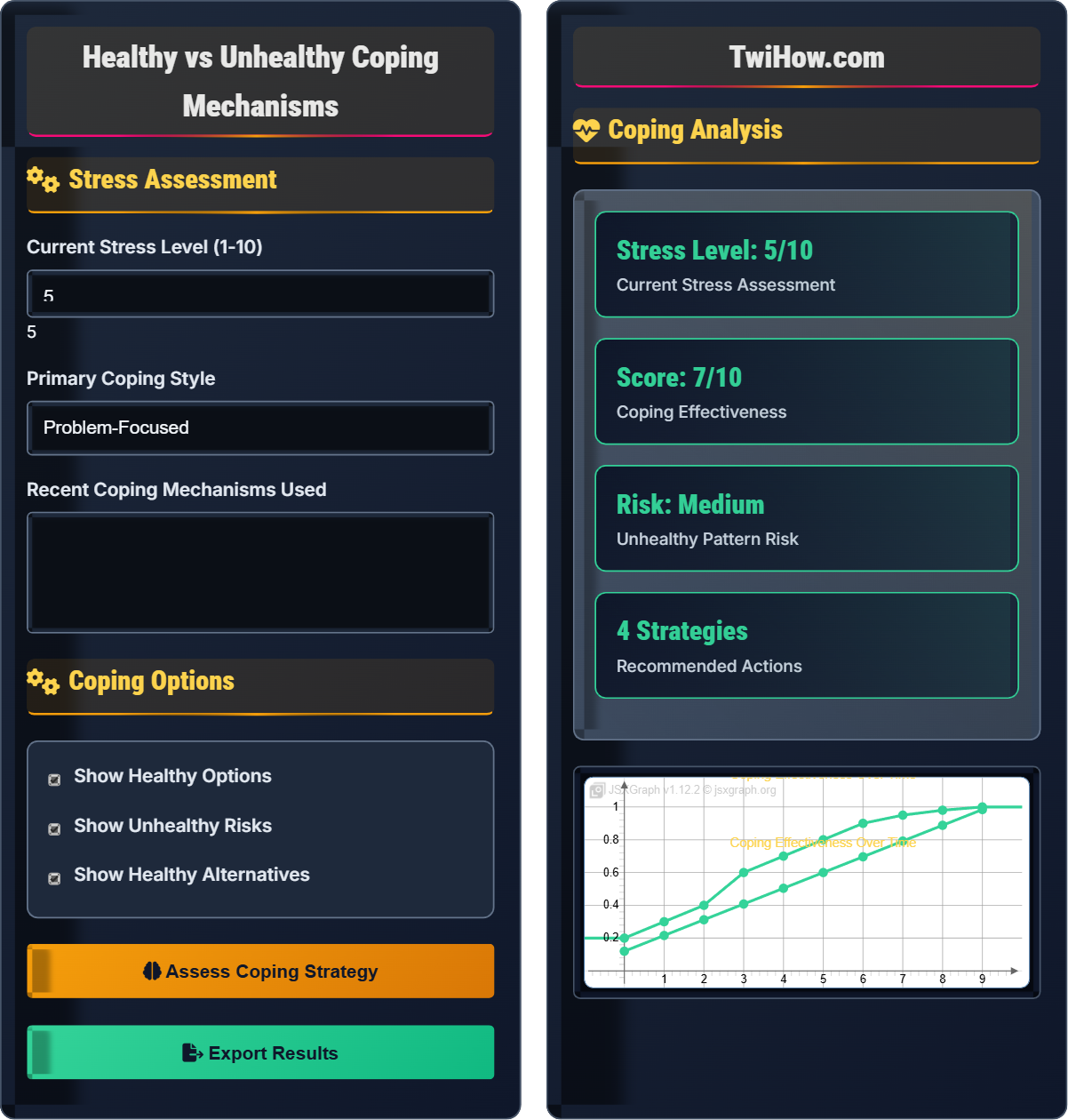
Stress Assessment
Coping Options
Coping Analysis
| Strategy | Type | Effectiveness | Risk Level |
|---|---|---|---|
| Exercise | Healthy | High | Low |
| Meditation | Healthy | High | Low |
| Socializing | Healthy | Medium | Low |
| Avoidance | Unhealthy | Low | High |
Physical activity releases endorphins and reduces stress hormones like cortisol and adrenaline.
Using alcohol or drugs to numb emotional pain can lead to addiction and worsen problems.
Understanding Coping Mechanisms
Coping mechanisms are conscious or unconscious efforts to manage stress and difficult emotions. They serve as our psychological defense systems against overwhelming feelings and situations. There are two main categories:
- Healthy Coping: Strategies that address problems constructively and promote long-term well-being
- Unhealthy Coping: Behaviors that provide temporary relief but often create additional problems
The effectiveness of coping mechanisms can be measured by their impact on mental health, relationships, and overall functioning.
The coping process follows a structured approach:
Where:
- Stressor: The situation or event causing stress
- Appraisal: How we interpret and evaluate the stressor
- Coping Strategy: Our chosen response method
- Outcome: The result of our coping effort
Effective coping mechanisms are applied in various life situations:
- Workplace Stress: Time management, boundary setting, breaks
- Relationship Issues: Communication, therapy, self-reflection
- Financial Problems: Budgeting, seeking advice, planning
- Health Concerns: Medical care, lifestyle changes, support groups
- Grief & Loss: Counseling, memorial activities, social support
- Academic Pressure: Study skills, time management, breaks
- Problem-focused: Address the source of stress directly
- Emotion-focused: Manage emotional responses to stress
- Meaning-focused: Find purpose in difficult situations
- Acceptance-focused: Acknowledge and accept what cannot be changed
- Avoidance-focused: Temporarily avoid or ignore stressors (can be healthy short-term)
Healthy Coping Mechanisms
Physical exercise, meditation, journaling, social support, creative expression, nature walks.
Positive Outcome = (Coping Strategy × Consistency) + Social Support - Negative Consequences
Where Positive Outcome = improved well-being, Coping Strategy = healthy method, Consistency = regular practice.
- Address root causes of stress
- Promote long-term well-being
- Build resilience and skills
Unhealthy Coping Mechanisms
Substance abuse, avoidance, isolation, overeating, self-harm, excessive gaming.
- Temporary relief from stress
- Increased problems over time
- Escalation of coping behaviors
- Deterioration of well-being
- Short-term relief with long-term consequences
- Dependency on the behavior
- Negative impact on daily functioning
- Avoiding responsibility or growth
Healthy vs Unhealthy Coping Comparison
Physical activity releases endorphins and reduces stress hormones like cortisol and adrenaline.
Using alcohol or drugs to numb emotional pain can lead to addiction and worsen problems.
Connecting with trusted friends or family members provides emotional support and perspective.
Withdrawing from social connections can increase feelings of loneliness and depression.
Writing down thoughts and feelings helps process emotions and gain clarity.
Constantly avoiding problems prevents resolution and often increases anxiety.
Coping Mechanisms Learning Quiz
Which of the following is an example of a healthy emotion-focused coping mechanism?
Emotion-focused coping strategies aim to manage the emotional response to stress rather than changing the stressor itself. Mindfulness meditation is an excellent example of emotion-focused coping that helps regulate emotions and reduce stress responses.
The answer is C) Practicing mindfulness meditation.
It's important to distinguish between emotion-focused and problem-focused coping. Emotion-focused coping doesn't change the stressor but helps manage the emotional reaction to it. This is particularly useful when the stressor cannot be changed (like grieving a loss). Mindfulness meditation trains attention and awareness, helping individuals observe their emotions without being overwhelmed by them.
Emotion-focused coping: Strategies that aim to regulate emotional responses to stress
Problem-focused coping: Strategies that aim to change or eliminate the stressor
Mindfulness: Awareness of the present moment without judgment
• Both emotion and problem-focused strategies are needed
• Emotion-focused is effective for uncontrollable stressors
• Healthy strategies don't create additional problems
• Match coping strategy to the type of stressor
• Combine multiple healthy approaches
• Practice regularly for maximum benefit
• Confusing problem and emotion-focused strategies
• Using only one type of coping
• Choosing strategies that create new problems
Analyze the difference between problem-focused and emotion-focused coping strategies. Provide examples of when each type would be most appropriate and explain why.
Problem-focused coping: Directly addresses the stressor by taking action to change or eliminate it. Examples include studying harder for poor grades, confronting someone about a conflict, or creating a budget for financial stress.
Emotion-focused coping: Manages the emotional response to stress without necessarily changing the stressor. Examples include meditation, talking to friends, or engaging in hobbies during stressful times.
Appropriate use: Problem-focused is best when the stressor is controllable (work deadline, relationship conflict). Emotion-focused is more appropriate when the stressor is uncontrollable (grief, chronic illness, natural disasters).
The effectiveness of coping strategies depends on the nature of the stressor. Research shows that matching the coping approach to the controllability of the stressor leads to better outcomes. When facing an exam, problem-focused strategies like studying are most effective. When dealing with a loved one's terminal illness, emotion-focused strategies like counseling or support groups may be more appropriate since the situation itself cannot be changed.
Controllable stressor: Situation that can be changed through action
Uncontrollable stressor: Situation that cannot be changed
Stress appraisal: Evaluation of whether a situation is threatening
• Assess controllability before choosing strategy
• Flexibility between approaches is important
• Some situations require both approaches
• Ask: "Can I change this situation?"
• Use problem-focused first when possible
• Switch to emotion-focused if problem-focused fails
• Trying to solve uncontrollable situations
• Ignoring controllable stressors
• Sticking rigidly to one approach
Sarah is a college student experiencing significant academic stress due to upcoming finals, a part-time job, and family responsibilities. She has been skipping meals, staying up late, and drinking coffee constantly to keep up. Recently, she started smoking cigarettes to "calm her nerves." Identify Sarah's current coping mechanisms and recommend a comprehensive healthy alternative plan.
Sarah's current unhealthy coping mechanisms: Skipping meals (neglecting physical needs), sleep deprivation (poor recovery), excessive caffeine (temporary stimulant), smoking (addictive substance use).
Recommended healthy alternatives: 1) Time management and scheduling to balance responsibilities, 2) Regular sleep schedule with 7-9 hours nightly, 3) Balanced nutrition with regular meals, 4) Exercise for stress relief, 5) Mindfulness techniques for relaxation, 6) Academic support services for study strategies.
Implementation: Start with small changes, prioritize sleep and nutrition, gradually replace unhealthy habits with healthy ones.
This scenario demonstrates how multiple stressors can lead to maladaptive coping strategies. Sarah's approach is problematic because she's trying to manage stress through behaviors that actually increase stress on her body. The key is addressing the underlying time management and stress issues while building healthy foundational habits like proper nutrition and sleep, which support all other coping efforts.
Maladaptive coping: Strategies that increase problems over time
Foundational habits: Basic health practices that support all coping
Gradual replacement: Replacing unhealthy habits with healthy ones slowly
• Address basic needs first (sleep, nutrition, safety)
• Make sustainable, gradual changes
• Seek support when overwhelmed
• Prioritize basic needs before advanced strategies
• Build a support network early
• Use multiple healthy strategies together
• Trying to change everything at once
• Neglecting basic physical needs
• Avoiding help when needed
You notice a friend has been increasingly isolated, declining invitations, and seems irritable. They mention feeling overwhelmed but refuse to discuss details. Analyze this situation and propose strategies to help them recognize and change potentially unhealthy coping patterns.
Signs of unhealthy coping: Social withdrawal (isolation), irritability (poor emotional regulation), avoidance (refusing to discuss problems).
Approach strategy: 1) Express concern non-judgmentally, 2) Listen actively without offering immediate solutions, 3) Encourage professional help if needed, 4) Suggest healthy alternatives like exercise or social activities, 5) Offer consistent support.
Key principle: Avoid pushing or forcing, instead provide gentle encouragement toward positive change while respecting their autonomy.
Recognizing unhealthy coping in others requires sensitivity and understanding. The goal isn't to fix someone else but to offer support and resources. Effective intervention involves validating their experience, normalizing the struggle, and gently guiding toward healthier options. The person must want to change, but support can make the difference between remaining stuck and moving forward.
Active listening: Fully focusing on and understanding another person
Non-judgmental approach: Supporting without criticism
Autonomy: Respecting individual choice and control
• Respect the person's autonomy
• Focus on listening rather than fixing
• Encourage but don't force professional help
• Use "I" statements when expressing concern
• Offer specific, concrete support
• Be patient with resistance to change
• Trying to solve problems for others
• Being judgmental about choices
• Giving up after initial resistance
Which of the following best describes the long-term outcome of consistently using healthy coping mechanisms?
Healthy coping mechanisms build psychological resilience over time. Regular use of healthy strategies like exercise, meditation, and social support strengthens the brain's ability to handle stress, leading to improved emotional regulation and reduced reactivity to future stressors. This creates a positive cycle where stress becomes more manageable.
The answer is B) Increased resilience and improved stress management.
The concept of neuroplasticity explains how repeated healthy coping behaviors literally change brain structure over time, strengthening neural pathways associated with stress regulation. This is why consistent practice of healthy coping strategies becomes easier and more effective. Unlike unhealthy coping which creates dependency and tolerance, healthy coping builds capacity and confidence in handling future challenges.
Resilience: Ability to recover from or adapt to adversity
Neuroplasticity: Brain's ability to reorganize and form new connections
Tolerance: Need for increasing amounts of a substance
• Consistency builds resilience over time
• Healthy coping creates positive cycles
• Skills improve with practice
• Start with small, manageable changes
• Track progress to stay motivated
• Expect setbacks but persist
• Expecting immediate results
• Giving up after setbacks
• Comparing to others' progress
FAQ
Q: How do I know if my coping mechanisms are healthy or unhealthy?
A: Healthy coping mechanisms generally have these characteristics:
1. Long-term effectiveness: They reduce stress without creating new problems
2. No negative side effects: They don't harm your health, relationships, or responsibilities
3. Build resilience: They strengthen your ability to handle future stress
4. Don't create dependency: You can stop or modify the behavior without negative consequences
Unhealthy coping mechanisms often provide immediate relief but create problems in other areas of life, require increasing amounts over time, or interfere with daily functioning. If you find yourself needing a behavior more frequently or it's affecting your work, relationships, or health, it may be unhealthy.
Q: What's the difference between occasional use of an unhealthy coping mechanism and having an unhealthy coping pattern?
A: The key differences are frequency, dependency, and impact:
Occasional use: May happen during extreme stress, doesn't interfere with daily life, you can easily return to healthy strategies, doesn't require increasing amounts over time.
Unhealthy pattern: Becomes the primary way of coping, interferes with work or relationships, requires more frequent or intense use for the same effect, creates additional problems.
For example, having a drink occasionally to unwind after a particularly stressful day is different from drinking every day to avoid dealing with problems. The pattern becomes concerning when it's the only coping strategy you rely on or when it starts causing more problems than it solves.