What Are Healthy Ways to Process Grief?
Complete grief management guide • Step-by-step explanations
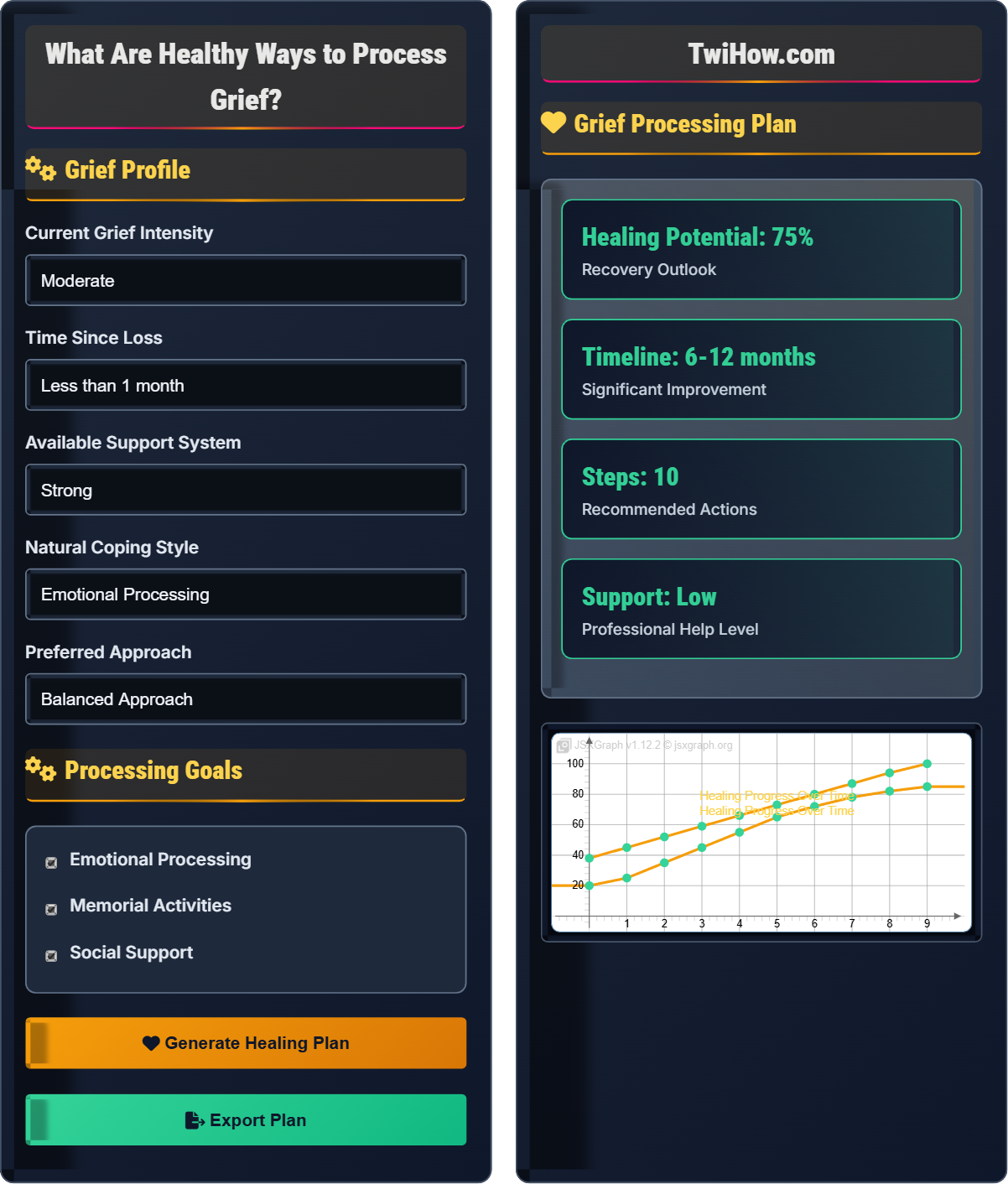
Healthy Grief Processing:
Show Grief Processing ToolHealthy grief processing involves allowing yourself to feel and express the full range of emotions that come with loss, seeking appropriate support, and engaging in activities that honor the deceased while maintaining your own well-being. Grief is not a linear process and varies greatly among individuals.
Grief processing works through acknowledging the loss, experiencing the emotional pain, adjusting to a new reality without the deceased, and eventually finding ways to maintain a connection while moving forward. The goal is not to "get over" the loss but to integrate it into your life in a healthy way.
Key healthy approaches include:
- Emotional Expression: Allowing and expressing feelings without judgment
- Social Support: Connecting with others who understand and support you
- Memorial Activities: Creating meaningful ways to remember and honor the deceased
- Self-Care: Maintaining physical and emotional health during the process
- Professional Help: Seeking counseling when needed
With proper support and healthy coping strategies, grief can become integrated into life in a way that honors both the loss and the continuing journey.
Grief Profile
Processing Goals
Grief Processing Plan
| Strategy | Method | Frequency | Difficulty |
|---|---|---|---|
| Emotional Expression | Journal writing | Daily | Easy |
| Social Support | Support group | Weekly | Medium |
| Memorial Activities | Memory book | As needed | Easy |
| Self-Care | Regular exercise | 3x/week | Medium |
Healthy Grief Processing Explained
Grief is the natural response to loss, encompassing a wide range of emotions including sadness, anger, guilt, confusion, and even relief. It's not a disorder but a normal human response to the death of someone significant in your life. Grief is highly individual and doesn't follow a predictable timeline or pattern.
Healthy grief processing involves allowing yourself to experience these emotions while gradually adapting to life without the deceased. The goal is integration of the loss into your life story rather than forgetting or moving past it completely.
Healing = (Acceptance × Expression × Support) ÷ (Suppression + Isolation)
Where:
- Acceptance: Acknowledging the reality of the loss
- Expression: Allowing and processing emotions
- Support: Seeking and receiving help from others
- Suppression: Attempting to avoid emotions
- Isolation: Withdrawing from social connections
Proven strategies for healthy grief processing include:
- Emotional Expression: Crying, talking, writing, or creating art to process feelings
- Social Support: Connecting with family, friends, or support groups
- Memorial Activities: Creating photo albums, planting trees, or establishing scholarships
- Self-Care: Maintaining physical health through nutrition, exercise, and sleep
- Professional Help: Seeking counseling when grief feels overwhelming
- Routine Maintenance: Keeping up with daily activities and responsibilities
- Spiritual Practices: Prayer, meditation, or connecting with faith community
- Legacy Projects: Continuing the deceased's work or values
- Individual Variation: Everyone grieves differently and at their own pace
- No Timeline: There's no "normal" length of time for grief
- Non-Linear Process: Good days and bad days are normal
- Anniversary Reactions: Special dates may trigger renewed grief
- Complicated Grief: Professional help may be needed for prolonged difficulty
- Co-occurring Issues: Grief may be complicated by depression or anxiety
Grief Processing Fundamentals
Grief, mourning, bereavement, loss, acceptance, integration, healing.
Healing = (Acknowledgment + Expression + Connection) ÷ (Avoidance × Isolation)
Where Healing indicates recovery progress, components are weighted by therapeutic effectiveness.
- There's no right or wrong way to grieve
- Feelings are temporary, but memories last forever
- Healing doesn't mean forgetting
Applications
Support groups, grief counseling, memorial services, legacy projects, self-care routines.
- Accept the reality of loss
- Experience the pain of grief
- Adjust to a world without the deceased
- Find a way to maintain connection while moving forward
- Individual responses vary greatly
- Professional help is available
- Support systems are crucial
- Healing takes time
Grief Processing Learning Quiz
Which of the following is a common myth about grief?
The myth is that there's a standard timeline for grief. In reality, grief is highly individual and doesn't follow a predictable schedule. While some people may feel better within weeks or months, others may experience intense grief for years. The idea that grief should follow a specific timeline (like "one year for major holidays") is a harmful myth that can create additional pressure on those who are grieving.
The answer is B) There's a standard timeline for grief.
Understanding grief myths is crucial for healthy processing. The timeline myth is particularly damaging because it can make people feel abnormal if their grief doesn't resolve within expected timeframes. This can lead to suppression of emotions and prolonged suffering. Healthy grief processing requires accepting that there's no "normal" duration for grief.
Grief: Natural response to loss
Myth: False belief about grief process
Individual Variation: Different responses to loss
• Grief has no timeline
• Everyone grieves differently
• Feelings are valid regardless of duration
• Don't compare your grief to others
• Trust your own process
• Be patient with yourself
• Expecting grief to follow a schedule
• Comparing grief timelines
• Feeling guilty about duration
Explain the traditional stages of grief model and discuss its current understanding in grief counseling.
Traditional Five Stages Model (Kübler-Ross):
1. Denial: Refusing to accept the reality of the loss. "This can't be happening."
2. Anger: Feeling mad at God, the deceased, or others. "Why did this happen?"
3. Bargaining: Attempting to negotiate to reverse the loss. "If I do this, maybe they'll come back."
4. Depression: Sadness and regret about the loss. "I can't live without them."
5. Acceptance: Coming to terms with the reality of the loss. "I can live with this."
Current Understanding:
Non-Linear Process: Grief doesn't follow a linear sequence. People may experience stages in different orders, revisit stages multiple times, or skip stages entirely.
Individual Variation: The model was originally developed for people facing their own death, not for bereaved individuals. Grief is highly individual.
Integrated Model: Modern grief counseling focuses on tasks rather than stages:
• Accepting the reality of the loss
• Processing the pain of grief
• Adjusting to a world without the deceased
• Finding a way to maintain connection while moving forward
Current Research: Studies show that the stage model doesn't accurately reflect most people's grief experiences. Many people experience grief in waves, with good and bad days, rather than progressing through discrete stages.
Practical Application: While the stages model can provide a framework for understanding that grief involves different emotional states, it's more important to recognize that grief is highly individual and non-linear.
The evolution of grief understanding shows how scientific knowledge develops. The Kübler-Ross model was groundbreaking but has been refined based on research and clinical experience. This demonstrates the importance of staying informed about current understanding rather than rigidly adhering to older models.
Kübler-Ross Model: Traditional stages of grief
Non-Linear: No predictable sequence
Integrated Model: Modern grief approach
• Grief is not linear
• Individual experiences vary
• Models are guides, not rules
• Use models as guides, not rigid frameworks
• Expect variability in emotions
• Trust your own process
• Expecting to follow stages in order
• Feeling abnormal for skipping stages
• Thinking stages are required
Sarah lost her mother six months ago and has a small circle of close friends, but they don't seem to know how to support her. She feels isolated and misunderstood. What strategies should she pursue to build an effective support system?
Strategies for Building Support System:
1. Expand Support Sources: Don't rely solely on friends who may be uncomfortable with grief. Consider:
• Grief support groups (specific to loss type)
• Bereavement counseling services
• Religious or spiritual communities
• Online grief support communities
2. Educate Your Current Support: Help your friends understand how they can support you:
• Tell them specific things that help: "Just sitting with me helps" or "I'd like to talk about Mom."
• Let them know what doesn't help: "Please don't say 'she's in a better place'" or "I don't need advice, just listening."
• Share resources about grief with them so they understand what you're going through.
3. Seek Similar Experiences: Connect with others who have experienced similar losses:
• Mother loss support groups
• Age-specific grief groups (if you're younger)
• Cultural or ethnic-specific support groups
4. Professional Support: Consider individual counseling with a grief specialist who can provide support and teach coping strategies.
5. Creative Expression: Join groups that combine grief support with creative outlets:
• Grief writing groups
• Art therapy groups
• Music therapy sessions
6. Legacy Activities: Engage in activities that honor your mother's memory while connecting with others:
• Volunteer for causes she supported
• Create a memorial project
• Plant a garden in her memory
7. Patience and Persistence: Building a new support system takes time. Try different options until you find what works for you.
Remember that grief support is about finding people who understand your experience and can provide empathy, not necessarily solving your problems.
Grief support often requires expanding beyond one's immediate circle because the loss may be difficult for close friends to understand or relate to. The key is finding others who share similar experiences or have specialized training in grief support. This demonstrates that healing sometimes requires seeking out specific types of support rather than relying only on traditional social networks.
Support System: Network of people providing help
Grief Support Groups: Groups for people with similar losses
Legacy Activities: Honoring memory through meaningful actions
• Don't limit support to current friends
• Seek others with similar experiences
• Be specific about support needs
• Try different types of support groups
• Educate others about your needs
• Combine grief with meaningful activities
• Expecting friends to understand grief
• Not seeking specialized support
• Isolating during difficult times
John wants to honor his father's memory through meaningful memorial activities but isn't sure what would be appropriate or helpful. What types of memorial activities are most beneficial for healthy grief processing, and how should he choose them?
Beneficial Memorial Activities:
1. Personal Memory Projects:
• Create a photo album or scrapbook with memories and stories
• Write letters to the deceased
• Record stories about the deceased from others
• Create a memory box with meaningful items
2. Ongoing Memorial Activities:
• Plant a tree or garden in their memory
• Establish a scholarship or donation fund
• Create an annual event or tradition
• Continue their hobbies or interests
3. Community-Based Memorials:
• Volunteer for causes they supported
• Organize community service projects
• Support organizations they valued
• Participate in fundraising events
4. Creative Expression:
• Write poetry or stories about the relationship
• Create art or crafts that honor their memory
• Compile recipes or favorite quotes
• Make a video tribute
How to Choose Memorial Activities:
Consider Their Values: What did your father care about? What would he appreciate?
Match Your Personality: Choose activities that feel comfortable and meaningful to you.
Practical Considerations: What fits your schedule, budget, and abilities?
Involve Others: Consider activities that allow family and friends to participate.
Long-term Sustainability: Choose activities you can maintain over time.
Personal Significance: Focus on what feels meaningful rather than what seems "appropriate" to others.
Flexibility: Be willing to modify or change activities as your needs evolve.
Therapeutic Benefits: Choose activities that allow for emotional expression and reflection.
Important Considerations:
Timing: Some memorial activities may feel too overwhelming initially. It's okay to wait until you're ready.
Evolution: Your relationship with memorial activities may change over time. What feels helpful now may change later.
Balance: Memorial activities should honor the deceased while supporting your ongoing life.
Remember that memorial activities are for your healing and should feel meaningful to you, not just serve as public tributes.
Memorial activities serve multiple purposes in grief processing: they provide ongoing connection to the deceased, create positive outlets for emotions, and help integrate the loss into life in a meaningful way. The key is choosing activities that feel personally meaningful rather than socially expected, and understanding that the relationship with these activities may evolve over time.
Memorial Activities: Actions honoring the deceased
Personal Significance: Meaning to the individual
Therapeutic Benefits: Healing effects of activities
• Choose activities that feel meaningful
• Consider the deceased's values
• Allow for flexibility over time
• Start with simple activities
• Involve others when appropriate
• Be patient with the process
• Choosing activities based on others' expectations
• Feeling pressured to do elaborate memorials
• Not allowing activities to evolve over time
Which of the following indicates that professional grief counseling may be beneficial?
Professional grief counseling may be beneficial when intense grief symptoms interfere with daily functioning for several months. This includes symptoms like inability to perform basic self-care, severe depression, thoughts of self-harm, complete inability to function at work or in relationships, or grief that feels overwhelming and unmanageable. While normal grief involves sadness, sleep difficulties, and missing the deceased, professional help becomes important when these symptoms severely impact daily life for an extended period.
The answer is C) Experiencing intense grief symptoms that interfere with daily functioning for several months.
It's important to distinguish between normal grief reactions and symptoms that indicate the need for professional support. Normal grief includes sadness, sleep disruption, and missing the deceased - these are expected parts of the process. Professional help becomes important when grief significantly impairs functioning, suggesting complicated grief or co-occurring depression or anxiety that may benefit from specialized intervention.
Professional Help: Support from trained counselors
Complicated Grief: Prolonged, severe grief symptoms
Daily Functioning: Ability to perform normal activities
• Seeking help is a sign of strength
• Normal grief includes sadness
• Professional support available when needed
• Don't wait until crisis point
• Many counselors specialize in grief
• Support groups are also available
• Thinking grief should be handled alone
• Waiting until symptoms are severe
• Believing professional help means weakness
FAQ
Q: I feel like I should be "over" my grief by now, but I'm still struggling. Am I doing something wrong?
A: You're absolutely not doing anything wrong. Grief doesn't have a timeline, and there's no "normal" amount of time to grieve:
Grief is Individual: Everyone processes loss differently based on their relationship with the deceased, personality, support system, and other factors.
Non-Linear Process: Grief comes in waves. You might have good days followed by difficult ones, and that's completely normal.
Anniversary Reactions: Certain dates, holidays, or events may trigger renewed grief even years later.
Complicated Relationships: If your relationship with the deceased was complex, grief may be more complicated and take longer.
Significant Loss: Major losses (spouse, child, parent) often require more time to process.
Support Factors: Those with limited support systems may need more time to process.
Healing vs. Forgetting: Healthy grief processing means integrating the loss into your life, not forgetting or "getting over" it.
Current Understanding: Mental health professionals now understand that grief is a lifelong process of integration, not something to "get over." The goal is learning to live with the loss in a way that honors both the deceased and your ongoing life.
Be patient with yourself and trust your own process. If your grief feels overwhelming or is significantly interfering with your ability to function, consider seeking professional support, but don't feel guilty about the time it takes to heal.
Q: How do I maintain my connection to the deceased while still moving forward with my life?
A: The goal of healthy grief is not to forget or move on completely, but to find ways to maintain connection while continuing to live:
Meaningful Memorial Activities:
• Continue traditions or activities the deceased enjoyed
• Create rituals for special dates
• Keep their memory alive through storytelling
• Establish scholarships or charitable giving in their name
Internal Connection:
• Talk to them in your thoughts when making decisions
• Remember their advice and values when facing challenges
• Carry forward lessons they taught you
Living Their Values:
• Continue their charitable work
• Practice values they instilled in you
• Share their wisdom with others
Creating New Meaning:
• Use your experience to help others who are grieving
• Find purpose in your loss by supporting others
• Honor their memory by living fully
Accepting Change:
• Understand that your relationship has changed, not ended
• Allow yourself to form new relationships and experiences
• Remember that loving someone new doesn't diminish love for the deceased
Setting Boundaries:
• Don't feel guilty about enjoying life or new experiences
• It's okay to laugh and find joy again
• The deceased would want you to live fully
Professional Support: Grief counselors can help you find personalized ways to maintain connection while moving forward.
The key is understanding that moving forward doesn't mean letting go of love - it means carrying the love forward into a new chapter of life.