What Are Warning Signs of a Mental Health Crisis?
Complete crisis recognition guide • Step-by-step explanations
Mental Health Crisis Recognition:
Show Crisis Assessment ToolA mental health crisis involves severe symptoms that significantly impair functioning and may include thoughts of self-harm or suicide. Warning signs include dramatic behavioral changes, extreme mood swings, withdrawal from social activities, and expressions of hopelessness or worthlessness.
Recognizing mental health crises is crucial for early intervention and preventing tragic outcomes. The warning signs often develop gradually, with multiple indicators appearing before a crisis occurs. Understanding these signs enables timely support and professional intervention.
Key warning signs include:
- Behavioral Changes: Sleep disruption, appetite changes, social withdrawal
- Emotional Indicators: Intense sadness, anxiety, hopelessness, irritability
- Cognitive Symptoms: Difficulty concentrating, racing thoughts, suicidal ideation
- Physical Manifestations: Fatigue, headaches, panic attacks
Early recognition and intervention can save lives and significantly improve outcomes for individuals experiencing mental health challenges.
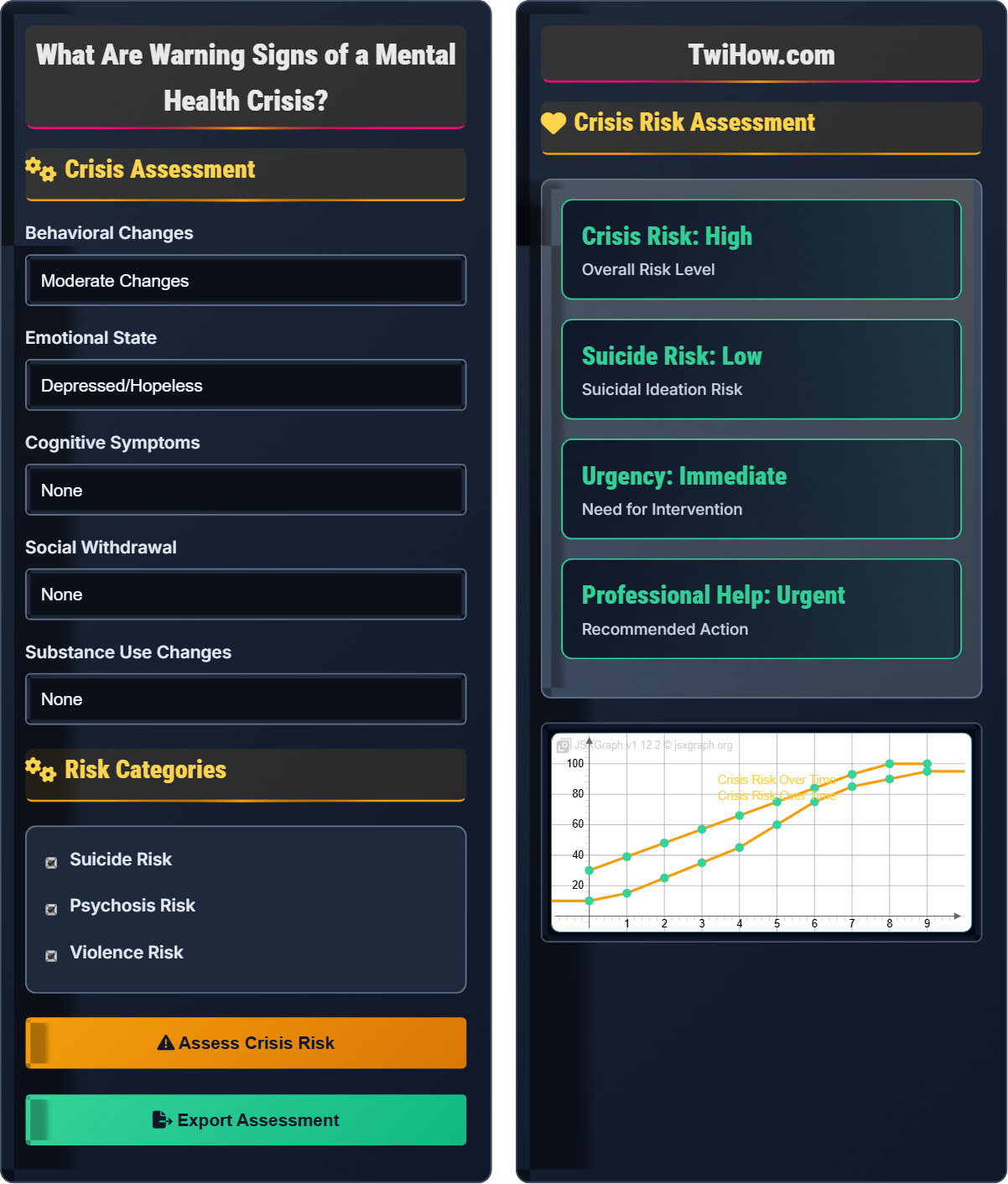
Crisis Assessment
Risk Categories
Crisis Risk Assessment
| Category | Warning Sign | Severity | Action |
|---|---|---|---|
| Behavioral | Social withdrawal | Moderate | Monitor closely |
| Emotional | Hopelessness | High | Seek support |
| Cognitive | Negative thoughts | Moderate | Professional help |
| Physical | Sleep disruption | Low | Self-care |
Mental Health Crisis Recognition Explained
A mental health crisis is a temporary period when an individual experiences severe mental distress that significantly impairs their ability to function and may include thoughts of self-harm or suicide. It can involve sudden onset of severe symptoms or a gradual deterioration in mental state that reaches a critical point.
Mental health crises can be triggered by various factors including stress, trauma, substance use, medication changes, or underlying mental health conditions reaching a critical threshold. The key characteristic is that the individual's coping mechanisms are overwhelmed.
Crisis Risk = (Suicidal Ideation × 2) + (Behavioral Changes × 1.5) + (Emotional Instability × 1.5) + (Cognitive Impairment × 1.2) - (Support Systems × 0.8)
Where:
- Suicidal Ideation: Presence and intensity of self-harm thoughts
- Behavioral Changes: Dramatic alterations in daily functioning
- Emotional Instability: Severity of mood disturbances
- Cognitive Impairment: Problems with thinking and concentration
- Support Systems: Available social and professional support
Immediate warning signs that require urgent attention:
- Suicidal Ideation: Thoughts of death, self-harm, or suicide
- Psychosis: Hallucinations, delusions, or severe detachment from reality
- Severe Agitation: Extreme anxiety, panic, or violent behavior
- Substance Abuse Crisis: Overdose, severe intoxication, or withdrawal symptoms
- Severe Mood Episodes: Mania, severe depression, or rapid mood cycling
- Self-Neglect: Failure to maintain basic self-care
- Protective Factors: Strong support systems, treatment engagement, coping skills
- Risk Factors: Isolation, substance use, previous attempts, access to means
- Acute Indicators: Direct threats, giving away possessions, final arrangements
- Chronic Factors: Long-standing mental health conditions, trauma history
- Environmental Stressors: Recent losses, relationship problems, financial stress
- Biological Factors: Sleep disruption, medication changes, substance effects
Crisis Recognition Fundamentals
Mental health crisis, warning signs, suicidal ideation, risk assessment, intervention, de-escalation.
Risk Level = (Dangerous Behaviors × 2) + (Thought Content × 1.5) + (Functional Impairment × 1.2) - (Protective Factors × 0.8)
Where Risk Level indicates urgency of intervention, components are weighted by clinical significance.
- Take all threats seriously
- Never leave someone alone during crisis
- Seek professional help immediately
Applications
Family intervention, workplace mental health, school counseling, community support, peer support.
- Recognize warning signs
- Assess risk level
- Take appropriate action
- Connect to professional help
- Trust your instincts
- Act quickly in crisis
- Professional help is essential
- Follow-up is crucial
Mental Health Crisis Learning Quiz
Which of the following represents an immediate warning sign of a mental health crisis that requires urgent intervention?
Expressing a specific plan for self-harm is an immediate warning sign of a mental health crisis that requires urgent intervention. This indicates a high level of suicidal ideation with a concrete plan, which significantly increases the risk of attempted suicide. All other options represent normal variations in mood or behavior that do not indicate imminent danger.
The answer is B) Expressing a specific plan for self-harm.
The distinction between normal mood variations and crisis indicators is crucial. A specific plan for self-harm demonstrates intention, capability, and means - the three critical components of suicide risk. The acronym IS PATH WARM helps remember warning signs: Ideation, Substance use, Purposelessness, Anxiety, Trapped, Hopelessness, Withdrawal, Anger, Recklessness, Mood changes.
Suicidal Ideation: Thoughts about ending one's life
Concrete Plan: Specific method and timing for self-harm
Immediate Risk: Danger requiring urgent intervention
• Take all threats seriously
• Specific plans require immediate action
• Never leave person alone
• Ask directly about self-harm thoughts
• Remove access to means
• Contact emergency services
• Minimizing expressed plans
• Not taking threats seriously
• Leaving person alone
Explain the difference between protective factors and risk factors in mental health crisis assessment, and provide examples of each.
Protective Factors: These are elements that reduce the likelihood of a mental health crisis or its severity. They provide stability and resilience.
Examples of Protective Factors:
1. Strong Support Systems: Close relationships with family, friends, or community members who provide emotional support and practical assistance.
2. Effective Treatment: Ongoing engagement with mental health professionals, medication compliance, and participation in therapy.
3. Coping Skills: Healthy stress management techniques, problem-solving abilities, and emotional regulation skills.
4. Religious or Spiritual Beliefs: Faith systems that provide meaning, purpose, and hope.
5. Sense of Responsibility: Obligations to family, work, or pets that provide reasons for living.
Risk Factors: These are elements that increase the likelihood or severity of a mental health crisis.
Examples of Risk Factors:
1. Isolation: Lack of social connections or support systems.
2. Substance Abuse: Alcohol or drug use that can intensify mental health symptoms.
3. Previous Attempts: History of suicide attempts or self-harm behaviors.
4. Access to Means: Easy access to firearms, medications, or other lethal methods.
5. Psychiatric Conditions: Untreated or poorly managed mental health disorders.
6. Recent Losses: Death of loved ones, relationship breakdowns, job loss, or other significant life changes.
Assessment involves weighing these factors to determine overall risk level and appropriate intervention strategies.
Understanding the balance between protective and risk factors is essential for accurate crisis assessment. Think of it as a scale where protective factors tip toward safety and risk factors tip toward danger. The goal is to strengthen protective factors while reducing risk factors. This dynamic assessment helps determine the appropriate level of intervention needed.
Protective Factors: Elements that reduce crisis risk
Risk Factors: Elements that increase crisis risk
Crisis Assessment: Evaluating danger and safety factors
• Balance protective and risk factors
• Strengthen protective factors
• Address risk factors immediately
• Build support networks
• Remove access to dangerous means
• Connect to professional help
• Focusing only on risk factors
• Not recognizing protective factors
• Misjudging the balance
You discover that your friend has been posting concerning messages on social media about feeling hopeless and worthless. They've stopped responding to calls and texts, and you learn they've been giving away prized possessions. What immediate steps should you take and why?
Immediate Steps to Take:
1. Contact Emergency Services: Call 911 or your local emergency number immediately. The combination of social media posts indicating hopelessness, social withdrawal, and giving away possessions represents multiple warning signs of imminent suicide risk.
2. Do Not Leave Them Alone: If possible, arrange for someone to stay with your friend until professional help arrives. Never leave someone alone during a mental health crisis.
3. Remove Access to Means: If safe to do so, remove or secure access to firearms, medications, alcohol, or other potentially harmful items.
4. Direct Communication: If you can reach them, ask directly: "Are you thinking about hurting yourself?" This is crucial and does not increase risk - it opens the door for honest conversation.
5. Professional Referral: Contact the National Suicide Prevention Lifeline (988) or local crisis services for guidance and support.
Why These Steps Are Critical:
Multiple Warning Signs: Social media posts about hopelessness indicate suicidal ideation, withdrawal from contact suggests isolation, and giving away possessions is a classic warning sign of final arrangements.
Immediate Risk: The combination of these factors significantly elevates the risk level and requires urgent professional intervention.
Professional Expertise: Crisis workers are trained in de-escalation and can coordinate appropriate care.
Remember: Taking action is better than inaction when multiple warning signs are present.
This scenario demonstrates the importance of recognizing multiple concurrent warning signs. Each individual sign might not indicate immediate danger, but when combined, they create a high-risk situation. The key principle is that multiple warning signs significantly increase risk and require immediate professional intervention rather than waiting to see if things improve.
Warning Signs: Indicators of mental health crisis
Final Arrangements: Preparations before potential self-harm
Immediate Risk: Danger requiring urgent response
• Multiple warning signs = high risk
• Never leave alone during crisis
• Take all signs seriously
• Act quickly in crisis
• Professional help is essential
• Waiting to see if things improve
• Not taking social media seriously
• Leaving person alone
A family member is experiencing a mental health crisis characterized by extreme agitation, paranoia, and erratic behavior. They are pacing, speaking rapidly, and appear to be experiencing hallucinations. How should you approach de-escalation and what techniques should you use?
Approach to De-escalation:
1. Ensure Safety First: Remove potential hazards from the area and ensure your own safety. If the person becomes physically aggressive, step back and call for professional help.
2. Remain Calm and Non-Threatening: Keep your voice low and calm, speak slowly, and avoid sudden movements. Maintain open body language with hands visible.
3. Use Active Listening: Acknowledge their feelings without validating delusions. Say things like "I can see you're upset" rather than "I understand what you're seeing."
4. Avoid Arguing About Delusions: Don't try to convince them that their perceptions are wrong. Instead, focus on their emotions: "It sounds scary when you hear voices."
5. Create a Quiet Environment: Reduce noise, lighting, and stimulation. Move to a quiet, comfortable space if possible.
6. Offer Choices: When possible, give them some control: "Would you like to sit down or walk slowly with me?"
7. Validate Emotions: Acknowledge their distress: "I can see this is really frightening for you."
8. Professional Contact: Call emergency services or crisis intervention if symptoms escalate or if there's any danger.
Key Techniques:
LEAPS Method: Listen actively, Empathize with their experience, Agree on common ground, Paraphrase their concerns, Summarize the situation.
Important Note: If there's any risk of harm to self or others, immediately contact emergency services (911) or crisis intervention.
De-escalation during a mental health crisis requires understanding that the person's brain is experiencing altered reality due to their mental state. The goal is not to correct their perceptions but to reduce their distress and ensure safety. The key is to remain calm, validate their emotional experience, and provide a sense of security while working toward professional intervention.
De-escalation: Reducing agitation and distress
Delusions: False beliefs not based in reality
LEAPS: De-escalation communication technique
• Safety is the priority
• Don't argue about delusions
• Call for professional help
• Stay calm and patient
• Validate emotions, not delusions
• Reduce environmental stimuli
• Arguing with delusions
• Not ensuring safety first
• Approaching too quickly
What is the current national suicide and crisis lifeline number in the United States?
The current national suicide and crisis lifeline number in the United States is 988. This three-digit number launched in July 2022 as a simplified way to access crisis support services. While the old number (1-800-273-8255) still works, 988 is now the primary number for the National Suicide Prevention Lifeline and Crisis Text Line.
The answer is B) 988.
Having easy-to-remember crisis resources is crucial for effective intervention. The 988 number provides 24/7 access to trained crisis counselors who can provide immediate support, assess risk, and connect callers to local resources. This simple number makes crisis intervention more accessible during times of distress.
988: National suicide and crisis lifeline
Crisis Counselor: Trained professional for crisis intervention
24/7 Access: Round-the-clock availability
• Remember 988 for crisis support
• Available 24/7
• Free and confidential
• Memorize 988
• Share with others
• Use for yourself or others
• Not knowing the number
• Forgetting it during crisis
• Not sharing with others
FAQ
Q: How do I know if someone is just going through a rough patch versus experiencing a mental health crisis?
A: The key differences lie in severity, duration, and functional impairment:
Rough Patch: Temporary mood changes, maintains daily functioning, can still find pleasure in activities, symptoms improve over time, can talk about feelings rationally.
Mental Health Crisis: Severe symptoms that significantly impair functioning, inability to perform daily tasks, persistent hopelessness, thoughts of self-harm, extreme agitation or withdrawal, significant changes in sleep/appetite, talking about death or suicide.
Warning Signs of Crisis:
1. Functional Impairment: Inability to work, attend school, or maintain basic self-care.
2. Suicidal Ideation: Talking about death, making plans, or expressing hopelessness.
3. Severe Mood Changes: Extreme highs or lows, rapid cycling, or complete emotional shutdown.
4. Psychotic Symptoms: Hallucinations, delusions, or severe detachment from reality.
5. Dangerous Behaviors: Self-harm, substance abuse, or reckless behavior.
When in Doubt: It's always better to err on the side of caution and seek professional help. A brief consultation with a mental health professional can clarify the situation and provide appropriate guidance.
Q: What should I do if someone tells me they're having thoughts of suicide but asks me not to tell anyone?
A: This is a critical situation that requires immediate action:
Confidentiality vs. Safety: When someone's life is in danger, the duty to protect life supersedes confidentiality agreements. Mental health professionals are legally obligated to break confidentiality when there's risk of harm.
Immediate Steps:
1. Take It Seriously: Never ignore or minimize statements about suicide. Ask directly: "Are you thinking about killing yourself?"
2. Don't Promise Secrecy: Explain that their safety is more important than keeping secrets: "I want to help you get the support you need."
3. Stay with Them: Do not leave them alone. If you must leave, ensure they're in safe hands.
4. Contact Professionals: Call 988 (National Suicide Prevention Lifeline), 911, or take them to the nearest emergency room.
5. Remove Access to Means: If safe to do so, remove firearms, medications, or other potentially harmful items.
6. Follow Up: Continue to check on them and encourage professional treatment.
Remember: The person is likely ambivalent about dying - they want to stop the pain, not necessarily to die. Your intervention could save their life. The guilt of keeping a secret that results in tragedy far outweighs the temporary anger from breaking confidentiality.