What Is Emotional Intelligence and How Can I Develop It?
Complete emotional intelligence guide • Step-by-step explanations
Emotional Intelligence Fundamentals:
Show EQ AssessmentEmotional intelligence (EQ) is the ability to recognize, understand, and manage your own emotions, as well as recognize and influence the emotions of others. It encompasses four key components: self-awareness, self-regulation, social awareness, and relationship management. Research shows that EQ is often more important than IQ for personal and professional success.
Emotional intelligence works by enhancing your ability to navigate social complexities, make better decisions, and manage stress and conflict. It involves developing emotional self-regulation skills, empathy, and social awareness that improve relationships and communication. The good news is that EQ can be developed through practice and conscious effort.
Key components of EQ include:
- Self-Awareness: Recognizing your emotions and their impact
- Self-Regulation: Managing disruptive emotions and impulses
- Social Awareness: Understanding others' emotions and social dynamics
- Relationship Management: Developing and maintaining positive relationships
With consistent practice and self-reflection, emotional intelligence can be significantly improved at any age, leading to better relationships, career success, and overall well-being.
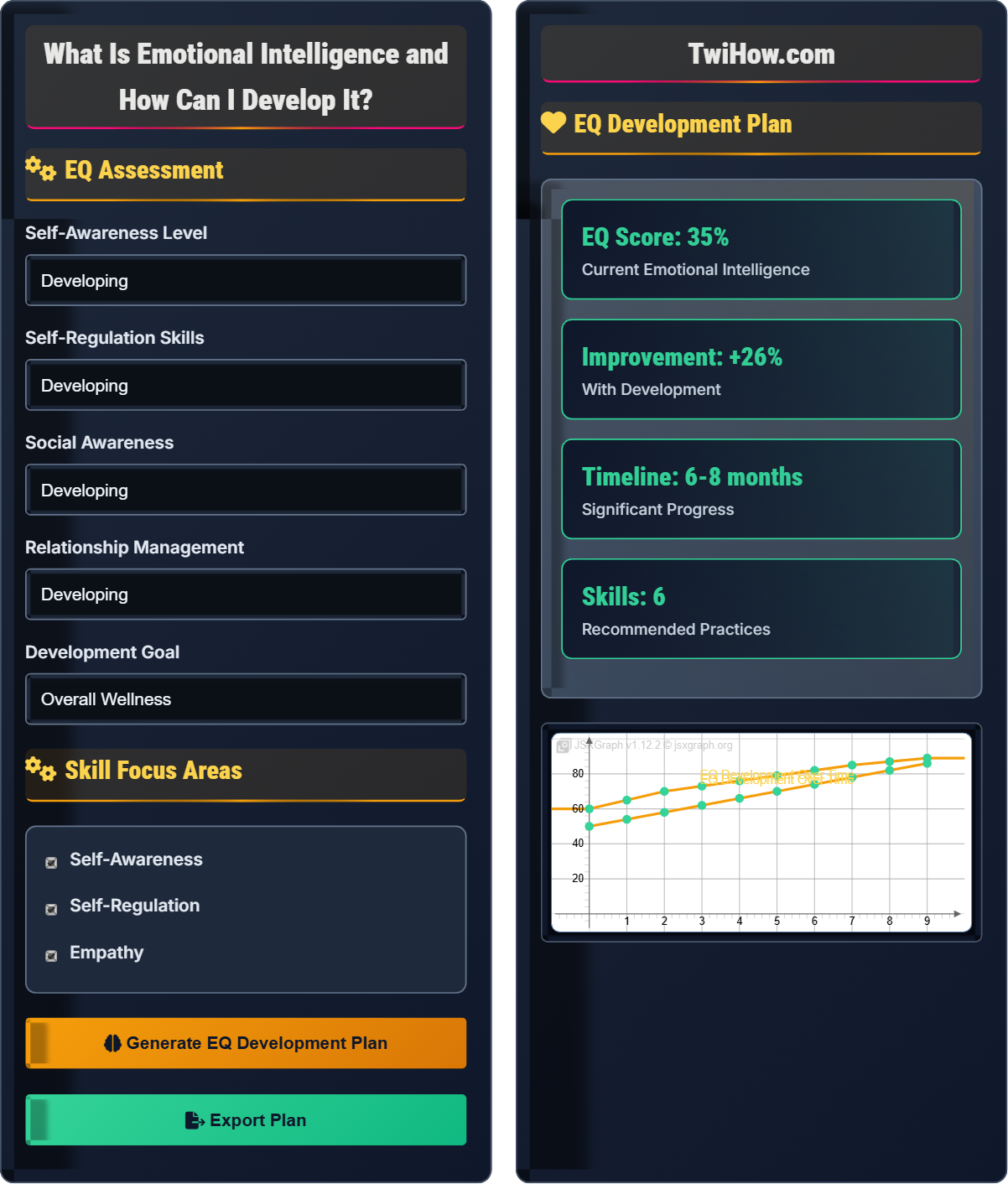
EQ Assessment
Skill Focus Areas
EQ Development Plan
| Skill | Practice | Frequency | Impact |
|---|---|---|---|
| Self-Awareness | Emotion journaling | Daily | High |
| Self-Regulation | Breathing techniques | As needed | High |
| Empathy | Active listening | Daily | Medium |
| Communication | Non-violent communication | Daily | Medium |
Emotional Intelligence Development Explained
Emotional intelligence (EQ) is the ability to recognize, understand, and manage emotions in yourself and others. It was popularized by psychologist Daniel Goleman, who identified five key components: self-awareness, self-regulation, motivation, empathy, and social skills.
Unlike IQ, which is largely fixed, EQ can be developed and improved throughout life. Research shows that people with high EQ tend to have better relationships, are more successful professionally, and experience greater overall well-being.
EQ = (Self-Awareness × Self-Regulation × Social Skills × Empathy) ÷ (Stress Response + Emotional Reactivity)
Where:
- Self-Awareness: Ability to recognize emotions
- Self-Regulation: Ability to manage emotions
- Social Skills: Ability to interact effectively
- Empathy: Ability to understand others
- Stress Response: Negative impact on EQ
- Emotional Reactivity: Negative impact on EQ
The four main components of emotional intelligence:
- Self-Awareness: Recognizing your emotions, strengths, weaknesses, and values
- Self-Management: Controlling disruptive emotions and impulses
- Social Awareness: Understanding others' emotions and organizational dynamics
- Relationship Management: Developing and maintaining good relationships
- Mindfulness: Practice present-moment awareness
- Journaling: Reflect on emotions and reactions
- Active Listening: Focus on understanding others
- Emotional Vocabulary: Expand your emotional language
- Stress Management: Develop healthy coping mechanisms
- Feedback Seeking: Ask for input from others
EQ Development Fundamentals
Emotional intelligence, self-awareness, empathy, emotional regulation, social skills, EQ.
EQ Growth = (Self-Awareness + Practice + Reflection) × Consistency
Where EQ Growth indicates improvement, components are weighted by research evidence.
- EQ can be developed at any age
- Practice makes progress
- Self-awareness is the foundation
Applications
Leadership, relationships, conflict resolution, communication, stress management.
- Assess current EQ level
- Identify development areas
- Practice targeted skills
- Seek feedback and reflect
- Change takes time and practice
- Progress is not linear
- Consistency is crucial
- Professional help available
EQ Development Learning Quiz
According to Daniel Goleman's model of emotional intelligence, which of the following is NOT one of the five key components?
According to Daniel Goleman's model of emotional intelligence, the five key components are: self-awareness, self-regulation, motivation, empathy, and social skills. Technical skills are not part of the EQ model but rather fall under traditional competency models. The EQ components focus specifically on emotional and social competencies rather than technical abilities.
The answer is C) Technical Skills.
This question tests understanding of the fundamental model of emotional intelligence. It's important to distinguish between EQ and traditional competencies. While technical skills are important for job performance, EQ focuses on emotional and social abilities that complement technical skills and often determine success in leadership and interpersonal relationships.
Emotional Intelligence: Ability to manage emotions effectively
Self-Awareness: Recognizing one's emotions
Technical Skills: Job-specific competencies
• EQ focuses on emotional/social abilities
• Technical skills are separate
• EQ complements technical competencies
• EQ and technical skills work together
• Focus on emotional competencies
• Both are important for success
• Confusing EQ with technical skills
• Thinking EQ is only about empathy
• Not understanding the full model
Explain the importance of self-awareness as the foundation of emotional intelligence and describe practical ways to develop it.
Importance of Self-Awareness:
Self-awareness is the cornerstone of emotional intelligence because it's the ability to recognize and understand your own emotions, strengths, weaknesses, values, and motivations. Without self-awareness, you cannot effectively manage your emotions or understand others' emotions.
Why It's Foundational:
1. Emotion Recognition: You must first recognize what you're feeling before you can manage it.
2. Impact Understanding: Awareness of how your emotions affect others.
3. Authentic Behavior: Understanding yourself leads to genuine interactions.
4. Decision Making: Awareness of emotional influences on choices.
5. Growth Foundation: Self-knowledge is essential for personal development.
Practical Ways to Develop Self-Awareness:
1. Emotional Check-ins: Regularly pause throughout the day to identify current emotions and their triggers.
2. Journaling: Write about daily experiences, emotions, and reactions to understand patterns.
3. Mindfulness Practice: Engage in meditation or mindfulness exercises to observe thoughts and feelings.
4. Feedback Seeking: Ask trusted friends or colleagues for honest feedback about your behavior and impact.
5. Values Clarification: Identify your core values and assess whether your actions align with them.
6. Emotional Vocabulary: Expand your ability to describe emotions precisely (beyond "happy" or "sad").
7. Body Awareness: Notice physical sensations that accompany emotions (tight chest, relaxed shoulders).
8. Pattern Recognition: Identify recurring emotional responses to specific situations or people.
Self-awareness is an ongoing practice that improves with consistent effort and reflection.
Self-awareness serves as the foundation because it provides the raw material for all other EQ skills. If you don't know what you're feeling, you cannot manage those emotions, empathize with others, or navigate social situations effectively. Developing self-awareness is like installing an internal monitoring system that provides the data needed for emotional intelligence to function.
Self-Awareness: Recognition of one's emotions and impact
Emotional Check-ins: Regular self-assessment of feelings
Pattern Recognition: Identifying emotional trends
• Self-awareness is the foundation
• Must recognize before managing
• Requires consistent practice
• Set daily reminders for check-ins
• Use emotion wheels for vocabulary
• Practice mindfulness regularly
• Not taking time for self-reflection
• Avoiding difficult emotions
• Not seeking external feedback
During a team meeting, your colleague publicly criticizes your project proposal in a harsh tone, making you feel angry and embarrassed. How should you apply emotional intelligence principles to handle this situation effectively?
Applying Emotional Intelligence in This Situation:
1. Self-Awareness: Recognize your immediate emotional response (anger, embarrassment) and acknowledge it without acting impulsively. Notice physical sensations and thoughts.
2. Self-Regulation: Use breathing techniques or mental reframing to manage your emotional response. Take a pause before responding. Remind yourself that the criticism is about the proposal, not your worth as a person.
3. Social Awareness: Consider the colleague's possible motivations (stress, different perspective, communication style). Observe the reactions of other team members.
4. Empathy: Try to understand the colleague's perspective and concerns, even if their delivery was inappropriate.
5. Relationship Management: Respond constructively by addressing the content of their concerns rather than the tone: "I appreciate your feedback. Let me address the specific concerns you raised..."
Specific Actions:
Immediate Response: "Thank you for your feedback. I'd like to address your concerns. Could you elaborate on specific points so I can respond appropriately?"
Later Follow-up: Approach the colleague privately to discuss communication preferences for future meetings.
Alternative Perspective: Consider if there's merit to their concerns that could improve your proposal.
Outcome: This approach maintains professionalism, addresses the substantive issues, and preserves relationships while modeling appropriate behavior for the team.
By applying EQ principles, you transform a potentially damaging situation into a constructive dialogue that benefits everyone involved.
This scenario demonstrates how EQ skills work together in real-time. The key is recognizing that emotional intelligence isn't about suppressing emotions but rather using awareness and regulation skills to respond more effectively. The goal is to address the issue while maintaining relationships and professional credibility.
Self-Regulation: Managing emotional responses
Social Awareness: Understanding social dynamics
Relationship Management: Navigating interpersonal situations
• Pause before reacting emotionally
• Address content, not delivery
• Consider multiple perspectives
• Practice breathing techniques
• Reframe criticism as feedback
• Focus on issues, not personalities
• Reacting impulsively to emotions
• Taking criticism personally
• Not addressing underlying issues
You're a manager and notice that one of your team members seems disengaged, arriving late and producing lower-quality work. How would you use emotional intelligence to address this situation?
Using EQ to Address Team Member's Performance:
1. Self-Awareness: Recognize your initial frustration and judgment. Acknowledge that your emotions might cloud your assessment of the situation.
2. Self-Regulation: Manage your impulse to immediately address the performance issues. Take time to approach the situation with curiosity rather than criticism.
3. Social Awareness: Observe the team member's behavior patterns, body language, and interactions with others. Consider possible external factors affecting their performance.
4. Empathy: Consider what challenges they might be facing that could explain the change in behavior. Put yourself in their shoes.
5. Relationship Management: Schedule a private, non-judgmental conversation to understand the situation.
Approach Strategy:
Private Meeting: Create a safe space for open dialogue: "I've noticed some changes in your recent work and wanted to check in. Is everything okay? How can I support you?"
Active Listening: Listen without interrupting, ask clarifying questions, and validate their feelings.
Collaborative Problem-Solving: Work together to identify solutions and adjust expectations if needed.
Follow-up: Monitor progress and provide ongoing support.
Example Response: "I've noticed you've been arriving a bit later and seemed distracted lately. I wanted to check in because your well-being matters to me. Is there anything going on that I should know about? How can I support you right now?"
Benefits of This Approach:
• Builds trust and psychological safety
• Addresses root causes rather than symptoms
• Demonstrates leadership through empathy
• Preserves the relationship while addressing performance
• Creates a positive team culture
This approach often leads to better long-term outcomes than disciplinary action alone.
This example shows how EQ transforms leadership from reactive management to proactive relationship-building. Instead of immediately addressing symptoms (late arrival, poor work), EQ encourages understanding the person behind the behavior. This approach often resolves issues more effectively while building stronger relationships and team culture.
Psychological Safety: Environment where people feel safe to speak up
Active Listening: Fully focusing on understanding others
Collaborative Problem-Solving: Working together on solutions
• Address behavior, not character
• Listen before judging
• Focus on understanding first
• Create safe spaces for dialogue
• Ask open-ended questions
• Validate feelings before problem-solving
• Jumping to conclusions about behavior
• Not considering external factors
• Focusing only on performance metrics
Research has consistently shown that people with higher emotional intelligence are more likely to experience which of the following outcomes?
Extensive research has consistently shown that people with higher emotional intelligence tend to be more effective leaders and have better job performance. They're better at managing relationships, navigating social complexities, resolving conflicts, and creating positive work environments. Studies also show correlations with better mental health, stronger relationships, and greater life satisfaction.
The answer is B) Better leadership effectiveness and job performance.
EQ enhances performance by improving interpersonal relationships, communication, and emotional regulation—all critical for leadership and teamwork. Rather than diminishing other abilities, EQ complements technical skills and cognitive abilities, often leading to better overall outcomes in both personal and professional contexts.
Leadership Effectiveness: Ability to guide and inspire others
Job Performance: Quality and quantity of work
Interpersonal Skills: Abilities in relating to others
• EQ complements other abilities
• Improves relationship quality
• Enhances leadership skills
• EQ enhances other competencies
• Improves team dynamics
• Supports career advancement
• Thinking EQ is separate from performance
• Not valuing emotional skills
• Focusing only on technical abilities
FAQ
Q: Can emotional intelligence really be developed, or is it just a natural talent?
A: Yes, emotional intelligence can definitely be developed! This is one of the most important distinctions from traditional intelligence (IQ), which remains relatively stable throughout life:
Neuroplasticity: Our brains are capable of forming new neural pathways and strengthening existing ones through practice and learning.
Learnable Skills: EQ involves specific, teachable skills like emotional self-awareness, empathy, and conflict resolution that can be practiced and improved.
Research Evidence: Multiple studies have shown that EQ training programs result in measurable improvements in emotional intelligence scores and real-world outcomes.
Practical Development: EQ skills can be developed through:
• Self-reflection and mindfulness practices
• Feedback from others and self-assessment
• Specific training programs and coaching
• Deliberate practice in real situations
Timeline: While some improvement can be seen within weeks of consistent practice, significant development typically occurs over months of dedicated effort.
Age Factor: EQ can be developed at any age, though the approach might differ for children, adolescents, and adults.
Individual Variation: People may develop different aspects of EQ at different rates, and some may have natural strengths in certain areas.
The key is treating EQ development like any other skill—through consistent practice, feedback, and reflection.
Q: How does emotional intelligence impact leadership effectiveness?
A: Emotional intelligence is often considered the strongest predictor of leadership effectiveness:
Relationship Building: Leaders with high EQ create stronger connections with team members, fostering trust and loyalty.
Communication: They communicate more effectively, adapting their style to different audiences and being more attuned to non-verbal cues.
Conflict Resolution: High-EQ leaders navigate conflicts more skillfully, finding win-win solutions and maintaining relationships.
Team Climate: They create positive, psychologically safe work environments that encourage innovation and collaboration.
Decision Making: They manage their emotions during decision-making and consider the emotional impact of decisions on others.
Change Management: They help teams navigate transitions by addressing emotional concerns and maintaining morale.
Performance Outcomes: Teams led by high-EQ leaders typically show:
• Higher engagement and job satisfaction
• Better retention rates
• Increased productivity and innovation
• Improved customer satisfaction
• Reduced workplace stress and conflict
Research Findings: Studies consistently show that EQ accounts for 85-90% of what distinguishes outstanding leaders from average ones, far more than technical skills or cognitive ability.
However, the most effective leaders combine high EQ with strong technical competencies and strategic thinking.