What Is the Difference Between Stress and Burnout?
Complete stress vs. burnout guide • Step-by-step explanations
Stress vs. Burnout:
Show Assessment ToolUnderstanding the difference between stress and burnout is crucial for maintaining mental health and well-being. While stress and burnout are related, they are distinct conditions with different characteristics, causes, and outcomes. Stress is a natural response to pressure or demands, while burnout is a state of emotional, physical, and mental exhaustion caused by prolonged and excessive stress.
Stress typically involves feeling overwhelmed by too much pressure or demands, while burnout involves feeling empty, drained, and unable to meet constant demands. Stress is characterized by over-engagement, while burnout is characterized by disengagement and feeling defeated.
Key differences include:
- Duration: Stress is usually temporary; burnout is chronic
- Intensity: Stress is high energy; burnout is low energy
- Focus: Stress is about too much; burnout is about nothingness
- Outlook: Stress is hopeful; burnout is hopeless
- Physical Effects: Stress causes hyperarousal; burnout causes depletion
Recognizing these differences helps individuals take appropriate action to address their condition and prevent further deterioration of their mental and physical health.
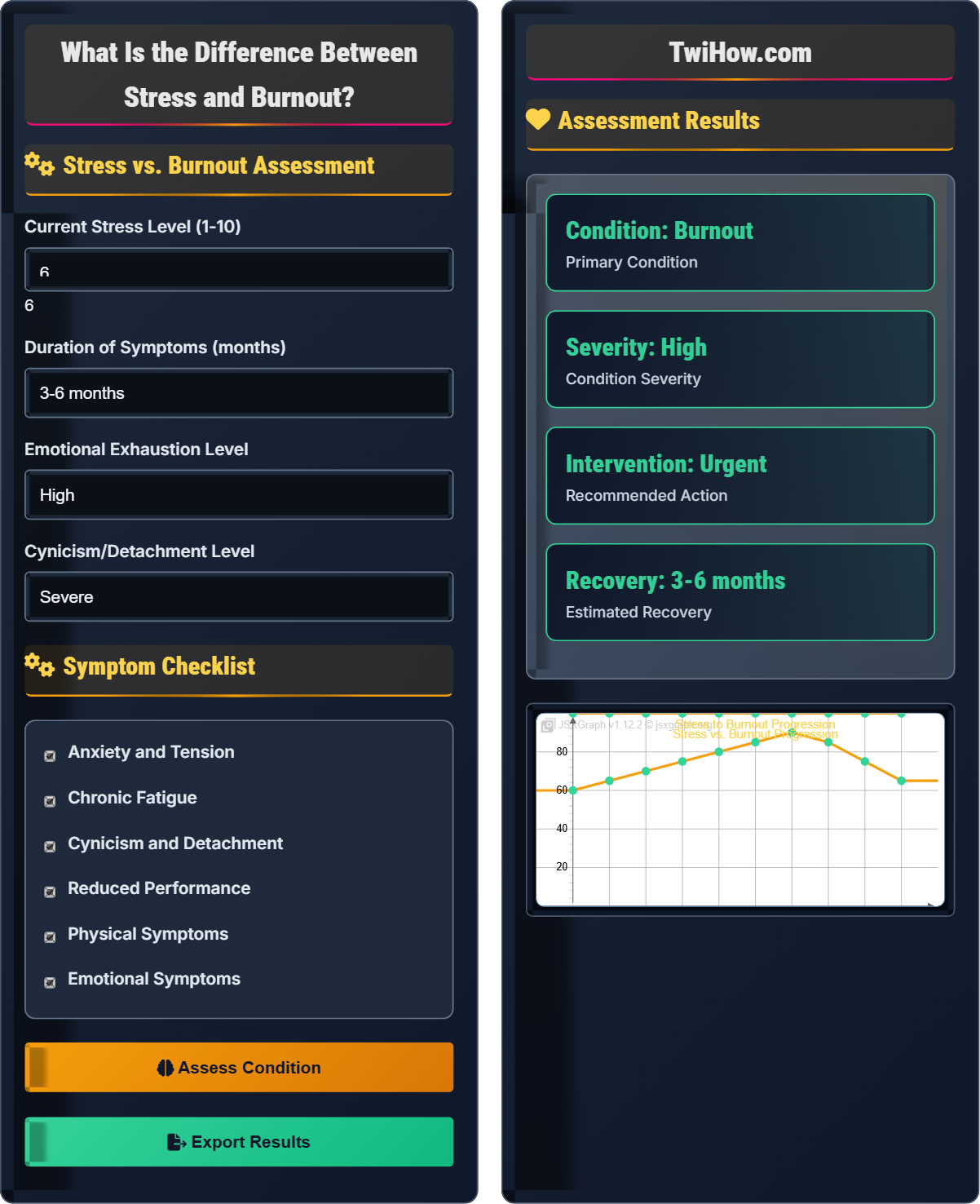
Stress vs. Burnout Assessment
Symptom Checklist
Assessment Results
| Aspect | Stress | Burnout | Your Condition |
|---|---|---|---|
| Energy Level | High Energy | Depleted | Depleted |
| Motivation | Overwhelmed but motivated | Detached and unmotivated | Unmotivated |
| Emotional State | Overwhelmed | Empty and numb | Empty |
| Outlook | Hopeful but pressured | Hopeless | Hopeless |
| Physical Symptoms | Hyperarousal | Depletion | Depletion |
Stress vs. Burnout Explained
While stress and burnout are related concepts, they represent different psychological states with distinct characteristics. Stress is a response to excessive pressure or demands, while burnout is a state of physical, emotional, and mental exhaustion caused by prolonged and excessive stress. Understanding these differences is crucial for appropriate intervention and recovery.
The relationship between stress and burnout can be understood through a progression model:
Where:
- Stress: Initial pressure or demands
- Duration: Length of time stress is experienced
- Coping Resources: Available support and stress management strategies
Understanding stress vs. burnout helps in various contexts:
- Workplace Wellness: Identifying and addressing employee stress levels
- Personal Health: Recognizing symptoms and seeking appropriate help
- Healthcare: Proper diagnosis and treatment planning
- Academic Settings: Managing student stress and preventing burnout
- Relationships: Understanding partner's mental state and needs
- Leadership: Managing team stress and preventing organizational burnout
- Energy Level: Stress = high energy, burnout = depleted energy
- Motivation: Stress = overwhelmed but motivated, burnout = detached
- Emotional State: Stress = overwhelmed, burnout = empty and numb
- Outlook: Stress = hopeful, burnout = hopeless
- Physical Response: Stress = hyperarousal, burnout = depletion
Stress vs. Burnout Fundamentals
Stress, burnout, emotional exhaustion, mental health, work-life balance, coping strategies.
Burnout Development = Stress × Duration × Coping Resources
Where Stress = pressure/demands, Duration = time period, Coping = available resources.
- Stress is temporary, burnout is chronic
- Stress involves over-engagement, burnout involves disengagement
- Early intervention prevents progression
Application Strategies
Stress management, burnout prevention, work-life balance, self-care, professional support.
- Recognize symptoms and patterns
- Determine if it's stress or burnout
- Apply appropriate intervention
- Monitor progress and adjust
- Individual responses vary
- Professional help may be needed
- Recovery takes time
- Prevention is important
Stress vs. Burnout Learning Quiz
How do energy levels typically differ between stress and burnout?
One of the key differences between stress and burnout is the energy level. During stress, individuals often experience high energy levels due to the body's fight-or-flight response and the adrenaline rush. However, in burnout, the energy is completely depleted after prolonged exposure to stress. Burnout represents the end stage of unmanaged stress where the body and mind are exhausted.
The answer is B) Stress involves high energy; burnout involves depleted energy.
Energy level is one of the most distinguishing characteristics between stress and burnout. During stress, the body's stress response system is activated, leading to increased energy and alertness. In burnout, the stress response system becomes exhausted, leading to complete depletion of energy resources.
Stress Response: Body's reaction to pressure or demands
Adrenaline Rush: Hormone surge during stress
Energy Depletion: Complete exhaustion of resources
• Stress = high energy, burnout = low energy
• Energy levels indicate condition type
• Depletion indicates burnout
• Monitor your energy patterns
• High energy may indicate stress
• Complete depletion suggests burnout
• Confusing high energy with well-being
• Not recognizing energy depletion
• Assuming constant fatigue is normal
Explain how motivation differs between stress and burnout, and provide specific examples of how each condition affects a person's drive and engagement.
Stress and Motivation:
During stress, individuals are typically still motivated but feel overwhelmed by the demands placed on them. They may have a strong desire to succeed and meet expectations, but feel there's not enough time or resources to do so. The motivation is still present, but it's channeled into coping with immediate pressures.
Example: A project manager under stress might work late nights and weekends, driven to meet deadlines and deliverables, but feeling stretched thin and anxious about potential failures.
Burnout and Motivation:
In burnout, motivation is completely absent. Individuals feel detached, cynical, and disconnected from their work or responsibilities. They no longer care about outcomes and may exhibit minimal effort or engagement. The emotional and physical exhaustion makes it impossible to summon any motivation.
Example: The same project manager experiencing burnout might show up to work but do the bare minimum, arrive late, leave early, and show indifference to project outcomes or team performance.
The key difference is that stress involves being motivated but overwhelmed, while burnout involves being unmotivated and detached.
Motivation is a crucial distinguishing factor between stress and burnout. In stress, the drive is still there but is overwhelmed by demands. In burnout, the drive is completely gone, replaced by cynicism and detachment. This difference is important for determining the appropriate intervention.
Motivation: Drive to achieve goals or outcomes
Overwhelmed: Feeling unable to manage demands
Detached: Emotionally disconnected from responsibilities
• Stress = motivated but overwhelmed
• Burnout = unmotivated and detached
• Motivation level indicates condition
• Notice changes in enthusiasm
• Track engagement levels
• Monitor for cynicism
• Confusing low motivation with laziness
• Not recognizing early detachment
• Assuming motivation will return naturally
A healthcare worker has been working long hours during a pandemic for 8 months. Initially, they felt energized and motivated to help patients, but recently they feel emotionally drained, indifferent to patient outcomes, and struggle to get out of bed. They report feeling exhausted but unable to sleep properly. Analyze whether this represents stress or burnout and explain your reasoning.
Condition Assessment: This represents burnout, not stress.
Reasoning:
1. Duration: 8 months of prolonged exposure to high-stress conditions
2. Energy Level: Transitioned from high energy to complete emotional and physical exhaustion
3. Motivation: Shifted from motivated to indifferent and detached
4. Emotional State: Feeling emotionally drained and numb rather than overwhelmed
5. Physical Symptoms: Exhaustion combined with sleep difficulties
6. Engagement: Cynicism and detachment from patient outcomes
Supporting Evidence:
• Prolonged duration (8 months) far exceeds typical stress timelines
• Complete emotional exhaustion rather than temporary overwhelm
• Cynicism and detachment replacing initial motivation
• Physical and emotional depletion rather than hyperarousal
Conclusion: This pattern indicates burnout, which requires different intervention strategies than acute stress.
This example demonstrates the progression from stress to burnout. Initially, the healthcare worker experienced stress (high energy, motivation, engagement) but over time, the prolonged exposure led to burnout (exhaustion, detachment, cynicism). The key is recognizing the transition point and responding appropriately.
Progression: Movement from one condition to another
Transition Point: When stress becomes burnout
Intervention: Appropriate response to condition
• Duration matters in assessment
• Energy changes indicate progression
• Cynicism signals burnout
• Monitor for changes over time
• Notice shifts in attitude
• Track energy patterns
• Not recognizing the progression
• Continuing same coping strategies
• Minimizing the change in symptoms
You're helping someone understand the different recovery approaches needed for stress versus burnout. Explain why the treatment and recovery strategies differ significantly between these two conditions.
Stress Recovery Approaches:
1. Stress Management: Techniques to reduce immediate stress levels (breathing, relaxation, time management)
2. Problem-Solving: Addressing specific stressors and demands
3. Short-Term Relief: Temporary strategies to manage acute stress
4. Efficiency Improvements: Better ways to handle current workload
Burnout Recovery Approaches:
5. Complete Rest: Extended time off to allow for physical and emotional recovery
6. Lifestyle Changes: Fundamental changes to work-life balance and values
7. Identity Reconstruction: Rebuilding sense of self beyond work role
8. Long-Term Healing: Months of recovery focused on rebuilding energy and motivation
Why Different Approaches Are Needed:
• Resource Levels: Stress involves temporary depletion; burnout involves complete exhaustion
• Motivation: Stress maintains motivation; burnout requires rebuilding it from scratch
• Time Frame: Stress recovery can be quick; burnout recovery takes months
• Intervention Scope: Stress requires tactical changes; burnout requires strategic life changes
Attempting to treat burnout with stress management techniques alone is insufficient.
The recovery approaches differ because the underlying conditions are fundamentally different. Stress is about managing current demands, while burnout is about rebuilding from complete depletion. The recovery strategies must match the severity and nature of the condition.
Recovery Approaches: Strategies to address condition
Resource Depletion: Exhaustion of energy reserves
Identity Reconstruction: Rebuilding sense of self
• Match approach to condition type
• Burnout requires more intensive intervention
• Recovery time differs significantly
• Assess recovery needs accurately
• Don't underestimate burnout recovery
• Plan for longer recovery periods
• Using same strategies for both conditions
• Underestimating burnout recovery time
• Not recognizing need for lifestyle changes
How do the physical responses typically differ between stress and burnout?
The physical responses differ significantly between stress and burnout. During stress, the body's sympathetic nervous system is activated, leading to hyperarousal symptoms like increased heart rate, muscle tension, and heightened alertness. During burnout, the body is completely depleted, leading to symptoms of exhaustion, fatigue, and physical shutdown. The stress response system becomes exhausted in burnout.
The answer is B) Stress causes hyperarousal; burnout causes depletion.
The physical response difference reflects the different states of the nervous system. Stress activates the fight-or-flight response, while burnout represents the exhaustion of this system. Understanding these differences helps in recognizing and treating each condition appropriately.
Hyperarousal: Heightened state of alertness and tension
Depletion: Complete exhaustion of resources
Sympathetic Nervous System: Fight-or-flight response system
• Stress = hyperarousal symptoms
• Burnout = depletion symptoms
• Physical symptoms reflect nervous system state
• Notice physical tension patterns
• Monitor for exhaustion signs
• Track physical symptoms over time
• Not recognizing physical symptoms
• Confusing tension with relaxation
• Ignoring physical signs of burnout
FAQ
Q: Can stress turn into burnout?
A: Yes, stress can turn into burnout, but it's not inevitable. The progression from stress to burnout typically occurs when:
Factors That Lead to Progression:
• Prolonged exposure to stress without adequate recovery
• Inadequate coping resources and support systems
• Continued high demands without relief
• Failure to address early warning signs
• Lack of work-life balance
Prevention Strategies:
• Implement stress management techniques early
• Take regular breaks and time off
• Address stressors proactively
• Maintain adequate sleep and self-care
• Seek support when needed
Recovery Time:
• Stress: Days to weeks with proper management
• Burnout: Months to years with comprehensive intervention
Early intervention during stress can prevent the development of burnout.
Q: How can I tell if I'm experiencing stress or burnout?
A: Here are key indicators to help distinguish between stress and burnout:
Signs of Stress:
• Feeling overwhelmed but still motivated
• High energy levels (though tense)
• Difficulty sleeping due to racing thoughts
• Irritability and anxiety
• Physical tension and muscle tightness
• Hopeful about resolving the situation
Signs of Burnout:
• Complete emotional and physical exhaustion
• Cynicism and detachment from work/activities
• Feeling empty and numb
• Reduced performance and motivation
• Physical symptoms of depletion
• Hopelessness about improvement
Duration Matters:
• Stress is typically temporary (days to weeks)
• Burnout is chronic (months to years)
When to Seek Help:
• If symptoms persist beyond 2-3 weeks
• If you experience thoughts of hopelessness
• If physical symptoms interfere with daily life
• If you feel unable to manage on your own
Professional support can help with both conditions but requires different approaches.