The Future of Digital Mental Health Tools
Complete digital mental health guide • Step-by-step explanations
Digital Mental Health Future:
Show Digital Health SimulatorThe future of digital mental health tools promises revolutionary advances in accessibility, personalization, and effectiveness. From AI-powered therapy companions to immersive VR experiences, these innovations will democratize mental health support and provide tailored interventions for diverse populations.
Digital mental health tools are evolving rapidly, incorporating cutting-edge technologies like artificial intelligence, virtual reality, and advanced biometric monitoring. These tools will bridge the gap between traditional therapy and scalable, accessible solutions for millions worldwide.
Key technological trends:
- AI-Powered Therapy: Personalized therapeutic interventions
- Immersive Environments: VR/AR for exposure therapy and mindfulness
- Biomarker Integration: Real-time physiological feedback
- Predictive Analytics: Early intervention through data analysis
The future will focus on seamless integration with daily life, proactive mental wellness, and evidence-based digital therapeutics that complement traditional care approaches.
Digital Health Assessment
Future Options
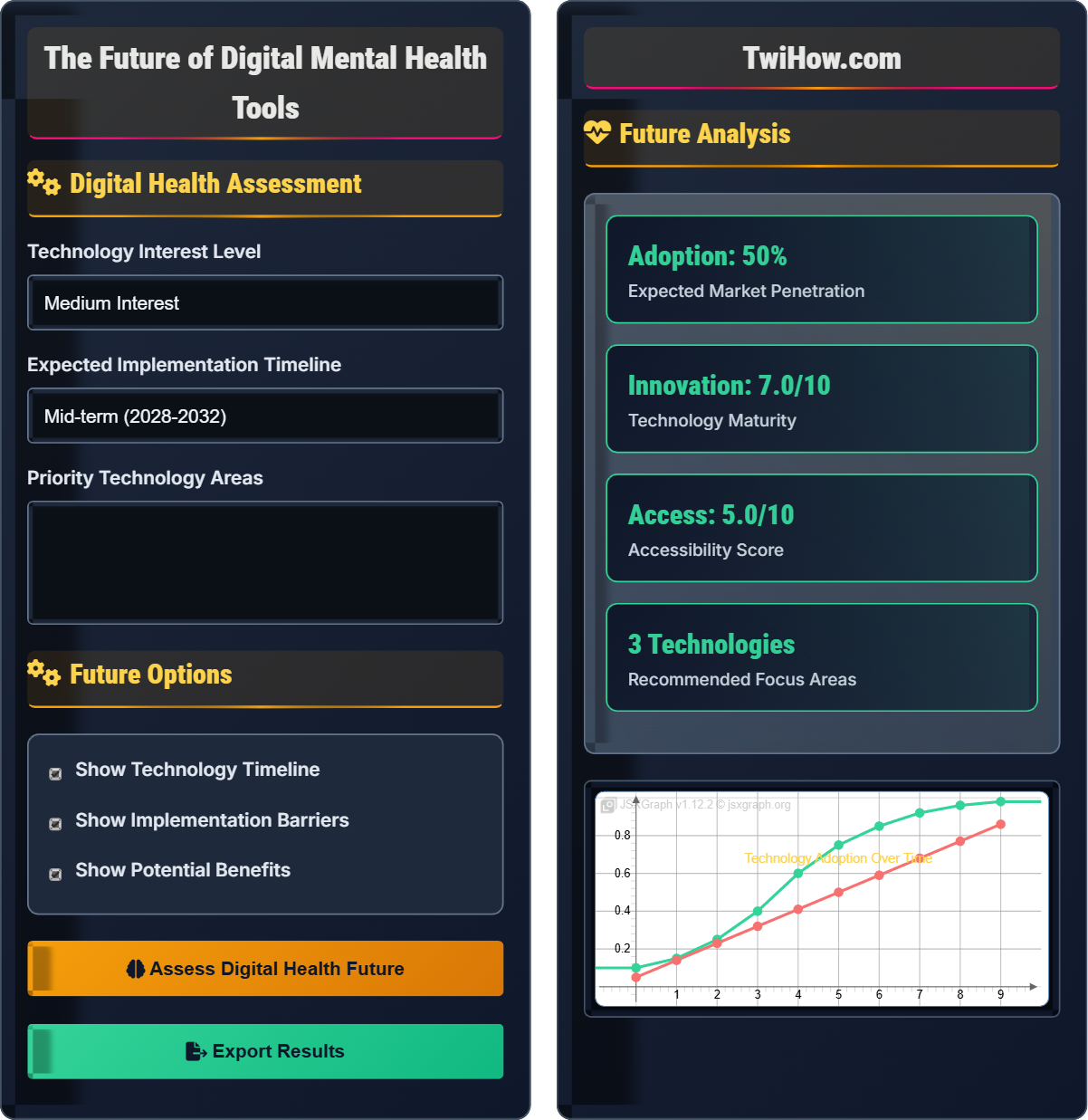
Future Analysis
| Technology | Maturity | Impact | Timeline |
|---|---|---|---|
| AI Therapy | High | High | 2026 |
| VR Therapy | Medium | High | 2027 |
| Biometric Monitoring | High | Medium | 2025 |
| Personalized Medicine | Low | High | 2030 |
Advanced AI systems that provide personalized therapeutic interventions, real-time emotional support, and predictive mental health insights.
Immersive environments for exposure therapy, mindfulness, and therapeutic experiences in controlled settings.
Understanding the Future of Digital Mental Health
Digital mental health encompasses technology-enabled solutions for mental health prevention, treatment, and management. This includes mobile applications, online therapy platforms, AI-powered tools, and wearable devices that support mental wellness and therapeutic interventions.
- Therapeutic Applications: Guided interventions and treatment programs
- Monitoring Tools: Tracking mood, behavior, and physiological markers
- Support Platforms: Community support and peer connections
- Diagnostic Tools: Early detection and screening capabilities
The future promises even more sophisticated integration of artificial intelligence, virtual reality, and predictive analytics to revolutionize mental health care delivery.
The evolution of digital mental health follows this progression:
Where:
- Current State: Basic apps and telehealth platforms
- Enhanced AI: Sophisticated AI therapists and personalization
- Immersive Tech: VR/AR therapy and biofeedback integration
- Predictive Care: Anticipatory interventions based on data
- Proactive Wellness: Preventive mental health maintenance
Future digital mental health tools will be applied across multiple domains:
- Clinical Settings: Hospitals, clinics, and private practice
- Corporate Wellness: Employee mental health and productivity
- Educational Institutions: Student mental health support
- Community Health: Population-level mental wellness
- Remote Areas: Access to mental health care in underserved regions
- Special Populations: Veterans, elderly, children, and marginalized groups
- AI Therapists: Conversational agents providing therapeutic support
- Immersive Therapy: VR/AR for exposure and mindfulness therapy
- Biomarker Integration: Real-time physiological feedback
- Predictive Analytics: Early intervention through data analysis
- Personalized Medicine: Treatment tailored to genetic profiles
- Blockchain Security: Privacy-preserving data management
Technology Trends Timeline
2024-2026: Foundation Era
Refinement of current mobile apps, improved AI therapy chatbots, expanded telehealth adoption, and integration of basic biometric data.
2027-2029: Integration Era
Seamless integration of VR therapy, advanced AI with emotional recognition, predictive analytics for early intervention, and personalized treatment plans.
2030-2034: Immersion Era
Full VR/AR therapy environments, brain-computer interfaces for mental health, genetic-based treatment personalization, and community-based digital therapeutics.
2035+: Proactive Era
Proactive mental health maintenance through continuous monitoring, predictive interventions, and AI therapists indistinguishable from human providers.
Key Technologies Overview
AI therapy, VR/AR, biometric monitoring, predictive analytics, personalized medicine, blockchain security.
Adoption Rate = (Technology Readiness × Market Need × Accessibility) / Implementation Barriers
Where Adoption Rate = expected market penetration, Technology Readiness = maturity level of innovation.
- Privacy and security are paramount
- Clinical validation is essential
- User experience drives adoption
Future Technology Categories
Advanced artificial intelligence systems that provide personalized therapeutic interventions, real-time emotional support, and predictive mental health insights.
Immersive environments for exposure therapy, mindfulness, and therapeutic experiences in controlled, safe settings.
Sophisticated mobile applications with integrated biometric sensors, real-time mood tracking, and AI-powered interventions.
Digital Mental Health Future Learning Quiz
Which technology is expected to have the greatest impact on mental health accessibility in the near future?
AI-powered chatbots are expected to have the greatest near-term impact on accessibility because they can be deployed at scale, are available 24/7, and can provide immediate support to users globally without geographical limitations. While VR therapy is promising, it requires expensive equipment that limits accessibility.
The answer is B) AI-Powered Chatbots.
When evaluating the impact of digital health technologies, we must consider both technological capability and practical accessibility. AI chatbots represent a sweet spot of technological sophistication and widespread accessibility. They can be accessed on smartphones, don't require special equipment, and can be deployed globally. This makes them particularly valuable for addressing the massive unmet need for mental health support worldwide.
Accessibility: Ease of access to mental health resources
Scalability: Ability to serve large numbers of users
Chatbot: AI system that simulates conversation
• Consider both capability and accessibility
• Evaluate timeline feasibility
• Assess global impact potential
• Focus on technologies with low barriers
• Consider existing infrastructure
• Evaluate cost-effectiveness
• Overvaluing sophisticated but inaccessible tech
• Underestimating infrastructure requirements
• Ignoring cost considerations
Discuss the privacy and ethical considerations that will shape the future of digital mental health tools and explain how these challenges might be addressed.
Privacy concerns: Mental health data is among the most sensitive personal information. Digital tools collect extensive data including mood patterns, behavioral data, location, voice patterns, and biometric information.
Ethical considerations: Algorithmic bias in AI therapy, informed consent for data use, accountability for AI decisions, and potential for surveillance.
Addressing challenges: End-to-end encryption, blockchain for data ownership, differential privacy techniques, strict regulatory frameworks (HIPAA, GDPR), and transparent data governance policies.
Privacy and ethics are fundamental to the success of digital mental health tools. Users must trust that their intimate mental health data will be protected. The challenge lies in balancing the data collection needed for effective AI and personalization with privacy preservation. This requires innovative technical solutions like federated learning (where data stays on devices) and homomorphic encryption (allowing computation on encrypted data).
Federated learning: Training AI without centralizing data
Differential privacy: Protecting individual privacy in datasets
Data sovereignty: User control over personal data
• Privacy by design is essential
• Transparency builds trust
• User consent must be meaningful
• Implement privacy controls from start
• Use decentralized architectures
• Regular third-party audits
• Adding privacy as an afterthought
• Complex consent forms
• Weak data security measures
A mental health startup wants to develop an AI-powered therapy companion that uses voice analysis, facial recognition, and behavioral tracking to provide personalized mental health support. Analyze the technological requirements, potential benefits, and risks associated with such a system, and propose implementation strategies.
Technological requirements: Natural language processing, emotion recognition algorithms, behavioral analysis models, secure cloud infrastructure, and multimodal AI fusion capabilities.
Potential benefits: 24/7 support, real-time intervention, personalized care, early detection of mental health crises, and scalable mental health access.
Risks: Privacy violations, algorithmic bias, misdiagnosis, over-reliance on technology, and potential for surveillance.
Implementation strategies: Phased rollout starting with low-risk populations, rigorous testing for bias, transparent privacy policies, human oversight mechanisms, and gradual feature expansion.
This scenario illustrates the complexity of developing comprehensive AI mental health systems. The technology stack is multifaceted, requiring integration of multiple AI modalities. The ethical and privacy considerations are paramount, as is the need for clinical validation. A responsible implementation approach prioritizes user safety, maintains human oversight, and builds trust gradually through transparency and proven effectiveness.
Multimodal AI: AI that processes multiple types of data
Phased rollout: Gradual implementation in stages
Human oversight: Human monitoring of AI decisions
• Clinical validation is mandatory
• Privacy must be built-in
• Human oversight is essential
• Start with simple features
• Partner with clinicians
• Conduct bias testing
• Underestimating regulatory requirements
• Ignoring bias in training data
• Overpromising on capabilities
You're developing a digital therapeutic app for treating depression that uses AI to personalize interventions based on user data. Analyze the regulatory pathway you would need to follow to bring this product to market in the US and EU, including key milestones and documentation requirements.
US Pathway: FDA Software as Medical Device (SaMD) classification, 510(k) clearance or De Novo pathway for novel devices, Quality Management System (QMS) implementation, clinical evidence submission, post-market surveillance requirements.
EU Pathway: CE marking under Medical Device Regulation (MDR), Notified Body assessment, clinical evaluation report, risk management documentation, post-market clinical follow-up.
Key milestones: Pre-submission meetings, clinical validation studies, technical documentation completion, regulatory submissions, approval, post-market surveillance.
Regulatory compliance for digital therapeutics is complex and time-intensive. The FDA and EU have specific pathways for software-based medical devices, but the bar for evidence is high. Clinical validation studies are typically required to demonstrate safety and efficacy. Companies must also implement robust quality management systems and maintain comprehensive documentation throughout the development lifecycle.
SaMD: Software as Medical Device classification
510(k): FDA premarket notification pathway
CE Marking: European conformity assessment
• Start regulatory planning early
• Clinical evidence is required
• Post-market surveillance is ongoing
• Engage regulators early
• Build evidence throughout development
• Plan for post-market requirements
• Underestimating regulatory timelines
• Insufficient clinical evidence
• Poor documentation practices
Which factor is most likely to determine the success of digital mental health tools in the next decade?
User engagement and retention is the most critical factor. Even the most technologically advanced tool will fail if users don't engage with it consistently. Mental health interventions require sustained participation to be effective. Many current apps suffer from high dropout rates, limiting their real-world impact regardless of their technological capabilities.
The answer is B) User engagement and retention.
This highlights a fundamental truth about digital health interventions: technology alone is insufficient. The most successful digital mental health tools will be those that create compelling, engaging experiences that users want to return to. This requires understanding behavioral science, user experience design, and the psychological factors that drive long-term engagement. Technical excellence must be paired with behavioral effectiveness.
User engagement: Active participation with the tool
Retention: Continued use over time
Behavioral science: Study of human behavior
• Engagement drives outcomes
• User experience is critical
• Behavioral factors matter most
• Focus on user-centered design
• Gamification can improve engagement
• Regular updates maintain interest
• Prioritizing features over engagement
• Poor onboarding experiences
• Ignoring user feedback
FAQ
Q: How accurate are AI-powered mental health tools compared to human therapists, and what are the limitations?
A: Current AI tools excel at specific, well-defined tasks like mood tracking, providing psychoeducational content, and delivering structured interventions like CBT modules. However, they cannot match human therapists in:
1. Complex emotional nuance: Reading subtle emotional cues and contextual factors
2. Therapeutic relationship: The healing power of human connection and empathy
3. Crisis intervention: Assessing and responding to suicide risk or severe mental health crises
4. Complex cases: Multi-layered mental health conditions requiring integrated approaches
AI is best viewed as a complementary tool that can enhance accessibility and support human therapists, rather than replacing them entirely.
Q: What are the biggest technical challenges in developing effective digital mental health tools?
A: The primary technical challenges include:
Data quality: Mental health data is subjective and self-reported, making it difficult to standardize and validate. Unlike physical measurements, emotional states are complex and context-dependent.
Context understanding: AI systems struggle to understand the complex situational factors that influence mental health, requiring sophisticated natural language processing and contextual reasoning.
Personalization: Creating models that adapt to individual users while maintaining privacy and avoiding overfitting to specific patterns.
Real-time processing: Delivering timely interventions based on real-time data streams while ensuring system reliability and responsiveness.
Ethical AI: Ensuring algorithms are fair, unbiased, and transparent while maintaining the necessary complexity for effective mental health support.